
Best Sink for Quartz Countertops: 2026 Selection Guide
Your sink isn't a mere plumbing fixture. It's the high-performance engine of your kitchen's equity. Choosing the wrong basin doesn't just ruin your workflow; it puts your expensive stone investment at risk through poor weight distribution and moisture leaks. You've likely spent weeks selecting the perfect slab. Now, you need the technical synergy of a sink system that won't fail your surface.
We understand the anxiety of drilling into a premium quartz countertop. You want a seamless, low-maintenance workspace that looks as sharp as it performs. This 2026 selection guide identifies the best sink for quartz countertops by merging aesthetic precision with structural logic. You'll learn how to navigate mounting styles, material durability, and the critical fabrication nuances that separate DIY disasters from professional-grade results. We're breaking down the exact frameworks our Cincinnati-based craftsmen use to ensure your sink remains a high-yield asset for years to come. From 16-gauge stainless steel to integrated workstation ledges, we'll provide the data you need to build a kitchen that scales with your lifestyle.
Table of Contents
Why Your Sink Choice Dictates Quartz Countertop Performance
Your kitchen's operational efficiency lives and dies at the sink. It's the highest-traffic zone in the system, handling everything from heavy cast iron scrubbing to high-heat thermal shocks. While quartz is legendary for its non-porous durability, the sink cutout creates a structural vulnerability. It's a precision-engineered void in a solid slab. If you choose a basin that doesn't distribute weight correctly or requires an unstable mounting system, you're inviting structural failure. The wrong choice doesn't just look bad; it can lead to stone chipping or catastrophic seal failure.
The best sink for quartz countertops isn't just a design choice. It's a strategic move to protect a premium home investment. Improperly supported sinks put unnecessary stress on the polished edges of the quartz. This often leads to micro-cracks that are difficult and expensive to repair. We treat the sink as a high-yield asset. A high-performance basin maintains the integrity of the stone, prevents moisture from rotting your custom cabinetry, and maximizes your kitchen equity over the long term. You're building a system, not just buying a bucket.
The Synergy of Quartz and Stainless Steel
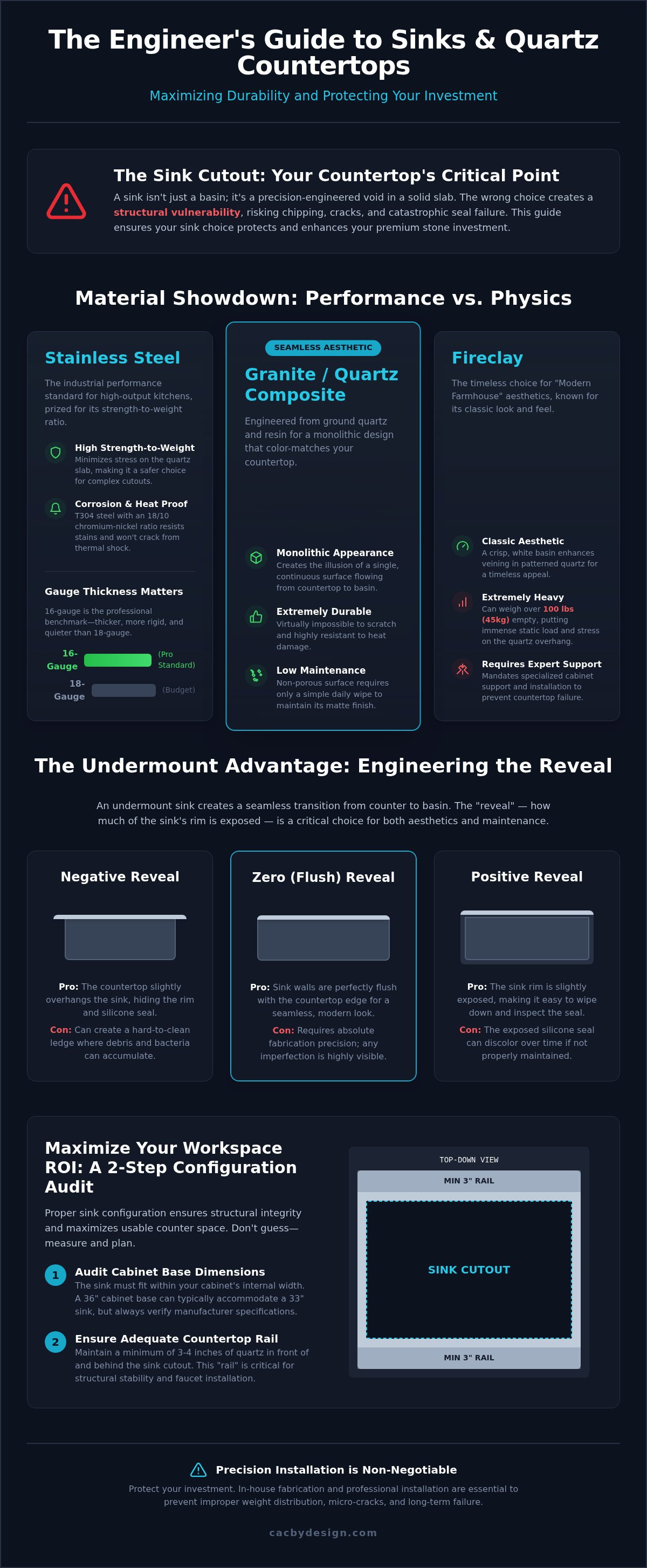
16-gauge stainless steel is the professional benchmark for quartz systems. It's significantly thicker and more rigid than budget-friendly 18-gauge alternatives. This rigidity is critical when you're hanging a heavy basin from a stone slab. High-quality stainless options include advanced sound-dampening technology. These multi-layered pads eliminate the tinny echo typical of cheap installs, creating a premium sensory experience during heavy use. Visually, the cold metallic finish offers a sharp, modern contrast to the organic patterns found in premium quartz. It's a timeless look that scales with evolving design trends.
Quartz Composite: The Seamless Aesthetic
Quartz composite sinks offer a monolithic design language. These basins are engineered from a mix of ground quartz and resin, mirroring the countertop's own DNA. This allows for a near-perfect color match, creating the illusion of a single, continuous surface. Beyond aesthetics, these sink materials offer high heat resistance and are virtually impossible to scratch. Maintenance protocols are minimal. A simple daily wipe preserves the matte finish, ensuring the sink doesn't become a visual dead spot over time. It's the ultimate choice for homeowners seeking a low-maintenance, high-performance workspace.
Material Showdown: Stainless vs. Fireclay vs. Granite Composite
Material selection is the primary lever for kitchen performance. While your stone slab is the star, the sink material determines the system's durability-to-weight ratio. Heavy basins like fireclay can weigh over 100 pounds before you even fill them with water. This puts immense pressure on the quartz overhang. Conversely, stainless steel offers a high strength-to-weight ratio, making it a safer bet for complex cutouts. According to the Consumer Reports countertop buying guide, pairing the right material with your surface is essential for long-term resistance to heat and impact. In Cincinnati, where hard water minerals can leave stubborn deposits, your choice also dictates your daily cleaning overhead.
Impact resistance is non-negotiable. You need a basin that protects your glassware while resisting its own structural damage. If you're installing a Calacatta-patterned quartz, a crisp white fireclay or polished stainless basin enhances the veining. For industrial, concrete-look surfaces, dark granite composites or brushed steel provide the necessary grit. Finding the best sink for quartz countertops means balancing these aesthetic goals with the cold logic of material physics.
Stainless Steel: The Industrial Performance Standard
Professional chefs don't use stainless steel by accident. It's the industrial standard for a reason. High-end T304 stainless steel contains an ideal 18/10 chromium-nickel ratio. This specific chemistry provides maximum corrosion resistance against Cincinnati's mineral-heavy water. It won't crack under thermal shock from boiling pasta water. For modern renovations, stainless integrates flawlessly with high-end cabinet hardware and professional-grade appliances. It's a low-risk, high-reward choice for any high-output kitchen.
Fireclay and Porcelain: Timeless Farmhouse Dynamics
Fireclay is the undisputed king of the "Modern Farmhouse" aesthetic prevalent in West Chester home upgrades. These sinks are fired at temperatures exceeding 2,000 degrees Fahrenheit, creating a dense, chip-resistant surface. However, their weight requires specialized engineering. You cannot simply hang a fireclay apron-front sink from a quartz slab without reinforced cabinetry. Our team ensures the cabinet base carries the load, preventing the sink from pulling away from the stone seal. This level of technical precision is why we recommend seeing these materials in person at our Cincinnati showrooms before finalizing your specifications. It’s about ensuring your luxury look doesn't compromise your structural integrity.
The Undermount Advantage: Engineering the Perfect Interface
Undermounting is the non-negotiable standard for high-end stone surfaces. By mounting the basin beneath the slab, you eliminate the elevated rim that acts as a "crumb catcher" in traditional drop-in setups. This isn't just about a sleek aesthetic; it's about hygiene and operational speed. You can wipe debris directly into the bowl without hitting a metal lip. In a high-traffic kitchen, this seamless transition saves time and prevents the buildup of bacteria along the sink's edge. Choosing the best sink for quartz countertops requires a focus on this interface where the stone meets the steel.
The integrity of this connection depends on two invisible factors: the waterproofing system and the structural support. High-grade, 100% silicone is your first line of defense. It creates a flexible, watertight barrier that handles the natural expansion and contraction of your home. For large-basin undermount sinks, we don't rely on adhesive alone. We use mechanical support systems that transfer the weight of a full sink directly to the cabinet carcass. This protects the quartz from unnecessary tension and ensures the seal never breaks under pressure.
Positive vs. Negative Reveals
The "reveal" refers to how much of the sink rim is visible under the quartz edge. A positive reveal leaves a small portion of the rim exposed, providing a ledge for accessories like cutting boards. A negative reveal allows the quartz to overhang the basin, hiding the seal and making it the easiest to clean. Zero-reveal installations are the gold standard for modern aesthetics, where the stone edge is perfectly flush with the sink walls. This requires extreme fabrication precision. Your choice here dictates both the visual weight of the sink and your daily maintenance routine.
Flush-Mounting: The High-End Alternative
Flush-mounting takes precision to the next level by recessing the sink into the stone so the two surfaces are perfectly level. This eliminates even the smallest vertical transition. It's a high-performance look that demands CNC-level accuracy during the fabrication process. While traditional undermounting is versatile, flush-mounting is the superior choice for homeowners wanting a monolithic, integrated appearance. It removes all barriers to cleaning and creates a workspace that feels like a single, continuous tool rather than two separate components joined together.
Configuration Strategy: Maximizing Your Workspace ROI
Stop viewing the sink as a passive basin. It's a high-yield workstation that dictates the speed of your entire kitchen. To select the best sink for quartz countertops, you must first execute a rigorous audit of your dishwashing and food prep workflow. If you frequently handle oversized roasting pans or commercial-grade stockpots, a divided bowl will only act as a bottleneck. Your habits should drive the design, not the other way around. We treat this as a technical alignment between your lifestyle and your stone's structural capacity.
Your cabinet base is the ultimate hard constraint. A standard 36-inch cabinet typically accommodates a 33-inch sink, leaving the necessary clearance for secure mounting hardware. Forcing a larger basin into a tight space compromises the quartz's structural integrity by leaving too little stone at the front and back rails. Bowl depth is equally critical for ergonomics and splash control. A 9 to 10-inch depth is the professional sweet spot. It provides enough volume to hide dirty dishes while preventing the lower back strain caused by reaching into a basin that's too deep. This precision in measurement ensures your kitchen remains a high-performance environment rather than a source of daily frustration.
The Rise of the Workstation Sink
Workstation sinks are the most significant innovation in the 2026 luxury market. These systems feature integrated ledges that support sliding accessories like walnut cutting boards, stainless colanders, and tiered drying racks. This turns the sink into a multi-functional hub, effectively expanding your usable counter space. It's an essential strategy for compact Cincinnati kitchen remodels where every square inch must deliver maximum utility. Our in-house craftsmen ensure the quartz cutout is fabricated with sub-millimeter accuracy, allowing these accessories to glide seamlessly across the stone-to-steel interface.
Single vs. Double Bowl: The Performance Debate
Large single-bowl sinks are currently dominating the high-end market in Butler and Warren County. Their ability to soak large items flat makes them superior for modern cleanup. However, the 60/40 or 50/50 split remains a viable configuration for households that prioritize simultaneous tasks, such as soaking dishes while prepping produce. If you're focused on resale value, a 30 to 33-inch single bowl is the safer bet for attracting high-end buyers who value a clean, minimalist aesthetic. Consult with our Cincinnati design team to audit your floor plan and select a configuration that maximizes your kitchen's long-term equity.
Precision Installation: Why Your Fabricator is Critical
Installation is the final, most critical failure point in your kitchen renovation. Third-party installers often treat a sink as a secondary accessory rather than a structural component. This is a dangerous oversight. Quartz physics demand a fabricator who understands how to manage weight distribution and vibration when fitting the best sink for quartz countertops. If your installer doesn't align the basin with sub-millimeter accuracy, the resulting stress can lead to visible edge chipping or a compromised seal. We eliminate this risk by using an in-house team of craftsmen for every project. This ensures that the technical specifications of your stone and the mechanical requirements of the basin are perfectly synchronized.
A high-performance kitchen requires a holistic approach to engineering. Your sink shouldn't just hang from the stone; it must be integrated with your custom cabinets in West Chester, OH. The cabinetry acts as the primary load-bearing structure, allowing the quartz to remain a decorative and functional surface rather than a structural bridge. Finding the best sink for quartz countertops is only half the battle. The other half is securing a one-stop partner who coordinates the stone, cabinetry, and plumbing. This vertical integration removes the common headaches of multi-contractor finger-pointing and ensures a seamless transition from fabrication to final connection.
The CAC Fabrication Process
Our fabrication methodology relies on advanced CNC technology to achieve micron-perfect cutouts. This level of precision is impossible with hand-held tools. We go beyond the cut by polishing the internal edges of the quartz to a premium finish, ensuring a tactile experience that matches the visual luxury. To support the heavy workstation basins popular in 2026, we employ proprietary bracing systems that anchor the sink to the cabinet carcass. This creates a rock-solid foundation that handles the weight of a full basin and a garbage disposal without stressing the stone.
Visit Our Cincinnati Showroom
Reading about materials is a start, but experiencing the synergy between stone and steel requires a physical touchpoint. We invite you to visit our Cincinnati showrooms to see these pairings in person. You can consult with our design-build experts who specialize in every facet of a kitchen remodel in Cincinnati. We'll help you map out a configuration that maximizes your home equity and daily workflow. Your next step is simple. Schedule a high-performance design consultation today to ensure your quartz investment is protected by the best installation team in the region.
Secure Your Kitchen's Structural Equity
Your kitchen renovation isn't finished until you've secured the technical interface between your stone and your basin. Selecting the best sink for quartz countertops requires more than an aesthetic preference. It demands a deep understanding of material physics, weight distribution, and precision fabrication. Whether you choose the industrial resilience of 16-gauge stainless steel or the monolithic look of quartz composite, the success of your installation hinges on the skill of your fabricator. A failed seal or a chipped edge can compromise your entire investment.
We've spent over 20 years mastering the mechanics of Cincinnati remodeling. Our in-house fabrication team uses custom-engineered installation systems to ensure your sink remains a high-performance asset rather than a structural liability. We don't rely on guesswork; we rely on data and repeatable frameworks. Ready to maximize your kitchen's equity with a design built for long-term performance? Schedule Your High-Performance Kitchen Consultation with our experts today. Your premium quartz surfaces deserve a partnership that values speed, clarity, and technical dominance. Build a workspace that performs as aggressively as you do.
Frequently Asked Questions
What is the best sink material for white quartz countertops?
Stainless steel and white fireclay are the top performers for white quartz surfaces. Stainless steel offers a modern, industrial contrast that hides hard water spots from local Cincinnati supplies. Fireclay provides a seamless, high-end aesthetic that matches the slab's brightness. Choose 16-gauge steel to ensure the basin doesn't flex under weight. This technical pairing protects your stone's edge from impact while maintaining a high-performance visual profile.
Can I use a top-mount sink with quartz?
You can use a top-mount sink, but it's a low-performance choice that compromises your kitchen's equity. The visible rim creates a debris trap and interrupts the clean lines of your quartz slab. Most high-end renovations in Butler County prioritize undermount systems for their superior hygiene and ease of maintenance. If you want a seamless workspace that maximizes your stone's visual impact, skip the drop-in models and invest in precision undermounting.
Is a stainless steel sink better than a quartz composite sink?
Neither is objectively superior; the choice depends on your specific performance metrics. Stainless steel is the industrial standard for heat resistance and durability. Quartz composite sinks offer a monolithic look that matches your countertop's DNA. If you prioritize a scratch-proof, silent basin for your Montgomery County kitchen, composite is the best sink for quartz countertops. However, for a timeless, high-output hub, 16-gauge stainless steel remains the professional benchmark.
How do I prevent my sink from leaking under my quartz countertop?
Preventing leaks requires a dual-layer defense system: 100% professional-grade silicone and mechanical bracing. The silicone creates a watertight seal, while the bracing transfers the basin's weight to the cabinet carcass rather than the stone. Our in-house craftsmen in Cincinnati use proprietary support systems to ensure the sink never pulls away from the quartz. This engineering prevents moisture from rotting your custom cabinetry and protects your home's structural integrity over the long term.
What size sink fits in a standard 36-inch base cabinet?
A 33-inch sink is the maximum scale for a standard 36-inch base cabinet. This configuration leaves 1.5 inches of clearance on each side for the mounting clips and structural hardware. Attempting to force a larger basin into this space leaves the quartz rails too thin, increasing the risk of stone failure. We recommend auditing your workflow in Warren County to see if a high-performance workstation sink in this size fits your daily food prep requirements.
Are farmhouse sinks compatible with quartz countertops?
Farmhouse sinks are fully compatible with quartz but require specialized cabinet engineering. Because these basins are significantly heavier than standard models, the cabinet must be reinforced to carry the load. Our design-build team frequently integrates fireclay apron-front sinks into West Chester renovations using custom-built supports. This ensures the sink doesn't rely on the quartz for structural stability, preventing cracks in your expensive stone slab while achieving that modern farmhouse aesthetic.
Do I need a special plumber for an undermount sink installation?
You don't need a specialized plumber, but the order of operations is critical. The countertop fabricator must mount and seal the sink before any plumbing connections occur. A plumber then handles the faucet, drain, and garbage disposal. For the best results in Hamilton County, use a full-service remodeler that coordinates both teams. This prevents the common communication failures that lead to leaks or improperly positioned fixtures in high-performance kitchen systems.
How do I clean a quartz composite sink without damaging it?
Maintain your quartz composite sink using mild dish soap and a soft cloth for daily wipes. Avoid abrasive cleaners or harsh chemicals like bleach, which can dull the resin finish over time. For stubborn mineral deposits from Cincinnati's hard water, a 50/50 vinegar and water solution is effective. Regular maintenance ensures your basin remains the best sink for quartz countertops by preserving its non-porous surface and resisting stains from high-pigment foods like coffee.


Comments