
Best Tile for Bathroom Floors: 2026 Design Guide
Your bathroom floor is not a decorative afterthought. It's a high-performance infrastructure investment that directly impacts your home's equity and daily safety. Most homeowners treat the search for the best tile for bathroom floors as a simple style exercise. This is a mistake. In the high-humidity environment of Ohio, a poor choice leads to moisture damage, maintenance fatigue, and slip hazards that compromise your investment.
We understand the frustration of decision fatigue. You want a cohesive look that aligns with your quartz countertops and custom cabinetry without sacrificing technical durability. This 2026 guide eliminates the guesswork by prioritizing data over trends. You'll learn to master the variables of friction metrics, water absorption rates, and aesthetic synchronization to maximize your renovation ROI.
We're stripping away the fluff to focus on what works. This overview covers the latest ANSI slip-resistance standards, the rise of large-format porcelain slabs, and the specific material frameworks that ensure your floor remains a waterproof asset for decades.
Table of Contents
Engineering Bathroom Equity: Why Floor Tile is a Strategic Asset
Porcelain vs. Natural Stone: The Data-Backed Durability Breakdown
Slip Resistance and Safety: Decoding the Performance Metrics
Aesthetic Integration: Coordinating Tile with Cabinetry and Counters
The Design-Build Implementation: Moving from Selection to Professional Install
Engineering Bathroom Equity: Why Floor Tile is a Strategic Asset
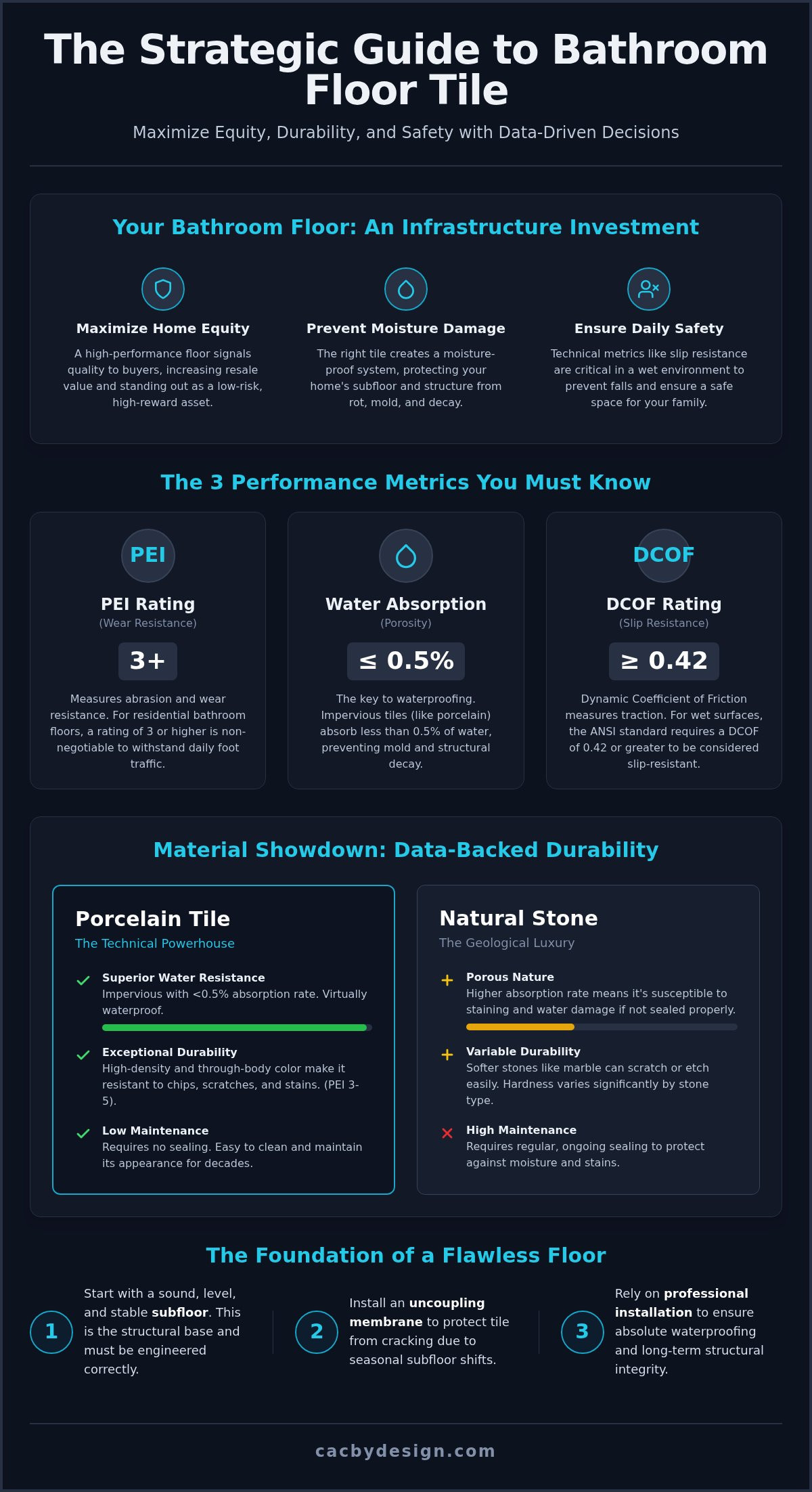
Bathroom tile is a strategic asset. It represents the intersection of mechanical safety and structural durability. It's not a decorative choice. It's the foundation of your home's most volatile environment. In a typical remodel, the floor endures more physical stress than any other surface. It handles constant moisture, temperature fluctuations, and heavy foot traffic. Choosing the best tile for bathroom floors requires a shift in perspective. You must view the floor as a comprehensive moisture-proof system rather than a simple surface. This systemic approach protects the underlying structure of your home from the silent threat of water migration.
The Financial Logic of Premium Materials
Smart investments prioritize lifecycle value over initial acquisition cost. Budget ceramic tiles often fail under the stress of high-moisture environments. They crack. They absorb water. They require premature replacement. High-density porcelain offers a superior density that resists impact and stains. Professional installation is the insurance policy for this material. It ensures the substrate is sound and the waterproofing is absolute. For homeowners considering bathroom remodeling Cincinnati, premium tile selection is a primary lever for increasing resale value. It signals to future buyers that the home was built with technical precision. In a competitive market, a master bath that features high-performance materials and flawless execution stands out as a low-risk, high-reward asset.
Durability Metrics for the Modern Home
Performance is measured, not guessed. The Porcelain Enamel Institute (PEI) rating provides a standardized scale for wear resistance. For residential bathroom floors, a PEI rating of 3 or higher is non-negotiable. This ensures the surface can withstand the abrasive nature of daily use without losing its finish. Water absorption is the next critical metric. High-performance tiles must have an absorption rate of 0.5% or lower. This technical specification is often found in Vitrified Tile Explained; this resource details how high-firing temperatures create a dense, glass-like structure. This low porosity prevents mold growth and structural decay within the subfloor. When you select the best tile for bathroom floors, you are choosing a material that manages moisture at a molecular level. This level of engineering is essential in Ohio, where seasonal humidity shifts can wreak havoc on inferior materials.
Porcelain vs. Natural Stone: The Data-Backed Durability Breakdown
Selecting the best tile for bathroom floors requires a choice between two distinct engineering philosophies: engineered resilience and geological luxury. Porcelain and natural stone occupy the top tier of the market, but they serve different performance goals. Porcelain is the high-performance standard for moisture resistance. Natural stone offers an irreplaceable organic aesthetic that drives high-end resale value. Your decision should align with your long-term maintenance capacity and your equity goals.
The Porcelain Advantage: Efficiency and Resilience
Porcelain is a technical powerhouse. It's fired at higher temperatures than standard ceramic. This process creates a vitrified material that's nearly impervious to water. Many high-performance lines feature "through-body" color. If the surface chips, the color remains consistent throughout the tile. This makes it the best tile for bathroom floors in high-traffic master suites where durability is paramount. Modern inkjet printing has evolved significantly. It now replicates the nuance of white oak or Carrara marble with extreme precision. You get the aesthetic of luxury materials without the maintenance overhead. These surfaces often meet or exceed ADA guidelines on slip resistance, providing a safe, high-friction environment for wet floors.
Natural Stone: Marble, Granite, and Slate
Natural stone is a high-yield asset. It creates a sensory experience that engineered materials cannot fully mimic. When you install natural stone, you're investing in a unique geological signature. There's a powerful design synergy in matching your floor to granite countertops Cincinnati. This cohesion elevates the architectural profile of the room and increases market appeal. However, stone requires a disciplined maintenance framework. Marble is porous and demands periodic sealing to prevent etching from soaps. Slate and travertine offer exceptional natural texture, providing inherent grip without sacrificing style. If your design prioritizes organic variation and "one-of-a-kind" luxury, stone is the logical choice. For those ready to scale their home's value through a full bathroom remodel, balancing these material trade-offs is the key to a successful project.
Slip Resistance and Safety: Decoding the Performance Metrics
Safety isn't an opinion; it's a technical metric. Aesthetics fail if the floor becomes a liability. The industry standard for identifying the best tile for bathroom floors is the Dynamic Coefficient of Friction (DCOF). According to the ANSI A326.3 standard, level interior floors expected to be walked on when wet must maintain a minimum DCOF value of 0.42. This is a non-negotiable benchmark for mitigating slip-fall risks. In high-performance senior-friendly bathroom design, this metric is the primary filter for material selection. A remodel must solve for mechanical safety before it solves for creative vision.
The Role of Texture in High-Traffic Zones
Surface finish dictates friction performance. Polished marble or high-gloss porcelain may offer a luxury aesthetic, but they create significant hazards in wet environments. These finishes are technically unsuitable for floor applications in a professional design-build project. Matte and honed finishes represent the operational standard. They provide the necessary micro-texture for consistent foot traction. For homeowners seeking a balance, "lapato" or semi-polished finishes offer a strategic compromise. These surfaces provide a sophisticated sheen while retaining the friction levels required to meet safety codes. Choosing the best tile for bathroom floors means prioritizing these tactile variables over purely visual appeal.
Grout Architecture as a Safety Feature
Tile format serves as a mechanical lever for safety. While large-format tiles are popular for their seamless look, they reduce the number of grout lines available for traction. In high-moisture zones like walk-in showers, smaller formats such as 2x2 mosaics or hexagons are technically superior. Every grout line functions as a "grip grid" for the foot. This increased surface interruption is essential for a slip-resistant floor. We utilize high-performance epoxy grouts for these specific installations. Unlike traditional cementitious options, epoxy is completely non-porous. It resists the staining and moisture absorption that typically lead to grout failure. Proper grout spacing is a calculated safety feature. It converts a potentially slick surface into a high-traction zone that remains easy to maintain over the lifecycle of the bathroom.
Aesthetic Integration: Coordinating Tile with Cabinetry and Counters
A high-performance bathroom is a unified system. The floor functions as the "fifth wall," providing the visual foundation that anchors every other element. Selecting the best tile for bathroom floors requires more than picking a pattern. It demands a rigorous analysis of undertones and material compatibility. If your floor clashes with your surfaces, the entire investment loses its impact. You must synchronize the floor's color temperature with your custom cabinets West Chester OH to create a cohesive environment. This isn't just about style; it's about protecting the aesthetic equity of your home.
The "Three-Surface Rule" is our framework for balancing complex patterns. To avoid visual chaos, limit yourself to three primary textures or patterns across your floor, walls, and countertops. If your vanity features a bold granite with heavy movement, your floor should be a grounding, neutral porcelain. Use transition materials, like a coordinating marble threshold or a matching tile baseboard, to bridge the vertical and horizontal planes. This creates a professional finish that separates a DIY look from a high-end remodel. Every transition should feel like a deliberate design choice, not a workaround.
Matching Tile with Quartz and Granite Surfaces
Stone surfaces dictate the room's color palette. When choosing the best tile for bathroom floors, identify the secondary accent colors within the veining of your quartz or granite. Pulling a subtle grey or warm taupe from the countertop into the floor tile creates an intentional, designer-led look. Large-format tiles are the modern standard for these installations. They minimize grout lines, which reduces visual clutter and allows the natural beauty of your stone surfaces to remain the focal point. This approach aligns with cincinnati oh bathroom remodeling standards required for luxury market dominance. It’s about creating a seamless flow that feels expansive and deliberate.
Cabinetry Coordination: Contrast vs. Complement
Your floor and cabinetry must work in tandem to define the room's volume. Pairing dark walnut cabinets with light, oversized porcelain floors creates a high-contrast look that feels modern and energetic. In smaller bathrooms, matching the tile color to the cabinetry can make the space feel significantly larger by removing sharp visual boundaries. Lighting is the final variable in this equation. We test all material samples under 3000K to 4000K LED lighting. This range mimics natural daylight and prevents "metamerism," where colors shift and clash under different light sources. Don't leave your design to chance. Start your project with a full bathroom remodel consultation to ensure every material is engineered for success.
The Design-Build Implementation: Moving from Selection to Professional Install
The best tile for bathroom floors is only as effective as the engineering beneath it. Installation is where aesthetic vision meets structural reality. Many homeowners focus exclusively on the surface; this is a tactical error. In Cincinnati, seasonal humidity and temperature shifts cause subfloors to expand and contract. Without a decoupling strategy, even the highest-rated porcelain will crack. High-performance installation requires a systems-led approach that treats the floor as a multi-layered mechanical assembly. Performance is binary: either the system manages the stress, or it fails.
Timeline expectations must remain realistic. A high-performance tile installation is not a weekend project. It involves meticulous substrate preparation, moisture barrier curing, and precision setting. Rushing this process compromises the waterproof integrity of your home. We prioritize technical accuracy over speed. This ensures your renovation remains a long-term equity asset rather than a maintenance liability. Professional execution eliminates the "lippage" and grout failure common in retail-grade installations.
Subfloor Systems and Moisture Management
Large-format tiles require a perfectly flat substrate. Even a slight deviation in the subfloor leads to lippage, where tile edges sit at different heights. We utilize advanced self-leveling compounds to create a surgical-grade foundation. For Cincinnati’s climate, uncoupling membranes like Schluter-DITRA are non-negotiable. These membranes allow the tile to move independently from the subfloor, preventing stress cracks during seasonal shifts. This system also incorporates waterproofing for curb-less shower transitions, ensuring a seamless, moisture-proof envelope. If you're investing in comfort, this is also the stage where we integrate radiant floor heating systems. These systems are embedded directly into the thin-set to provide efficient, uniform warmth without compromising the floor's structural height.
The CAC Advantage: Systems-Led Installation
Retail models often rely on third-party subcontractors who lack accountability. We take a different approach. As premier home renovation contractors cincinnati, our in-house craftsmen handle every phase of the project. There is a massive advantage in having the same team manage your custom cabinets, stone fabrication, and tile installation. It ensures that the floor undertones match the cabinetry and that the vanity sits on a perfectly level surface. This synergy reduces communication gaps and ensures a flawless finish. Our family-owned model is built on repeatable frameworks that deliver consistent, high-equity results. Visit our showroom to see these integrated design systems in person and start your high-performance transformation.
Maximize Your Renovation ROI with Data-Driven Selection
Choosing the best tile for bathroom floors is a high-stakes decision that dictates your home's long-term performance and market value. You've mastered the data. Success isn't found in a catalog; it's engineered through proper DCOF metrics, moisture-proof subfloor systems, and seamless aesthetic integration with your custom cabinetry. A beautiful surface fails without technical precision. In the Cincinnati market, equity is built on materials that withstand seasonal shifts and daily wear.
Countertops and Cabinetry By Design has been a family-owned industry leader since 2004. We don't guess. We scale your vision using an in-house fabrication and installation team that understands the mechanics of high-equity renovations. Our professionals ensure your tile, cabinets, and stone surfaces function as a single, high-performance unit. Stop settling for retail-grade uncertainty. It's time to build a legacy of durability and style.
Schedule Your High-Performance Bathroom Design Consultation to secure your investment. Your modern, waterproof sanctuary is ready for implementation.
Frequently Asked Questions
What is the most durable tile for a high-traffic bathroom floor?
High-density porcelain is the technical leader for durability in high-traffic environments. Its manufacturing process creates a vitrified body that resists impact and moisture better than standard ceramic or soft natural stones. You should prioritize a PEI rating of 4 for maximum wear resistance in residential master suites. This material ensures your investment survives decades of use without structural degradation or surface fading.
Is porcelain or ceramic better for bathroom floors in Ohio?
Porcelain is the superior choice for Ohio's fluctuating humidity and temperature shifts. It is more vitrified and significantly less porous than standard ceramic. This density prevents the tile from absorbing moisture that leads to cracking during seasonal transitions in counties like Butler or Warren. It provides the structural stability required for a high-performance remodel that stands up to local environmental stressors.
How do I choose a floor tile that isn’t slippery when wet?
Seek out materials with a Dynamic Coefficient of Friction (DCOF) of 0.42 or higher to ensure safety on wet surfaces. To find the best tile for bathroom floors, look for textured finishes like matte or honed rather than high-gloss options. These surfaces provide the necessary friction for safe movement. Mosaics are another tactical choice, as the increased frequency of grout lines creates a naturally slip-resistant surface.
What size tile is best for a small bathroom floor to make it look bigger?
Large-format tiles, such as 12x24 or 24x48 slabs, are the most effective for making a small bathroom feel expansive. Fewer grout lines reduce visual noise and create a continuous surface that tricks the eye into perceiving more square footage. This creates a modern, clean aesthetic in tight layouts. Rectified edges allow for thinner grout lines, which further enhances the seamless, high-end look.
Does natural stone tile require more maintenance than porcelain?
Natural stone tile requires a more disciplined maintenance framework than porcelain. Materials like marble or travertine are naturally porous and must be sealed periodically to prevent moisture penetration and permanent staining. Porcelain replicates these luxury aesthetics with nearly zero maintenance requirements. While stone offers a unique geological signature, porcelain is the logical choice for homeowners who prioritize long-term operational efficiency and ease of care.
What is the best grout to use to prevent mold and staining?
High-performance epoxy grout is the technical standard for preventing mold growth and staining. Unlike traditional cement-based grouts, epoxy is entirely non-porous and chemically resistant. It does not require sealing and remains color-consistent throughout its lifecycle. This is a critical component in a comprehensive waterproof system, especially in high-moisture zones like walk-in showers where traditional grout is prone to failure and discoloration.
Can I install new tile over my existing bathroom floor?
Professional design-build standards require a full tear-out of the existing floor rather than tiling over it. Installing new tile over old surfaces creates height transitions that interfere with custom cabinetry and door swings. It also conceals potential subfloor rot or structural instability. A clean start allows our team to install uncoupling membranes and proper leveling compounds, ensuring a flat, failure-proof foundation for your new floor.
How does floor tile choice affect my home’s resale value in Cincinnati?
Your choice of the best tile for bathroom floors directly impacts home equity in the Cincinnati market. Buyers in Hamilton and Warren counties prioritize high-performance materials like porcelain and natural stone. Coordinating these floors with custom cabinetry and quartz countertops signals a professional, high-end renovation. This design synergy maximizes your resale value by presenting a move-in-ready, durable asset that justifies a premium price point.


Comments