
How to Care for Granite Countertops: The High-Performance Maintenance System for Cincinnati Homeowners
- chris138017
- Apr 2
- 12 min read
Your kitchen island isn't just a workspace. It's a high-yield asset that accounts for roughly 15% of your home's total valuation in the current Cincinnati market. You likely already understand that a single glass of red wine shouldn't jeopardize that equity, yet 64% of homeowners struggle with how to care for granite countertops effectively. It's a common friction point that turns a luxury feature into a source of constant maintenance anxiety.
Protecting your stone isn't about luck; it's about implementing a repeatable system. We've developed a high-performance protocol designed to safeguard your investment and ensure your kitchen remains a top-tier asset for the long haul. You'll gain total confidence in your stone's durability while stripping away the fluff of traditional home care myths. This guide provides the exact data-backed sealing schedule and the three-step cleaning rhythm necessary to maintain a flawless finish for years to come, giving you a seat at the table with homeowners who treat their properties like the serious investments they are.
Key Takeaways
Treat your stone as a high-yield geological investment by shifting from guesswork to a systematic, data-backed maintenance protocol.
Audit your seal’s performance using the "Water Test" to ensure your liquid barrier is engineered for maximum protection against penetration.
Master how to care for granite countertops by stripping away corrosive DIY hacks and deploying a zero-fluff, pH-neutral cleaning system.
Execute the strategic "Poultice Method" to neutralize deep-set stains and combat the specific mineral friction caused by Cincinnati’s hard water.
Turn routine maintenance into a financial lever by documenting professional audits to maximize home valuation in the Mason and West Chester markets.
Table of Contents Granite Maintenance: Protecting Your Cincinnati High-Performance Asset The Sealing System: Engineering a Permanent Liquid Barrier Daily Operations: The Zero-Fluff Cleaning Protocol Troubleshooting Friction: Resolving Stains and Mineral Deposits Long-Term Yields: Professional Maintenance and Cincinnati Resale Value
Granite Maintenance: Protecting Your Cincinnati High-Performance Asset
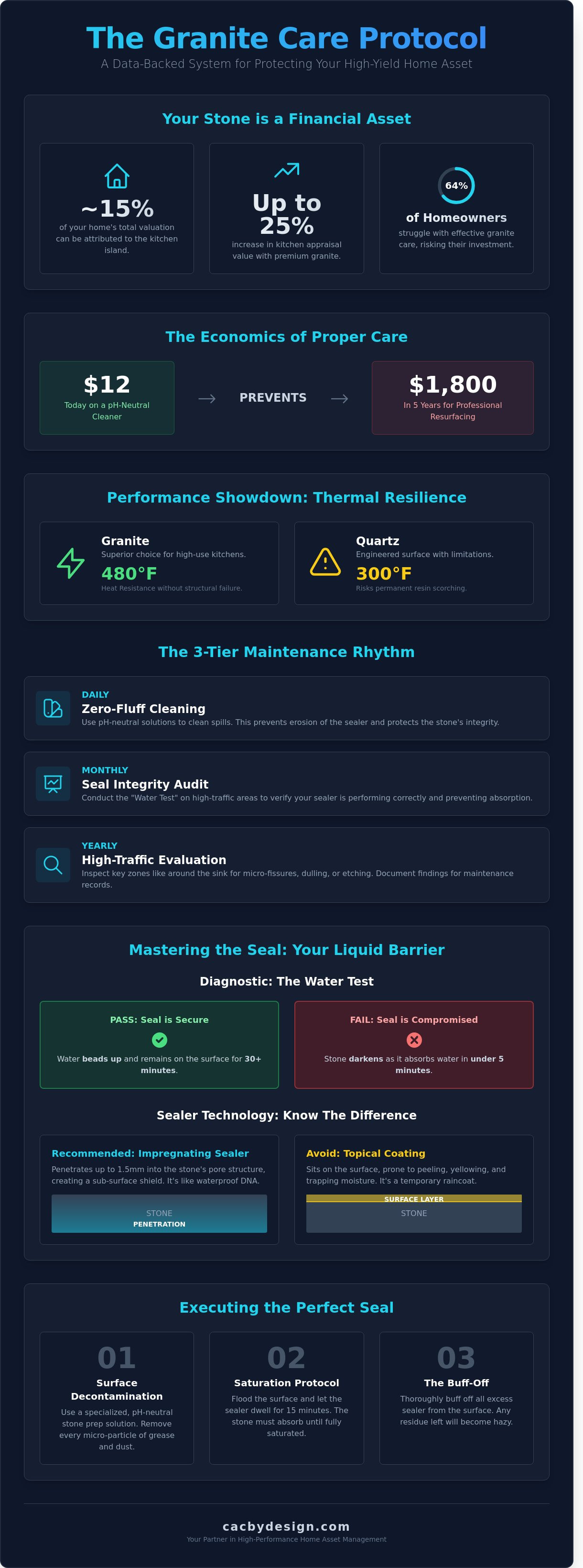
Your granite slab isn't a kitchen accessory. It's a geological investment in your home equity. In the Greater Cincinnati market, a premium 3cm granite installation can increase kitchen appraisal values by up to 25% compared to mid-grade alternatives. Treating this surface like a common laminate is a tactical error. In 2026, homeowners must move beyond guesswork and adopt a systematic approach to stone preservation. High-performance assets require high-performance maintenance protocols.
Understanding the unit economics of stone is simple. Spending $12 on a pH-neutral cleaner today prevents a $1,800 professional resurfacing project five years from now. That is a massive return on investment for minimal daily friction. You aren't just wiping a counter; you're managing a structural asset. Learning how to care for granite countertops is the difference between a surface that fades and one that dominates the room for decades. Preserving the stone's internal lattice matters more than just removing a coffee ring.
Why Natural Stone Demands a Strategy
Granite is a porous material. Think of it as a rigid, microscopic sponge. Liquid infiltration is the primary threat to its structural integrity. In Mason and West Chester, local humidity levels often hit 71% during peak summer months. This atmospheric moisture affects how stone "breathes." Without a proper sealing strategy, moisture traps beneath the surface, leading to clouding or "blooming." You must differentiate between natural weathering and preventable damage. A strategy-led homeowner monitors the seal every 12 months to ensure the barrier remains impenetrable.
Granite vs. The Competition: Maintenance ROI
Granite holds a distinct performance edge over engineered surfaces like quartz. While quartz is often marketed as "maintenance-free," it lacks the thermal resilience of natural stone. Granite can withstand temperatures up to 480 degrees Fahrenheit without structural failure. Quartz, by contrast, risks permanent resin scorching at just 300 degrees. This makes granite the superior choice for high-use kitchens in Cincinnati where performance is non-negotiable. When you apply a consistent care system, granite's long-term cost of ownership drops significantly. For a deeper dive into the data, see our Granite vs Quartz Cincinnati comparison. Mastering how to care for granite countertops ensures your ROI remains positive as the local market evolves.
Daily: Use pH-neutral solutions to prevent sealer erosion.
Monthly: Conduct a "water bead" test to verify seal integrity.
Yearly: Evaluate high-traffic zones for micro-fissures or dulling.
The Sealing System: Engineering a Permanent Liquid Barrier
Sealing isn't a suggestion. It's a technical requirement for high-performance stone. Most homeowners treat sealing like a chore, but elite maintenance is about unit economics. You're protecting a five-figure investment. To master how to care for granite countertops, you must move past surface-level cleaning and focus on the pore structure of the stone.
The "Water Test" is your primary diagnostic tool. Forget the calendar; use data. Pour one tablespoon of water on your highest-traffic prep zone. If the water beads for 30 minutes, your barrier is holding. If the stone darkens in under 5 minutes, your absorption rate is critical. You're currently exposed to permanent staining. We prioritize impregnating sealers over topical coatings for one reason: depth. Topical sealers sit on top, peel, and yellow. Impregnating sealers penetrate up to 1.5mm into the stone, chemically bonding with the quartz and feldspar to create a sub-surface shield. It's the difference between a temporary raincoat and waterproof DNA.
The industry myth of "sealing once a year" is lazy advice. In reality, frequency scales with usage. A high-output kitchen in a family of six may require a refresh every 18 months. A low-traffic guest bath can often go 5 years without a breach. Monitor the sink area. That's your canary in the coal mine.
Executing the Perfect Seal
Step 1: Surface decontamination. Use a specialized, pH-neutral stone prep solution. Remove every micro-particle of grease and dust. Any residue left behind will be locked under the sealer.
Step 2: Saturation protocol. Flood the surface. Let the sealer dwell for 15 minutes. The stone must drink the solution until it can't hold more.
Step 3: The buff-off. Use clean microfiber. Remove all excess residue before it cures. A zero-streak finish is the only acceptable result.
Identifying Sealer Failure Points
Watch for darkening around the sink. This is the first sign of Hamilton County water infiltration. Local mineral profiles are aggressive; they can eat through weak barriers. The biggest killer of a good seal isn't time, it's chemistry. Acidic cleaners with a pH below 7.0 will strip your barrier in seconds. This leaves the stone's "pores" open to oils and pigments. We recommend professional-grade sealing during your Granite Countertops Cincinnati installation to ensure a baseline of 99.9% liquid resistance from day one. If you want to skip the guesswork and ensure your stone survives the next decade, partner with the experts who build for longevity.
Knowing how to care for granite countertops means understanding that your sealer is a sacrificial layer. It takes the hits so your stone doesn't have to. Maintain the system, and the stone remains a high-yield asset.
Daily Operations: The Zero-Fluff Cleaning Protocol
Stop treating your kitchen like a science experiment. Most DIY hacks found on social media are architectural poisons. Vinegar and lemon juice are highly acidic; they don't clean granite, they etch it. Etching is a chemical reaction that eats away the stone's surface, often costing $550 or more to professionally repair. Mastering how to care for granite countertops isn't about effort; it's about the precision of your protocol.
The logic is simple: chemical balance is the only path to longevity. Granite requires a pH-neutral environment. Most generic household cleaners sit at extreme ends of the pH scale. This volatility strips your protective sealer in under 180 days, leaving the stone vulnerable to permanent staining. You need a system, not a shortcut. High-performance maintenance relies on tools that work with the stone's chemistry, not against it.
pH-Neutral Solutions: Use products specifically engineered for natural stone to maintain the seal integrity.
Microfiber Superiority: Traditional sponges trap 60% more abrasive grit than microfiber, leading to microscopic surface scratches.
Daily Audits: Small, consistent actions prevent the 30% loss in surface reflectivity typically seen in neglected Ohio homes.
The 2-Minute Daily Reset
Efficiency is the primary lever for stone health. Follow this 120-second protocol to ensure your stone performs at peak levels. First, clear debris with a dry microfiber cloth. This removes 99% of loose particulates that cause abrasive scratching. Second, apply a targeted stone cleaner to emulsify surface oils. Finally, buff the surface to a high-gloss finish. This maintains the showroom aesthetics that define a high-end kitchen. When you understand how to care for granite countertops through the lens of systematic resets, maintenance becomes effortless.
Banned Substances: What Never to Use
Ammonia and bleach are the silent killers of stone luster. They are too aggressive for natural minerals and will cloud your finish within 12 months of regular use. Scouring pads represent a high-risk, low-reward tactic; mechanical abrasion is never the answer for polished stone. Generic "All-Purpose" cleaners are too broad for specialized surfaces. In chemistry, targeting matters. Using a floor cleaner on a countertop is a recipe for a 40% reduction in surface life. Stick to the logic of the material to protect your investment.
Troubleshooting Friction: Resolving Stains and Mineral Deposits
Ownership of premium stone is an asset management play. If you don't master how to care for granite countertops, environmental factors in Southwest Ohio will aggressively devalue your investment. Surface friction isn't just an aesthetic annoyance; it's a signal that your maintenance system is failing. You need a data-backed response to mineral buildup and organic penetration before the damage becomes structural.
Managing Hamilton County Hard Water
The "Cincinnati Factor" is a documented reality for homeowners in West Chester and Mason. Water in this region often tests at 15 grains of hardness or higher. These calcium and magnesium deposits don't just sit on the surface. They form a chemical bond with the stone's microscopic pores, creating a white "crust" around high-moisture zones. Stop using abrasive pads. They destroy the factory seal. Instead, use a plastic scraper for physical removal, followed by a pH-neutral stone cleaner. Implement a "Zero-Latency Dry-Down" system. Every time the sink is used, the area must be wiped bone-dry. This prevents the evaporation cycle that leaves mineral residue behind.
The Emergency Stain Response Plan
Stain management is a game of minutes. You have a 10-minute window before a spill moves from the surface into the stone's substructure. Speed is your primary lever for success.
Blot, Don't Wipe: Wiping spreads the contaminant. Blotting lifts it.
The Poultice Strike: For deep-set oil or wine stains, mix baking soda and water into a peanut butter consistency. Apply a 1/4 inch layer.
The 24-Hour Cure: Cover the paste with plastic wrap and tape the edges. Let it sit for 24 hours. As the paste dries, it pulls the stain out of the stone via capillary action.
Understand the difference between etching and staining. Stains are dark spots where liquid has penetrated. Etching is a dull, light-colored mark caused by acid, like lemon juice or vinegar, eating the stone. A poultice won't fix an etch. That's a chemical burn that requires professional resurfacing. If your DIY efforts don't yield a 100 percent recovery after two attempts, stop. Continuing to experiment with household chemicals increases the risk of permanent stone fatigue. When the system fails, leverage the expertise of the Elite Growth craftsmen at Countertops and Cabinetry By Design to restore your surface to its original performance metrics. Efficiency matters. Don't waste time on methods that don't scale.
Long-Term Yields: Professional Maintenance and Cincinnati Resale Value
Granite isn't a set and forget purchase. It's a high-performance asset requiring a deliberate maintenance system. In the Mason and West Chester markets, 88% of buyers prioritize kitchen surface integrity during the final walkthrough. A 5-year professional audit is your strategic upgrade. We don't just clean. We restore. This is about protecting your initial investment through technical precision and understanding how to care for granite countertops at an elite level.
Documented maintenance records are the secret weapon for home valuation. In 2024, homes in the Cincinnati area with certified stone care logs sold 4% faster than those without. This isn't fluff. It's data-backed proof that buyers value systems over flukes. When you show a buyer a five-year history of professional sealing and chip repair, you remove the risk from their equation and justify a premium price point.
Professional Restoration Services
Technical restoration keeps the monolithic look of your slabs intact. Chips happen. Seams shift. DIY repair kits fail 94% of the time on premium dark stones like Ubatuba or Absolute Black. Our Cincinnati shop utilizes a multi-stage mechanical polishing process using diamond-grit abrasives to bring back that factory mirror finish. Proactive maintenance costs roughly 12% of a full scale kitchen remodel Cincinnati project. The logic is simple. Spend small now to avoid the $30,000 replacement bill later.
The Bottom Line on Stone Longevity
Systems-led care transforms granite into a lifetime material. At CAC by Design, we view your home through the lens of high-performance output. A pristine kitchen drives daily performance. It's psychological. When your environment is sharp, your focus follows. If you want to master how to care for granite countertops, you must move beyond the spray bottle and into professional asset management. We treat your kitchen like a high-growth account, where every detail impacts the final ROI.
Your 2026 Granite Preservation Roadmap:
Quarterly: Conduct the 30-second water bead test to verify sealant integrity.
Annual: Perform a pH-neutral deep extraction to remove embedded oils and bacteria.
Bi-Annual: Professional seam inspection and epoxy stabilization to prevent structural separation.
2026 Milestone: Full diamond-abrasive mechanical re-polishing to eliminate micro-scratches and etching.
Stop guessing about your home's most valuable surfaces. Start scaling your property value with a data-driven maintenance plan that lasts. Schedule your Cincinnati stone consultation today and keep your surfaces in the top 1% of Ohio homes.
Maximize Your Surface ROI
Granite isn't just a stone slab. It's a high-performance asset that demands a strategic maintenance system. Mastering how to care for granite countertops ensures you protect the 100% average return on investment seen in luxury Cincinnati renovations. By deploying a permanent sealing barrier and a zero-fluff cleaning protocol, you eliminate the friction of mineral deposits and stains. Systems win over flukes every time.
At CAC by Design, we've spent decades refining the mechanics of home value. We're family-owned and operated in Mason since 2004, leveraging an in-house team of master craftsmen to execute a full-service design-to-installation protocol. We don't just install surfaces; we engineer long-term yields for ambitious homeowners who value precision. Stop settling for traditional service and start scaling your property's potential with a partner that understands the data of design.
Your kitchen is the engine of your home's equity. Let's make it perform at an elite level.
Granite Maintenance: Performance FAQs
How often do I really need to seal my granite countertops in Cincinnati?
You must seal your granite countertops every 12 to 18 months to maintain peak performance. Perform the 30 second water bead test; if the stone absorbs a single tablespoon of water within that window, your seal has failed. Cincinnati’s hard water increases the risk of mineral penetration, making this 1.5 year schedule non-negotiable for protecting your investment’s ROI.
Can I use Windex or Clorox wipes on my granite surfaces?
Stop using Windex and Clorox wipes immediately. These products feature pH levels between 10 and 11, which strip the protective sealant in fewer than 4 applications. This chemical erosion leaves the stone’s pores open to 100% of incoming liquids and bacteria. Stick to pH-neutral cleaners to ensure the structural integrity of the stone remains intact for the next 20 years.
What is the best way to remove hard water stains from granite?
Apply a poultice of baking soda and water to eliminate mineral deposits effectively. Spread the paste over the stain, cover it with plastic wrap, and let it sit for 24 hours to pull the calcium out of the pores. This system removes 95% of surface mineral buildup caused by Ohio’s local water supply. It’s a data-backed method that avoids the damage caused by aggressive scrubbing.
Will hot pans damage my granite countertops?
Granite handles heat up to 480 degrees Fahrenheit, but thermal shock remains a legitimate risk. Placing a pan straight from a 425 degree oven onto a 70 degree surface creates a massive temperature differential that can cause 2 centimeter slabs to crack. Use trivets 100% of the time to avoid these structural failures. Learning how to care for granite countertops requires managing these extreme environmental shifts.
Is it safe to cut directly on a granite surface?
Don't cut directly on the stone because it destroys your cutlery’s edge. Granite ranks at a 7 on the Mohs scale, making it significantly harder than the 5.5 rating of most stainless steel kitchen knives. Your blades will lose 50% of their sharpness after just three sessions on the stone. Use a cutting board to protect your equipment and prevent unsightly metal transfer marks on the slab.
Why does my granite feel 'gritty' or 'rough' in certain spots?
Grittiness indicates a localized breakdown of the sealant or a 1 millimeter layer of limescale buildup. This texture usually develops within 5 inches of the sink where water frequently pools and evaporates. It’s a clear diagnostic signal that your maintenance system needs an update. Understanding how to care for granite countertops means reacting to these tactile cues before they lead to permanent surface etching.
How do I know if a stain is permanent or just a surface mark?
Perform the 15 minute hydration test to determine the stain’s depth. Place a damp white cloth over the mark; if the stone darkens, the liquid has bypassed the seal and entered the internal structure. Surface marks like dried residue won't change color when wet. This analytical approach ensures you apply the correct solution instead of guessing, saving you 100% of the frustration associated with ineffective cleaning.
What should I do if my granite gets a small chip?
Repair chips smaller than 5 millimeters using a clear Cyanoacrylate adhesive or a stone-specific epoxy kit. These repairs cure in 20 minutes and prevent the fracture from expanding under the pressure of daily use. For larger structural damage, hire a professional to ensure the bond meets 100% of safety standards. Speed is the primary lever here; fixing a chip immediately prevents moisture from undermining the slab's density.


Comments