
How to Choose a Kitchen Contractor in Cincinnati: The 2026 High-Performance Guide
Updated: Jul 3
Most kitchen renovations fail long before the first cabinet is hung because homeowners mistake a portfolio of pretty photos for a functional project management system. You've likely seen the fallout: fragmented communication between designers and installers, or hidden material markups that turn a fixed budget into a moving target. Learning how to choose a kitchen contractor in Cincinnati requires looking past the aesthetic surface and into the technical framework of their operations. It's about finding a partner who values data and systems over creative guesswork.
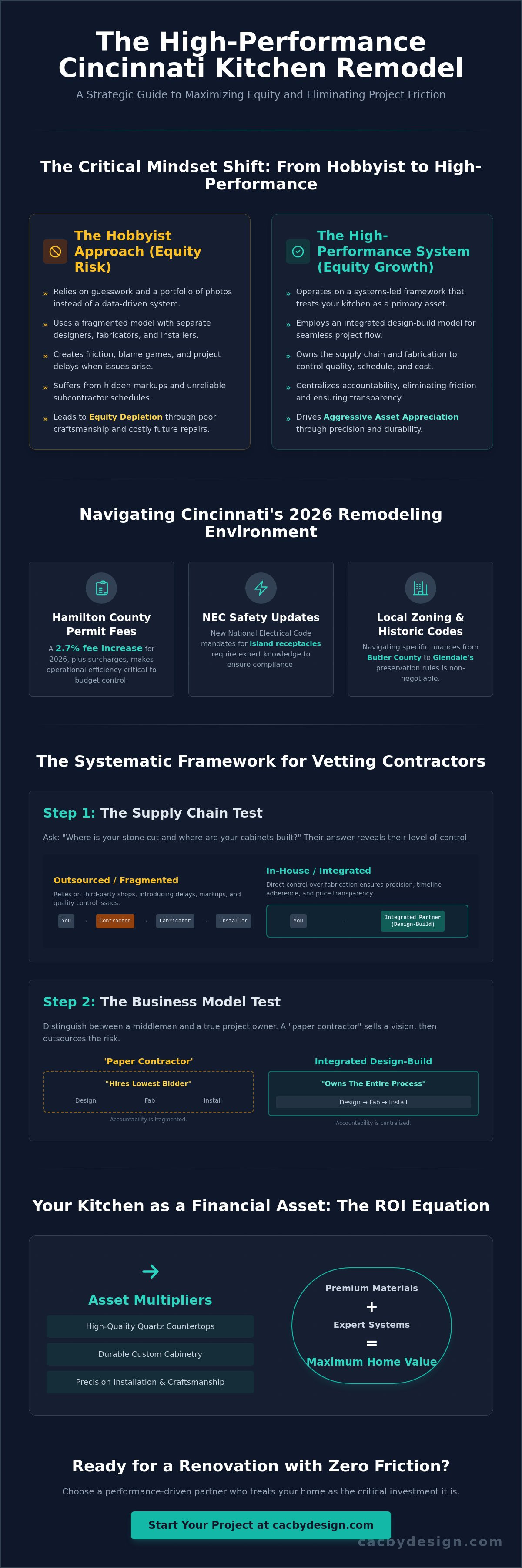
A successful remodel in 2026 isn't a matter of luck; it's the result of a scientific approach to construction. You now understand that mastering how to choose a kitchen contractor in Cincinnati requires looking beyond the portfolio. It demands an audit of their internal systems, from their grasp of Hamilton County's updated 2026 code surcharges to their control over the material supply chain. By prioritizing vertical integration and design-build accountability—a standard exemplified by premier firms like Atlas Design and Remodeling—you eliminate the friction that typically devalues a home renovation. This technical framework ensures your kitchen remains a liquid asset rather than a project management nightmare.
We've built this guide to help you master the vetting process for a high-performance remodel that delivers maximum equity and zero friction. You'll learn how to navigate the 2026 regulatory environment, including the 2.7 percent Hamilton County permit fee hike and the latest NEC safety updates for island receptacles. We'll also explore how to leverage high-quality quartz and custom cabinetry to drive measurable value. This is your roadmap to a renovation that combines the cold logic of a sound investment with the high energy of modern, nature-inspired design.
Table of Contents
The High-Performance Reality of Cincinnati Kitchen Remodeling
The Systematic Framework for Evaluating Contractor Capability
Cincinnati-Specific Constraints: Historic Codes and Modern Zoning
Eliminating Project Friction: The Case for Integrated Fabrication
Executing the Remodel: Transitioning from Design to Installation
The High-Performance Reality of Cincinnati Kitchen Remodeling
Cincinnati's real estate market in 2026 demands a total shift in perspective. A kitchen isn't just a room; it's a primary equity lever. If you're looking at The Renovation Process through the lens of aesthetics alone, you're leaving capital on the table. Ambitious homeowners from the historic streets of OTR to the modern estates in Mason understand that high-performance remodeling is about aggressive asset appreciation. It's the difference between a hobbyist contractor who relies on gut feelings and a performance-driven partner who operates with surgical precision.
Mastering how to choose a kitchen contractor in Cincinnati requires a look at current market constraints. Labor efficiency is now the primary driver of project success. With Hamilton County permit fees increasing by 2.7 percent for 2026 and specialized surcharges for technology and planning, there's no room for operational waste. A hobbyist contractor might offer a lower initial bid, but fragmented communication and unreliable subcontractor schedules lead to equity depletion. This occurs when poor craftsmanship or material failures force repairs within a few years, erasing any initial savings and damaging the long-term value of the property.
Efficiency is the new currency. Understanding how to choose a kitchen contractor in Cincinnati means recognizing that the 2026 market context is defined by the tension between rising material costs and the need for labor speed. You can't control the price of quartz or hardwoods, but you can control the systems used to install them. High-performance systems integrate material sourcing and labor management to bypass the friction of traditional models. Localized expertise is non-negotiable. A contractor who doesn't understand the specific zoning nuances of Butler County or the historic preservation requirements of Glendale will inevitably cause delays.
Kitchen Remodeling as a Financial Asset
Investing in premium materials like quartz countertops and custom kitchen cabinets is a data-backed strategy. These materials offer superior durability and timeless appeal that protect your home's valuation in a competitive market. Cheap labor is a liability that degrades these high-end assets through poor installation. A high-performance remodel is the intersection of design, durability, and data. By prioritizing material integrity and technical execution, you ensure your kitchen remains a liquid asset rather than a maintenance burden.
The Problem with Market Fragmentation
Traditional remodeling is fundamentally broken. When you hire separate designers, material fabricators, and installers, you create a breeding ground for friction. This fragmentation is the leading cause of delays in the Cincinnati market. If a quartzite slab is cut incorrectly or a cabinet doesn't fit the plumbing layout, the finger-pointing begins. The designer blames the installer; the installer blames the fabricator. You're left with a stalled project and mounting costs. A unified design-build system eliminates this risk by centralizing accountability. It's the only way to ensure your renovation moves from concept to completion with zero friction and maximum momentum.
The Systematic Framework for Evaluating Contractor Capability
Choosing a contractor based on a "gut feeling" is a high-risk gamble. In a market where labor efficiency dictates ROI, you need a technical framework for vetting. When you're determining how to choose a kitchen contractor in Cincinnati, look for operational maturity. Most contractors are "paper contractors" who outsource every phase of the project. They sell you a vision and then hire the lowest bidder to execute it. This model is built on friction and markups. A high-performance partner operates differently. They own the process from stone fabrication to final cabinet installation.
Verification starts with the Supply Chain Test. Ask where their stone is cut and where their cabinets are built. Direct access to fabrication means they control the quality and the timeline. If they rely on third-party shops, your project is at the mercy of someone else's backlog. High-performance teams integrate these services to eliminate lead-time variability. This ensures your quartz or quartzite countertops are fabricated to exact tolerances without the middleman markup. This level of control is what separates a professional operation from a lucky speculator.
Demand a digital-first communication protocol. A professional team doesn't rely on scattered texts or verbal promises. They use centralized project management systems to track schedules, permits, and change orders in real time. This transparency is critical for managing the complex logistics of a modern renovation. You should also require line-item financial estimates. Lump-sum bids are often used to hide "guesswork" that leads to budget bloat. A detailed breakdown allows you to see the logic behind every dollar spent and ensures your capital is deployed effectively.
Vetting the Technical Portfolio
Don't be distracted by professional photography. Zoom in on the details that matter. High-quality stone joins should be tight and color-matched. Cabinet doors must be perfectly aligned with consistent gaps. These are the markers of technical precision. When reviewing a kitchen remodel cincinnati portfolio, look for repeatable excellence across different styles. Ask for references from projects completed three or more years ago. This confirms that the materials and construction methods can withstand the rigors of daily use without degrading.
The In-House Advantage
The "In-House" model is the only way to guarantee a predictable schedule. When a contractor uses their own craftsmen, they can move with speed and precision. This is essential for maintaining compliance with the International Residential Code during critical inspection phases. In-house crews understand the brand's quality standards and work together daily. This synergy prevents the "finger-pointing" common in subcontracted models. Ask which specific crew will be assigned to your Hamilton County home to ensure accountability. If you want a renovation that moves with momentum, partner with a team that controls its own labor and fabrication.
Cincinnati-Specific Constraints: Historic Codes and Modern Zoning
Cincinnati’s geography dictates its regulatory complexity. From the historic brickwork of Over-the-Rhine to the sprawling estates of Mason, the legal landscape changes every few miles. Learning how to choose a kitchen contractor in Cincinnati requires auditing their local regulatory IQ. A contractor who treats a Gaslight Clifton renovation like a new build in West Chester will trigger a stop-work order. You need a partner who understands that zoning and permitting are technical hurdles, not suggestions. This knowledge is as critical as the quality of the stone they install.
In 2026, Hamilton County building fees increased by 2.7 percent. This isn't a flat rate; it's a calculated stack of surcharges. You must account for a 3 percent technology surcharge, a 5 percent planning surcharge on construction and plumbing, and a 1 percent state surcharge for residential dwellings. If your project involves a new sewer tap, expect a $5,900 permit fee for standard residential meters. These are hard costs that a high-performance contractor builds into your initial feasibility study. They don't leave you to discover these line items during the inspection phase.
Suburban scaling in Mason and West Chester presents its own friction. Homeowners Associations (HOAs) and modern zoning codes often dictate everything from debris bin placement to exterior structural changes. A performance-driven contractor manages these stakeholders aggressively to keep your timeline on track. They ensure every design choice aligns with the 2024 Ohio Building Code and the latest 2023 NEC updates. This includes the major shift in kitchen island receptacle requirements, where side-mounted outlets are no longer permitted to meet countertop provisions in many jurisdictions. Ignoring these details results in failed inspections and costly rework.
Hamilton County Permitting Realities
A full-service kitchen remodel requires a stack of approvals. You'll need building, plumbing, and HVAC permits at a minimum. The timeline for these inspections can make or break your project momentum. A reputable contractor has a documented standing with the Cincinnati Department of Buildings and Inspections and uses their online portal for real-time tracking. They schedule inspections as technical milestones, ensuring no phase of construction sits idle while waiting for a city official. This proactive approach keeps the labor efficiency high and the friction low.
Historic Home Engineering
Renovating a historic Cincinnati estate is a structural challenge. You're often dealing with plaster walls, knob-and-tube wiring, and outdated plumbing stacks. Integrating a modern custom cabinets in West Chester, OH aesthetic into an 1890s shell requires precise engineering. Structural load-bearing analysis is non-negotiable for open-concept conversions. Your contractor must identify these surprises during the data-gathering phase, not after they've started demolition. This level of foresight protects your equity and prevents the friction of mid-project structural failures.
Eliminating Project Friction: The Case for Integrated Fabrication
The traditional "Middleman" model is the primary cause of project failure in the Cincinnati market. When you hire a contractor who outsources stone fabrication and cabinetry production, you're introducing multiple points of failure. Each handoff between a designer, a third-party fabricator, and an independent installer creates a "data gap." This fragmentation leads to the "finger-pointing" dynamic that stalls renovations for weeks. A high-performance alternative is vertical integration. This is a critical technical benchmark for how to choose a kitchen contractor in Cincinnati. By centralizing these services, you ensure the person cutting the stone and the person designing the layout operate from the same digital template.
Integrated systems do more than just save time; they protect your investment from material defect disputes. In a fragmented model, if a quartz slab arrives at your home with a hairline fracture or a sizing error, the contractor blames the fabricator, and the fabricator blames the installer. You're left with a stalled kitchen and a legal headache. An integrated team owns the entire lifecycle of the material. They identify defects at the fabrication facility, not on your job site. This level of accountability ensures that only perfect components enter your home, maintaining the momentum of the build and the integrity of your equity.
The Lifecycle of a Quartz Countertop
Modern quartz and quartzite require surgical precision from slab selection to final install. The process starts with digital templating, where lasers capture the exact dimensions of your cabinet layout. This data feeds directly into CNC cutting machines that shape the stone with sub-millimeter accuracy. Precision fabrication is what allows for tight, nearly invisible seams and perfectly aligned sink cutouts. This isn't just about looks; it's about kitchen longevity. Poorly cut stone creates stress points that lead to cracking over time. Granite countertops in Cincinnati also require this specialized local handling to manage the natural weight and structural nuances of the material without compromising the cabinet boxes beneath them.
Reducing Lead Times through Vertical Integration
Vertical integration is the only real antidote to the "endless" remodel. In the 2026 market, relying on third-party supply chains is an unnecessary risk. Compare the friction of a 12-week wait for "ordered" components to the precision of an in-house fabrication schedule. A unified team controls the "demolition-to-install" window. They don't wait for a subcontractor’s truck to show up; they move the moment the site data says the project is ready. This eliminates the weeks of dead time common in traditional models. If you're ready to bypass the middleman and secure a predictable timeline, partner with a vertically integrated fabrication team to ensure your remodel stays on track.
Executing the Remodel: Transitioning from Design to Installation
Executing a high-performance remodel requires a five-phase operational sequence that eliminates the guesswork of traditional construction. When you're determining how to choose a kitchen contractor in Cincinnati, you're actually auditing their ability to move from data-gathering to a finished handover without losing momentum. The process begins with a feasibility consultation that treats your space as a technical environment. We move from site data to material finalization. This ensures your quartz surfaces and custom cabinetry are locked in before the first sledgehammer swings. Locking in materials early is the only way to insulate your project from 2026 supply chain variability.
Phase three focuses on technical prep. This is where your contractor handles the Hamilton County permit stack. This includes the 2026 surcharges and technology fees mentioned earlier. Phase four is the build. Because high-performance systems use integrated fabrication, demolition and installation happen in a tight, systematic window. The final phase is the handover. This isn't a casual look-around; it's a performance check. We verify that every cabinet alignment and stone join meets the technical benchmarks established in the design phase. This systematic approach ensures your kitchen delivers maximum equity from day one.
The Selection Experience
Visualizing the outcome is critical for risk mitigation. Using a showroom allows you to interact with the materials that will define your home’s equity. High-performance home renovation contractors in Cincinnati use 3D rendering to bridge the gap between imagination and engineering. This technology allows you to see how specific cabinet hardware interacts with the veining of your quartzite or the matte finish of your wood countertops. It turns an aesthetic choice into a data-backed decision. You can select your sinks and faucets with the confidence that they fit the technical profile of your new kitchen without the friction of mid-project returns.
Finalizing the Partnership
A pro-level contract is a document of clarity. It contains no vague "allowances" that lead to mid-project budget bloat. Every material, from the marble countertops to the cabinet hardware, is line-itemed and finalized. You should demand a firm start and end date. A contractor who can't commit to a schedule doesn't have a system; they have a hope. Mastering how to choose a kitchen contractor in Cincinnati means choosing the certainty of a proven framework over the chaos of traditional remodeling. If you're ready to see how high-performance systems translate into physical reality, audit our Cincinnati showroom and fabrication facility today.
Secure Your High-Performance Kitchen Asset
A successful remodel in 2026 isn't a matter of luck; it's the result of a scientific approach to construction. You now understand that mastering how to choose a kitchen contractor in Cincinnati requires looking beyond the portfolio. It demands an audit of their internal systems, from their grasp of Hamilton County's updated 2026 code surcharges to their control over the material supply chain. By prioritizing vertical integration and design-build accountability, you eliminate the friction that typically devalues a home renovation. This technical framework ensures your kitchen remains a liquid asset rather than a project management nightmare.
Stop settling for the fragmented middleman model that relies on unreliable subcontractors and third-party fabrication shops. We leverage an in-house stone fabrication facility and over 20 years of Cincinnati remodeling data to ensure your project moves with surgical precision. Our design-build systems are engineered to eliminate chaos and maximize your property's financial performance. It's time to treat your renovation as the high-yield investment it is. Upgrade your kitchen equity with a results-driven consultation. Your vision deserves the certainty of a proven framework.
Frequently Asked Questions
What influences the cost of a kitchen remodel in Cincinnati in 2026?
Project costs are primarily driven by your choice of materials, structural complexity, and the current regulatory environment. In 2026, homeowners must account for the 2.7 percent increase in Hamilton County permit fees and specialized surcharges for technology and planning. A high-performance contractor provides a line-item estimate that reflects these local variables. This approach ensures financial transparency and prevents the budget bloat common in "lump sum" guesswork models.
Do I need a separate architect and kitchen contractor in Hamilton County?
You don't need to hire a separate architect if you partner with an integrated design-build firm. These firms handle the entire technical sequence, including the stamped plans required by Hamilton County for structural changes. Centralizing design and construction under one roof eliminates the friction of managing multiple entities. It ensures that your design is engineered for reality rather than just looking good on paper.
How long should a kitchen renovation take from demolition to completion?
A standard high-performance renovation typically requires 6 to 12 weeks depending on the scope of work. Choosing a contractor with in-house stone fabrication and cabinetry design can significantly reduce this window by eliminating third-party lead times. Your team should provide a firm schedule with clear milestones. This level of operational maturity is the only way to avoid the "endless" remodel trap often found in fragmented construction models.
What are the most durable countertop materials for a high-traffic Cincinnati kitchen?
Quartz and quartzite are the gold standards for durability and long-term equity. Quartz is a non-porous, engineered material that resists staining and requires zero sealing; it's ideal for busy households. Quartzite offers the aesthetic of natural stone with superior hardness compared to marble. Both materials protect your investment by withstanding daily use without the surface degradation seen in lower-quality alternatives.
How do I verify if a Cincinnati contractor is properly licensed and insured?
Verify their credentials through the Cincinnati Department of Buildings and Inspections and the Ohio Construction Industry Licensing Board. Learning how to choose a kitchen contractor in Cincinnati involves requesting a Certificate of Insurance that includes general liability and workers' compensation. This protects you from liability during the build. Always confirm they are registered to pull permits in your specific municipality, whether it's Mason, West Chester, or OTR.
Is it better to choose a local Cincinnati company or a national franchise?
Local companies offer a distinct advantage because they possess deep knowledge of Cincinnati building codes and historic district regulations. National franchises often lack the integrated fabrication facilities and regional subcontractor networks needed to manage local logistics. A local partner understands the specific structural challenges of Cincinnati’s historic estates and modern suburban builds. This localized expertise ensures your project moves through the inspection phase without friction.
What should I do if my kitchen remodel requires structural changes?
Structural changes require a load-bearing analysis by a qualified professional and a specific building permit. Your contractor must identify these requirements during the feasibility phase to ensure your design aligns with the 2024 Ohio Building Code. High-performance teams integrate this engineering into the initial plan. This proactive strategy prevents costly mid-project corrections and ensures the structural integrity of your home remains intact during open-concept conversions.
How does an integrated design-build model differ from a general contractor?
An integrated design-build model centralizes design, material sourcing, and installation under a single point of accountability. While a general contractor typically manages various independent subcontractors, a design-build firm owns the entire fabrication and labor process. This model is the most efficient way to execute a remodel because it eliminates the data gaps that cause delays. It provides a seamless transition from your initial vision to the final performance check. For those in other regions looking for this level of professional oversight, Vancouver General Contractors provides a similar high-performance approach to full home renovations and custom construction.


Comments