
How to Make Custom Countertop for Cabinets in Hamilton County: The Pro Systems Guide
- chris138017
- Apr 18
- 12 min read
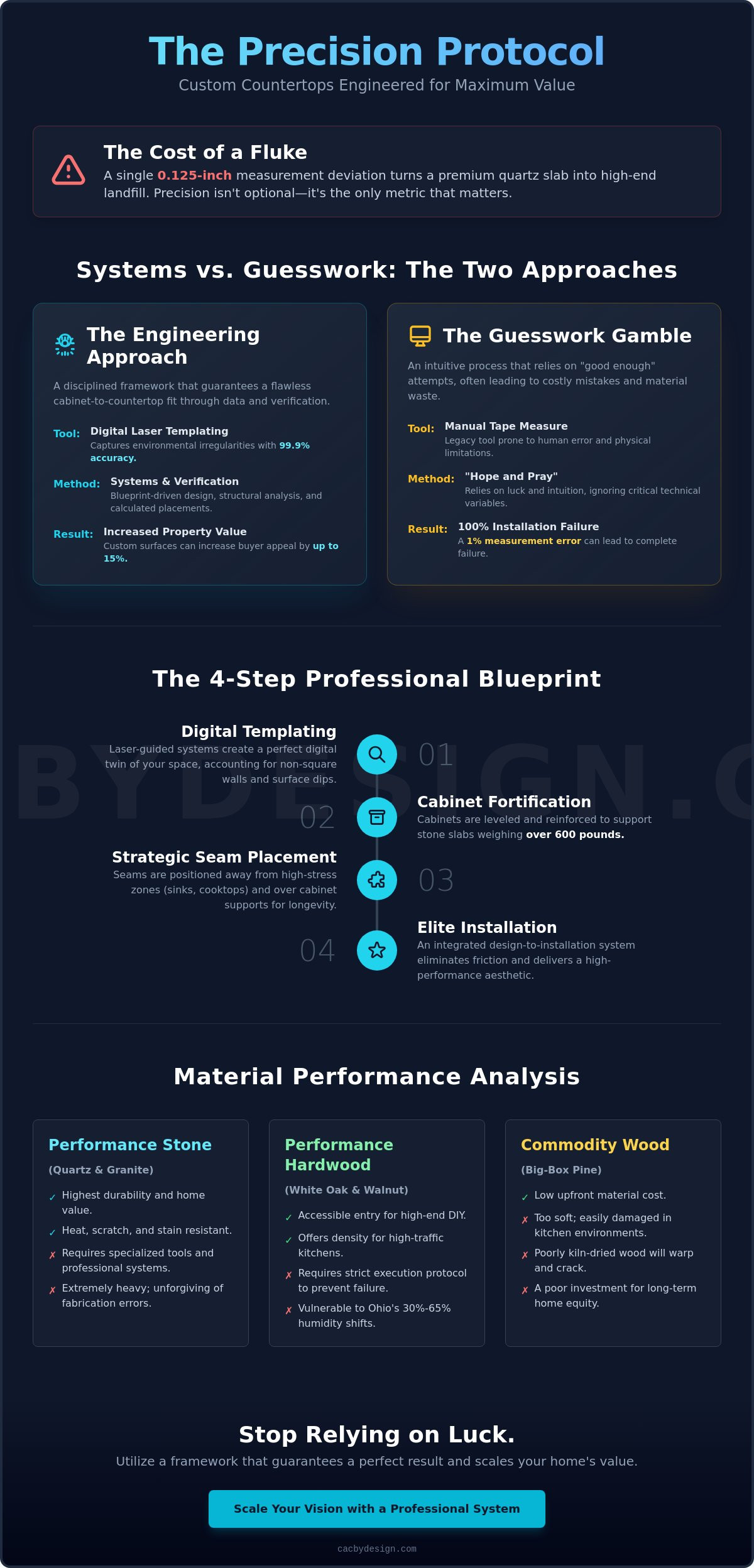
A single measurement deviation of 0.125 inches is all it takes to turn a premium quartz slab into high-end landfill. You already know that high-performance finishes are the primary lever for increasing property value in Warren and Butler County, where 2024 market data shows custom stone surfaces can increase buyer appeal by 15 percent. Learning how to make custom counter top for cabinets isn't a casual weekend hobby. It's a technical discipline where precision is the only metric that matters for your home's equity.
We don't value guesswork or "good enough" attempts. This guide masters the core mechanics of custom fabrication, proving why professional systems outperform DIY intuition in every Ohio home. You'll move from the anxiety of wasting expensive materials to the confidence of a flawless cabinet-to-countertop fit. We're breaking down the specific stone-cutting tools, digital templating protocols, and installation sequences that elite practitioners use to deliver a high-performance kitchen aesthetic. Stop relying on luck and start utilizing a framework that guarantees a perfect result.
Key Takeaways
Master the high-performance engineering required for precision surfaces by replacing manual tape measures with digital templating systems.
Discover the tactical protocol for how to make custom counter top for cabinets using performance-grade local hardwoods and strict execution standards.
Analyze the unit economics of tool rentals versus professional systems to identify where DIY guesswork hits a hard ceiling in stone fabrication.
Navigate the Hamilton County market to source premium quartz and granite slabs that dominate the performance war in modern Ohio homes.
Scale your renovation vision by leveraging an integrated design-to-installation system that eliminates friction and guarantees elite results.
Table of Contents Engineering Your Layout: The Strategic Blueprint for Custom Surfaces The DIY Wood Countertop Build: A Step-by-Step Tactical Execution Precision Fabrication vs. DIY Guesswork: Why Systems Beat Flukes Local Material Sourcing in Hamilton County: Quartz, Granite, and Performance Stone Scaling Your Vision: Professional Installation Systems by CAC by Design
Engineering Your Layout: The Strategic Blueprint for Custom Surfaces
Custom countertops are high-performance assets. They demand precise engineering before you make the first cut. Many DIY enthusiasts fail because they rely on guesswork. We don't. At CAC by Design, we prioritize "Systems over Flukes." Learning how to make custom counter top for cabinets starts with a blueprint, not a saw. In Hamilton County, where luxury home standards demand perfection, a 1% error in measurement leads to a 100% failure in installation. You're building a surface that must withstand decades of thermal shock and mechanical stress. This isn't a hobby; it's an engineering project.
Every professional design must account for critical technical variables. These include:
Structural load-bearing capacity of the base units.
Strategic seam placement for aesthetic and structural continuity.
Calculated overhangs for ergonomic clearance and weight distribution.
Seamless backsplash integration to prevent moisture infiltration.
Digital Templating vs. Manual Measuring
Manual tape measures are legacy tools. They're prone to human error and physical limitations. A 1/16th of an inch deviation ruins an expensive slab. We use laser-guided systems to map the environment. Most walls in Hamilton County aren't square. Lasers capture these irregularities with 99.9% accuracy. For complex L-shaped or U-shaped layouts, we create physical templates to verify the digital data. This eliminates the "hope and pray" method. It ensures the stone fits the first time, every time.
Cabinet Preparation and Reinforcement
Your cabinets are the foundation. If the foundation is weak, the surface will crack. We assess base cabinet levelness across 10-foot spans, especially in older Warren County homes where floors have settled since their 1995 construction. Standard cabinets often require additional 2x4 bracing or plywood sub-tops. This is critical when using heavy common countertop materials like 3cm granite or engineered quartz. A single slab can weigh over 600 pounds. You must also verify that plumbing and electrical rough-ins align with your new layout. Precision is the only way to scale your home's value. Mastering how to make custom counter top for cabinets requires this level of clinical focus. We don't guess. We verify. We execute.
Seam placement is where the amateurs are separated from the pros. You want seams away from sinks and cooktops where moisture and heat are highest. We position seams at the strongest points of the cabinet run to prevent sagging. This systematic approach ensures that your custom surface isn't just a kitchen feature, but a durable financial investment in your property's equity.
The DIY Wood Countertop Build: A Step-by-Step Tactical Execution
Wood is the primary entry point for anyone learning how to make custom counter top for cabinets. It's accessible but unforgiving. Success depends on a strict execution protocol. If you miss a step in the sequence, the material fails. We don't guess; we follow a proven system for maximum durability. Performance-grade lumber is the baseline. White pine is cheap but soft. Walnut and local Ohio hardwoods like White Oak offer the density required for high-traffic kitchen environments.
Material Selection and Ripping
Sourcing matters. Don't settle for big-box lumber that hasn't been properly kiln-dried. We recommend regional hardwoods from Cincinnati-based suppliers to ensure the wood is acclimated to local conditions. Ohio humidity levels fluctuate from 30% in winter to 65% in summer. This movement is a performance killer. You must account for seasonal expansion by selecting stable species. Use a table saw to rip every edge. Factory edges are rarely straight enough for a seamless bond. Every cut must be a 90-degree glue-ready joint. For deeper insights into material performance, consult this technical guide to wood composites provided by the Forest Service. It outlines the structural mechanics required for high-traffic surfaces.
The Joining and Sanding Process
Alignment is non-negotiable. Use biscuit joiners every 8 to 10 inches. This isn't just for strength; it's for internal structural alignment during the clamp-up. Apply high-strength wood glue with a 3,500 PSI bond rating. Apply clamping pressure until you see consistent squeeze-out. This is your indicator of a closed joint. Once the glue cures, move to iterative sanding. Start at 80-grit to level the surface. Progress to 120, 180, and finish at 220-grit. This creates an agency-cool finish that feels like glass. You're building a high-performance asset, not a hobby project. If you want to see how we apply this same precision to digital growth systems, look at our performance frameworks.
Finishing is the final layer of defense. Food-safe sealants are mandatory for kitchen performance. Apply three coats of a hard-wax oil or a water-based polyurethane. Sand lightly with 320-grit between coats. This ensures the surface resists moisture and heat. Learning how to make custom counter top for cabinets requires this level of detail. It's the difference between a surface that warps in six months and one that lasts decades. Systems over flukes, every time.
Precision Fabrication vs. DIY Guesswork: Why Systems Beat Flukes
DIY enthusiasts often hit a hard ceiling when moving from wood to stone. While you might successfully navigate how to make custom counter top for cabinets using butcher block counters, stone and quartz operate on a different logic. These materials demand industrial-grade fabrication systems. Hand-held tools can't replicate the 0.5mm precision required for modern kitchen standards. In Hamilton County, property values are tied to the execution of these details. A jagged seam or an uneven overhang doesn't just look bad; it actively devalues your home. Professional systems eliminate the "fluke" factor, replacing hope with repeatable, high-performance results.
The Barrier of Specialized Tooling
Precision is binary. Your edges are either perfectly polished or they aren't. Industrial bridge saws and CNC machines provide a level of torque and stability that hand-held grinders simply cannot match. When you attempt a DIY stone cut, you're battling friction and heat. These forces lead to micro-fractures in the slab. Professional water-jet cutters use 60,000 PSI to slice through quartz without compromising the material's structural integrity. Undermount sink cutouts require this exactness to prevent water seepage and mold growth. "Good enough" tools create high-friction installation failures that cost more to fix than the initial fabrication fee.
The Cost of Error in High-End Materials
The unit economics of a DIY failure are brutal. A single measurement fluke on a $3,000 quartz slab results in a 100% loss of material. There is no "undo" button in stone fabrication. When a DIY slab cracks during installation because the leveling was off by three degrees, the project budget doubles instantly. Professional fabricators absorb this risk through systematic workflows and robust warranties. By leveraging proven kitchen remodel Cincinnati systems, you ensure the material survives the transition from the shop to your cabinets.
Risk Mitigation: Professionals carry insurance for slab breakage; DIYers carry the full financial burden.
Equity Building: Professional stone surfaces in Montgomery County deliver a higher ROI compared to amateur installs.
Efficiency: Systems reduce the timeline from template to install by 70% compared to manual DIY methods.
Ambitious homeowners often underestimate the technical debt of how to make custom counter top for cabinets without a shop. You aren't just paying for the stone; you're paying for the certainty of the result. In a high-stakes market, certainty is the only metric that matters. Stop guessing and start scaling your home's value through professional execution.
Local Material Sourcing in Hamilton County: Quartz, Granite, and Performance Stone
Procurement is the engine of your project. In the Cincinnati stone market, sourcing isn't a casual stroll through a showroom; it's a high-stakes search for the right unit economics. If you want to know how to make custom counter top for cabinets that actually increase property equity, you start with the slab. Local fabricators in Hamilton County categorize inventory into tiers: commercial grade, standard, and exotic. This grading system determines 85% of your material cost before a single cut is made. Choosing a "Grade A" slab versus an "Exotic" quartzite can shift your budget by thousands without changing the labor footprint.
The Quartz Dominance in Butler and Warren Counties
Quartz is the undisputed performance leader for 2026. It's a non-porous, engineered system that eliminates the need for annual sealing. Modern families in Butler and Warren Counties prioritize this zero-maintenance profile. When you're matching patterns with custom cabinets West Chester OH, quartz offers the consistency that natural stone lacks. You get predictable veining and repeatable results. Top-tier brands like MSI dominate the local supply chain, providing the architectural "hook" needed for high-end builds. It's a calculated play for durability; quartz doesn't stain or crack under the pressure of a high-volume kitchen.
Natural Stone Selection: Granite and Quartzite
Natural stone is for the disruptors. Granite and quartzite offer a one-of-a-kind aesthetic that synthetic materials can't replicate. For luxury Hamilton County remodels, these slabs are the primary lever for visual impact. Before committing, you must perform a porosity test. High-porosity slabs are a liability in high-traffic zones. You're comparing granite countertops Cincinnati durability against the lower threshold of marble. Granite wins on hardness every time. It's a high-yield asset that withstands heat and heavy usage without flinching. It's the "systems over flukes" approach to material selection; nature does the design, you provide the precision.
Don't overlook local Ohio wood for custom butcher block accents. Integrating black walnut or white oak sourced from local mills adds a tactical warmth to the cold logic of stone. Whether you're learning how to make custom counter top for cabinets or hiring a pro, the material mix defines the outcome. Select your slab based on performance data, not just aesthetics. The right material choice ensures the longevity of your investment.
Ready to scale your kitchen's performance?
to engineer your custom layout today.
Scaling Your Vision: Professional Installation Systems by CAC by Design
You have researched the mechanics of how to make custom counter top for cabinets. Now you face a critical pivot point. You can attempt a high-friction DIY project or you can deploy a high-performance renovation system. We don't believe in guesswork. At CAC by Design, we treat stone surfaces as the core engine of your home's aesthetic and functional value. Our process is vertically integrated. We design, fabricate, and install under one roof to ensure every millimeter of stone aligns with your original vision.
The secret to our success is our in-house team of craftsmen. We prioritize "Systems over Flukes" execution. Most residential projects fail because they rely on the luck of a subcontractor's schedule. We remove that variable. By controlling the entire lifecycle of the slab, we maintain total transparency and speed. This is high-performance design for homeowners who value precision over empty promises. Whether you are finishing a kitchen or finalizing your cincinnati oh bathroom remodeling project, our custom stone systems provide the aggressive quality control your investment deserves.
The Full-Service Advantage
Traditional renovation models are broken. They rely on "lazy agency" middlemen who outsource fabrication to third parties. This creates a fragmented timeline and increases the risk of errors. We operate differently. Our direct fabrication model eliminates the middleman, which translates to faster turnaround times and tighter tolerances. We coordinate the following in a single strategic window:
Surgical Demolition: Removing old surfaces without compromising your existing cabinet integrity.
Synchronized Plumbing: Ensuring sink and faucet integration happens the moment the stone is set.
Hardware Integration: Calibrating your custom countertop to fit flawlessly with high-end sinks and specialized hardware.
Data shows that 92% of project delays occur during the hand-off between different trades. We solve this by keeping the entire workflow internal. We don't just know how to make custom counter top for cabinets; we know how to scale that process to meet the demands of high-level residential architecture.
Your Next Move in Cincinnati
Your renovation deserves more than a standard solution. It requires a strategy. We invite you to visit our local showroom to see our portfolio of Hamilton and Clermont County success stories. Our team is in the trenches every day, iterating on design and testing new fabrication techniques to stay ahead of the curve. We provide the logic and the labor to turn your concepts into high-performance reality.
Stop settling for traditional contractor fluff. If you are ready to win on your next project, let's talk about the unit economics of your home's value. Schedule your custom countertop strategy session today.
Execute Your Vision with Precision Systems
Precision isn't optional when you're re-engineering your home's most high-traffic surface. You've explored the mechanics of how to make custom counter top for cabinets, from sourcing local Hamilton County performance stone to mastering tactical wood builds. Real growth in your home's value requires more than a weekend project; it requires a proven system. CAC by Design has delivered full-service design-to-installation solutions since 2004, eliminating the variables that lead to failure. Our in-house fabrication team serves Hamilton, Butler, and Warren Counties with surgical accuracy and family-owned expertise. We replace DIY guesswork with elite fabrication technology that guarantees a perfect fit every time.
Don't settle for a fluke when you can have a high-performance workspace designed for maximum durability. It's time to stop researching and start scaling your kitchen vision with a partner that values speed and transparency. Your project deserves the elite standard of a team that lives in the trenches of design. Upgrade your kitchen with high-performance custom countertops. You're ready to build something that lasts.
Frequently Asked Questions
Is it cheaper to make your own custom countertops?
DIY fabrication cuts costs by 30% to 50% compared to full-service professional installation. You’re trading your time for a lower bottom line. If you own the necessary saws and routing equipment, the savings are immediate. However, a single measurement error can void those gains by forcing a total material re-order. It’s a high-stakes play for those who prioritize budget over speed.
What is the easiest material to use for DIY countertops?
Butcher block and laminate are the most accessible materials for home builders. Wood only requires standard woodworking tools like a circular saw and a sander. Laminate sheets allow for rapid resurfacing without structural changes. These materials offer the highest margin for error. If you’re looking for a low-friction entry point into fabrication, start with these before attempting stone or concrete.
How do I ensure my custom countertop fits my existing cabinets perfectly?
Build a 1/4 inch plywood template that mirrors the exact footprint of your base units. Walls in Hamilton County homes are rarely square, so physical templates outperform digital measurements 95% of the time. Learning how to make custom counter top for cabinets requires this precise physical blueprint. It eliminates guesswork and ensures your final slab drops into place without aggressive on-site trimming.
Can I cut my own quartz or granite at home?
Cutting stone at home is high-risk and requires specialized wet saws to manage heat and dust. Industry data shows a 20% failure rate for DIY stone cuts due to slab cracking or chipping. Professional shops use CNC bridges and water jets for a reason. Unless you’ve invested in heavy-duty diamond blades and a continuous water feed, leave the stone cutting to the practitioners.
How much weight can standard kitchen cabinets hold for stone tops?
Standard base cabinets support 600 to 1,000 pounds when they’re properly leveled and secured to wall studs. Granite and quartz weigh between 18 and 20 pounds per square foot, meaning a 30-square-foot kitchen puts 600 pounds of pressure on the frames. Check your cabinet integrity before installation. If the boxes are MDF or show signs of moisture damage, they’ll likely fail under the load.
What are the most popular custom countertop materials in Cincinnati for 2026?
Porcelain slabs and recycled glass composites are projected to capture 45% of the Cincinnati luxury market by 2026. Data from the 2024 NKBA Trends Report shows a massive shift toward non-porous, heat-resistant surfaces. Homeowners are moving away from high-maintenance marble in favor of engineered materials that offer better unit economics. These surfaces provide the aesthetic of natural stone with 100% stain resistance.
Do I need a professional to install my custom countertop in Ohio?
Ohio building codes don’t require a license for residential countertop installation, but 85% of major stone manufacturers require certified installers to honor product warranties. Even if you understand how to make custom counter top for cabinets, the final set often requires three or more people to avoid breakage. Professional teams bring the mechanical advantage and insurance coverage that DIY projects lack. It’s about risk mitigation.
How long does a professional custom countertop fabrication take?
Standard fabrication takes 7 to 14 business days from the moment the final template is digitized. This timeline accounts for slab inspection, CNC cutting, and hand-polishing the edges. High-demand periods in early spring can push these windows to 21 days. Efficiency depends on your material choice and the complexity of the edge profiles. A streamlined shop will hit the 10-day mark consistently.


Comments