
How to Seal Natural Stone Countertops: The High-Performance Maintenance Protocol
What if the very cleaners you use to sanitize your kitchen are actually dissolving the chemical barrier protecting your five-figure investment? You've likely heard a dozen different opinions on maintenance, and that confusion leads to one of two things: total paralysis or expensive mistakes. You've invested in premium marble or quartzite to elevate your home's equity. The fear of a permanent red wine stain or a deep oil etch is a legitimate threat to that value.
We're here to replace that anxiety with technical precision. This guide cuts through the fluff to deliver a high-performance protocol on how to seal natural stone countertops using the latest 2026 industry standards. You'll master a repeatable framework that ensures your surfaces remain impenetrable to daily wear. We're breaking down the physics of stone absorption, the impact of new VOC regulations on sealer longevity, and the exact steps to maintain a high-gloss, pristine aesthetic that lasts for years. It's time to treat your stone like the high-value asset it is. Let's get to work.
Table of Contents
Natural Stone Sealing: The High-Performance Framework for Asset Protection
Natural stone isn't just a surface; it's a high-value geological asset that requires a technical management strategy. Most homeowners view their countertops as indestructible, but stone is inherently porous. Without a protective protocol, you're leaving your kitchen's equity exposed to permanent staining and deep oil etches. Sealing isn't a "set it and forget it" task. It's a sacrificial barrier designed to buy you time. Understanding how to seal natural stone countertops correctly is the difference between a pristine kitchen and a depreciating asset. Think of sealant as a sacrificial layer. It's designed to take the hit so your stone doesn't have to. When you skip this maintenance, you aren't just risking a spot; you're risking the long-term yield of your home's valuation. Stained marble or etched quartzite can decrease the perceived value of a high-end kitchen remodel by thousands of dollars during a resale.
Porosity: The Invisible Risk Factor in Your Kitchen
Stone surfaces look solid, but at a molecular level, they're full of microscopic tunnels. Capillary action pulls liquids like wine, citrus juice, and oils deep into the stone's structure. Porosity is the ratio of void space within a stone's volume. While Granite is relatively dense, marble has a high-absorption profile that demands aggressive protection. If you ignore this technical reality, you're inviting chemical reactions that can't be wiped away with a sponge. Professional-grade sealing is the logical extension of a premium installation. It fills those molecular voids, creating a tension that forces liquids to bead on the surface rather than penetrate the core. Our Cincinnati showroom serves as a resource for material-specific care products designed to address these specific absorption rates.
Why 'Factory Sealed' Isn't a Lifetime Guarantee
The term "factory-sealed" is often used as a marketing tool to imply a permanent solution. It's a myth. Initial sealants are a baseline, not a bulletproof vest. Daily use, heat, and chemical exposure from standard cleaners degrade these barriers within months. In Cincinnati, indoor humidity levels fluctuate significantly, which impacts how sealants cure and hold up over time. We define the first 12 months of ownership as the 'Critical Protection Window'. This is when the stone is most vulnerable and when you must establish your maintenance cycle. If you wait until you see a stain to learn how to seal natural stone countertops, you've already lost the battle. Active maintenance is the only way to ensure your stone remains a high-performance feature of your home.
The Water Test: A Technical Audit of Your Stone's Integrity
Stop guessing about your maintenance schedule. High-performance stone care relies on data, not calendars. Before you even consider how to seal natural stone countertops, you must perform a diagnostic audit. The Water Test is the industry standard for identifying whether your stone's protective barrier is intact or compromised. Applying fresh sealant over an already-sealed surface is a tactical error. It leads to chemical buildup, hazy residue, and a waste of high-grade product. You need a binary answer: is the stone absorbing liquid, or is it repelling it? This test provides that clarity in under twenty minutes.
Executing the 15-Minute Absorption Audit
Precision is mandatory for an accurate audit. Follow these three steps to gather the necessary data on your stone's current health:
Step 1: Decontaminate. Select a high-traffic area, usually near the sink or cooktop. Clean a 6-inch square with a pH-neutral solution to remove surface oils and micro-residue that could skew the results.
Step 2: Application. Place a single tablespoon of room-temperature water directly on the stone. Start your timer the moment the liquid touches the surface.
Step 3: Observation. Monitor the site closely. You aren't just looking for the water to disappear; you're looking for a "fail state." This is characterized by surface darkening or the formation of a dark ring around the perimeter of the droplet.
Interpreting Results: When to Seal vs. When to Wait
Your results will fall into one of three technical categories. If the stone darkens in under five minutes, your barrier is non-existent. This is a high-priority sealing event. For porous materials like marble, this exposure window represents an immediate threat to your kitchen's equity. Immediate absorption means any spill is already migrating into the stone's molecular structure.
Moderate absorption between five and fifteen minutes indicates a thinning barrier. You've entered the optimal maintenance window. While not an emergency, refreshing the sealant now prevents the stone from reaching a critical state of vulnerability. If you're seeing these results, it's time to review the Natural Stone Institute care guidelines to ensure your cleaning habits aren't prematurely dissolving your protection.
If the water remains beaded after thirty minutes, your current barrier is performing at peak efficiency. Do not apply more product. Adding layers to a fully sealed surface creates "ghosting" and a sticky finish that attracts dirt. If your test results are inconsistent across different slabs, visit our Cincinnati showroom to discuss material-specific protocols with our fabrication team. Data-driven maintenance ensures you only invest time and chemicals when the stone actually requires the intervention.
Selecting Your Sealant: Penetrating vs. Topical Formulas
Choosing the wrong chemical can turn a high-value kitchen into a maintenance nightmare. Most generic sprays found in big-box stores are topical coatings that fail to address the stone's internal structure. To understand how to seal natural stone countertops for maximum durability, you must look at the carrier chemistry. High-performance maintenance demands an impregnating sealer. Unlike topical coatings that create a plastic-like film, impregnators penetrate the surface to bond at a molecular level. This ensures your stone looks natural while remaining impenetrable to liquids.
Impregnating Sealers: The Professional Gold Standard
Impregnating sealers are the only choice for premium stone. They work by filling the microscopic pores with fluoropolymers, which repel both water and oil-based contaminants. The primary advantage is breathability. Natural stone is a living material; it needs to allow moisture vapor to escape. If you trap moisture with a topical sealer, you risk clouding, efflorescence, or structural degradation. This is vital for granite countertops in Cincinnati, where seasonal humidity shifts can cause trapped vapor to damage the finish. The Natural Stone Institute emphasizes that sub-surface protection is the only way to preserve aesthetic integrity without compromising physical properties.
Water-Based vs. Solvent-Based Formulas
The carrier liquid determines how the sealer enters the stone. As of 2026, water-based fluoropolymer sealers have become the industry standard due to tighter VOC regulations. They offer lower odor and easier application for most residential marble and granite installs. However, solvent-based formulas still hold a technical edge for ultra-dense materials like quartzite. The smaller molecular size of the solvent carrier allows active ingredients to reach deeper into tight pores that water-based products might miss. When using solvent-based options, follow these safety protocols:
Ensure cross-ventilation by opening windows and using exhaust fans.
Wear nitrile gloves to prevent skin absorption of the chemical carrier.
Allow the carrier to evaporate completely before returning the surface to daily service.
Selecting the right formula isn't about brand names. It's about matching the chemical's penetration depth to your stone's specific porosity. This technical alignment ensures your protective barrier lasts the standard 18 to 36 months rather than failing within weeks. If you're unsure which carrier fits your specific slab, our team can provide a material-specific recommendation at our local showroom.
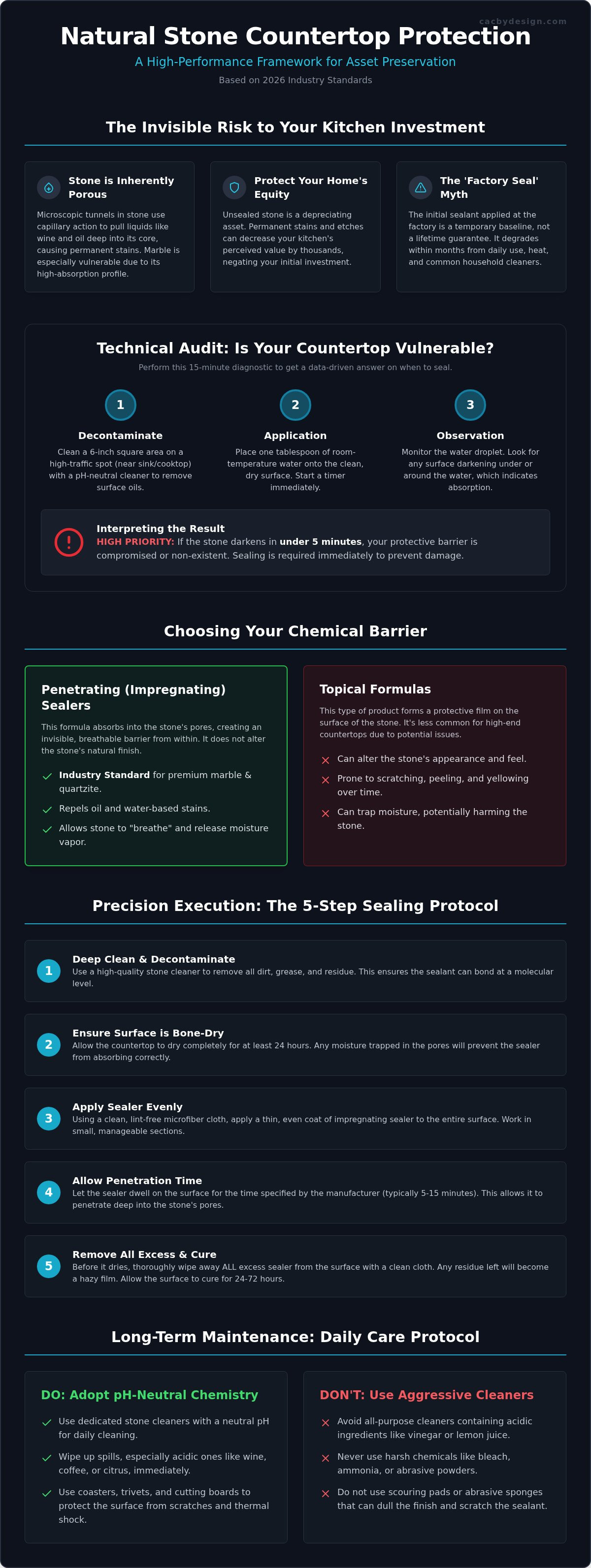
The 5-Step Sealing Protocol: Precision Execution for Homeowners
Mastering how to seal natural stone countertops requires moving beyond the "wipe on, wipe off" mentality. This is a technical execution. If you cut corners on preparation, the chemical bond fails. Your kitchen deserves a professional-grade result. Follow this five-step protocol for maximum asset protection.
Step 1: Deep Clean. Use a dedicated stone cleaner to strip surface contaminants and existing oils. You aren't just cleaning; you're decontaminating the substrate.
Step 2: Dry-State Verification. This is the most ignored phase. Your stone must be bone-dry for at least 24 hours. Any moisture trapped in the pores will repel the sealer, leading to an uneven, failed application.
Step 3: Saturation. Apply the sealer using a lint-free microfiber or high-density foam applicator. Don't be stingy with the product; the stone needs to be visibly wet.
Step 4: Dwell Time. Let the product sit for the manufacturer-specified duration, usually 10 to 15 minutes. This allows the carrier to pull the fluoropolymers deep into the stone's molecular structure. If the stone absorbs the sealer entirely before the timer ends, apply a second coat immediately.
Step 5: Buff and Cure. Remove excess liquid and let the surface cure for 24 hours before any contact with water or food.
Surface Preparation: Eliminating Micro-Contaminants
Standard dish soap is the enemy. It leaves a fatty acid residue that prevents sealers from penetrating. For a sterile surface, perform a final wipe with denatured alcohol. It evaporates quickly and leaves zero residue. Ensure your HVAC system is off or windows are closed to prevent dust from settling into the wet sealer. A single hair or dust particle can create a permanent blemish in the finish. If you're managing a complex renovation, our team provides expert stone fabrication and installation to ensure your project starts with a perfect foundation.
Application and Buffing: Achieving the Perfect Finish
Precision application requires a cross-hatch method. Apply in vertical passes, then horizontal. This ensures 100% coverage across the stone's topography. The 3-minute buffing window is critical. Once the dwell time ends, you must remove 100% of the surface residue. If the sealer begins to dry on the surface, it will haze. This creates a cloudy, unattractive finish. If hazing occurs, don't panic. Apply a small amount of fresh sealer to the spot to re-liquefy the residue, then buff immediately with a clean, dry cloth. This attention to detail preserves the high-gloss, pristine kitchen aesthetic you've invested in. Following this repeatable framework ensures your investment remains safe from daily wear.
Long-Term Maintenance: Preserving the Barrier
You've executed the protocol. Now you must defend it. Daily habits are the primary driver of sealant degradation. If you're using generic sprays or "natural" kitchen cleaners, you're likely stripping the fluoropolymers you just applied. Knowing how to seal natural stone countertops is only half the battle; the other half is making sure that seal lasts through years of high-volume use. This isn't just about cleanliness; it's about preserving the financial yield of your kitchen remodel Cincinnati. High-performance surfaces require a strict chemical discipline to maintain their market dominance.
PH-Neutral Cleaning: Preserving the Chemical Barrier
Chemistry doesn't lie. Acidic substances react violently with the calcium carbonate in marble and the mineral structure of granite. Vinegar, lemon juice, and even "organic" citrus-based cleaners are corrosive agents. They don't just sit on the surface; they eat through the sealant and etch the stone substrate. Only pH-neutral cleaners are acceptable for daily maintenance. These solutions maintain surface tension without compromising the impregnating barrier. For residents in the Hamilton, Butler, and West Chester areas, our showroom provides professional-grade maintenance products formulated to handle local water profiles and specific stone types. Avoid any product that doesn't explicitly state it is stone-safe.
Professional Restoration vs. DIY Sealing
There is a technical limit to how to seal natural stone countertops at home. If your stone has suffered deep etching or mechanical scratches, a fresh coat of sealer won't fix the aesthetics. Sealing prevents stains; it doesn't repair structural damage. When you see dull spots or "rings" that won't buff out, you're looking at physical stone degradation. This requires professional diamond-honing to resurface the slab and restore its original clarity. Our in-house craftsmen specialize in restoring high-traffic surfaces to their original factory finish, ensuring your investment remains a high-value asset.
Schedule a recurring audit every six months. Don't wait for a failure to act. Run the 15-minute Water Test we covered earlier in this guide. If the stone fails the audit, repeat the sealing protocol immediately. Consistent maintenance is the only way to ensure your home's high-value equity remains intact. Ready for a high-performance upgrade? Schedule a consultation at our Cincinnati showroom to discuss your next project with our design-build team.
Protect Your High-Value Surface Equity
Stone protection is a high-yield strategy, not a chore. You've now mastered the technical framework for the Water Test and the precision application of impregnating sealers. By shifting to a pH-neutral maintenance protocol, you're ensuring that your marble or quartzite remains a high-performance asset for years to come. Don't leave your investment to chance. Understanding how to seal natural stone countertops is just the baseline for a larger commitment to material durability and home equity.
As a family-owned Cincinnati business since 2004, Countertops and Cabinetry By Design provides the in-house fabrication and installation expertise needed to build kitchens that last. Our professional craftsmen offer expert guidance on material equity, ensuring your surfaces withstand the rigors of a modern lifestyle. We move beyond empty promises to deliver speed, clarity, and results for ambitious homeowners ready to invest in quality.
Design your high-performance kitchen with Countertops and Cabinetry By Design. Your kitchen is ready for its next evolution.
Frequently Asked Questions
How often should I seal my natural stone countertops?
Most homeowners in the Cincinnati area should execute a sealing protocol every 18 to 36 months. However, high-traffic surfaces or porous materials like honed marble may require maintenance every 12 months. The only way to determine your specific schedule is through a technical audit. If the surface fails the 15-minute Water Test, your barrier is compromised. Regular testing prevents the financial risk of permanent staining and preserves your home's equity.
Can I seal my countertops myself, or do I need a professional?
You can execute a high-performance seal yourself by following a strict technical framework. DIY application is effective for routine maintenance and barrier preservation. However, if your stone shows deep etches or mechanical scratches, a sealer won't fix the aesthetic. In those cases, you need our in-house Cincinnati fabrication team for professional diamond-honing. Sealing is a preventative measure, while restoration is a corrective surgical strike for damaged surfaces.
What is the best sealer for marble vs. granite?
Use an impregnating fluoropolymer sealer for both materials. While marble benefits from water-based formulas that allow the stone to breathe, dense granite often requires solvent-based carriers to penetrate its tighter molecular structure. Avoid topical coatings that sit on the surface. These create a plastic-like film that clouds the natural aesthetic. At our Cincinnati showroom, we provide material-specific chemicals designed to match the exact porosity of your specific slab.
Will sealing my countertops prevent them from etching?
No, sealing does not prevent etching. It's a common misconception that sealers act as a bulletproof vest against acid. Sealing prevents liquid absorption and staining by filling internal pores. Etching is a physical chemical reaction between acids and the stone's minerals, like calcium in marble. To prevent etches, you must avoid acidic contact entirely. If an etch occurs, you'll need professional resurfacing rather than just another layer of sealant.
How long does it take for countertop sealer to dry and cure?
Expect a 24-hour cure window for maximum performance. While the surface may feel dry to the touch within 30 to 60 minutes, the chemical bond requires a full day to reach total molecular stability. During this critical window, keep the stone bone-dry and free of contaminants. Learning how to seal natural stone countertops includes respecting this timeline. Rushing back into service can displace the sealer and leave your investment vulnerable to moisture.
How do I know if my countertops were already sealed?
Perform the 15-minute Water Test to verify the integrity of your current barrier. Place a tablespoon of water on a high-traffic area of your stone. If the water beads and remains on the surface after 15 minutes, your seal is intact. If the stone darkens or a ring forms, the barrier has failed. This diagnostic audit is mandatory before applying new chemicals to avoid hazy residue and product waste.
Can I use Windex or vinegar on my sealed stone countertops?
Never use vinegar or Windex on natural stone. Vinegar is highly acidic and will dissolve your sealant and etch the stone substrate. Windex often contains ammonia, which is too aggressive for the chemical barrier. These household cleaners are the primary cause of premature sealer failure in Hamilton and Butler county homes. Use only pH-neutral cleaners designed for stone equity. They clean effectively without stripping the sacrificial layer protecting your kitchen's value.
Does quartzite need more sealing than granite?
Quartzite often requires more frequent audits than granite because of its unique geological structure. While it's exceptionally hard, some varieties have higher absorption rates or micro-fissures that pull in oils. Mastering how to seal natural stone countertops involves recognizing these material-specific nuances. Don't assume all "hard" stones behave the same. Test your quartzite every six months to ensure the barrier remains impenetrable to daily wear and kitchen contaminants.


Comments