
How to Select Cabinet Hardware: The High-Performance Design Guide for 2026
Updated: Jul 24
Your kitchen hardware isn't just jewelry for your cabinets. It's a high-performance functional lever that dictates the daily ergonomics of your space and the eventual resale value of your home. If you're feeling paralyzed by a sea of finish options or the fear of choosing the wrong size for your large drawers, you aren't alone. Mastering how to select cabinet hardware requires moving past aesthetic guesswork and adopting a systematic approach to modern design.
You want a kitchen that feels cohesive and looks high-end without the maintenance headaches of cheap materials. It's a common goal, but one that's hard to hit without a data-backed plan. This guide provides the technical and aesthetic framework you need to maximize both functionality and equity. We'll analyze the 2026 shift toward mixed metals and textured finishes like knurling, while ensuring your selections meet modern ergonomic standards. From sizing oversized linear pulls to balancing warm brass with cool stone, you're about to build a hardware strategy that delivers long-term results.
Table of Contents
The Strategic Value of Cabinet Hardware in 2026
Cabinet hardware is the primary physical touchpoint of your kitchen architecture. Every interaction with your storage begins and ends with these components. While many treat these pieces as secondary "jewelry," high-performance design-build professionals view them as critical levers for home equity. Learning how to select cabinet hardware is not about browsing catalogs. It's about engineering a tactile experience that justifies your renovation budget. For those executing a kitchen remodel in Cincinnati, hardware represents a high-yield investment. It bridges the gap between raw materials and finished luxury.
Builder-grade hardware is a liability. It feels hollow, uses cheap zinc alloys, and degrades under daily stress. Custom-grade hardware is an asset. It signals quality through weight, finish depth, and structural integrity. Professionals use a High-Performance Selection Framework to ensure every piece serves both a mechanical and financial purpose. Understanding cabinetry basics helps you realize that hardware is the only moving part of your storage system. If the hardware fails, the cabinetry's utility drops to zero. You aren't just buying handles; you're buying the interface for your most valuable room.
The ROI of Premium Finishes
First impressions are tactile. A potential buyer's perception of your kitchen's quality is formed the moment they pull a drawer. Solid brass remains the gold standard for 2026. It offers superior weight, natural antimicrobial properties, and a finish that develops character rather than peeling. Zinc alloys might look similar on a screen, but they feel cheap in hand. The cost-to-value ratio favors premium materials because they endure. Current trends prioritize "weighted" hardware. People want to feel the gravity of the metal. It communicates permanence and precision. This is how to select cabinet hardware that pays for itself during a home appraisal.
Hardware as a Functional Bridge
Hardware serves as a protective shield. It prevents the transfer of oils and moisture from your hands to the cabinet faces. This is vital for maintaining the finish of custom cabinets in West Chester, OH. Large, custom-built drawers require pulls that can handle the mechanical load of heavy cookware. Proper sizing is essential. Small knobs on massive drawers lead to uneven tension and eventual structural failure. High-performance selection means matching the scale of the hardware to the architectural volume of the cabinetry. It's a functional bridge that ensures your design looks as good as it performs.
The Technical Selection Framework: Knobs, Pulls, and Latches
Selection is about mechanics, not just aesthetics. Understanding how to select cabinet hardware starts with categorizing your components by their functional profiles. Knobs offer maximum versatility. They provide a minimalist footprint ideal for traditional or transitional door panels. If your goal is a clean, unobtrusive look, knobs are the standard. They require a single mounting hole, making them the easiest to swap if you decide to pivot your style later.
Pulls are the ergonomic champions of the kitchen. Bar pulls deliver a modern, linear aesthetic that complements the horizontal lines of wide drawers. Cup pulls offer a classic, "bin" style feel for farmhouse or heritage designs. Finger pulls are the ultimate choice for minimalist kitchens, mounting to the top edge of the drawer for a discrete, nearly invisible profile. These choices dictate the speed and ease of your workflow.
Don't overlook the technical requirements of integrated panels. Standard pulls will fail under the suction of a heavy refrigerator door. Appliance pulls are a mandatory requirement here. They're engineered with the scale and structural integrity to handle higher torque. For specific focal points like a walk-in pantry or a bar area, latches and T-bars serve as statement pieces. They add mechanical interest and break up the visual monotony of a long cabinet run.
Coordinating with Countertop Profiles
High-performance design requires hardware to match the visual weight of your surfaces. If you've invested in a 3cm Quartzite or Quartz slab, delicate hardware will look out of proportion. You need pieces with enough mass to balance the stone. Consider the veining. If your marble or granite has bold, sweeping movement, choose hardware with clean, quiet lines to avoid visual conflict. The Edge-to-Hardware logic is a professional secret. Pair eased or square countertop edges with angular, geometric pulls. If your countertops feature a rounded edge, softer hardware creates a more harmonious flow. Before finalizing your order, explore our hardware gallery to see these high-end pairings in action.
The 'All-Pull' vs. 'Mixed' Strategy
The 'All-Pull' strategy is a dominant trend for 2026. It creates a cohesive, modern look and provides superior accessibility across all zones. However, mixing hardware is a sophisticated way to define different areas of a large kitchen. A common rule for high-equity homes in Mason and Montgomery is using knobs for upper cabinets and pulls for lower bases. This maintains a visual rhythm while prioritizing ergonomics where the heaviest lifting occurs. In massive, open-concept kitchens, hardware serves as a navigational cue. Use a consistent finish but vary the styles to separate the prep zone from the entertainment island. This systematic approach ensures your kitchen performs as well as it looks.
Material Engineering: Selecting Finishes for Long-Term Performance
Hardware is a metallurgical choice. While previous sections focused on the visual scale and mechanical types, the material composition dictates the lifespan of your investment. Mastering how to select cabinet hardware means looking beyond the surface color and evaluating the substrate. Solid brass is the industry benchmark. It provides a dense, heavy hand-feel that cheaper zinc or aluminum alloys cannot replicate. Beyond the weight, brass is naturally antimicrobial. It's a high-performance choice for high-touch environments where hygiene and durability are non-negotiable.
Stainless steel serves as the primary alternative for contemporary industrial aesthetics. It's essential for high-moisture zones near sinks or dishwashers. For maximum scratch resistance, look for PVD (Physical Vapor Deposition) finishes. This technology uses a vacuum-sealing process to bond the finish to the metal at a molecular level. It's virtually impossible to chip or peel, making it the superior choice for high-traffic kitchens. Bronze remains a staple for transitional designs, but the "Living Finish" debate is a critical fork in your decision tree. Unlacquered brass and bronze will patina. They change with every touch. In 2026, this organic evolution is a luxury signal, but it requires a specific maintenance mindset.
The 2026 Finish Performance Matrix
Your lifestyle dictates your finish. Static finishes, like chrome or PVD gold, stay exactly as they appear on day one. Living finishes evolve. If you demand a permanent, pristine look, avoid unlacquered options. Maintenance also varies by texture. Matte black is a modern favorite, but it's a magnet for fingerprints and oils. It requires more frequent cleaning than brushed nickel or honey bronze. When coordinating with high-end faucets and lighting, don't feel forced to match brands. Aim for a "tonal match" where the undertones of the metal align, creating a curated rather than a kitted look.
Durability in the Ohio Climate
Geography impacts hardware performance. The high humidity levels in the Cincinnati area can accelerate the degradation of low-quality platings. Professional-grade hardware undergoes salt-spray testing to measure corrosion resistance. This is a vital metric for long-term equity. To prevent finish degradation, avoid abrasive cleaners. A simple protocol of mild soap and water preserves the integrity of the protective topcoat. Determining how to select cabinet hardware for an Ohio home means prioritizing materials that can withstand seasonal shifts without losing their luster. High-performance design is about choosing materials that work as hard as you do.

The Precision Placement Protocol: Sizing and Installation
Precision is where high-end design meets mechanical engineering. Even the most expensive solid brass handle fails the equity test if it's misaligned by a single millimeter. Mastering how to select cabinet hardware requires a command of scale and placement. The "1/3 Rule" is your primary metric for success. For a balanced, high-performance look, your pull should be roughly one-third the total width of the drawer. A 30-inch pot drawer demands a 10-inch pull. This ratio ensures the hardware doesn't look swallowed by the cabinetry or appear overbearingly large. It's a repeatable framework that eliminates visual guesswork.
Mounting logic is equally critical to the kitchen's flow. Upper cabinet doors require vertical orientation to align with the door's swing. Base drawers require horizontal mounting to facilitate a natural upward pull. While centering a pull on a drawer face offers perfect visual symmetry, top-third placement is the ergonomic standard for deep base cabinets. It reduces the distance you need to lean, protecting your back during heavy kitchen use. Always check corner clearance. In tight L-shaped configurations, oversized pulls can collide. This prevents doors from opening fully and damages the finish. Failure to account for these mechanical clearances is a hallmark of amateur design, which is why many homeowners rely on the professional interior remodeling expertise found at brightwisehandyman.com.
Sizing for Oversized Drawers
Modern kitchens increasingly feature 36-inch and 48-inch wide drawers. These massive units present a unique structural challenge. You can use two smaller pulls spaced at the 1/4 and 3/4 marks, or a single extra-long "statement" pull. For 2026, the trend favors the single long pull for its clean, uninterrupted lines and superior ergonomics. However, you must ensure the pull's tensile strength matches the load capacity of your heavy-duty drawer slides. A heavy drawer full of cast iron requires hardware that won't flex or pull through the wood under pressure. It's about matching the hardware's structural integrity to the drawer's intended utility.
Professional Installation Standards
Success in installation is binary. It's either perfect or it's wrong. Our in-house craftsmen use precision-machined jigs and templates to achieve sub-millimeter accuracy across every cabinet face. We prioritize "back-bolting" for maximum security. This involves using high-grade fasteners that anchor deep into the material, preventing the hardware from loosening over time. For knobs, we utilize dual-point mounting or internal positioning pins. This eliminates "hardware spin," ensuring your knobs stay perfectly upright regardless of how often they're used. If you want a kitchen installed to these rigorous standards, schedule a consultation with our design-build team today.
The Countertops and Cabinetry By Design Advantage: From Selection to Installation
Hardware selection is the final mile of a high-performance renovation. Digital catalogs and pixelated photos are insufficient for high-equity projects. You need to feel the weight. Mastering how to select cabinet hardware requires a physical audit of material density, grip ergonomics, and finish depth. Countertops and Cabinetry By Design provides a vertically integrated model that bridges the gap between initial design and final mounting. This isn't just about choosing a style. It's about a systematic process where we handle procurement, logistics, and installation. We ensure your hardware integrates perfectly with your bathroom remodeling Cincinnati plans or your primary kitchen architecture.
Our commitment to excellence relies on our in-house craftsmen. We don't outsource the final touch of your project to subcontractors. By maintaining control over the installation, we guarantee sub-millimeter alignment and a secure fit that lasts for decades. This approach eliminates the friction of traditional remodeling models. We treat hardware as a structural component, not an afterthought. It's the difference between a kitchen that looks good in photos and one that performs under the rigors of daily use.
The Showroom Experience
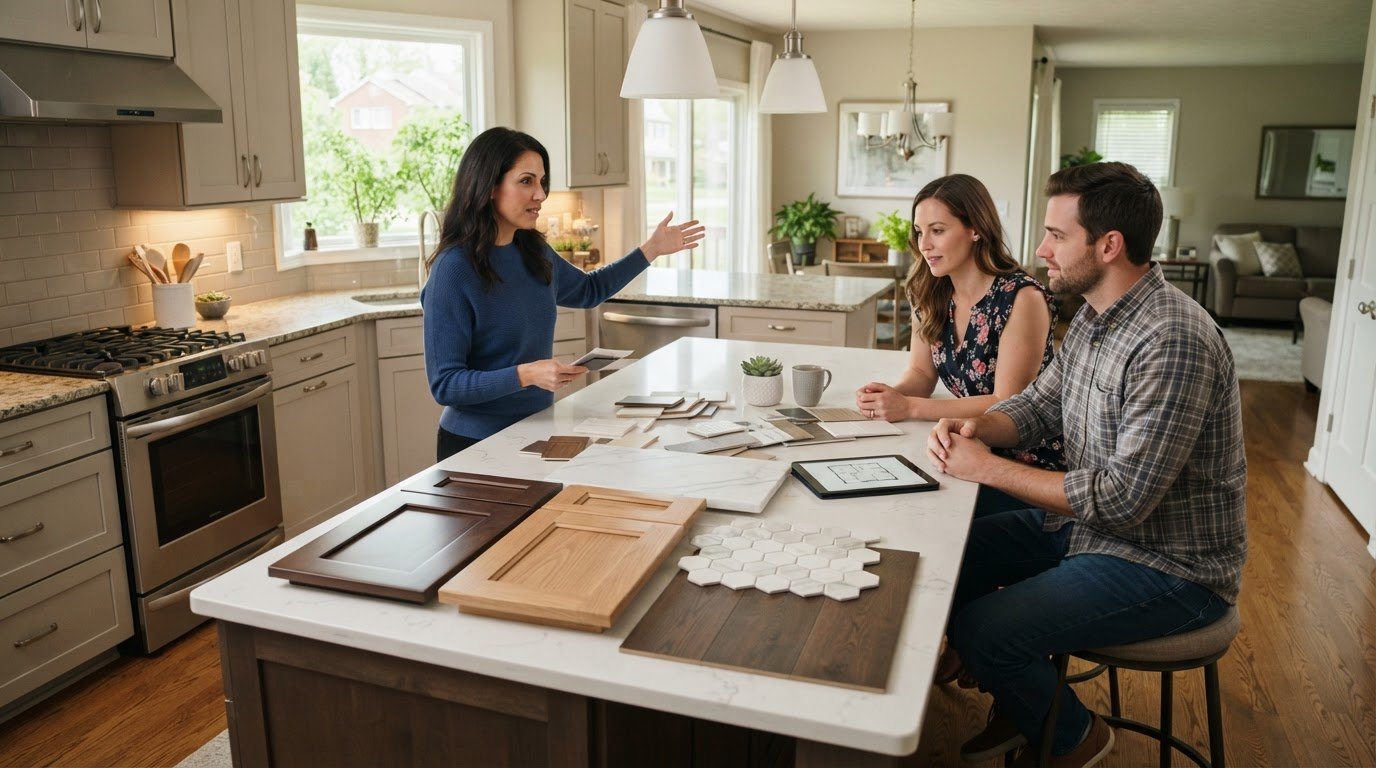
Testing the hand-feel of your hardware is non-negotiable. At our local showroom, you can experience the gravity of solid brass versus lightweight, mass-market alloys. You don't have to guess. We allow you to pair physical hardware samples directly with your chosen Quartzite, Marble, or Granite slabs. This tactile verification ensures the visual weight of the metal balances the movement of the stone. Our designers understand the specific aesthetic demands of the Butler and Hamilton County markets. We provide the technical expertise to ensure your selection drives maximum home equity.
Seamless Project Execution
DIY ordering is a primary source of project delays. Missing screws, backordered SKUs, and incorrect sizing kill momentum. Countertops and Cabinetry By Design eliminates these bottlenecks by managing the entire procurement cycle. Our "white glove" installation process is designed for custom cabinetry and high-end finishes. We use precision jigs and back-bolting techniques to ensure your hardware never wobbles or spins. Stop guessing how to select cabinet hardware and let our team engineer the results. Your kitchen deserves a professional interface. Schedule your high-performance design consultation today to begin the transformation.
Engineer Your Kitchen’s High-Performance Future
Hardware isn't an afterthought. It's the mechanical interface of your home. By prioritizing material engineering and precision placement, you transform standard storage into a high-yield asset. Mastering how to select cabinet hardware means moving beyond the visual "jewelry" and focusing on the tactile ROI of solid brass and sub-millimeter installation accuracy. You've learned the technical frameworks and the 1/3 rule. Now, it's time to execute with total clarity.
Don't leave your final touchpoints to chance. Countertops and Cabinetry By Design has been family-owned since 2004, serving 8 counties across the Cincinnati area with a dedicated in-house team of professional craftsmen. We don't just sell products; we deliver a systematic design-build experience that guarantees alignment and durability. From our local showroom to your final mounting, we handle every technical detail to ensure your project performs as well as it looks. Schedule your Cincinnati design-build consultation today and secure the equity your home deserves. Let's build something that lasts.
Frequently Asked Questions
Should I use knobs or pulls for my kitchen cabinets?
Use pulls for drawers and knobs for doors if you prefer a transitional look. Modern high-performance designs often utilize an "all-pull" strategy for superior ergonomics. Pulls allow for a multi-finger grip, which is essential for heavy, custom drawers. Knobs remain a minimalist choice for upper cabinets where the mechanical load is lower and visual clutter should be minimized.
How do I choose the right size hardware for large drawers?
Apply the 1/3 rule to ensure visual and mechanical balance. Your hardware should cover roughly one-third of the drawer's total width. For 36-inch pot drawers, a 12-inch pull is the high-performance standard. This prevents the hardware from looking undersized and ensures the pull strength matches the weight of heavy-duty drawer slides found in premium cabinetry.
Can I mix different hardware finishes in the same kitchen?
Mixing finishes is a sophisticated design lever for 2026. Use a dominant finish for 80% of the room and a secondary accent for focal points like the island or a dry bar. This adds depth and prevents a "kitted" look. Ensure the undertones are consistent, pairing warm brass with copper rather than clashing cool and warm metals in the same zone.
What is the most durable finish for cabinet hardware in 2026?
Physical Vapor Deposition (PVD) finishes and 304-grade stainless steel are the industry leaders for durability. PVD technology bonds the finish at a molecular level, making it virtually immune to chipping or salt-spray corrosion. This is critical for maintaining equity in the humid Ohio climate. Matte black remains popular but requires more maintenance than brushed finishes to stay pristine.
Is solid brass cabinet hardware worth the extra cost?
Solid brass is the gold standard for tactile quality and long-term performance. It offers a heavy, premium hand-feel that cheaper zinc alloys can't replicate. Beyond aesthetics, it's naturally antimicrobial. This makes it a strategic choice for high-touch areas. When you're researching how to select cabinet hardware, prioritize material density over initial price to ensure a high-yield investment.
Where should hardware be placed on shaker-style cabinets?
Place knobs and pulls on the vertical stiles of the doors, typically 2 to 3 inches from the corner. For drawers, center the hardware on the recessed panel or the top rail. Panel centering is the traditional choice. Top-rail placement offers better ergonomics for base cabinets, reducing the reach distance and protecting the user's back during daily tasks.
How do I match my cabinet hardware to my kitchen faucet?
Aim for a tonal match rather than an exact brand match. Metals should share similar warmth or coolness levels. If you have a champagne bronze faucet, select hardware in honey bronze or brushed gold. This curated approach feels more intentional and high-end than a perfectly matched set, allowing the hardware to stand out as a distinct design element.
Does cabinet hardware increase home resale value in Cincinnati?
Hardware acts as a high-yield lever for perceived quality during a home appraisal. It's the first thing a buyer touches. High-performance hardware signals that the entire renovation was executed with precision. In the Cincinnati market, details like solid brass pulls and perfect alignment differentiate custom homes from builder-grade flips. This is a primary factor in how to select cabinet hardware for maximum equity.

Comments