
Is a Kitchen Island Worth It? Engineering Equity and Performance in 2026
Updated: Jul 22
Stop treating your layout as a design preference. Treat it like a high-yield asset. In 2026, asking is a kitchen island worth it is a question of pure financial performance. You want the output of a professional workstation without the friction of a cramped floor plan. We understand the anxiety. Nobody wants to commit to a renovation that chokes traffic flow or utilizes materials that fail under pressure. You need data, not guesswork.
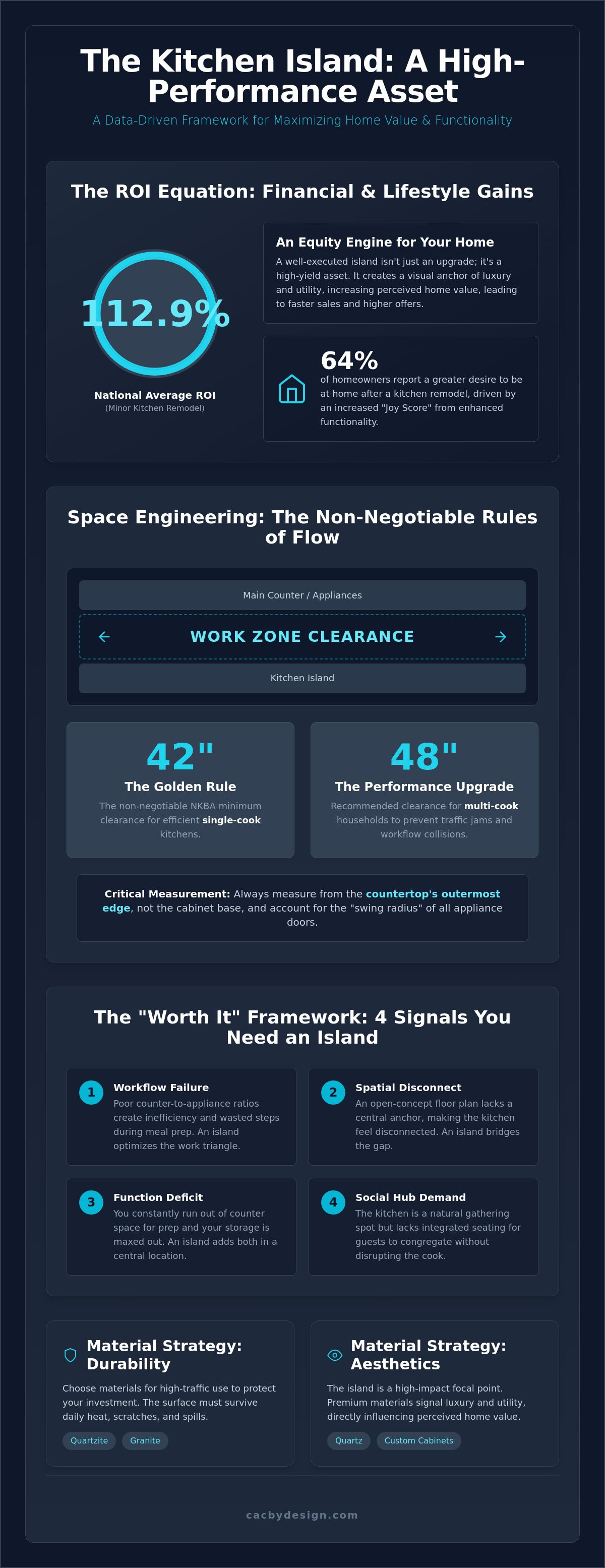
This article delivers the cold logic of kitchen island ROI. You'll learn the non-negotiable spatial requirements for modern homes and how to leverage premium materials like quartzite or custom cabinets to maximize your valuation. We provide a clear framework for the investment, including an analysis of the 112.9% ROI seen in minor kitchen remodels. We'll validate your choice between quartz and granite while ensuring you hit the 42-inch clearance standard. This is the definitive answer on whether an island fits your financial and functional strategy.
Table of Contents
The ROI Equation: Is a Kitchen Island a High-Performance Asset?
Stop viewing your kitchen through the lens of Pinterest aesthetics. Start viewing it as a high-yield asset. A kitchen island isn't just a decorative block of cabinets; it's a multi-functional system engineered for prep, storage, and high-frequency social interaction. It's the primary engine of the modern home. When homeowners ask is a kitchen island worth it, they're really asking if the upfront capital expenditure translates into measurable market dominance. The answer lies in the data of 2026.
Modern Kitchen island design and function dictates that these structures serve as the central hub in open-concept layouts. They bridge the gap between high-utility workstations and luxury living spaces. By consolidating prep areas and storage into a central focal point, you strip away the inefficiencies of traditional wall-bound kitchens. You aren't just adding a counter; you're re-engineering the flow of your entire home to meet 2026 standards of performance.
Equity Gains in the Cincinnati Market
Cincinnati buyers in 2026 are aggressive about functional square footage. In the Midwest, a large, well-executed island increases perceived home value by creating a visual anchor that communicates luxury and utility. The correlation is clear: larger islands with premium stone fabrication lead to faster sales and higher offers. According to Zonda’s 2025 data, a minor kitchen remodel has a national average ROI of 112.9%. This proves that is a kitchen island worth it isn't a matter of opinion; it's a matter of equity. In Ohio, a high-end kitchen remodel typically yields an equity return that outperforms most other interior upgrades, provided the material choices align with current market demands for durability and style.
Lifestyle Performance Metrics
Efficiency is the primary metric for any professional-grade kitchen. An island optimizes the work triangle by shortening the distance between the sink, cooktop, and refrigeration units. It forces a transition from a single-purpose prep area to a multi-channel social hub. This shift is critical for modern household dynamics. Integrated seating allows the kitchen to function as a workspace, a dining area, and a social zone simultaneously. Over 64% of homeowners report a greater desire to be at home after a kitchen remodel, a statistic driven by the increased "Joy Score" that a functional island provides. You're investing in a system that scales with your lifestyle, ensuring your home remains a high-performance environment for years to come.
Space Engineering: The 42-Inch Rule and Traffic Mechanics
Space is the ultimate bottleneck in kitchen performance. A premium island becomes a liability the moment it disrupts the flow of your home. You aren't just placing a cabinet; you're engineering traffic patterns. If you ignore the math of your floor plan, you create permanent gridlock. Deciding is a kitchen island worth it requires a clinical assessment of your available square footage against established industry benchmarks.
Professional designers rely on specific kitchen island spacing guidelines set by the NKBA. These aren't suggestions. They're operational requirements. You must distinguish between "pass-through" space, where people simply walk, and "work-zone" space, where doors swing and bodies move. High-performance kitchens demand a clear separation of these zones to prevent collisions during peak usage hours. If your island placement forces a guest to move every time you open the refrigerator, your design has failed.
Common spatial failures happen when homeowners prioritize slab size over clearance. Gridlock occurs when the dishwasher door hits the island or when two people can't pass each other comfortably. Measuring your floor plan with a focus on "swing radius" is the first step in determining the viability of your investment. You need to account for every inch of extension from your range, dishwasher, and cabinetry.
The Golden Rule of Clearance
42 inches is the non-negotiable minimum for high-performance kitchens. This provides enough clearance for single-cook efficiency. However, if your household involves multiple people prepping simultaneously, you should adjust your target to 48 inches. This extra space prevents the "kitchen trap" where one person is pinned behind an open appliance. Always measure from the outermost edge of the countertop overhang, not the cabinet base, to ensure your calculations are accurate.
Small Kitchen Solutions
Not every floor plan supports a massive central block. In narrow Cincinnati homes, a peninsula often provides better ROI by maintaining an open path while still offering extra prep space. Alternatively, a "Skinny Island" strategy utilizes slim 12-inch or 18-inch cabinets to provide utility without the bulk. If you're struggling to reconcile your vision with your actual square footage, a full kitchen remodel strategy can help you pivot to a high-utility layout that maximizes every inch.
Mobile workstations offer a flexible alternative for tight spaces, but they rarely deliver the same equity gains as a fixed structure. For true market dominance, a fixed island with integrated power and premium stone remains the gold standard. The key is ensuring the structure scales with the room rather than dominating it.
Material Strategy: Maximizing Durability and Aesthetics
Your island is the most visible surface in your home. If you cut corners on fabrication, you compromise the entire project's valuation. High-performance design requires a material strategy that balances brute-force durability with elite aesthetics. When evaluating is a kitchen island worth it, you must look at the lifespan of the surfaces you choose. An island handles more impact, spills, and social friction than any other part of the kitchen. It needs to be bulletproof. You aren't just selecting a color; you're selecting a performance grade.
Countertop Selection for the Focal Point
In 2026, the market has shifted toward materials that offer zero-maintenance reliability. While granite remains a classic for its heat resistance and natural variation, Quartz Countertops have become the dominant choice for high-traffic workstations. Quartz provides a non-porous surface that resists staining and bacterial growth without the need for annual sealing. This is critical for an island that serves as both a prep station and a dining hub. For a truly high-impact result, consider a waterfall edge. This design extends the stone vertically to the floor, creating a seamless, monolithic look that signals luxury to future buyers. You should also coordinate your slab size with your island dimensions to avoid unnecessary seams. A single, uninterrupted piece of stone is the ultimate marker of a high-end installation.
Custom Cabinetry Systems
The base of your island should do more than just hold up a slab. It's a strategic storage engine. By integrating Custom Cabinets in West Chester, OH, you can engineer a layout that maximizes every cubic inch of vertical space. Think beyond basic cupboards. Deep drawers for heavy cookware, pull-out waste systems, and specialized spice racks turn a static block into a high-utility tool. Electrical integration is equally vital. Modern islands require dedicated circuits for charging stations, hidden outlets for small appliances, and task lighting that doesn't clutter the visual field. This level of technical detail ensures your island remains a functional asset rather than a crowded obstacle.
Execution matters. A disconnected material strategy will lead to a fragmented kitchen that feels dated before the paint dries. To ensure your investment delivers maximum equity, follow a proven framework like the one found in our Kitchen Remodel Cincinnati: The High-Performance Guide to 2026 Renovations. Success is built on the marriage of elite stone and precision cabinetry.
The Worth It Framework: 4 Signs You Should Build an Island
Stop guessing. Start measuring. To determine if is a kitchen island worth it for your specific lifestyle, you need a go/no-go framework based on operational data. Most homeowners follow trends. You should follow performance metrics. If your kitchen hits these four red flags, an island is no longer an option; it's a requirement for home equity.
Sign 1: Your counter-to-appliance ratio is failing. If your coffee station, air fryer, and stand mixer occupy more than 30% of your perimeter workspace, your efficiency is dead. You're fighting for inches every time you prep a meal.
Sign 2: You lack a physical barrier. In open-concept Cincinnati homes, an island creates a necessary psychological and physical boundary between the chaos of the living room and the precision of the kitchen.
Sign 3: Your storage requirements exceed capacity. When 68% of homeowners replace all cabinets during a remodel (Houzz 2026), they're usually fighting for more volume. Perimeter cabinets are finite; islands are expandable.
Sign 4: Social isolation during preparation. If you spend your time staring at a backsplash while guests or family gather behind you, your layout is working against your household dynamics.
The Storage Lever
The Social Anchor
The 10/10 Joy Score reported by the NAR/NARI 2025 Remodeling Impact Report isn't an accident. It's the result of human-centric engineering. The island has effectively replaced the formal dining table for the modern family. Is a kitchen island worth it for your social life? Absolutely. Designing for "perch" seating, where guests can lean and interact without committing to a full chair, changes the household dynamic. You face the room. You stay in the conversation. You control the environment. For those looking to elevate their hosting game, professional services like Exquisite Catering can provide the high-end bar packages and menus that turn your new island into the ultimate event hub. This psychological shift is the primary driver behind the 64% increase in the desire to be at home after a high-performance remodel.
Ready to optimize your floor plan for maximum equity? Start your high-performance kitchen remodel today and reclaim your workspace.
Executing the Vision: The Design-Build Advantage in Cincinnati
Execution determines equity. A stand-alone island addition often fails because it lacks the structural and aesthetic DNA of the original kitchen. You end up with a mismatched block that feels like an afterthought. This devalues your property. To avoid this, you need a unified strategy. Working with Home Renovation Contractors in Cincinnati ensures your island is integrated into the home's core systems from day one. You aren't just adding furniture. You're re-engineering a workstation.
Logistics are the silent killer of renovation budgets. Adding a sink or cooktop isn't just about the counter. It requires sub-floor plumbing and dedicated electrical runs. If these aren't managed through a design-build framework, costs spiral and timelines fracture. A cohesive remodel strategy handles these technical nuances behind the scenes. This allows you to focus on the high-level performance of your new layout rather than managing a dozen different subcontractors.
The Full-Service Execution Model
In-house fabrication is the only way to guarantee a perfect stone fit. We eliminate the middleman. This reduces project friction and ensures zero-waste efficiency. You aren't waiting on three different companies to communicate. One team. One timeline. Maximum performance. By coordinating demolition and installation within a single system, you reduce project timelines significantly. This is the difference between a three-week disruption and a three-month disaster.
Local Expertise and Showroom Access
Visit a Cincinnati showroom. You need tactile testing. You need to feel the difference between honed quartzite and polished granite before you commit to a slab. Local craftsmen understand Ohio home construction styles, from historic over-the-rhine renovations to modern West Chester new builds. They know how to navigate local codes and structural requirements without the guesswork. This local intelligence is a barrier against common installation errors that plague generic contractors.
So, is a kitchen island worth it? If you prioritize high-performance storage, social anchoring, and the 112.9% ROI framework we've discussed, the answer is an assertive yes. It's the most powerful lever for home equity in 2026. Don't leave your results to chance. Schedule a high-performance design consultation and engineer your kitchen for market dominance.
Maximize Your Asset: The Final Verdict on Kitchen Islands
A kitchen island isn't just a design choice. It's a strategic intervention in your home's financial and functional output. By adhering to the 42-inch clearance rule and selecting high-performance materials like quartz or granite, you secure a workstation that yields a documented 112.9% ROI. The data is clear. Deciding is a kitchen island worth it depends on your commitment to precision engineering and market-ready aesthetics. You aren't just filling space; you're optimizing it for the high-speed demands of 2026 living.
Success requires more than a slab and a dream. It requires a partner with deep local roots and technical mastery. As a family-owned Cincinnati business since 2004, we provide the in-house fabrication and installation teams necessary for a zero-waste execution. Whether you need custom cabinetry or a premium selection of marble and quartzite, we deliver results that scale. Stop settling for a fragmented workflow. Engineer your kitchen equity; schedule a design consultation today. Your home's highest performance is just one layout change away.
Frequently Asked Questions
Is a kitchen island worth it for a small kitchen?
Yes, provided the structure doesn't compromise traffic flow. In tight floor plans, a skinny island or a peninsula provides the extra prep surface needed without the bulk. Deciding is a kitchen island worth it in a compact space requires a clinical look at your clearance. If you can maintain the 42-inch rule, the added storage and workstation efficiency outweigh the loss of open floor space.
How much value does a kitchen island add to a home in 2026?
A kitchen island is a primary driver of resale value. Homes featuring high-performance islands with premium stone and custom cabinetry often see higher offers and faster closing times. According to the NAR/NARI 2025 report, kitchen upgrades receive a perfect Joy Score. This emotional appeal, combined with the 112.9% ROI seen in minor remodels, makes the island a high-yield financial asset.
What is the minimum space needed for a kitchen island?
You must have at least 42 inches of clearance around the perimeter. For households with multiple cooks, 48 inches is the target. This ensures that appliance doors can swing fully without hitting the island and that traffic flow remains fluid. If you can't hit these benchmarks, your kitchen will suffer from gridlock, which negatively impacts both your daily output and your home's equity.
Can you put a sink or stove in a kitchen island?
Yes, and over 50% of homeowners now integrate at least one appliance into their island. Adding a sink or a cooktop converts the structure from a simple counter into a high-utility hub. This requires professional plumbing and electrical routing through the floor. While this adds technical complexity to your remodel, it optimizes the work triangle and centralizes your prep and cleaning zones for maximum efficiency.
Is it cheaper to have a peninsula or an island?
Peninsulas are usually more budget-friendly. They connect to existing walls, which allows them to share plumbing and electrical lines with your perimeter cabinets. This avoids the cost of trenching through a subfloor. However, an island offers better traffic flow and 360-degree accessibility. The choice depends on whether you prioritize upfront savings or the long-term performance and social anchoring of a central island.
Does a kitchen island need to be attached to the floor?
Yes, any permanent island with electrical outlets or plumbing must be anchored to the subfloor. This is a safety requirement and a building code standard. Fixed islands provide the stability needed for heavy stone slabs like quartz or quartzite. While mobile carts exist, they don't offer the same equity gains or functional performance as a built-in, code-compliant structure.
What is the best countertop material for a kitchen island?
Quartz is the leading choice for 2026 due to its non-porous surface and zero-maintenance profile. It resists stains and bacteria, making it ideal for high-traffic zones. Granite remains a top performer for those who prioritize natural aesthetics and high heat resistance. The best choice depends on your specific performance needs, but both materials serve as elite focal points that signal quality to future buyers.
How much does it cost to add an island during a remodel?
The investment depends on the scale of your custom cabinetry, the square footage of your stone slab, and the complexity of utility integration. Custom islands with integrated sinks and high-end stone fabrication involve multiple trades, including plumbing and electrical. While the upfront expenditure is higher than a prefab unit, the long-term equity gain and 112.9% ROI potential make it a justifiable capital investment for serious homeowners.


Comments