
Kitchen Cabinet Materials: The High-Performance Guide to Long-Term Equity
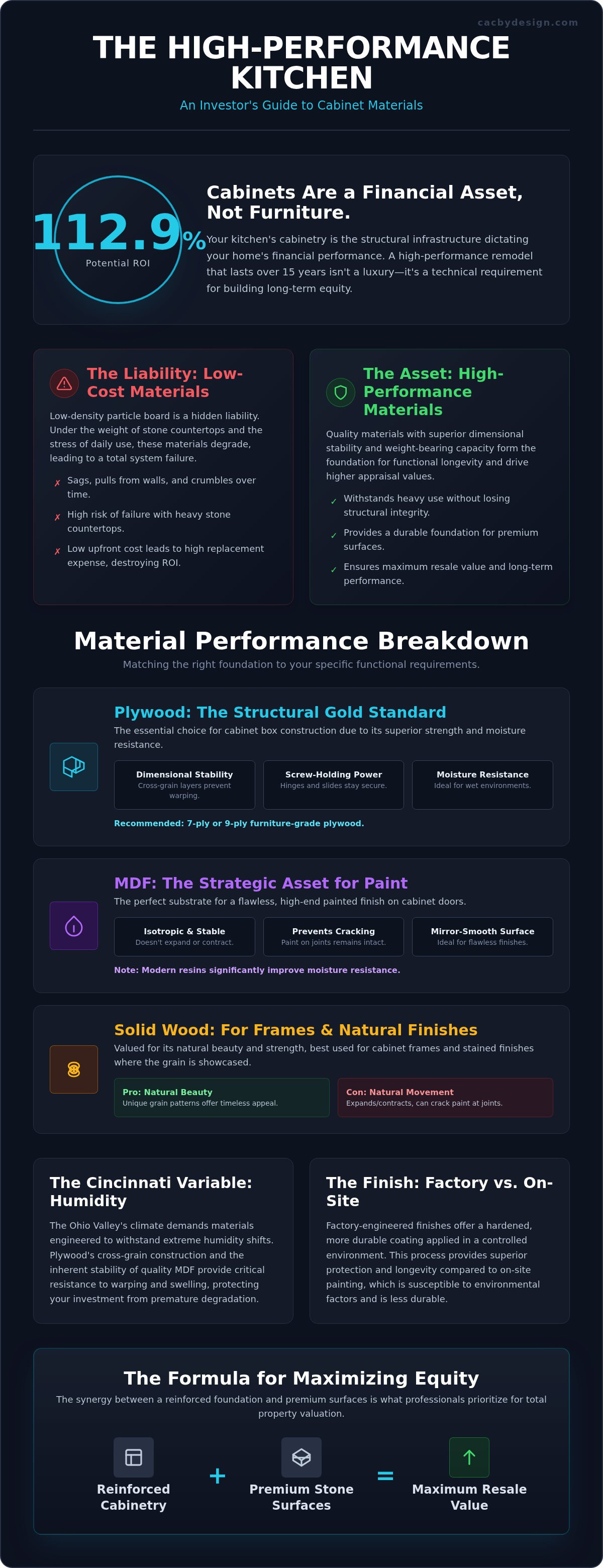
Cabinetry isn't furniture; it's the structural infrastructure of your home's financial performance. When selecting kitchen cabinet materials, you're engineering a high-yield asset, not just picking a door style. You've likely felt the anxiety of Ohio humidity warping your investment or worried about the off-gassing of cheap, imported materials. It's a valid concern. Precision matters when the return on investment for a minor remodel can reach 112.9%. You want a kitchen that survives heavy daily use while maintaining its structural integrity for fifteen years or more.
This guide promises to cut through the confusion between MDF and solid wood to provide a high-performance blueprint for your Cincinnati property. We will analyze the latest 2026 emission standards, moisture-resistance technicalities, and the specific material combinations that maximize resale value. By the end, you'll have the data-driven confidence to choose materials that don't just look good, but perform under pressure. It's time to stop guessing and start building for long-term equity.
Table of Contents
The Infrastructure of Design: Why Cabinet Materials Dictate ROI
Plywood vs. MDF vs. Solid Wood: The Technical Performance Breakdown
Engineered Durability: Analyzing Finished vs. Unfinished Options
The Cincinnati Variable: Selecting Materials for Local Climate Stability
Integrated Equity: Matching Premium Materials with High-Yield Countertops
The Infrastructure of Design: Why Cabinet Materials Dictate ROI
Kitchen cabinetry represents the single largest investment in a high-performance remodel. It's the structural skeleton of the room. If the skeleton fails, the entire system collapses. Most homeowners focus on paint colors or handle styles, but savvy investors look at the substrate. Your choice of kitchen cabinet construction materials dictates the useful life of the space. In the 8-county Cincinnati region, a remodel that lasts twenty years versus one that fails in five is the difference between building equity and burning cash. High-performance kitchen cabinet materials aren't a luxury; they're a technical requirement for a durable asset. You aren't just buying storage. You're engineering a foundation that supports your home's valuation.
The Cost of Cheap Materials
Inferior materials like low-density particle board are a liability. When you pair cheap boxes with the heavy granite countertops Cincinnati buyers expect, the structural risk is real. Over time, moisture and weight cause contractor-grade materials to sag, pull from the wall, or crumble. This isn't just an aesthetic annoyance. It's a total system failure. Replacing cabinets five years after a remodel is a hidden expense that destroys your initial ROI. Choosing a short-term solution is an expensive mistake that ambitious homeowners avoid. Cheap materials don't just look worse over time; they physically degrade under the pressure of daily use and heavy stone surfaces. The math is simple: low upfront costs lead to high replacement expenses.
Engineering Equity through Quality
Quality materials drive appraisal values. In Hamilton and Butler counties, buyers look for longevity. High-performance cabinetry means using kitchen cabinet materials with superior dimensional stability and weight-bearing capacity. This is the foundation for functional longevity. We define high-performance as a system that withstands heavy daily use without losing structural integrity or aesthetic appeal. It's about repeatable frameworks for success. When you treat your kitchen as a long-term asset, you move from creative guesswork to scientific growth. This approach ensures your property remains competitive in the modern market. Premium wood pairings and reinforced boxes create a symbiotic relationship with your stone surfaces. This synergy is what professional architects of kitchen equity prioritize to ensure maximum resale value and long-term performance.
Plywood vs. MDF vs. Solid Wood: The Technical Performance Breakdown
Performance isn't an accident. It's the result of material engineering. Selecting kitchen cabinet materials requires a deep understanding of how substrates react to mechanical stress and environmental variables. Most homeowners assume solid wood is the ultimate standard. That's a mistake. In a high-performance kitchen, the right material depends on the specific structural role it plays. You need to distinguish between furniture-grade components and the low-density fillers found in big-box retail cabinets. The goal is a system that maintains its geometry under the weight of stone and the friction of daily use.
Plywood: The Structural Gold Standard
Plywood outclasses standard particle board in every critical performance metric. Particle board is essentially sawdust and glue; it lacks the tensile strength to support heavy granite countertops. High-performance custom cabinetry utilizes 7-ply or 9-ply furniture-grade plywood for box construction. Plywood's cross-grain layering creates a structural lattice that serves as the foundation for its extreme dimensional stability. This engineering provides superior screw-holding power. Your hinges won't sag. Your drawer slides won't pull loose. Unlike composite alternatives, plywood resists moisture-induced swelling, making it the essential choice for wet environments.
MDF and Engineered Composites
Medium Density Fiberboard (MDF) is often misunderstood. In the context of high-end painted finishes, it's a strategic asset. Natural timber moves. It expands and contracts with seasonal humidity shifts, which inevitably cracks paint at the door joints. MDF is isotropic. It stays flat and stable regardless of the weather. Modern resins have significantly improved the moisture resistance and density of engineered wood. For door panels, it provides a mirror-smooth surface that solid wood cannot replicate. If you want a flawless, modern aesthetic that won't show "bridge lines" over time, MDF is the technical solution.
Solid wood remains the standard for face frames and stained door styles. It offers unmatched beauty and grain depth. However, using solid wood for large, flat panels is a liability due to the risk of warping. A high-performance build often uses a hybrid approach: plywood boxes for strength, solid wood frames for durability, and MDF panels for paint stability. If you're ready to engineer a kitchen built for long-term equity, explore our custom cabinetry solutions to find the right balance for your home. This scientific approach to material selection ensures your kitchen remains a high-yield asset for decades.
Engineered Durability: Analyzing Finished vs. Unfinished Options
The finish is the armor of your kitchen. It's the primary barrier between your investment and the daily assault of steam, grease, and cleaning chemicals. When evaluating kitchen cabinet materials, the application method of the finish is just as critical as the substrate itself. You face a choice between factory-applied coatings and on-site painting. The performance gap between these two is massive. A high-performance kitchen requires a surface that won't peel, yellow, or degrade under thermal stress. To maximize equity, you need a finish engineered for a twenty year lifecycle, not a temporary aesthetic mask.
The Superiority of Factory Finishes
Factory finishes are applied in sterile, climate-controlled environments. This isn't just about avoiding dust. It's about chemistry. High-end manufacturers use conversion varnishes and UV-cured coatings that are "baked on" to the surface. This process creates a cross-linked molecular bond that on-site painters cannot replicate. These finishes meet strict 2026 standards, including the federal TSCA Title VI and CARB P2 regulations, ensuring formaldehyde emissions stay below 0.05 ppm for hardwood plywood. The result is a surface with extreme chemical resistance. It survives exposure to boiling water, acidic oils, and high temperatures without softening. This technical precision is why factory finishes typically carry significantly longer performance warranties than any field-applied alternative.
Natural Wood and Stains
Current 2026 data shows a significant shift in homeowner preference. Wood has officially surpassed white as the leading finish choice, with 29% of homeowners opting for natural grains compared to 28% choosing white. This trend demands a mastery of wood species and stain absorption. Different kitchen cabinet materials react uniquely to pigments:
Maple: A dense, closed-grain wood that requires specialized pre-treatments to avoid blotching.
Oak: Features a prominent open grain that accepts deep stains, ideal for the "expressive wood visuals" trending this year.
Cherry: Known for its natural photosensitivity, it darkens and richens over time as it reacts to light exposure.
Protecting these natural surfaces requires clear topcoats with integrated UV inhibitors. Without this protection, sunlight will cause uneven fading and "ambering" of the wood. A high-performance stain isn't just about color; it's about stabilizing the timber against environmental degradation. This is the difference between a kitchen that ages gracefully and one that requires a costly overhaul in five years. By selecting the right species and a factory-grade finish, you ensure your cabinetry remains a high-yield asset in the competitive Cincinnati market.
The Cincinnati Variable: Selecting Materials for Local Climate Stability
The Ohio Valley is a high-stakes environment for wood-based infrastructure. In Cincinnati, humidity isn't just a weather report; it's a technical variable that dictates the performance of your kitchen cabinet materials. Homes in Hamilton and Butler counties experience extreme seasonal shifts. These fluctuations force wood to expand and contract, a phenomenon often called the "Ohio Swell." If your cabinetry isn't engineered to handle these mechanical stresses, you'll face misaligned doors and structural warping within years. Engineering for local stability is the only way to protect your home's equity against regional environmental pressures.
Humidity and the 'Ohio Swell'
Wood is hygroscopic. It breathes. When humidity spikes during Cincinnati summers, solid wood fibers absorb moisture and expand. During the dry winters, they shrink. This cycle is the primary cause of door warpage and joint failure. High-performance design prioritizes materials with extreme dimensional stability to mitigate this risk. This is why plywood boxes are technically superior to solid wood or particle board for the 8-county region. Plywood's cross-grain construction limits movement in all directions. It provides a rigid foundation that resists the environmental pressures of a damp basement or a high-steam kitchen. Without this technical foundation, your investment is at the mercy of the dew point.
Local Craftsmanship as a Quality Filter
National cabinet retailers often ignore regional environmental stressors. They sell a generic product designed for an average climate. High-performance kitchens require a regional perspective. Our in-house team of craftsmen understands how Cincinnati architecture reacts to the soil and the air. When planning custom cabinets west chester oh, local expertise ensures the installation accounts for home settling and seasonal shifts. We use system-led quality control to ensure your cabinetry stays level and functional regardless of the weather outside. This isn't just about aesthetics; it's about structural survival. We engineer every joint and finish to withstand the specific thermal and moisture loads of the Ohio Valley.
Don't let regional climate shifts degrade your kitchen's value. Secure your home's future with a system built by local experts who understand the mechanics of durability. If you're ready to engineer a kitchen that performs for decades, explore our custom cabinetry and stone solutions today. We provide the high-performance foundation your Cincinnati property deserves.
Integrated Equity: Matching Premium Materials with High-Yield Countertops
A high-performance kitchen is a unified structural system. You cannot separate the foundation from the surface. While previous sections detailed the technical specs of kitchen cabinet materials, those choices only matter if they support your choice of stone. The relationship is symbiotic. If you pair a premium, heavy slab with weak cabinetry, the system fails. To maximize the equity of your property, you must engineer the entire assembly for compatibility and weight-bearing capacity. This is where creative strategy meets financial results.
The Weight of Luxury
Thick quartz, marble, or granite countertops Cincinnati buyers demand are heavy. A standard 3cm granite slab weighs approximately 18 to 20 pounds per square foot. On a typical kitchen layout, your cabinets must support thousands of pounds of static load. Stock cabinets with stapled plastic corners will fail under this pressure. High-performance cabinetry requires reinforced I-beam or full-top construction. This ensures the box remains square and the stone doesn't crack due to substrate shifting. Building a kitchen remodel Cincinnati investors value means prioritizing this structural integrity. If the box sags, the stone breaks. It's that simple.
Use this checklist to finalize your high-yield material selection:
Substrate: Minimum 3/4-inch furniture-grade plywood for all box components.
Reinforcement: Solid wood I-beams or full plywood tops to distribute stone weight.
Stability: MDF center panels for painted doors to prevent seasonal joint cracking.
Finish: Factory-applied conversion varnish to resist moisture and chemicals.
Hardware: Heavy-duty, full-extension soft-close slides rated for high-frequency use.
The Design-Build Advantage
Fragmented projects lead to failure. When you hire separate cabinet and counter contractors, you invite finger-pointing when things don't align. The design-build model eliminates this risk. By using a single-source provider, you ensure the kitchen cabinet materials are specifically engineered to match the stone fabrication specs. Our in-house team of craftsmen manages the entire technical funnel from design to installation. This system-led approach creates speed, clarity, and repeatable quality. You get a kitchen built on a scientific foundation of growth rather than lucky guesswork. This is how you achieve market dominance in the Cincinnati real estate ecosystem.
Stop settling for average results. Invest in a kitchen engineered for maximum durability and resale value. Schedule your high-performance design consultation today. We are the architects of kitchen equity, ready to scale your home's performance.
Secure Your High-Performance Infrastructure
Your kitchen isn't just a room; it's a strategic financial asset. Selecting the right kitchen cabinet materials is the technical foundation of that investment. You've seen how furniture-grade plywood and factory finishes defend against the "Ohio Swell." You understand that structural integrity is non-negotiable when supporting premium stone. Don't leave your equity to chance with fragmented contractors or inferior stock components that degrade within years. Precision engineering is the only way to ensure your Cincinnati property remains a market leader.
Our family-owned firm utilizes a system-led approach to ensure your remodel delivers maximum performance. With our in-house fabrication and installation team, we eliminate the friction between cabinetry and stone surfaces. We engineer every joint for the local climate and every box for extreme weight-bearing capacity. It's time to build with scientific precision rather than guesswork. Engineer your high-performance kitchen with a professional consultation and transform your property into a high-yield asset today. You deserve a foundation that lasts a lifetime.
Frequently Asked Questions
What is the most durable material for kitchen cabinets?
Furniture-grade plywood is the most durable substrate for box construction due to its multi-layer cross-grain engineering. It resists moisture and supports heavy loads without sagging over time. For external durability, solid wood face frames provide the highest mechanical resistance against impacts. Pairing these high-performance substrates with factory-applied conversion varnishes creates a system that outlasts standard particle board or cheap stock alternatives found in big-box retail stores.
Is plywood better than MDF for kitchen cabinets?
Plywood is superior for structural box construction because of its screw-holding power and load-bearing capacity. However, MDF is often the better choice for painted door panels. It provides an isotropic, smooth surface that doesn't expand or contract like natural timber. This stability prevents paint from cracking at the joints during seasonal shifts. Achieving high-yield results often requires a hybrid approach using both materials strategically within the same cabinetry system.
What cabinet materials are best for the Cincinnati climate?
Cincinnati's extreme humidity swings require materials with high dimensional stability, such as 7-ply or 9-ply furniture-grade plywood. These substrates resist the "Ohio Swell" better than solid wood or low-density composites. For painted finishes in Hamilton County, MDF door panels are essential to prevent moisture-induced warping. Selecting kitchen cabinet materials engineered for regional environmental stressors ensures your kitchen remains level and functional through every season of the Ohio Valley weather cycle.
Can my cabinets support the weight of quartz countertops?
Your cabinets can support heavy quartz or granite if they feature reinforced I-beam or full-top construction. Standard 3cm quartz slabs weigh approximately 18 to 20 pounds per square foot, creating significant static load. Stock cabinets with stapled corners often fail under this pressure. Our in-house craftsmen ensure every box is engineered with structural blocking to distribute this weight safely across the entire footprint of your high-performance kitchen system.
How do I choose between painted and stained cabinet materials?
Choose based on your desired aesthetic and maintenance profile. Painted finishes require MDF substrates to ensure a mirror-smooth surface that won't show joint lines. Stained finishes highlight the natural grain of species like Maple or Oak, which is a leading 2026 trend. While paint offers a modern look, stained wood is often more forgiving of minor scratches. Both options require factory-applied UV inhibitors to prevent environmental degradation and uneven color fading.
What is the difference between custom and semi-custom cabinet materials?
Custom cabinetry allows for total control over material thickness, wood species, and reinforced construction standards tailored to your specific layout. Semi-custom options offer limited material choices and fixed sizing increments. Custom builds often utilize thicker 3/4-inch plywood for all components, whereas semi-custom may use thinner materials or composite backs. This difference in material volume and quality directly impacts the long-term durability and appraisal value of your Cincinnati property.
Do certain cabinet materials increase home resale value?
Premium kitchen cabinet materials like furniture-grade plywood and solid hardwood increase resale value by extending the kitchen's useful life. Appraisers in the Cincinnati market recognize the difference between short-term contractor-grade units and high-performance custom systems. A minor midrange remodel can recoup an average of 112.9% of its cost. Investing in durable substrates and factory finishes ensures your kitchen remains a high-yield asset during home inspections and future appraisals.
What are the environmental impacts of different cabinet materials?
Environmental impact is measured by formaldehyde emissions and sustainable sourcing. High-performance materials must meet 2026 TSCA Title VI and CARB P2 standards, limiting emissions to 0.05 ppm for hardwood plywood. Choosing low-VOC factory finishes also reduces chemical off-gassing in your home. We prioritize materials that balance structural longevity with indoor air quality, ensuring your kitchen is safe for your family while remaining a durable, eco-conscious investment for your home.


Great insights on choosing durable materials. It’s helpful to see what a reliable Kitchen Cabinets Supplier should consider for long-term quality.