
Kitchen Renovation Timeline Estimate: The 2026 High-Performance Guide
Updated: Jun 25
What if the "dark period" of your kitchen remodel wasn't an unpredictable void, but a mathematically calculated window of high-velocity execution? Most homeowners accept a state of perpetual construction as the inevitable price of a premium upgrade. You're tired of living in a dust-filled zone while waiting on lead times for custom cabinets or natural stone. It's time to stop guessing. A precise kitchen renovation timeline estimate is the difference between a project that drags on for a year and one that follows a high-performance roadmap.
We understand that speed is a function of strategy, not luck. You want a predictable completion date and a kitchen that delivers maximum ROI. This guide masters the mechanics of your schedule, from the 12-week lead times for custom cabinetry to the 6 to 12 week active construction phase. We'll outline exactly how to synchronize material procurement with site work to minimize downtime. You're about to learn how to execute a phase-by-phase plan that prioritizes efficiency and high-yield aesthetic results.
Table of Contents
The 2026 Kitchen Renovation Timeline Estimate: A Macro View
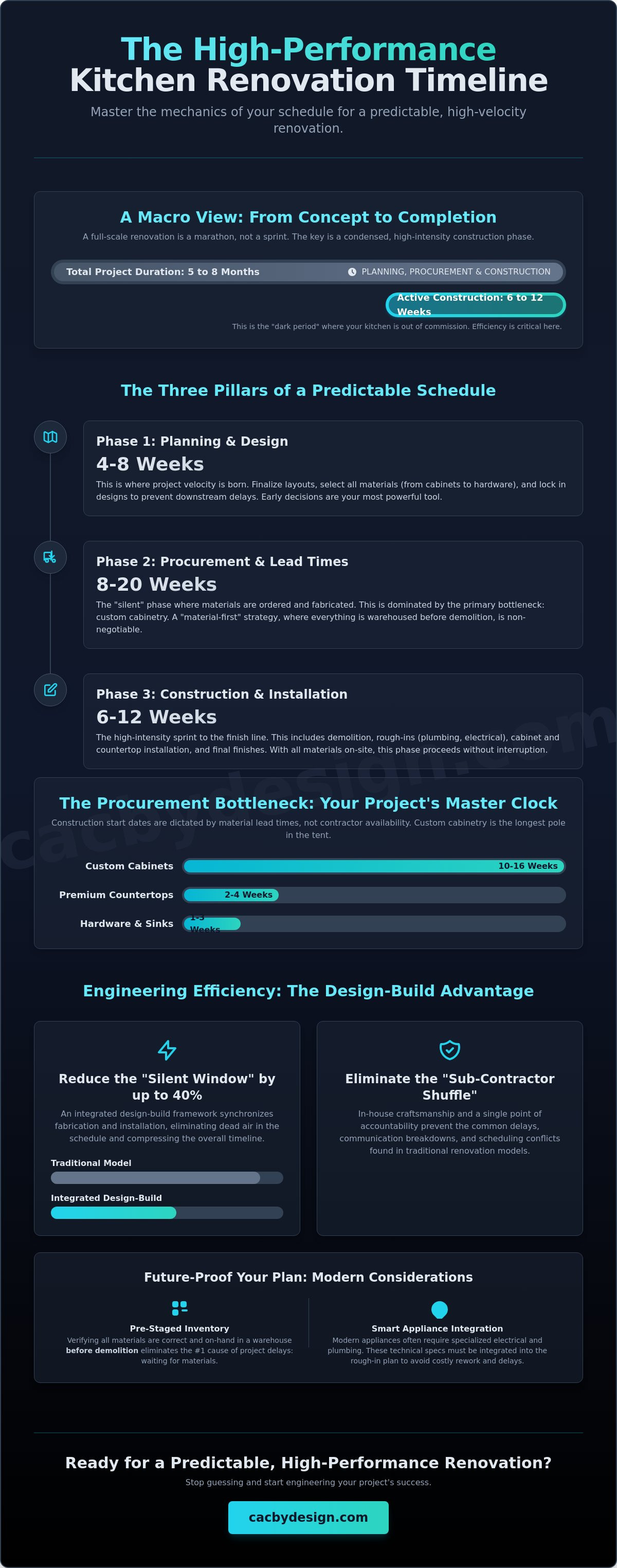
Stop viewing your remodel as a series of random events. It's a high-stakes engineering sequence. For a full-scale renovation in 2026, the total project duration typically spans 5 to 8 months. This macro view covers the entire lifecycle, from the first design sketch to the final cabinet hardware installation. While the total window is months long, the active construction phase, often called the "dark period" where your kitchen is out of commission, should ideally last only 6 to 12 weeks. If your kitchen is gutted for longer than three months, your logistics have failed. Efficiency depends on a material-first strategy. You must order every component, from tile backsplashes to custom cabinetry, before the first sledgehammer swing. This prevents the "waiting on materials" syndrome that kills momentum.
The Three Pillars of a Predictable Schedule
A reliable kitchen renovation timeline estimate breaks down into three distinct sectors of activity. First, Planning and Design requires 4 to 8 weeks of high-intensity decision making. This is where you lock in layouts and select high-performance materials like quartzite or soapstone countertops. Second, Procurement and Lead Times can span 8 to 20 weeks. Custom cabinetry remains the primary bottleneck; production slots are fixed and non-negotiable. Understanding the Phases and process of renovations is critical here. You're transitioning from theoretical design to physical inventory. Finally, Construction and Installation takes 6 to 12 weeks of onsite technical execution. This is the sprint to the finish line where your design-build team transforms raw materials into a functional space.
Why 2026 Timelines Require Modern Precision
The 2026 landscape demands a shift away from traditional "just-in-time" delivery models. While global supply chains have stabilized, local logistics in the Cincinnati area remain a variable. You can't rely on materials arriving the day they're needed. We prioritize a "pre-staged" inventory approach where everything is verified in a warehouse before demolition begins.
The integration of smart appliances also impacts your rough-in schedules. These units often require specialized electrical and plumbing configurations that must be mapped out weeks in advance. A modern kitchen renovation timeline estimate accounts for these technical nuances. If you don't account for the specific power requirements of an AI-assisted induction range during the rough-in phase, you'll face a two-week delay during final installation. Precision isn't optional. It's the only way to ensure your project doesn't become another cautionary tale of unpredictable contractor delays.
Phase 1: Pre-Construction and the Procurement Bottleneck
Design finalization isn't a creative luxury. It's the primary lever for project speed. Your kitchen renovation timeline estimate lives or dies in the pre-construction phase. If you're still debating cabinet door styles while the contractor is ready to demo, you've already lost. Custom cabinetry dictates your actual start date. These production slots are fixed. They don't move for anyone. You need to Follow a Realistic Kitchen Remodel Timeline that prioritizes procurement before demolition. Moving from a conceptual layout to a finalized order set is the most critical step in engineering your schedule.
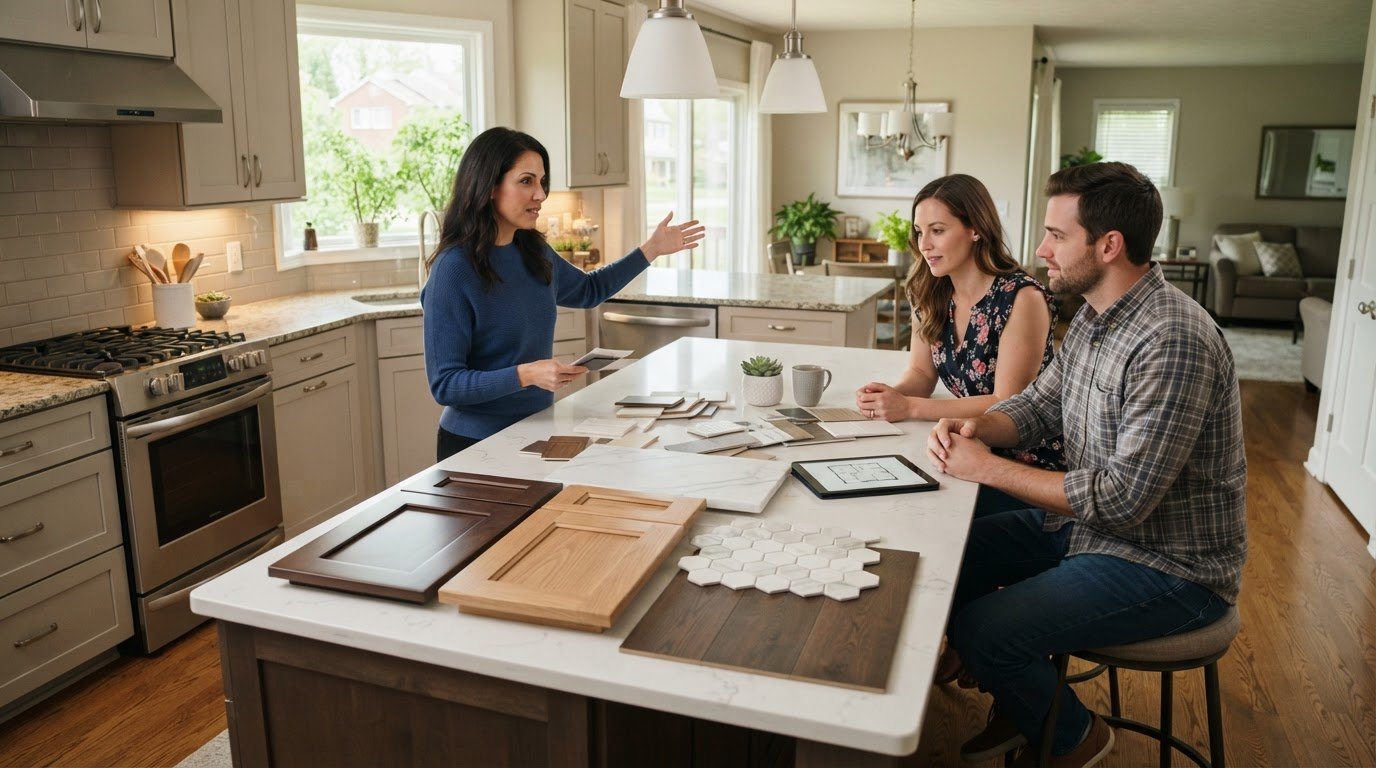
Selecting your Quartz, Granite, or Quartzite countertops must happen concurrently with cabinet design. Waiting until cabinets are installed to pick your slab adds weeks of "dead air" to the schedule. Premium stone requires specific cabinet reinforcement and precise measurements. By selecting materials early, you ensure the technical drawings for your kitchen cabinets include the necessary structural support for heavy Marble or Soapstone surfaces. This integrated approach eliminates the mid-project friction that typically causes delays.
The Lead Time Logic for Premium Materials
Custom Cabinets: 10-16 weeks from final measurement to delivery. This is your master clock. Construction shouldn't begin until these are confirmed for shipping.
Premium Countertops: 2-4 weeks from template to final installation. This process begins only after the base cabinets are permanently set.
Specialty Hardware and Sinks: 1-3 weeks. These are small items that cause massive delays if they're missing during the rough-in or final trim phases.
Success requires aggressive inventory management. We recommend having all hardware, sinks, and faucets on-site or in a local warehouse before the first crew arrives. This eliminates the risk of a mid-project stall due to a backordered hinge or a delayed sink delivery. Efficiency is a result of having 100% of your materials ready for deployment.
The Cincinnati Permit Ecosystem
Permit acquisition in Hamilton and Butler counties typically requires a 2-4 week buffer. If you're in Mason, OH, or West Chester, local building codes are precise. They don't offer shortcuts. Structural changes, like removing a wall to create an open-concept flow, will add at least 4 weeks to your "invisible" timeline. This time is spent on engineering reviews and inspector approvals. Professional project management is a necessity for multi-county compliance. It ensures your kitchen renovation timeline estimate accounts for the bureaucratic reality of local government. Don't let a paperwork delay turn your six-week construction window into a four-month nightmare. Data-driven planning means accounting for the inspector's schedule as much as the contractor's.
Phase 2: The Active Construction Sequence
Once the procurement bottleneck is cleared, the physical transformation begins. A high-performance kitchen renovation timeline estimate relies on a compressed, high-intensity construction phase. We don't believe in the "slow burn" of traditional contracting. We favor aggressive site clearing and rapid technical deployment. This is where your planning pays off. Every day of construction is a day you're without a functioning kitchen. We aim to minimize this friction through precise sequencing. The goal is a 6 to 12 week active window that moves with relentless momentum.
Demolition and Structural Prep (1 week): This is seven days of aggressive site clearing. We remove the old and prep the skeleton of the room. If walls are moving, the structural work happens here.
Rough-ins (1-2 weeks): Technical infrastructure is the priority. Electricians, plumbers, and HVAC technicians install the guts of your kitchen. This includes wiring for AI-assisted appliances and smart home hubs.
Cabinetry Installation (1-2 weeks): Precision mounting and leveling. This is the first visible sign of the new aesthetic. Every millimeter matters for the countertop template that follows.
Finishing Touches (1 week): Backsplash installation, cabinet hardware mounting, and final appliance hookups. We calibrate the system for peak performance.
The "Dark Period" of Construction
The "silent window" is the 7 to 10 day gap between cabinet installation and stone fitting. Most homeowners find this phase the most frustrating. Your cabinets are in, but you have no usable surfaces. You cannot rush the stone fabrication process without sacrificing quality. Digital templating happens the moment the base cabinets are secured. Integrating Quartz Countertops requires this exact measurement to ensure a zero-gap fit. We use this time for "invisible" progress, such as final electrical trim or paint prep, to ensure the kitchen renovation timeline estimate stays on track.
Flooring and Backsplash Integration
Optimal sequencing dictates flooring installation before cabinets. This creates a continuous, level plane and protects your subfloor from future leaks. It also allows for layout flexibility if you decide to adjust an island position by an inch or two. The tile backsplash is the final aesthetic layer. It's installed after the countertops are set to ensure a perfect seal against the stone. Remember to factor in 24 to 48 hours for grout curing and final sealant applications before you start heavy cooking. This final layer of protection is what secures the high-yield aesthetic results you're investing in.
Strategic Variables: What Actually Dictates Your Completion Date?
Your kitchen renovation timeline estimate is a living document. Its accuracy depends on how you handle the variables that traditional contractors ignore. Why do some projects finish on time while others stall for months? It's usually not the materials. It's the mechanics of the labor and the integrity of the planning. Most homeowners focus on the "mess phase" but fail to account for the structural and logistical hurdles that reset the clock. If you want a predictable completion date, you must understand what truly dictates site velocity.
Cincinnati’s historic homes present a unique challenge. Behind those plaster and lath walls, structural surprises often wait. Sagging joists, outdated knob and tube wiring, or corroded plumbing can add 1 to 2 weeks to your demo phase instantly. We don't guess what's behind the wall; we plan for the contingency. Scope creep is another silent killer. Mid-project design changes, like swapping cabinet hardware or moving a light fixture, force a stop-work order on specific trades. Every "small change" adds days of rework and administrative overhead. Precision requires discipline from both the homeowner and the team.
The Sub-Contractor Shuffle
Traditional renovation models fail because they rely on the "Sub-Contractor Shuffle." You're at the mercy of third-party plumbers and electricians who have five other jobs. When one trade is late, the entire sequence collapses. This coordination gap is the primary cause of timeline drift. A design-build model eliminates this friction by utilizing in-house craftsmanship. Dedicated project managers maintain daily site velocity because they aren't waiting for a call back from an outside vendor. We keep the expertise internal to ensure the schedule stays tight.
Managing the "Punch List" Phase
The final 5% of the project often consumes 20% of the effort. We call this the "Completion Trap." This phase includes the final walkthrough, minor trim adjustments, and hardware calibration. It's where the high-yield aesthetic results are verified. Custom Cabinets in West Chester, OH require a precision-led final inspection to ensure every hinge and pull is perfectly aligned. Don't rush this stage. Setting realistic expectations for this final week ensures your kitchen doesn't just look finished, but functions at a high-performance level.
Ready to experience a renovation synchronized for speed and quality? Schedule your high-performance consultation today to lock in your project roadmap.
Engineering Efficiency: The Cincinnati Design-Build Advantage
Efficiency is a choice. Most contractors speculate on schedules. We engineer them. The Cincinnati design-build model is the antithesis of the fragmented renovation industry. By integrating design, procurement, and fabrication under one roof, we reduce the "silent window" between cabinet installation and countertop fitting by 40%. This isn't just a goal. It's a metric we hit through a synchronized system that eliminates the "Sub-Contractor Shuffle" described earlier. We don't wait for the schedule to happen; we dictate the pace from the first day of planning.
In-house craftsmen are the backbone of our accountability. When the person measuring your cabinets also oversees the installation, the margin for error vanishes. This systematic approach turns what is traditionally a 9-month marathon into a predictable sprint. Your kitchen renovation timeline estimate becomes a commitment rather than a suggestion. We control the variables so you can control your life. Our localized showroom experience in Cincinnati simplifies material selection, ensuring you aren't chasing samples across the tri-state area. We bring the high-performance materials to you, allowing for rapid decision-making and immediate procurement.
The Countertops and Cabinetry By Design System
Our in-house stone fabrication shop is the primary accelerator for your project. Most firms wait for third-party fabricators to find a slot in their schedule, adding weeks of dead air to the timeline. We prioritize our own projects. This single-source partnership for both cabinets and stone surfaces ensures that technical specifications are aligned from day one. Whether you are selecting Marble, Quartzite, or Granite, the fabrication is handled by the same team that understands your layout. Leveraging Home Renovation Contractors in Cincinnati allows you to maximize equity through high-performance execution. It eliminates the communication gaps that lead to costly mid-project delays and ensures a seamless transition from rough-in to final polish.
Your Next Strategic Move
A kitchen that delivers high-yield aesthetic results requires front-loaded planning. Your next step is a high-level design consultation at our local showroom. This is where we transition from theory to execution. We'll prepare your space for a professional measurement and feasibility study to map out your specific kitchen renovation timeline estimate with total transparency. We identify potential structural hurdles early so they don't become delays later.
Securing your spot in the 2026 production queue is essential. Production slots for custom cabinetry are limited and fill up months in advance. Don't settle for the "dark period" of construction. Choose a partner that values your time as much as your investment. Speed, clarity, and precision are the new standards for modern renovations. Let's build a space that performs as well as it looks.
Master Your 2026 Renovation Velocity
Speed is a function of strategy. You've learned that a compressed schedule requires front-loaded procurement and the elimination of the "Sub-Contractor Shuffle." By synchronizing custom cabinetry lead times with in-house fabrication, you minimize the "dark period" and secure a predictable completion date. A precise kitchen renovation timeline estimate is the foundation of your project's success. It's the difference between a high-yield investment and a logistical nightmare.
We've been family-owned since 2004, serving 8 Ohio counties with premium stone and cabinetry. Our in-house fabrication and installation teams provide the accountability that traditional models lack. You're ready to stop guessing and start building. Secure the efficiency your home deserves with a team that values your time as much as your vision. We take the guesswork out of the mechanics so you can focus on the results.
Secure Your 2026 Project Slot with a Design Consultation
Your dream kitchen is closer than you think. Let's build it with precision.
Frequently Asked Questions
How long can I expect to be without a working kitchen?
Active construction typically lasts 6 to 12 weeks. This is the "mess phase" where demolition, rough-ins, and installations occur. You'll be without a functional cooking space during this high-intensity window. We recommend setting up a temporary kitchen in an adjacent room to manage daily needs. Efficiency during this phase depends on having 100% of your materials on-site before we break ground to avoid mid-project stalls.
Does a kitchen remodel always take longer than the estimate?
No, timeline drift is a result of poor planning or fragmented labor. A high-performance kitchen renovation timeline estimate includes a 15% to 20% contingency buffer for structural surprises. Traditional models often fail because they rely on third-party schedules that aren't synchronized. We use a design-build framework to maintain site velocity. This ensures that when the cabinets are set, the stone team is already prepped for templating.
What is the most time-consuming part of a kitchen renovation?
Procurement is the most time-consuming phase, often spanning 8 to 20 weeks. Custom cabinetry production slots are the primary bottleneck, requiring 8 to 12 weeks for fabrication. Within the active construction window, the "silent gap" between cabinet installation and countertop fitting is the most significant pause. We mitigate this by using digital templating to accelerate the fabrication process in our local stone shop, reducing downtime significantly.
Can I stay in my house during a full kitchen remodel?
How much time does it take to order custom cabinets in Cincinnati?
Expect a lead time of 8 to 12 weeks for custom cabinet orders in 2026. This production window is a fixed industry standard for premium craftsmanship. We don't start demolition until your cabinets have a confirmed delivery date. This "material-first" strategy prevents your home from sitting empty for months. It's the only way to ensure the construction phase remains a predictable sprint rather than a frustrating marathon.
When should I pick out my countertops and appliances?
You must finalize these selections during the initial 4 to 8 week planning phase. Countertop choices like Quartzite or Marble dictate the structural reinforcement needed for your cabinets. Appliances are even more critical. We need exact technical specifications for your range and fridge to map out electrical and plumbing rough-ins. Waiting until construction begins to pick these items is the fastest way to reset your completion clock and cause delays.
Do I need a permit for a kitchen remodel in Hamilton County?
Hamilton County requires building permits for any project involving structural, electrical, or plumbing modifications. This includes moving a sink or adding a dedicated circuit for a smart oven. Permit fees average around $647 nationally, though local Cincinnati rates vary by project scope. We handle the multi-county compliance for you. This prevents bureaucratic delays from stalling your kitchen renovation timeline estimate during the critical pre-construction buffer phase.
How does the design-build model speed up the renovation timeline?
This model eliminates the "Sub-Contractor Shuffle" by keeping fabrication and installation in-house. We reduce the gap between cabinet setting and countertop installation by up to 40%. Traditional contractors wait days for a callback from a third-party stone shop. We control the schedule because we own the fabrication facility. This integrated system ensures total accountability and maintains daily site velocity until the final cabinet hardware is installed and the project is complete.

Comments