
Marble Countertops in Cincinnati: The High-Performance Guide to Natural Stone Luxury
- chris138017
- 4 hours ago
- 12 min read
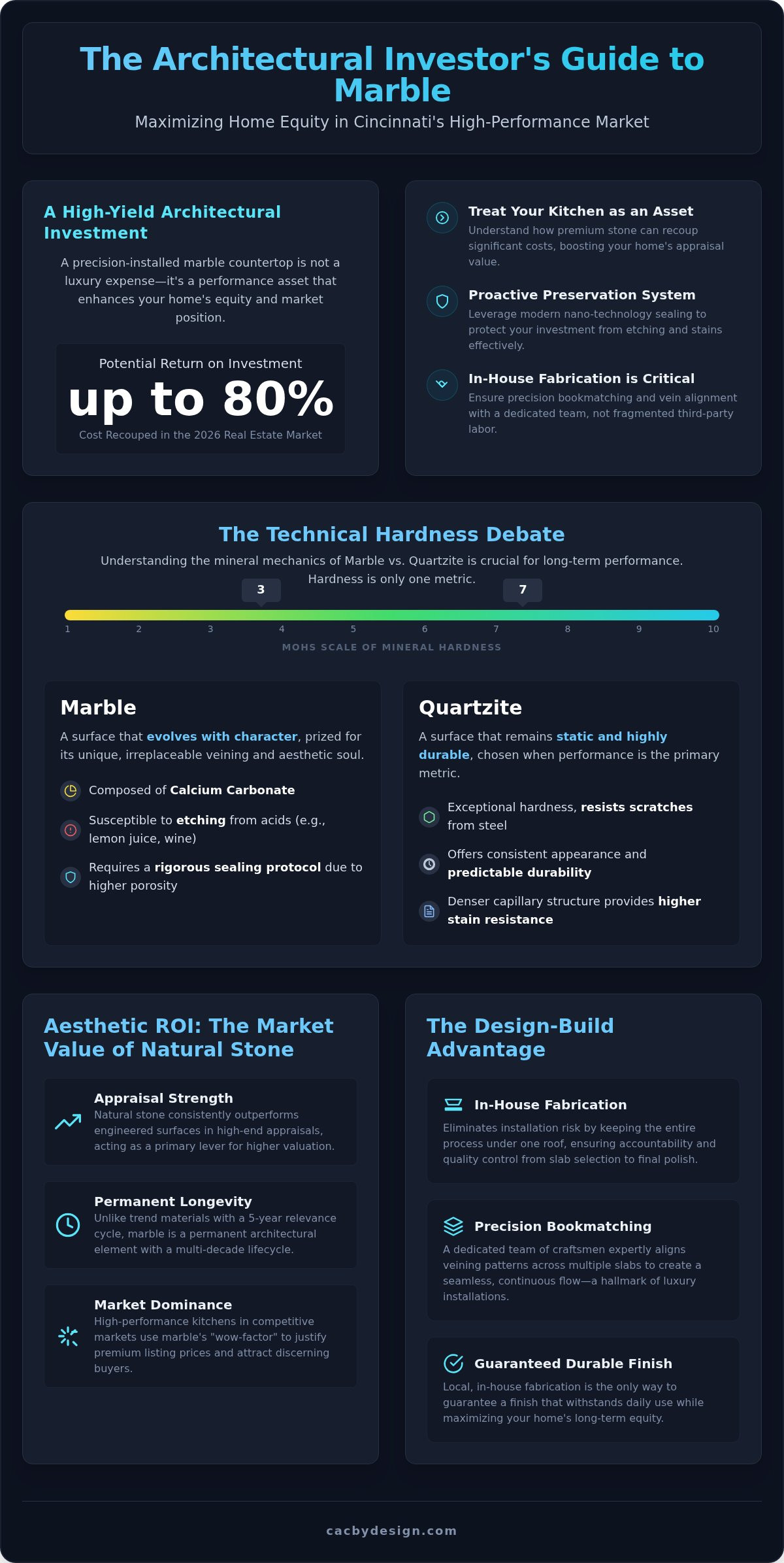
Most Cincinnati homeowners view a kitchen remodel as a luxury expense. They're wrong. When executed with precision, installing marble countertops in Cincinnati is a high-yield architectural investment that can recoup up to 80% of its cost. You want the unmatched aesthetic of natural stone, but the fear of etching and staining is real. You're caught between the desire for a legacy kitchen and the cold logic of resale value in a competitive market like Mason or West Chester.
It's time to stop guessing and start calculating. This guide masters the technical nuances of stone selection to transform your home into a performance asset. You'll learn the truth about the Mohs scale, the reality of modern sealing technology, and why local in-house fabrication is the only way to guarantee a durable finish. We are stripping away the design fluff to focus on the mechanics of luxury. We'll show you how to choose a surface that survives daily use while maximizing your home's equity. From technical specs to aesthetic strategy, this is how you build a kitchen that performs as well as it looks.
Table of Contents
The Architecture of Marble: Why Cincinnati Homeowners Prioritize Natural Luxury
Marble isn't a commodity. It's a geological masterpiece that defines the "lived-in luxury" aesthetic preferred by Cincinnati's most ambitious homeowners. While synthetic alternatives offer predictability, they lack the soul and market weight of natural stone. Choosing marble countertops in Cincinnati is a strategic move. It positions your home as a high-value asset rather than a cookie-cutter property. Appraisers recognize this. In competitive markets, the presence of authentic stone acts as the primary lever for a higher valuation.
The distinction between varieties is critical for your specific design-build framework. Carrara offers a soft, feathered grey palette, ideal for subtle elegance. Calacatta delivers bold, high-contrast architectural drama. Exotic varieties provide a unique visual signature that no factory can replicate. This material remains the undisputed benchmark for any premium kitchen remodel Cincinnati project aiming for the 2026 design standard. It's about more than just a surface; it's about establishing a foundation of quality that synthetic products can't touch.
The Geology of Performance: How Marble Forms
The geology of marble is a story of intense heat and pressure. This metamorphic rock evolution creates a slab density that feels substantial and permanent. Every veining pattern is a technical fingerprint. It's a snapshot of earth's history trapped in stone. When you walk through a Cincinnati showroom, you'll see that no two slabs are identical. This rarity is what drives demand. It ensures your kitchen remains a one-of-one original. Marble's crystalline structure allows it to take a high polish or a sophisticated hone. This versatility is why it remains a favorite among practitioners of modern design who value aggressive experimentation over safe, boring choices.
Aesthetic ROI: The Market Value of Natural Stone
In Hamilton and Warren County, the financial impact of premium stone is measurable. Modern open-concept designs rely on a central focal point to anchor the space. Marble provides that psychological wow-factor. It's a signal of quality that resonates with data-obsessed buyers looking for long-term stability. Unlike short-lived trend materials that lose relevance in five years, natural stone has a multi-decade lifecycle. It scales with your home's equity.
Appraisal Strength: Natural stone consistently outperforms engineered surfaces in high-end Cincinnati appraisals.
Longevity: It's a permanent architectural element, not a temporary cosmetic fix.
Market Dominance: High-performance kitchens in Mason or West Chester utilize marble to justify premium listing prices.
Don't settle for the "safe" choice. Invest in a material that performs. Marble isn't just about beauty; it's about building a legacy asset with clear financial upside. It requires a systems-based approach to fabrication, but the results are undeniable.
Marble vs. Quartzite: The Technical Hardness Debate
The choice between these two stones is often reduced to a simple "hard vs. soft" argument. That's an oversimplification. To master the selection of marble countertops in Cincinnati, you must understand the mineral mechanics. Marble sits at a 3 on the Mohs scale of mineral hardness. Quartzite ranks at a 7. This gap represents the difference between a surface that yields to steel and one that resists it. But hardness is only one metric in a high-performance kitchen. You're choosing between a material that evolves and one that remains static.
The real technical hurdle is etching. Marble is composed of calcium carbonate. When acidic liquids like lemon juice, vinegar, or wine hit the surface, a chemical reaction occurs. This isn't a stain that can be wiped away; it's a physical dissolution of the stone's top layer. Understanding the technical characteristics of marble is vital for anyone prioritizing long-term equity over temporary trends. Porosity also plays a role. Marble's structure is more open, requiring a rigorous sealing protocol to prevent deep-seated oil penetration that quartzite's denser capillaries might resist.
The Quartzite Alternative: When Durability is the Only Metric
Quartzite originates as sandstone, forged through intense tectonic heat. It's virtually bulletproof against scratches and high heat. However, the Cincinnati market often sees dolomitic marble mislabeled as quartzite. These "soft quartzites" lack the 7-rating durability and will etch just like traditional marble. True quartzite is the choice for high-utility environments where the "lived-in" look is viewed as a defect rather than a feature. It's for the data-obsessed homeowner who demands a zero-maintenance profile. If you're looking for a surface that survives high-impact cooking, you can browse our quartzite and marble inventory to see the physical differences for yourself.
The Marble Defense: Why Beauty Often Trumps Hardness
Performance isn't always about resisting change. The "Patina" philosophy treats etching as a badge of a working kitchen, much like the aged surfaces found in European estates. If you can't tolerate the visibility of etches, the technical fix is a honed finish. Matte surfaces diffuse light, making chemical reactions nearly invisible compared to high-gloss polished slabs. Choosing marble for low-traffic areas or dedicated baking islands allows you to leverage its aesthetic power without over-stressing the material in high-utility zones. It's a strategic deployment of luxury. You don't need a bulletproof surface everywhere; you need the right surface for the specific task.
Determine your kitchen performance profile before you buy. If you cook aggressively and entertain often, quartzite might be your baseline. If you value the historical weight and unique veining of marble, the maintenance trade-off is a calculated, high-yield investment. Stop guessing and start engineering your design around your actual lifestyle.
Engineering Equity: The ROI of Premium Stone in Greater Cincinnati
Cincinnati real estate is a battleground of high-end finishes. In the 2026 market, a minor kitchen remodel in our region yields a 60% to 80% return on investment. This isn't a guess; it's a data-backed reality for homeowners in areas like Mason and West Chester. Choosing marble countertops in Cincinnati isn't just about a visual upgrade. It's about engineering equity. By treating your kitchen as a high-performance asset, you ensure every dollar spent on materials works toward your home's total valuation. While some view luxury countertop materials as a sunk cost, smart investors see them as equity drivers that separate premium listings from the rest of the market.
You don't need to wrap every surface in stone to see a return. Strategic placement is the key. Using a high-impact marble slab on a central island creates a focal point that anchors the entire room. This maximizes the "wow-factor" while keeping your total material investment lean. This approach works best when paired with high-yield storage solutions like custom cabinets in West Chester, OH. A cohesive design system is the only way to ensure your renovation doesn't look like a collection of random upgrades. It's about a unified strategy that drives appraisal value.
Local Market Dynamics: Hamilton to Clermont County
From Hamilton to Clermont County, market-specific trends dictate what buyers expect. In neighborhoods where luxury is the baseline, marble is often a "must-have" for resale. A fragmented renovation devalues your property. If you have premium stone but subpar cabinets or professional Cincinnati oh bathroom remodeling that doesn't match the kitchen's caliber, you create a design disconnect. Cheap installation is a liability. It leads to poor seams and misaligned veining that savvy buyers notice immediately. High-performance homes require high-performance execution across every square foot.
Cost Transparency: Slab vs. Fabrication
Understanding the "all-in" cost of marble countertops requires looking past the price of the slab. Rare exotics command a premium because of their scarcity and unique visual fingerprints. But the real cost differentiator is fabrication. Third-party installers often hide fees or cut corners on precision. Our in-house craftsmanship system eliminates these variables. Since 2004, we've focused on a design-to-installation workflow that removes the risk of fragmented labor. You aren't just buying a slab; you're buying a technical execution that protects your investment. Precision matters. When veining is bookmatched and seams are invisible, the perceived value of the stone skyrockets.
Systematic Execution: In-house teams ensure quality control that third-party subs can't match.
Market Timing: 2026 data shows that natural stone remains the top choice for high-end appraisals.
Risk Mitigation: Professional fabrication prevents the costly errors that devalue "budget" installs.
Maintenance Systems for High-Performance Marble Surfaces
Stop thinking about cleaning. Start thinking about preservation. If you want marble countertops in Cincinnati to remain a high-yield asset, you need an operational protocol, not just a rag and a bottle of soap. Generic advice like "soap and water" is insufficient for professional-grade stone. Soap creates a dulling film; water can penetrate capillaries if your seal is compromised. To maintain the 2026 design standard, you must adopt a systems-led approach to surface management. This isn't about domestic chores. It's about protecting the molecular integrity of your investment.
The 2026 sealing standard has shifted from traditional topical applications to advanced nano-technology. These modern sealers don't just sit on top of the stone. They bond at a microscopic level to create an oleophobic and hydrophobic barrier. This technology buys you time. It prevents immediate absorption of oils and pigments, giving you the window needed to manage spills before they become permanent stains. However, even the best seal won't stop etching. You must understand the chemical reality: acids dissolve calcium carbonate on contact. High-performance maintenance is about managing these risks with precision.
The 3-Step Daily Maintenance Protocol
Step 1: pH-Neutral Agents. Use only specialized stone cleaners. Acidic "natural" cleaners containing lemon or vinegar are destructive. pH-neutral agents are non-negotiable for preserving the stone's finish.
Step 2: Immediate Moisture Management. Marble is porous. Wipe spills immediately to prevent deep-seated staining. Don't let liquids sit, especially high-pigment items like wine or coffee.
Step 3: Visual Inspection. Daily checks for dull spots or "ghosting" tell you exactly where your seal is weakening. Proactive detection prevents expensive professional restoration.
Advanced Protection: Long-Term Sealing Solutions
How often should you seal marble in 2026? The answer depends on your kitchen's performance profile. High-utility islands may require a refresh every six months, while low-traffic areas can go longer. Use the "Water Bead Test" as your diagnostic tool. Pour a small amount of water on the surface; if it hasn't absorbed after 10 minutes, your seal is intact. If the stone darkens, your barrier has failed. While DIY topical applications are available, they lack the durability of permanent factory seals. If you notice persistent etching or deep scratches, it's time to call a Cincinnati stoneworks expert to mechanically repolish the surface. Ready to upgrade your kitchen's durability? Schedule a consultation with our stone experts today.
The Design-Build Advantage: Why In-House Fabrication Matters
Buying the slab is just the beginning. Real value is created during the transition from raw stone to finished surface. If you source elite marble but rely on fragmented third-party labor, you're inviting failure. Subcontractors often lack the specialized equipment and accountability needed for high-performance stone. This leads to misaligned veining, visible seams, and compromised structural integrity. To secure the full ROI of marble countertops in Cincinnati, you must control the entire workflow. Our in-house craftsmanship system is designed to eliminate these variables. We don't just install; we engineer a cohesive design asset.
Success requires a systems-led approach. This philosophy separates elite home renovation contractors in Cincinnati from general laborers. By keeping fabrication in-house, we ensure that the digital templates created in your kitchen translate perfectly to the CNC machines. This vertical integration is the only way to achieve complex bookmatching. This is where the natural veining of the stone flows uninterrupted across seams. It's the difference between a high-end architectural statement and a disjointed collection of stone pieces.
Precision Fabrication: Technology Meets Artistry
We've replaced manual measurement with digital templating. It's about extreme economy and eliminating human error. Our CNC cutting technology ensures that every radius and sink cutout is mathematically perfect. However, marble still requires a human touch. Our craftsmen hand-finish every edge to ensure the texture is consistent with the stone's unique character. Your choice of edge profile is a technical design decision. A mitered edge can create the illusion of a massive, solid block of stone. These choices impact how the stone handles daily impact and long-term wear. We value systematic scaling over creative guesswork.
White-Glove Installation: The Final Execution
Installation day is the final test of the design-build system. A professional crew assesses the structural support of your cabinetry before the first slab is moved. Marble is heavy. If your cabinets aren't reinforced, the stone will eventually crack. We also ensure compliance with the 2019 Residential Code of Ohio. Even though the code exempts countertops from permit requirements, all associated electrical work must meet strict GFCI standards. Our final walkthrough isn't a formality. It's a systematic verification of every seam and seal. We ensure your high-performance asset is ready for immediate use. You've invested in luxury; we provide the precision execution that keeps that luxury intact.
Digital Accuracy: Laser templating removes the 1/8-inch margin of error common in manual measurements.
Structural Integrity: In-house teams verify load-bearing capacity to prevent future stone failure.
Code Compliance: Professional installation ensures all electrical and plumbing work meets Cincinnati and Ohio building codes.
Engineering Your Kitchen's Future
Stop viewing your remodel as a cost center. It's a high-performance architectural asset. You've seen the data: marble countertops in Cincinnati can recoup up to 80% of their cost when executed with precision. Success isn't about picking a pretty slab; it's about mastering the technical nuances of stone density, nano-sealing protocols, and vertical integration. Fragmented labor kills quality. To maximize your home's equity in Mason or West Chester, you need a system that handles everything from digital templating to the final white-glove installation.
Since 2004, our family-owned team has refined a design-build framework that removes the risk from natural stone. Our in-house craftsmen ensure 100% quality control, delivering a seamless workflow that third-party installers can't replicate. You deserve a kitchen that performs as well as it looks. Don't leave your investment to chance; choose a partner that understands the mechanics of growth. Schedule your high-performance design consultation today. Your legacy kitchen is ready for its transformation.
Frequently Asked Questions
Are marble countertops worth the investment for a Cincinnati kitchen remodel?
Yes, marble countertops in Cincinnati are high-yield assets that drive significant home equity. Data shows that minor kitchen remodels in the region recoup 60% to 80% of their cost upon resale. In competitive luxury markets like Mason and West Chester, appraisers prioritize natural stone over synthetic alternatives, making marble a strategic choice for long-term financial performance.
How do I prevent my marble countertops from staining or etching?
Prevention requires a proactive preservation system rather than reactive cleaning. You must use pH-neutral cleaning agents and apply advanced nano-technology sealers that bond at a molecular level. Etching is a chemical reaction between acids and calcium carbonate, so managing moisture and avoiding acidic liquids like lemon juice or vinegar is the only way to maintain the stone's integrity.
What is the price difference between marble and quartz in Cincinnati?
Quartz is an engineered product with predictable manufacturing costs, while marble is a natural resource with pricing dictated by slab rarity and geological origin. High-performance design often favors marble for its unique architectural fingerprint and superior resale weight. While quartz offers durability, marble provides a one-of-one visual signature that synthetic materials cannot replicate in high-end appraisals.
Can I use marble in my bathroom remodel in West Chester?
Marble is an ideal material for a high-end bathroom remodel in West Chester. It creates a sophisticated aesthetic that scales with your home's total valuation. Because bathroom surfaces generally face less exposure to acidic food items than kitchen islands, marble's maintenance profile is often more manageable in these environments while still delivering maximum visual impact.
How often do I need to seal my marble countertops?
Your sealing schedule depends entirely on your kitchen's performance profile. Use the "Water Bead Test" as a diagnostic tool; if water absorbs into the stone after 10 minutes, your barrier has failed. High-utility areas may require a refresh every six months, while lower-traffic zones can often go a full year before needing a new application of professional-grade sealer.
What is the best edge profile for a marble kitchen island?
A mitered edge is the benchmark for high-performance islands because it creates the illusion of a solid, massive block of stone. This profile hides the seam where the top meets the side apron, providing an aggressive, architectural look. For homeowners prioritizing durability in high-traffic zones, a modern eased edge offers a clean aesthetic that resists chipping better than sharper profiles.
Do you offer in-house fabrication for all natural stone slabs?
Yes, we utilize a dedicated team of in-house craftsmen for every project since 2004. We don't rely on third-party installers because fragmented labor kills quality control and precision. Our design-build system ensures that your marble countertops in Cincinnati are templated, cut, and installed by the same team, guaranteeing perfect veining alignment and structural integrity.
What happens if my marble countertop gets chipped or scratched?
Marble is a metamorphic rock that can be professionally restored to its original standard. Minor etches or surface scratches can be mechanically repolished by an expert to remove the damaged layer. If a deeper chip occurs, our technicians use color-matched resins to fill the void, followed by a precision polish that makes the repair virtually invisible to the naked eye.


Comments