
Quartz vs. Quartzite Cincinnati: Benchmarking Your Kitchen’s Performance DNA
- chris138017
- 5 minutes ago
- 11 min read
Your kitchen countertop isn't just a design choice. It's a high-stakes performance asset that dictates your home's ROI and daily operational efficiency. Most homeowners treat material selection like a simple paint color. That's a mistake. The wrong decision leads to permanent etching, stubborn stains, and a wasted investment. If you're currently weighing quartz vs quartzite Cincinnati, you've likely hit a wall of conflicting advice. You want the luxury of natural stone. You fear the maintenance. You want engineered durability. You worry about heat damage.
We agree that a kitchen remodel should be a calculated upgrade, not a gamble. This article audits the technical performance DNA of these two powerhouse materials to stop the confusion. We'll benchmark the Mohs hardness, chemical resistance, and maintenance profiles of each. We're moving past the aesthetic surface to look at the mechanics of durability. By the end, you'll have a clear, data-backed roadmap to determine which surface fits your lifestyle and protects your equity. It's time to stop guessing and start benchmarking.
Table of Contents
The Nomenclature Trap: Decoding the Quartz vs. Quartzite Performance Profile
Naming conventions in the stone industry are intentionally vague. They create a friction point for homeowners during the procurement phase. Quartz and quartzite sound like siblings. In reality, they are entirely different species of material. One is a product of industrial engineering. The other is a product of geological time. Choosing between quartz vs quartzite cincinnati requires more than an eye for color; it requires a performance audit of your daily kitchen operations. Your lifestyle dictates the material. Aesthetics are secondary to the technical reality of how you cook, clean, and live.
Engineered Consistency: The DNA of Quartz
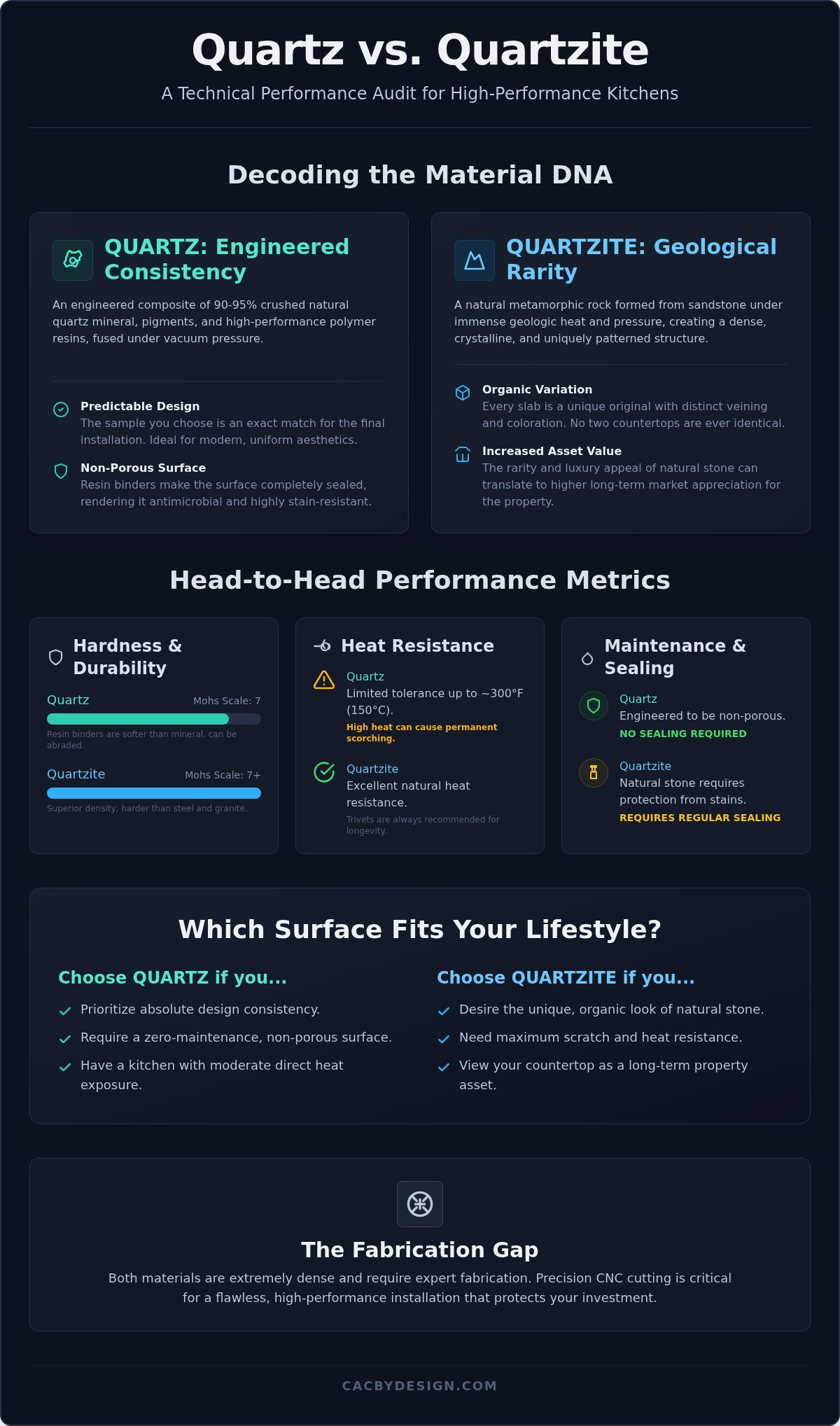
Quartz is an engineered composite. It is a calculated blend of 90-95% crushed mineral bound by high-performance polymer resins. Manufacturers use a rigorous industrial process involving vibration, vacuum, and pressure to eliminate air pockets. This creates a dense, non-porous slab with absolute design predictability. If you select a sample in a showroom, the final installation will match it with surgical precision. This consistency is a primary driver for modern, minimalist designs where variation is a defect, not a feature.
Predictability: The slab you buy is the slab you get. No surprises during templating.
The Resin Factor: These binders provide flexibility and impact resistance. However, they also introduce a thermal ceiling.
Industrial Process: Vacuum-sealed manufacturing ensures zero internal voids, making the surface naturally antimicrobial.
Geological Rarity: The DNA of Natural Quartzite
Quartzite is a different animal. It is a natural metamorphic rock. To understand what is quartzite, you have to look at the transition from sandstone under extreme tectonic pressure. This process creates a dense, crystalline structure that rivals granite for hardness. It is the ultimate solution for the 'Marble Trap.' Homeowners want the sophisticated veining of marble but fear the maintenance liability of soft, porous stone. Quartzite delivers that high-end aesthetic without the constant threat of etching from acidic liquids.
Organic Variation: Every slab is an organic original. No two kitchens in Cincinnati will ever look the same.
Crystalline Structure: The extreme density makes it one of the hardest natural surfaces available for residential use.
Asset Value: The rarity of natural stone often translates to higher long-term market appreciation for the property.
Your decision isn't just about the slab. It's about how you use the space. A high-volume family kitchen has different technical requirements than a low-use executive suite. We treat material selection as a strategic pillar of your remodel. Understanding the quartz vs quartzite cincinnati dynamic ensures you don't over-invest in features you don't need or under-invest in the durability your lifestyle requires. It is about matching the material DNA to your home's operational reality.
Technical Benchmarking: Hardness, Heat, and UV Stability
Technical performance isn't a suggestion. It's the baseline for your kitchen's survival. When evaluating quartz vs quartzite cincinnati, you're auditing two different engineering philosophies. One relies on polymer chemistry. The other relies on geological compression. This section benchmarks the technical thresholds that determine if your investment will withstand the daily friction of a high-traffic home.
The Mohs Scale Advantage
The Mohs Scale of Mineral Hardness measures a material's resistance to scratching; it's the definitive metric for long-term kitchen longevity. Quartzite is a high-performance outlier. It frequently registers a 7 or higher on the scale. This makes it harder than steel and significantly more durable than most granite varieties. While quartz is highly scratch-resistant, its resin binders are softer than the mineral itself. This makes the surface susceptible to abrasive cleaners or sustained friction. If your lifestyle involves heavy prep work and high-impact activity, quartzite's "diamond-killer" density provides a superior technical edge.
Thermal Thresholds and Scorching
Quartz has a hard thermal ceiling. The polymer resins used as binders typically have a maximum heat tolerance around 300 degrees Fahrenheit. Exceeding this limit causes permanent resin scorching or deep discoloration. You can't put a pot directly on the surface without a trivet. Quartzite handles heat with volcanic endurance. Because it's a 100% natural stone forged under intense pressure, it doesn't have a chemical binder to melt or burn. For the "busy chef" who needs to move hot pans quickly, quartzite offers a safety margin that engineered stone simply can't provide.
Sunlight and Pigment Fading
Cincinnati homes with expansive windows or open-concept sunrooms face a specific environmental risk. The engineered resins in quartz are UV-sensitive. Over time, direct exposure to the sun leads to pigment fading or a yellowing effect. Quartzite is naturally UV-stable. Its colors were baked into the rock millions of years ago and won't degrade under the Ohio sun. When planning a remodel with heavy natural light, material stability is a critical factor in maintaining your home's equity. You can explore these technical nuances with a full-service design partner who understands how local environmental factors impact material performance. Choosing quartz vs quartzite cincinnati requires this level of site-specific analysis to ensure your countertops don't just look good on day one, but perform for a decade.
The Maintenance Audit: Porosity, Sealing, and Chemical Resistance
Maintenance is where the honeymoon period ends and the operational reality begins. If you don't audit the performance DNA of quartz vs quartzite cincinnati, you'll eventually face permanent surface damage. One material is a set-and-forget asset. The other requires a systematic maintenance protocol. Your choice depends on your willingness to manage a natural surface or your preference for a chemically engineered one. Red wine, coffee, and cooking oils are the primary threats to your countertop's visual integrity.
Quartz is a non-porous composite. Because the mineral is bound by resin under vacuum pressure, there are zero internal voids. Pigments from red wine or coffee sit on the surface. They can't penetrate. Quartzite is a natural metamorphic rock with microscopic pores. Without a barrier, liquids migrate into the stone's deep tissue. This leads to "ghosting" or permanent shadows. While quartzite is chemically resistant to acids, its porosity makes it vulnerable to staining if the surface isn't properly managed.
Sealing Protocols for Quartzite
Natural stone requires a defensive layer to prevent deep-tissue staining. For Cincinnati homeowners, this typically means an annual application of a high-grade impregnating sealer. It's a 30-minute process that preserves your kitchen's equity. You should use the 'water bead test' to verify your barrier's integrity. Pour a small amount of water on the surface; if it fails to bead and starts to darken the stone, your seal has been compromised. Modern sealers have extended the life of a single application, but the annual check remains the industry standard for high-traffic kitchens.
The 'No-Seal' Advantage of Quartz
Quartz wins on operational efficiency. It's permanently non-porous and never requires sealing. This 'wipe and go' profile is the primary lever for families with young children or homeowners who prioritize zero-touch maintenance. However, it's not invincible. Engineered resins are vulnerable to high-pH chemicals and heavy-duty solvents. Avoid bleach and industrial degreasers. These substances can chemically burn the resin binders, leading to permanent clouding or a loss of surface sheen. Stick to pH-neutral cleaners to maintain the factory finish.
Matching the maintenance profile to your personal discipline is critical. If you can't commit to a brief annual sealing protocol, quartzite's beauty will eventually be marred by stains. If you want a surface that handles spills with zero intervention, quartz is the logical choice. Both materials offer high-performance results, but only if you respect their chemical and structural limitations.
The Fabrication Gap: Why Local Expertise Matters in Cincinnati
Fabrication is the silent filter that separates a high-performance kitchen from a failed investment. When analyzing quartz vs quartzite cincinnati, most homeowners ignore the mechanical reality of the cutting process. Quartzite is the "diamond-killer" of the stone world. Its 7+ Mohs hardness destroys standard diamond blades and wears down machinery at an accelerated rate. If a fabricator isn't equipped with high-torque, water-cooled CNC systems, the risk of slab failure skyrockets. You can't cut 7+ Mohs stone with equipment designed for soft marble.
Big Box retailers often outsource to the lowest bidder. These third-party installers rarely have the specialized equipment required for high-density natural stone. They treat quartzite like standard granite, leading to edge chipping, visible seams, and micro-fractures. We control the entire supply chain through our in-house fabrication facility in Cincinnati. This localized control ensures that the technical precision of the cut matches the creative vision of the design. It eliminates the "middleman risk" that plagues standard retail models.
Quartzite’s Fragility During Cutting
Natural stone carries a unique geological personality. Fissures and natural veins aren't just aesthetic markers; they're structural variables that require expert navigation. Standard bridge saws often vibrate too much for high-hardness quartzite, leading to catastrophic cracks mid-cut. In-house fabrication eliminates the communication gaps and technical errors inherent in third-party outsourcing. Our team audits every slab for internal stress points before the first blade makes contact. This systematic approach preserves the integrity of your material and prevents costly project delays.
Edge Profiles and Finishing
Material hardness dictates your design options. While quartz is uniform and predictable for complex ogee or bullnose edges, quartzite requires a more calculated approach to avoid splintering. Mitred edges are the gold standard for achieving a "thick slab" look without the weight of a solid 6cm piece. This technique requires extreme CNC precision to ensure the vein pattern flows seamlessly from the horizontal surface to the vertical edge. These high-performance details are essential when matching your stone to custom cabinets west chester oh for a cohesive, high-ROI result.
Don't leave your material investment to chance. You can secure a precision-engineered installation by partnering with an in-house Cincinnati fabricator who understands the mechanical limits of high-end stone. Choosing between quartz vs quartzite cincinnati is only half the battle; the other half is ensuring the person behind the saw has the technical capability to deliver on the stone's potential.
The ROI Blueprint: Integrating Countertops with Custom Cabinetry
ROI is a calculation, not a hope. When you benchmark quartz vs quartzite cincinnati, you're selecting the primary lever for your home's equity. But a high-performance stone slab is only as effective as the infrastructure supporting it. Placing a premium quartzite slab on stock cabinetry is a structural and financial mistake. To maximize market appreciation, you need a systems-led approach that treats the countertop and cabinetry as a single, integrated asset. In the Ohio region, upgrading to high-end countertops like quartzite can yield an average Return on Investment (ROI) of 60-70%, but only when the installation is executed with professional precision.
Coordinating Stone with Custom Cabinets
The technical synergy between your stone and your storage is critical. Weight is the first hurdle. A standard 3cm quartzite slab can easily exceed 700 lbs for a large island. You need custom cabinets engineered with reinforced frames to handle this dead load without sagging or structural failure over time. Beyond the mechanics, color theory plays a vital role in your home's valuation. The organic, high-energy movement of natural quartzite requires a minimalist cabinet finish to maintain visual balance. Conversely, the engineered consistency of quartz allows for bolder cabinetry textures. Creating this unified aesthetic is what drives the premium "Kitchen Remodel Cincinnati" ROI that modern buyers demand.
The CAC Design-Build Advantage
Efficiency is the byproduct of a controlled supply chain. Most remodelers force you to navigate a fragmented process: one vendor for stone, another for cabinets, and a third-party for installation. This creates a "middleman tax" and introduces massive project risk. Our design-build model eliminates these friction points. We coordinate demolition, cabinetry installation, and stone fabrication within a single, streamlined timeline. This isn't just about speed; it's about ensuring the template for your stone is perfectly calibrated to the final position of your cabinets. By handling everything in-house, we protect your investment from the communication errors that plague traditional models.
Your research phase is over. You understand the technical DNA, the maintenance requirements, and the fabrication risks of quartz vs quartzite cincinnati. The next move is to transition from data collection to execution. A high-performance kitchen requires a partner who understands the mechanics of growth and the precision of stone. Don't settle for a fragmented remodel that compromises your home's equity. Schedule your high-performance design consultation today to audit your space and build a kitchen that dominates the local market.
Secure Your Kitchen Equity
Selecting between quartz vs quartzite cincinnati is a strategic maneuver that defines your kitchen's operational lifespan. You've audited the technical trade-offs. Quartz delivers engineered consistency and zero-touch maintenance for busy households. Quartzite offers geological rarity and superior thermal resistance for those who demand natural stone. Both materials require precision fabrication to realize their full financial potential. A high-end surface is only an asset if the installation matches the material's DNA.
Since 2004, our family-owned team has positioned itself as the local authority on high-performance remodels. We operate our own in-house Cincinnati fabrication facility to ensure your 7+ Mohs quartzite is cut with surgical accuracy. This localized control eliminates the middleman risk and protects your home's equity. Don't leave your ROI to chance with third-party installers who lack specialized equipment. It's time to move from data collection to high-impact execution.
Audit your kitchen's performance potential with a CAC design consultation. We're ready to help you build a space that dominates the local market and performs for a lifetime. Your vision deserves a high-performance partner who understands the mechanics of durability.
Frequently Asked Questions
Is quartzite harder than quartz?
Quartzite is technically harder. It consistently registers a 7 or higher on the Mohs Scale of Mineral Hardness. While quartz is durable, its resin binders are softer than the natural mineral. When benchmarking quartz vs quartzite cincinnati, remember that quartzite's crystalline structure makes it more resistant to heavy impact. It is the hardest natural stone available, requiring high-torque machinery for precision cutting and professional installation.
Does quartzite require more maintenance than quartz?
Yes. Quartzite is a natural stone with microscopic pores that require a defensive barrier. You must apply an annual sealer to prevent liquids from migrating into the stone's deep tissue. Quartz is an engineered, non-porous composite that never requires sealing. If you value zero-touch maintenance, quartz is the logical choice. If you want the luxury of natural stone, you must commit to a systematic maintenance protocol.
Can I put hot pans directly on quartz or quartzite?
Only on quartzite. Quartz has a hard thermal ceiling of approximately 300 degrees Fahrenheit. Exceeding this limit causes the polymer resins to scorch or discolor permanently. Quartzite is a metamorphic rock forged under extreme heat; it doesn't have chemical binders to melt. While we always recommend trivets to protect your investment, quartzite offers a massive safety margin for the busy chef that engineered stone cannot match.
Why is quartzite more expensive than quartz?
Scarcity and mechanical difficulty drive the cost. Quartzite is a finite natural resource that must be quarried and shipped globally. Its extreme density also makes it a "diamond-killer" during fabrication. It requires more time, more expensive blades, and higher labor expertise than quartz. Quartz is a manufactured product with a predictable supply chain and a more straightforward fabrication process, making it the more budget-friendly performance asset.
Does quartzite stain or etch like marble?
No. Quartzite is silica-based, meaning it won't etch when exposed to acids like lemon juice or vinegar. This is the primary reason homeowners choose it over marble. However, it can stain if left unsealed. While marble is soft and chemically reactive, quartzite is chemically stable. Its only technical vulnerability is its porosity, which is easily managed with a high-grade sealer applied once a year.
Which material is better for a high-traffic family kitchen in Cincinnati?
Your lifestyle determines the winner. If your household prioritizes a "wipe and go" workflow, quartz is the superior choice for its non-porous surface. If you want maximum heat resistance and a one-of-a-kind aesthetic, quartzite is the better high-ROI asset. Both materials are top contenders for quartz vs quartzite cincinnati remodels. The decision rests on whether you prefer engineered consistency or natural performance.
Can I use quartz for an outdoor kitchen in Ohio?
No. Quartz is for indoor use only. The engineered resins used to bind the mineral are highly sensitive to UV radiation. Sustained exposure to the Ohio sun causes yellowing, pigment fading, and eventual structural breakdown. Quartzite is naturally UV-stable. It was forged in the earth and won't degrade under direct sunlight, making it the only viable high-performance stone for outdoor kitchens in the Cincinnati region.
How often do I need to seal my quartzite countertops?
Plan for an annual application. Use the "water bead test" to audit your surface's integrity. Pour a small amount of water on the stone; if it doesn't bead and starts to darken the material, your seal is compromised. This 30-minute maintenance protocol is a low-effort requirement to protect your kitchen's equity. Modern sealers are highly effective, but the yearly check remains the standard for high-traffic kitchens.


Comments