
Quartz vs Quartzite Cincinnati: The High-Performance Countertop Guide (2026)
- chris138017
- 7 days ago
- 11 min read
Updated: 5 days ago
Choosing a kitchen countertop is not just an aesthetic upgrade. It's a calculated move to maximize home equity. In the competitive Cincinnati market, the wrong choice leads to surface cracks, permanent stains, and depleted resale value. You're likely weighing quartz vs quartzite cincinnati options while trying to decode conflicting advice from retailers. It's a high-stakes decision. You need technical clarity, not just a color swatch.
We understand the frustration. Similar-sounding names often mask massive differences in maintenance requirements and long-term durability. You need a surface that handles the chaos of a busy Ohio kitchen while functioning as a premium design statement. This guide provides the data you need to select a clear winner for your lifestyle. We'll analyze the engineering behind quartz, the raw power of natural quartzite, and why your choice of a local fabrication partner is the ultimate lever for your 2026 kitchen performance.
Table of Contents
The Technical Foundations: Engineered Quartz vs. Natural Quartzite
Understanding the technical divide between these materials is the difference between a successful installation and a costly failure. In our local showrooms, we see the confusion constantly. The names are nearly identical, but the performance profiles are worlds apart. Deciding between quartz vs quartzite cincinnati isn't just about color. It's about choosing between factory precision and geological chaos. One is a product of chemistry; the other is a product of tectonic pressure.
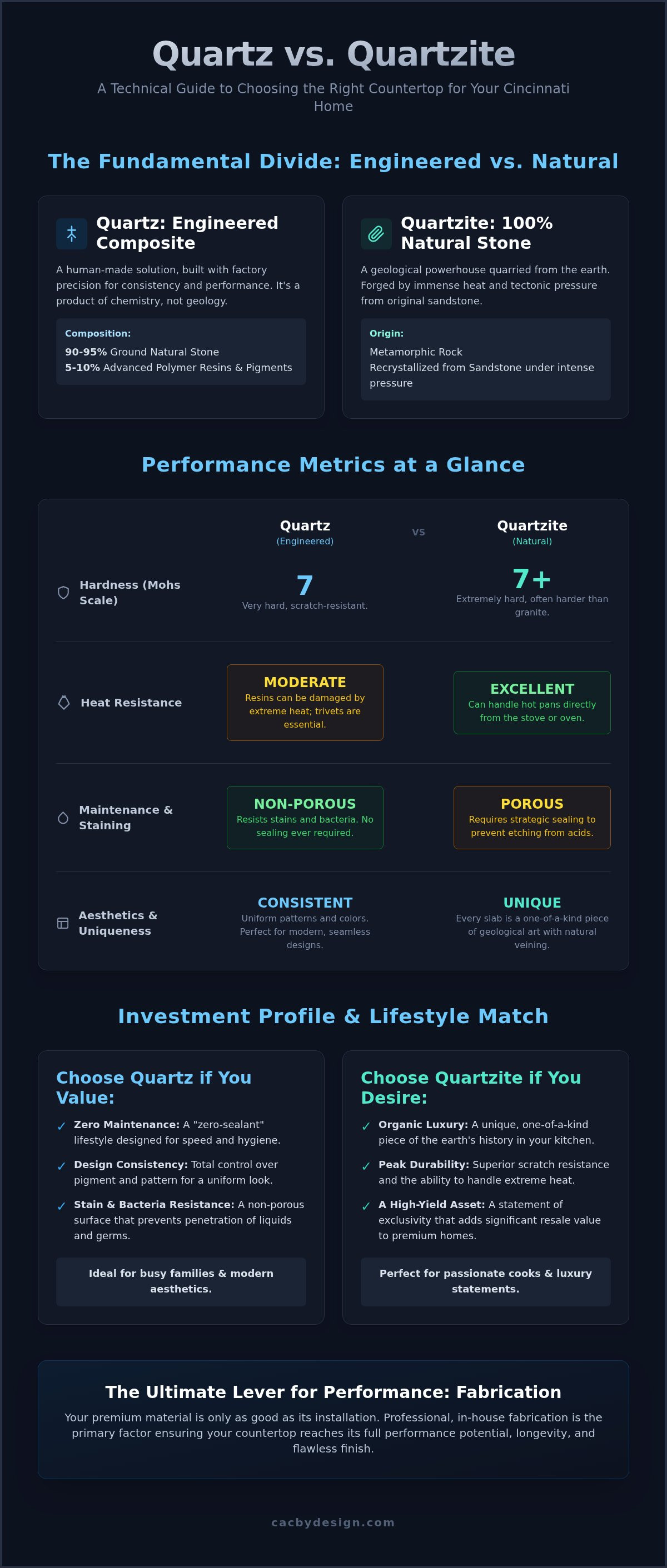
Quartz is a high-performance engineered composite. It typically consists of 90 to 95 percent ground stone bound by advanced polymer resins. It's a human-made solution to the inherent flaws of natural stone. Quartzite is a 100 percent natural metamorphic rock. It began as sandstone and was forged deep within the earth under extreme heat and pressure. One is built in a controlled environment. The other is quarried from the crust of the planet. This distinction dictates every aspect of how the material will behave in your kitchen.
Industry reports suggest that roughly 70 percent of homeowners initially confuse these terms. This misunderstanding often leads to critical maintenance errors. Some expect engineered resin to handle 500-degree pans, while others use harsh acidic cleaners on natural stone. We help you bypass that learning curve. By visiting a local showroom for physical material vetting, you can feel the difference in density and texture before committing your budget to a specific slab.
The Manufacturing Logic of Quartz
Engineering translates to predictability. In a high-stakes remodel, consistency is a feature, not a limitation. By controlling the ratio of stone to resin, manufacturers eliminate the structural weak points found in raw earth. The result is a non-porous surface. The science of zero absorption means quartz resists bacteria and staining at a molecular level. It never requires sealing. You also gain total pigment control. If your design requires aesthetic uniformity across multiple surfaces, engineered quartz is the only way to achieve it. It's a repeatable framework for success.
The Geological Genesis of Quartzite
Quartzite represents the pinnacle of organic luxury. Through the process of metamorphism, sandstone recrystallizes into an incredibly hard material. It frequently ranks higher on the Mohs scale than granite. This isn't a mass-produced product. Every slab is unique. Choosing quartzite means your kitchen becomes a gallery of one-of-a-kind geological art. This rarity factor positions quartzite as a high-yield asset for premium Cincinnati homes. It’s a statement of exclusivity that engineered products cannot replicate. You're investing in a piece of the earth's history that can never be duplicated.
Performance Metrics: Durability, Heat, and Scratch Resistance
Performance is the only metric that matters after the installation crew leaves. When comparing quartz vs quartzite cincinnati, you aren't just looking at slabs. You're analyzing failure points. Every kitchen is a high-traffic environment. You need a workhorse that survives the friction of daily life without compromising your home equity. Raw aesthetics won't save you from a surface that cracks under pressure.
The Mohs Scale provides the baseline. It measures mineral hardness. Quartzite typically hits 7 on this scale. Granite sits at 6. This makes quartzite the raw durability leader in the natural stone category. However, hardness isn't the only variable. Heat resistance, impact strength, and chemical sensitivity dictate the long-term ROI of your surface. You need to understand where these materials fail to ensure they last a lifetime.
The Quartzite Hardness Factor
Quartzite is a geological powerhouse. It outranks granite in raw scratch resistance. It handles hot pans directly from the stove. This heat threshold is its primary advantage over engineered alternatives. But don't be fooled by the "soft quartzite" label often used in retail environments. That's usually marble mislabeled as quartzite. Real quartzite is incredibly hard but chemically sensitive. It requires strategic sealing to prevent acid etching from lemons or vinegar. Without a consistent maintenance protocol, even the hardest stone can lose its luster. If you want to see these materials under real-world conditions, visiting a local Cincinnati showroom allows you to vet these performance claims in person.
The Quartz Non-Porous Advantage
Quartz wins the efficiency war. It offers a zero-sealant lifestyle. Because it's an engineered composite, it lacks the microscopic pores found in natural stone. Red wine, coffee, and oils cannot penetrate the surface. It's a maintenance-free system designed for speed and hygiene. Bacterial resistance is baked into the manufacturing logic. But it has a critical thermal limit. The resins used to bind the stone will scorch if exposed to extreme heat. Use a trivet every time. Ignoring this heat warning results in permanent yellowing or cracking. It’s a strategic trade-off. You gain stain immunity but sacrifice direct heat contact. Impact resistance is another win for quartz. The resin adds a level of flexibility. This makes it less prone to edge chipping than more brittle natural stones during heavy kitchen use.
Aesthetic Strategy: Consistency vs. Organic Luxury
Aesthetics are the primary lever for emotional and financial value in a high-end kitchen. When evaluating quartz vs quartzite cincinnati, you're choosing between two distinct design philosophies. Quartz offers the logic of industrial precision. Quartzite offers the chaos of geological art. Both can dominate a room, but they serve different strategic outcomes. Your choice dictates whether your kitchen feels like a controlled environment or a natural gallery.
Modern minimalism relies on control. Quartz provides a stable color palette that allows other design elements to breathe. It’s the safer bet for large-scale projects where visual uniformity is non-negotiable. There are no surprises in a quartz crate. Conversely, Cincinnati designers frequently pivot to quartzite when a client demands the "Marble Look" without the notorious "Marble Weakness." You get the iconic white-and-grey veining with the hardness of a metamorphic rock. It’s a tactical upgrade that preserves the aesthetic vision while securing the performance baseline. You aren't just buying a surface; you're buying insurance against the staining and etching common in softer stones.
Designing with Engineered Precision
Engineered quartz is the master of geometric perfection. Because the slabs are manufactured to exact specifications, you can achieve seamless vertical and horizontal integration. This is critical for matching backsplashes where the transition from counter to wall must be flawless. It also enables the execution of sharp, balanced waterfall edges. These features transform a standard island into a structural anchor. To maximize this effect, you must understand how to match countertops with cabinets in your Ohio home for a cohesive, high-performance system. Sourcing high-quality slabs from reputable distributors like Infinity Stone Inc. is the first step in ensuring your materials meet these precise manufacturing standards. Without this synergy, even the most expensive slab looks like an afterthought.
The Visual Gravity of Natural Quartzite
Quartzite possesses an optical depth that engineering cannot replicate. Its translucency allows light to penetrate the surface, creating a glow that feels alive. This visual gravity makes it the natural choice for a centerpiece island. However, this beauty comes with high stakes. Vein matching is an art form that requires master craftsmanship. You aren't just cutting stone; you're directing a narrative across your kitchen layout. Positioning quartzite as the "Art Piece" of a high-performance kitchen remodel in Cincinnati ensures the finished product is both a functional workspace and a unique asset. No two slabs are identical. This means your installation is mathematically exclusive to your home, a fact that resonates with high-net-worth buyers in the Hamilton County market.
The Cincinnati Investment: Cost, ROI, and Market Trends
Investing in your kitchen is a strategic financial play. In the quartz vs quartzite cincinnati debate, the cost delta reflects raw rarity and fabrication difficulty. Premium quartz offers a predictable price point. Rare quartzite, however, often commands a premium because of the sourcing and the specialized labor required to cut metamorphic rock. You aren't just paying for the stone. You're paying for the technical mastery required to install it without failure. Every dollar spent on professional fabrication is a dollar spent on long-term performance.
Local availability is the final hurdle for any high-stakes renovation. Digital photos cannot capture the translucency of quartzite or the exact pigment of quartz. Visiting a Cincinnati showroom is non-negotiable for high-stakes decision making. You need to see the slab under professional lighting to ensure the veining aligns with your cabinetry system. This physical vetting process eliminates the risk of choosing a material that looks different in your home than it did on a screen. It's the only way to guarantee your aesthetic and financial goals align.
ROI in the Ohio Market
In high-growth zones like Mason and West Chester, kitchen equity is the primary driver of property value. High-end materials aren't optional; they're the luxury standard. Buyers in the Hamilton County market expect surfaces that perform as well as they look. Countertops are the number one driver of renovation ROI because they are the most visible and used surface in the home. Consult our Cincinnati OH kitchen remodeling guide for a full equity analysis of how these material choices impact your final appraisal. Choosing the wrong surface for a premium neighborhood can actually cap your home's resale potential.
Maintenance Schedules for High-Performance Kitchens
Long-term maintenance costs are often overstated by those who don't understand the materials. Quartzite requires an annual sealing protocol that takes roughly 15 minutes. It's a minor investment to protect a 30-year asset. Quartz is maintenance-free but requires you to avoid abrasive cleaners. Using the wrong chemicals on engineered resin destroys the factory finish luster and can lead to permanent dullness. It's a binary choice. Do you want a maintenance-free surface with heat limitations, or a heat-resistant surface that requires a simple annual seal? To make the right call for your lifestyle, you should schedule a showroom consultation to discuss your specific usage patterns with a design-build expert.
Execution: Why In-House Fabrication is the Ultimate Lever
Material selection is only half the battle. The final performance of your quartz vs quartzite cincinnati project depends entirely on the mechanics of fabrication. You can source a rare, high-equity quartzite slab, but if the installer uses subcontracted labor, you risk structural failure. Subcontractors prioritize speed and volume; we prioritize the technical nuances of the stone. Fabrication quality is the primary lever that determines whether your countertop lasts five years or fifty.
In-house craftsmanship eliminates the variables that destroy premium materials. At Countertops and Cabinetry By Design, our master craftsmen handle every stage from slab to surface. We use high-performance fabrication technology to ensure every cut is mathematically precise. This isn't just about aesthetics. It's about engineering a surface that fits your kitchen architecture perfectly, minimizing visible seams and maximizing structural integrity. When the same team that designs the kitchen also cuts the stone, the margin for error disappears.
The Design-Build Advantage
A fragmented renovation model is a recipe for friction. When you hire separate teams for cabinets and stone, you create communication gaps that lead to installation errors. Our design-build system integrates these workflows into a single repeatable framework. One team manages the design, the cabinetry, and the stone fabrication. This ensures that the template for your stone is perfectly aligned with the structural load of your cabinets. Read our guide on home renovation contractors in Cincinnati to understand how this system engineers equity into your home through integrated execution.
Your Cincinnati Showroom Experience
Digital photos are insufficient for high-stakes decision making. You cannot feel the texture of a quartz composite or see the crystalline depth of a quartzite slab through a smartphone screen. Vetting your materials in person is the only way to align your vision with reality. Our Cincinnati area showrooms are designed for physical vetting, allowing you to check current 2026 lead times for quartzite slabs in Hamilton County before you commit. You can consult with design-build experts who understand the financial metrics of the local market. They'll help you select a material that maximizes your lifestyle and your home equity. Don't leave your kitchen performance to chance. Schedule your performance consultation today and execute a design strategy that delivers measurable results.
Secure Your Kitchen Performance Strategy
Your countertop selection is a high-stakes engineering decision. Navigating the quartz vs quartzite cincinnati market requires more than just picking a color. It demands a deep understanding of heat thresholds, chemical sensitivity, and long-term equity. Quartz offers the efficiency of a maintenance-free system. Quartzite provides the raw, organic power of a unique geological asset. Both materials require precision execution to reach their full performance potential in a modern home.
The primary lever for your success is the fabrication partner. Choosing a family-owned Cincinnati operation established in 2004 ensures you aren't just buying stone; you're investing in a proven framework. Our in-house team of master craftsmen manages every technical nuance within a full-service design-build system. This eliminates the friction of subcontracted labor and guarantees your material is installed to maximize home value. You've mastered the technical differences. Now, it's time to execute.
Schedule Your High-Performance Design Consultation today and start building a kitchen that performs at the highest level.
Frequently Asked Questions
Is quartzite more durable than quartz for a busy Cincinnati kitchen?
Quartzite is harder on the Mohs scale, but quartz is often more durable for high-traffic environments because it resists stains and impacts without sealing. While quartzite outranks granite in raw hardness, its porous nature makes it vulnerable to chemical etching. For most active Cincinnati households, quartz provides a more resilient surface that survives daily kitchen chaos without the need for periodic professional maintenance or specialized cleaning protocols.
Does quartzite need to be sealed, and how often?
Yes, quartzite requires annual sealing to maintain its non-porous performance. Because it is a 100 percent natural stone, it contains microscopic pores that can absorb liquids and harbor bacteria. A 15-minute annual protocol with a high-quality impregnating sealer is usually sufficient to protect your investment. This simple preventive measure ensures the slab remains resistant to deep-set staining from oils, red wine, or acidic liquids common in a functional kitchen.
Can I put hot pans directly on quartz or quartzite countertops?
You can place hot pans directly on quartzite, but you must use a trivet on quartz surfaces. Quartzite is a metamorphic rock forged under extreme geological heat, making it naturally heat-resistant. Quartz is an engineered composite containing polymer resins that will scorch or crack at high temperatures. Protecting your quartz investment requires a strict "no direct heat" policy to avoid permanent surface yellowing or structural damage caused by thermal shock.
Why is quartzite usually more expensive than quartz in Ohio?
Quartzite commands a premium because of its raw rarity and the technical difficulty of fabrication. Unlike engineered quartz, which is manufactured in controlled factory environments, quartzite is quarried and shipped as limited raw slabs. Its extreme hardness also requires specialized diamond tools and more labor-intensive cutting processes. When evaluating quartz vs quartzite cincinnati pricing, you're paying for the exclusivity of a natural asset and the master craftsmanship required to handle it.
Which material is better for a modern, minimalist kitchen design?
Quartz is the superior choice for modern, minimalist designs that require total visual consistency. Its engineered nature allows for uniform color palettes and seamless integration with contemporary cabinetry systems. You can achieve perfect waterfall edges and matching vertical backsplashes that natural stone cannot replicate. While quartzite offers organic beauty, quartz provides the clean, geometric precision essential for high-performance minimalist architecture that demands a controlled, predictable aesthetic across all surfaces.
How do I tell the difference between real quartzite and "soft" quartzite?
Real quartzite will scratch glass, while "soft" quartzite, which is usually mislabeled marble, will not. You can also test a small sample area with lemon juice or vinegar. True quartzite is resistant to acid etching, but marble will react immediately and lose its luster. Vetting your slabs in a local showroom is the only reliable way to ensure you're investing in a high-performance metamorphic rock rather than a sensitive, maintenance-heavy carbonate stone.
Does quartz fade if exposed to direct sunlight from kitchen windows?
Yes, prolonged exposure to direct UV rays can cause the resins in quartz to yellow or fade over time. This is a critical consideration for Cincinnati kitchens with large south-facing windows. If your kitchen layout includes high solar exposure, natural quartzite is the safer strategic choice. It is UV-stable and will maintain its original color and translucency regardless of sunlight intensity, ensuring your kitchen aesthetic remains unchanged for the life of the home.
What is the typical ROI for a quartzite countertop upgrade in Cincinnati?
Quartzite offers a high ROI in premium Cincinnati neighborhoods because it is viewed as a luxury standard. High-net-worth buyers prioritize the exclusivity and durability of natural stone over mass-produced engineered alternatives. Homeowners who invest in professional fabrication for quartz vs quartzite cincinnati projects typically see a lift in appraisal value. It positions your home as a high-performance asset, making it a strategic choice for those looking to maximize their equity in a competitive real estate market.
