
Soapstone Countertops Cincinnati: The High-Performance Guide to Architectural Surfaces
- chris138017
- 1 day ago
- 13 min read
Most homeowners shopping for soapstone countertops in Cincinnati ask the wrong question. They ask, "Is it durable enough?" when the real question is: "Why are you still settling for materials that can't handle heat, acids, or a decade of hard use?"
That instinct to second-guess soapstone is understandable. Natural stone carries a reputation for high maintenance, fragile surfaces, and confusing care rituals. You've probably heard conflicting advice about whether to oil it, leave it natural, or panic every time a cast iron pan gets near it. That confusion is real, and it's costing Cincinnati homeowners the wrong countertop decision every single day.
Here's the truth: soapstone isn't a compromise. It's a high-performance architectural material that is chemically inert, naturally heat-resistant, and built to outlast every synthetic alternative on the market. This guide cuts through the noise. You'll walk away with a clear picture of soapstone's real-world performance, a straight answer on maintenance, and a framework for finding a local fabricator who actually knows how to work with it. No guesswork. No filler. Just the information you need to make a confident, equity-building decision for your home.
Table of Contents
Why Soapstone Countertops are Cincinnati's Elite Design Power Move
Soapstone is a talc-schist metamorphic rock. That's not marketing language; it's geology. The high talc content is precisely what gives it an exceptional density, a naturally non-porous surface, and a thermal resistance that synthetic materials spend millions in R&D trying to replicate. It's not a trend material. It's an architectural material that has been used in laboratory countertops, wood stoves, and historic sinks for centuries because it performs under pressure.
Cincinnati designers are paying attention. There's a measurable pivot happening in the local luxury design-build sector away from engineered quartz and toward natural, matte surfaces that carry a story. Call it the Anti-Quartz movement. Homeowners who've spent a decade staring at identical polished slabs in every showroom from Blue Ash to Hyde Park are actively seeking materials that can't be replicated by a factory. Soapstone delivers exactly that. Its visual fingerprint is unrepeatable.
The Aesthetic of Authenticity
Soapstone's mineral composition, primarily magnesium silicate, is the direct source of its signature silky texture. The visual range runs from deep charcoal and slate grey to smoky green with subtle, organic veining that shifts under different light conditions. This isn't a surface you photograph once for a listing. It's a living finish. Over time, with use and optional mineral oil treatment, the stone darkens and develops a patina that reflects your kitchen's actual history. That evolution is the point. It's the opposite of a material that looks identical on day one and day three thousand.
This aesthetic versatility is a serious design asset in Cincinnati's diverse architectural landscape. A soapstone island anchors a restored Hamilton County farmhouse without looking forced. The same material reads as deliberately modern in a Mason open-plan kitchen or a converted loft space. The matte finish does the heavy lifting in both contexts, grounding the space without competing with cabinetry or fixtures.
Soapstone in the 2026 Cincinnati Market
Butler and Warren County high-end renovations are increasingly specifying matte natural stone as a primary surface. The reasoning is partly aesthetic, partly financial. In a competitive local real estate market, a kitchen that features a material buyers can't source from a big-box retailer creates a scarcity signal. That scarcity translates directly into perceived value and, in many cases, actual appraisal value.
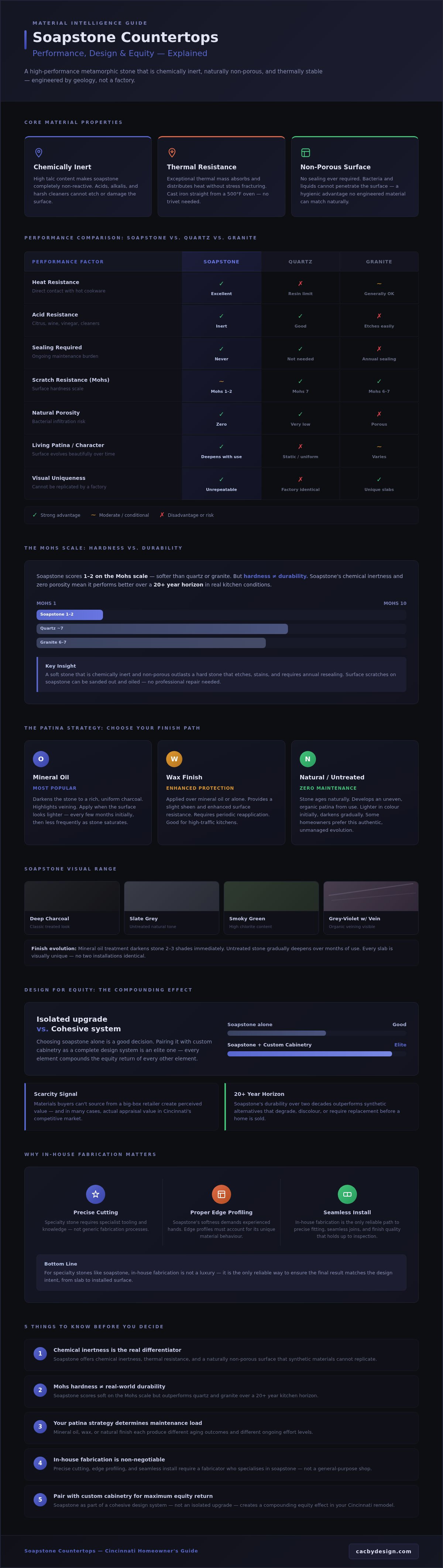
Soapstone countertops in Cincinnati are appearing more frequently in projects that integrate custom cabinetry as a complete system rather than as isolated upgrades. That pairing is deliberate. It's the same logic that drives a full kitchen remodel Cincinnati strategy: every element compounds the equity return of every other element. Choosing soapstone in isolation is a good decision. Choosing it as part of a cohesive design system is an elite one.
The Technical Advantage: Why Soapstone Outperforms Synthetic Surfaces
Forget durability as a vague concept. Let's talk about material science. Soapstone's performance advantages aren't marketing claims; they're the direct output of its mineral composition. High talc content creates a stone that is chemically inert, naturally non-porous, and thermally stable in ways that engineered quartz simply cannot match. These aren't overlapping benefits. They're compounding ones.
Heat Resistance as a Kitchen Utility
Soapstone has an exceptionally high thermal mass. That means it absorbs, distributes, and retains heat evenly without stress fracturing. A cast iron skillet pulled straight from a 500°F oven can go directly onto a soapstone surface. No trivet required. No risk of cracking, scorching, or discoloration.
Quartz can't make that claim. Engineered quartz is a resin-bonded composite, and that resin has a thermal ceiling. Sustained or sudden heat exposure can cause discoloration, warping, or surface cracking that voids most manufacturer warranties. The stone looks like stone. It doesn't perform like one. Soapstone does both.
This isn't a minor lifestyle upgrade. In a working kitchen, the ability to use your countertop as a functional heat-transfer surface changes how you cook. It's a utility advantage that compounds every single day.
Zero Sealing: The Low-Toxin Choice
Granite is porous. Marble is porous. Both require chemical sealers applied on a recurring schedule to prevent bacterial infiltration, staining, and moisture absorption. That's not a maintenance quirk; it's a structural limitation baked into the material.
Soapstone doesn't have this problem. Its density is high enough that liquids, acids, and bacteria have nowhere to go. The surface doesn't absorb. It repels. That's why soapstone countertops have been the standard in chemistry laboratories and medical facilities for generations. When sterility and chemical resistance are non-negotiable, soapstone is the specification.
The practical implications for a Cincinnati kitchen are direct:
No etching from acids. Lemon juice, vinegar, and wine don't chemically react with soapstone the way they destroy marble.
No sealer costs or scheduling. The material maintains its protective properties without chemical intervention.
No bacterial harborage. A non-absorbent surface is a genuinely more hygienic food prep environment.
For homeowners investing in soapstone countertops in Cincinnati, this means the material's performance is locked in from day one. It doesn't degrade without maintenance rituals. It just works.
If you want to see how soapstone's technical profile translates into a complete kitchen system, the team at Countertops and Cabinetry By Design can walk you through material selection alongside custom cabinetry options built to complement it.
Performance Comparison: Soapstone vs. Quartz and Granite
Here's where most comparison guides get it wrong. They treat hardness and durability as synonyms. They're not. On the Mohs scale, soapstone scores between 1 and 2, which sounds alarming until you understand what that number actually measures. Hardness quantifies scratch resistance from minerals. It says nothing about a material's resistance to heat, acids, bacteria, or the compounding wear patterns of a high-use kitchen. A diamond is a 10 on the Mohs scale. It's also catastrophically brittle under impact. Mohs hardness is one variable in a much larger performance equation, and in a kitchen context, it's not the most important one.
Durability is a 20-year calculation. It accounts for repairability, maintenance costs, thermal performance, and how the surface responds to real kitchen chemistry. Run that calculation honestly and soapstone wins the long game against both quartz and granite.
The repairability factor alone changes the ROI math. Soapstone scratches. Light scratches sand out with fine-grit paper in minutes. Deep scratches get the same treatment. No professional. No replacement slab. No insurance claim. Quartz doesn't offer that option. A crack or chip in an engineered surface is a permanent defect or a full replacement scenario. That asymmetry in repair cost is significant over a decade of actual kitchen use.
Soapstone vs. Granite: The Maintenance Debate
Granite requires annual sealing to maintain its stain resistance. Skip a cycle and the porous surface begins absorbing oils, wine, and acidic liquids at the microscopic level. That's not a hypothetical risk; it's the material's physical structure working against you. Soapstone has no such vulnerability. Its density eliminates the absorption problem entirely, which means no sealer costs, no scheduling, and no performance degradation between maintenance windows. For a high-performance Cincinnati kitchen, that's a meaningful operational difference. If you're evaluating both materials side by side, the full breakdown at granite countertops Cincinnati is worth reading before you finalize a specification.
Soapstone vs. Quartz: Aesthetics and Heat
Quartz has a visual ceiling. The patterns are manufactured, which means they're repeatable, predictable, and increasingly recognizable as synthetic. Soapstone's mineral veining is unrepeatable by definition. No two slabs read identically. That distinction matters in a luxury remodel where visual authenticity is part of the equity argument.
The heat performance gap is even sharper. Quartz is resin-bonded, and that resin has a documented thermal threshold. Sustained heat exposure risks discoloration and surface damage that most warranties exclude. Soapstone absorbs and distributes heat without structural stress. It's the difference between a surface that performs like stone and one that merely looks like it.
Choosing between these materials ultimately comes down to lifestyle. If you want a surface that stays pristine under careful management, quartz delivers that. If you want a surface that performs harder, ages with character, and doesn't punish you for cooking aggressively, soapstone countertops in Cincinnati are the stronger long-term specification.
Designing for Equity: Integrating Soapstone into Your Cincinnati Remodel
Material selection is one decision. Design integration is another. The homeowners who extract the most equity from soapstone countertops in Cincinnati don't treat the stone as a standalone upgrade. They engineer it into a cohesive system where every surface, finish, and hardware choice compounds the visual and financial return. That's the difference between a good remodel and an elite one.
The Cabinetry Connection
Soapstone's deep charcoal tones create a natural tension that cabinetry can either resolve or amplify. White oak is the strongest pairing right now in the Cincinnati market. The warm, linear grain of white oak against a dark soapstone surface creates contrast that reads as intentional and sophisticated without being trendy. Painted navies, particularly in matte or satin finishes, work equally well, reinforcing the stone's cool undertones and creating a monochromatic depth that photographs well and holds up in person.
Hardware is where the system gets finished. Brass and unlacquered copper accents do specific work here. They introduce warmth into a palette that could otherwise read as cold, and they age alongside the soapstone patina rather than fighting it. The result is a kitchen that looks more cohesive at year five than it did at installation. That's not an accident; it's material logic applied deliberately.
For homeowners in the northern Cincinnati corridor, the full breakdown of how to pair natural stone with custom cabinets in West Chester, OH is worth reading before you finalize any specification. The design principles translate directly to soapstone projects.
The Patina Maintenance Framework
You have two legitimate approaches to soapstone's finish, and both are defensible. The first is the mineral oil strategy. Apply food-safe mineral oil with a soft cloth, let it absorb for 20 to 30 minutes, then wipe the excess. Repeat weekly for the first month, then monthly after that. The stone darkens progressively and locks into a rich, uniform charcoal that stays consistent across the entire surface. It's a permanent aesthetic commitment, not a reversible one.
The second approach is simpler: leave it alone. Untreated soapstone develops its own natural patina through use, darkening unevenly in high-contact zones and staying lighter elsewhere. Many homeowners prefer this because it tells the actual story of the kitchen. It's not neglect; it's a deliberate design choice.
Either way, surface scratches are a non-issue. A light pass with 80-grit sandpaper erases most surface scratches in under a minute, with no professional required.
Edge profiles complete the picture. A chiseled or hand-worked edge highlights soapstone's texture in a way a polished bullnose never could. It signals craft. Pair that with an integrated soapstone sink and a matching backsplash, and the result is a monolithic stone environment that no tile or laminate alternative can replicate.
Ready to build this system from the ground up? The team at Countertops and Cabinetry By Design handles in-house fabrication and custom cabinetry together, so your soapstone and cabinet specifications are developed as a single, coordinated design decision rather than two separate guesses.
Engineering Your Renovation with Cincinnati's In-House Stone Experts
Soapstone is unforgiving of sloppy execution. Its density, its weight distribution, and its sensitivity to improper cutting all demand a fabricator who has worked the material before. Not watched a video. Not subcontracted it out. Actually worked it. That distinction matters more with soapstone than with almost any other surface material, and it's the first question you should ask any fabricator before you commit to a slab.
Outsourced fabrication introduces a chain of custody problem. When your stone leaves one facility, travels to a third-party shop, and arrives at your home through a separate installation crew, accountability fragments at every handoff. Nobody owns the outcome. Countertops and Cabinetry By Design eliminates that problem entirely. The in-house team of craftsmen handles fabrication and installation as a single, continuous workflow. One team. One standard. One outcome they're accountable for.
The Design-Build Advantage
Integrating stone fabrication with a broader remodel scope changes what's possible. When the same team speccing your soapstone countertops in Cincinnati is also coordinating your bathroom remodeling Cincinnati project, material decisions compound rather than conflict. Soapstone can carry through from kitchen to bath as a cohesive architectural thread, and that continuity adds a design coherence that disconnected contractors can't replicate.
Seam placement is where soapstone layouts get technically demanding. The stone's veining patterns and color variation mean seams need to be mapped against the actual slab before a single cut is made. Precision measurement technology removes the guesswork. Digital templating captures your kitchen's exact geometry, and the fabrication plan accounts for veining direction, slab thickness variation, and structural support requirements before anything hits the saw. That's not standard practice across the industry. It's the standard here.
Your Cincinnati Project Roadmap
First consultation prep matters. Bring what you have: rough sketches, cabinet door samples, hardware finishes, even photos of kitchens that caught your eye. The more context you bring, the faster the specification process moves. You don't need a finished design plan. You need enough to start a real conversation.
From initial consultation to completed installation, a high-performance stone project follows a defined sequence:
Slab selection: Evaluate actual stone in person, not digital renders. Texture, veining, and color read differently under showroom light than on a screen.
Digital templating: Precise field measurements lock in the fabrication plan and eliminate on-site surprises.
In-house fabrication: Cutting, edge profiling, and sink cutouts handled by the same craftsmen who understand soapstone's specific behavior under tooling.
Coordinated installation: Stone and cabinetry timelines aligned so neither trade is waiting on the other.
The showroom visit is the non-negotiable first step. You can't evaluate soapstone from a website. The tactile quality, the weight, the way the surface responds to touch — none of that translates digitally. That's the evaluation that changes the decision.
Schedule your high-performance design consultation today and bring your project to a team that owns the outcome from slab selection to final install.
The Stone That Earns Its Place: Your Next Move
The case for soapstone countertops Cincinnati homeowners are choosing isn't built on aesthetics alone. It's built on material science, long-term repairability, and a non-porous surface that outperforms synthetic alternatives in every real kitchen condition that matters. Pair that with a cohesive cabinetry system and you're not just upgrading a surface; you're engineering equity.
Execution is where most projects succeed or fail. Soapstone demands a fabricator who owns the outcome from slab selection through final installation. That's exactly what Countertops and Cabinetry By Design delivers: in-house craftsmen with over 20 years of Cincinnati renovation expertise, no outsourced labor, and seamless coordination between your stone and custom cabinetry specifications. One team. One standard. No accountability gaps.
The showroom visit is your first real decision. You can't evaluate this material from a screen. Start your soapstone project with a design consultation today and bring your kitchen the surface it deserves.
Frequently Asked Questions About Soapstone Countertops in Cincinnati
Does soapstone scratch easily, and can it be repaired?
Yes, soapstone scratches more readily than granite or quartz because of its high talc content and lower Mohs hardness rating. That's the honest answer. Here's the part most guides skip: those scratches are completely reversible. A light pass with 80-grit sandpaper removes surface scratches in under a minute, no professional required, no replacement slab, no insurance claim. That repairability is a structural advantage over engineered surfaces where a chip or crack is permanent.
Do I have to oil my soapstone countertops?
No. Oiling is a choice, not a requirement. Untreated soapstone develops its own natural patina through use, darkening unevenly in high-contact areas and staying lighter elsewhere. Many homeowners prefer this because it reflects actual kitchen history. If you want a uniform, deep charcoal finish from the start, food-safe mineral oil applied weekly for the first month and monthly after that achieves that result. Neither approach is wrong; they just produce different aesthetics.
Is soapstone more expensive than granite or quartz in Cincinnati?
Soapstone typically sits at a higher price point than standard granite and mid-range quartz, reflecting its specialty material status and the precision fabrication it demands. However, total cost of ownership tells a different story. No sealer purchases, no resealing labor, no professional scratch repair, and a lifespan that outlasts most synthetic alternatives all factor into the long-term calculation. Consult directly with a fabricator for current Cincinnati pricing rather than relying on industry averages, which shift with material availability.
Can I put hot pans directly on soapstone?
Yes, without reservation. Soapstone's high thermal mass allows it to absorb and distribute heat evenly without stress fracturing, discoloration, or surface damage. A cast iron skillet straight from a 500°F oven is a non-event on soapstone. This is a genuine functional advantage over resin-bonded quartz, which has a documented thermal threshold that most manufacturer warranties quietly exclude from coverage.
How do I clean soapstone countertops daily?
Warm water and mild dish soap applied with a soft cloth handles daily cleaning completely. Because soapstone is non-porous, there's no absorption to worry about and no need for specialty stone cleaners or pH-neutral formulas. Avoid abrasive scrubbing pads on oiled surfaces, as they can disrupt the patina you've built. For stubborn residue, a plastic scraper works without scratching the surface. That's the entire daily maintenance protocol.
Does soapstone harbor bacteria?
No. Soapstone's non-porous surface gives bacteria nowhere to penetrate or colonize. This is why soapstone countertops have been the specification standard in chemistry laboratories and medical facilities for generations, environments where surface hygiene is non-negotiable. For Cincinnati homeowners using their kitchen as a serious food prep environment, that's a meaningful hygiene advantage over porous materials like granite, which can harbor microorganisms in unsealed or under-sealed conditions.
Will soapstone countertops increase my Cincinnati home's value?
Soapstone countertops in Cincinnati contribute to perceived and appraised home value when they're part of a cohesive, high-quality remodel rather than an isolated upgrade. Buyers in competitive local submarkets like Mason and Hyde Park respond to materials they can't source from a big-box retailer; scarcity creates a value signal. The compounding effect is strongest when soapstone is paired with custom cabinetry as a complete system, where every element reinforces the quality of every other element.
What is the difference between 'oiled' and 'natural' soapstone?
The difference is purely aesthetic, not functional. Oiled soapstone has been treated with food-safe mineral oil, which accelerates and homogenizes the stone's natural darkening process, producing a rich, uniform charcoal finish across the entire surface. Natural soapstone is left untreated and darkens gradually and unevenly through use, creating an organic, varied patina. Both finishes are equally durable and non-porous; the choice comes down to whether you want a controlled, consistent look or one that evolves on its own timeline.


Comments