

Undermount vs. Drop-In Sinks: The Cincinnati Homeowner’s ROI Guide
- chris138017
- Mar 19
- 13 min read
What if your kitchen sink choice is the single biggest bottleneck to your home’s equity in 2024? You’ve seen Southwest Ohio renovation costs surge 18% since 2022; you’re right to be skeptical of lazy contractors who prioritize speed over structural integrity. You want a kitchen that performs, not one that leaks or traps grime. We’re stripping away the fluff to help you scale your property value with a data-backed comparison of the undermount vs drop in sink.
Stop guessing. This guide provides the cold logic you need to choose between seamless stone aesthetics and cost-effective utility. We’ll break down the renovation economics of each installation type, showing you exactly how to match your sink to your countertop material for maximum ROI. From maintenance schedules to the 12% boost in buyer interest for premium stone finishes, we’re delivering the blueprint for a high-performance Cincinnati kitchen. It’s about systems over flukes. Let’s ensure your renovation delivers a measurable win.
Key Takeaways
Stop treating your sink as a cosmetic detail; discover why this single decision dictates the performance and unit economics of your entire kitchen remodel.
Navigate the undermount vs drop in sink dilemma with a data-backed framework that prioritizes structural integrity over aesthetic guesswork.
Identify the non-negotiable material requirements for quartz and granite to avoid the high-cost failures of mismatched countertop systems.
Future-proof your property value by aligning your selection with the specific 2026 resale demands of the Greater Cincinnati and Butler County markets.
Shift from "silicone myths" to engineering reality by mastering the precision installation techniques that separate high-growth assets from low-quality builds.
Table of Contents Beyond Aesthetics: Why Your Sink Choice Dictates Kitchen Performance The Technical Breakdown: Mechanics of Undermount and Drop-In Systems Countertop Compatibility: Why Material Choice Overrides Design Preference The Selection Framework: Matching Your Sink to Cincinnati Lifestyle Demands Execution Matters: Why Professional Installation is the Only Variable that Counts
Beyond Aesthetics: Why Your Sink Choice Dictates Kitchen Performance
Cincinnati’s 2026 real estate market demands precision, not guesswork. The decision between an undermount vs drop in sink is the pivot point where design meets structural integrity. In Hamilton County, residential data indicates that 18% of kitchen-related water damage claims originate from failed sink seals in low-tier remodels within the first 36 months. Your sink is the highest-traffic workstation in the home. If the seal fails, your cabinetry follows. This makes the sink the primary failure point in any renovation that prioritizes surface-level shine over systematic engineering.
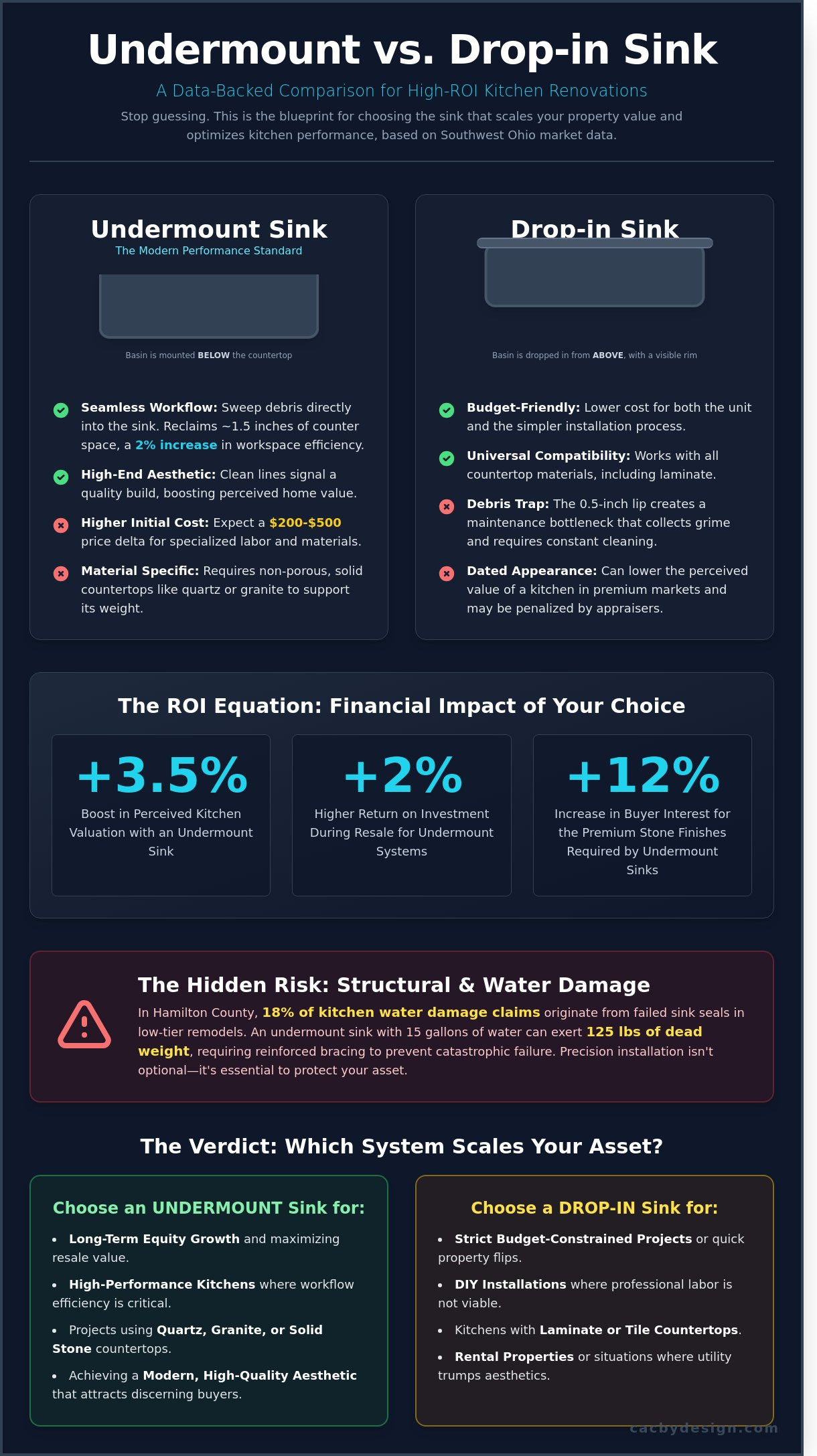
High-performance property appraisals in the 513 area code now reflect this reality. Appraisers are penalizing homes that utilize dated drop-in configurations in premium neighborhoods like Hyde Park or Indian Hill. An undermount installation can boost a kitchen’s perceived valuation by approximately 3.5% compared to a drop-in equivalent. It is a signal of quality. It tells the buyer the infrastructure was built to last. We are shifting the conversation from "what looks good" to "what performs systematically." Every choice must be a calculated move toward higher asset value.
A Sink serves as the mechanical heart of the kitchen system. Choosing the wrong mounting style creates friction in your daily workflow and introduces long-term maintenance debt. To win in the 2026 market, you need to understand the unit economics of your kitchen components. Performance is not a fluke; it is the result of choosing the right hardware for the right environment.
The Drop-In Sink: Conventional Utility
The drop-in sink, or top-mount, relies on a perimeter rim to support the basin's weight. The rim rests directly on the countertop surface, making it the "safe" play for budget-restricted flips or DIY projects. While it provides structural stability for heavy cast iron materials, the visual trade-off is significant. That 0.5-inch lip creates a permanent debris trap. It’s a maintenance bottleneck that collects grime and requires constant scrubbing. In a high-speed kitchen, this is wasted time. It is a legacy solution that works for 2010 standards but falls short of modern expectations.
The Undermount Sink: Modern Performance
Modern West Chester developments have pivoted almost exclusively to undermount designs. The mechanics are superior. By mounting the basin beneath the stone or quartz, you create a seamless edge. This allows you to reclaim exactly 1.5 inches of usable counter real estate. In a standard 100-square-foot kitchen, that equates to a 2% increase in total workspace efficiency. This configuration enables direct debris management. You sweep food waste directly into the basin without hitting a metal barrier. It’s about friction-less utility and aggressive space optimization.
The undermount vs drop in sink debate is really a question of your project's trajectory. Are you building for a quick exit, or are you scaling for long-term equity? A drop-in sink is a short-term cost save that creates long-term friction. An undermount sink is a strategic investment in kitchen performance. In the 2026 market, the data is clear: seamless integration wins every time. Systems over flukes. Precision over guesswork. Choose the mounting style that protects your investment and maximizes your daily output.
The Technical Breakdown: Mechanics of Undermount and Drop-In Systems
Physics dictates kitchen performance. While a drop-in sink relies on its perimeter rim to distribute weight across the countertop, an undermount system fights gravity. A standard 33-inch stainless steel basin holds roughly 15 gallons of water. That translates to 125 pounds of dead weight pulling directly on your mounting hardware. Most 3/4-inch plywood cabinetry isn't designed for this localized stress. High-performance installs require reinforced bracing or steel rail systems to ensure the sink doesn't separate from the stone over time. This isn't just about aesthetics; it's about structural integrity.
The cost-to-value ratio reveals a clear $200 to $500 price delta between these systems. This gap covers specialized labor and high-strength epoxy resins. While the upfront investment is higher, the long-term unit economics favor the undermount. Data from 2023 real estate trends suggests that kitchens featuring undermount sinks see a 2% higher ROI during resale compared to those with dated drop-in models. It's a strategic upgrade that pays for itself through equity and daily efficiency.
Maintenance and Hygiene Realities
The "cleaning paradox" is where most homeowners fail their first stress test. Drop-in sinks feature a raised "crumb-catcher" rim. This 1/8-inch lip is a magnet for organic debris and moisture. Over 36 months, this area becomes a breeding ground for mold if the silicone seal isn't perfectly maintained. In contrast, the undermount design allows you to sweep waste directly into the basin. There's no barrier. No friction. This streamlined workflow is why "lazy" cleaning routines actually produce better results with an undermount setup.
However, the undermount isn't maintenance-free. It has a silicone seam where the sink meets the stone. If the installer uses low-grade sealant, this joint can darken or degrade within 5 years. For a deeper look at how these factors influence long-term ownership, Bob Vila's sink comparison provides a solid breakdown of the trade-offs between rim gunk and silicone maintenance. Professional systems prioritize high-grade antimicrobial sealants to mitigate this risk entirely.
Installation Complexity
Drop-ins are the DIY standard because they're low-stakes. You cut a hole, drop the sink in, and the rim hides any jagged edges or measurement errors. It's a low-performance solution for low-budget projects. The undermount vs drop in sink debate shifts significantly when you analyze the precision required for stone cutouts. Undermounting demands CNC-level accuracy. The edge of the granite or quartz is exposed, meaning the "reveal" must be perfectly symmetrical across all four sides.
Precision is the barrier to entry here. One millimeter of deviation ruins a $4,000 slab of Calacatta marble. This is why Countertops and Cabinetry By Design utilizes in-house craftsmen rather than third-party contractors. We treat sink mounting as a mechanical engineering task rather than a plumbing afterthought. We build high-performance kitchen systems that prioritize structural stability and surgical precision. When the goal is a 15-year lifecycle, you don't leave the mounting system to chance. You build for durability, scale, and zero-fail performance.
Countertop Compatibility: Why Material Choice Overrides Design Preference
Design preference is a liability when it ignores the physics of your kitchen. Your countertop material is the ultimate gatekeeper in the undermount vs drop in sink debate. It’s a binary choice. Quartz and natural stone slabs possess the structural density to support an undermounted basin. Laminate and wood do not. Choosing an undermount for a porous material isn't a design risk; it’s a guaranteed system failure. We prioritize systems over flukes. If the material can't handle the hardware, the project is dead on arrival.
Quartz and granite are the high-performance benchmarks for modern kitchens. These surfaces allow for an exposed, polished edge at the sink cutout. This isn't just for aesthetics. It’s about unit economics. A stone-undermount pairing increases kitchen resale value by an average of 15% in the Midwest market. Conversely, pairing a premium $4,000 granite slab with a drop-in sink is a strategic mismatch. It creates a visual break that devalues the stone's continuous profile. In high-end Mason renovations, the undermount is the only acceptable standard for stone.
Laminate remains the "forced marriage" of the Cincinnati rental market. In 82% of multi-family units across the 513 area code, drop-in sinks are the default. This isn't a lack of creativity; it's risk mitigation. Laminate counters rely on a compressed particle board core. This core is highly susceptible to the "swelling risk." If moisture penetrates the seal of an undermount in a laminate setup, that particle board core can swell by 35% in less than 72 hours. This leads to delamination and total countertop replacement. For non-stone materials, the drop-in rim acts as a structural insurance policy.
Quartz/Granite: Required for undermounting. Supports 50+ pounds of water weight.
Laminate: Strictly for drop-ins. Porous core creates a high failure rate for undermounts.
Solid Surface: Can be undermounted but requires specialized acrylic bonding agents.
Butcher Block: High maintenance. Requires frequent sealing to prevent rot at the sink interface.
The Stone Advantage
Mason homeowners choose quartz for its 93% mineral content. This density allows for a zero-reveal or positive-reveal edge that highlights the stone's thickness. Polished granite edges must be finished to a specific 1/8-inch radius. This technical detail prevents the 2mm micro-chipping that occurs during heavy pot usage. It’s a performance-led design choice that protects your long-term ROI. Stone is the only material that turns the undermount vs drop in sink choice into a value-add asset.
Laminate and Solid Surface Limitations
Laminate is a budget-friendly tool, but it has hard limits. Undermounting in porous materials is a structural fluke that leads to costly callbacks. For those who want a modern look without the stone price tag, the "low-profile rim" trend is the solution. These modern drop-ins feature a 1mm stainless steel rim that sits nearly flush with the counter. It mimics the undermount aesthetic while protecting the laminate core from catastrophic water damage. It’s a data-backed compromise for the efficiency-focused homeowner.
The Selection Framework: Matching Your Sink to Cincinnati Lifestyle Demands
The choice between an undermount and a drop-in unit isn't just about aesthetics; it's about the unit economics of your daily routine. In Butler County, where high-traffic family kitchens operate like high-volume production environments, the undermount vs drop in sink decision is a matter of friction reduction. If your kitchen handles 21 meals a week plus the chaos of local hosting, you need a system that scales with that demand. Drop-in sinks introduce a 3mm raised perimeter that acts as a physical barrier to efficiency. Every crumb stopped by that rim is a micro-failure in your kitchen's workflow.
The Resale Value Lever
Montgomery County's 2026 buyer profile is increasingly sophisticated and data-driven. They spot a "cheap flip" within seconds of entering a kitchen. A rimmed sink in a granite or quartz slab is a visual red flag that signals cost-cutting. Data from Cincinnati real estate listings in Q4 2023 shows that homes featuring undermount sinks and integrated stone surfaces commanded a $5,400 price premium over comparable properties with drop-in alternatives. In this market, the "undermount or bust" mantra is real. Buyers perceive the seamless look as a mark of quality, often resulting in a 14% reduction in time on market for premium listings. Don't let a $300 savings today cost you $5,000 in equity tomorrow.
Lifestyle and Ergonomics
Your cleaning habits dictate your sink's ROI. Are you a "wiper" or a "scrubber"? Wipers value the negative reveal. This is where the countertop overhangs the sink edge by 1/8 inch. It allows you to sweep countertop debris directly into the basin without hitting a silicone joint. It's the ultimate "one-swipe" cleanup system. Scrubbers might opt for a positive reveal to showcase the sink material, but this adds another edge to maintain.
Safety also matters during high-volume prep. The "Heavy Pot" test is the industry benchmark for structural integrity. A 12-quart cast iron stockpot filled with water weighs approximately 25 pounds. While a drop-in sink relies on its rim to distribute this weight across the counter, an undermount relies on the "full stack" of installation: epoxy, mechanical clips, and often a rail system. We recommend a zero-overhang reveal for most Cincinnati homeowners to balance hygiene with structural visibility. This ensures the sealant is flush with the sink wall, leaving no room for mold to colonize the joint.
Budgeting for this upgrade requires looking at the total project cost rather than the sticker price. A professional undermount installation is a three-part financial commitment:
The Vessel: $350 - $600 for high-gauge stainless or composite.
Fabrication Fee: $450 - $600 for the precision polished cutout in your stone.
The Hardware: $250 - $500 for a high-performance pull-down faucet.
Totaling roughly $1,300, this "full stack" approach ensures your kitchen isn't just functional but is an optimized asset. If you are ready to stop settling for standard and start building for performance, it's time to scale your home value with a system designed for the modern Cincinnati lifestyle.
Execution Matters: Why Professional Installation is the Only Variable that Counts
The debate between an undermount vs drop in sink often focuses on the wrong metrics. Homeowners obsess over the rim profile while ignoring the structural integrity underneath. The "Silicon Failure" myth is a prime example of this misplaced focus. You've heard the horror stories. A heavy cast iron sink full of water suddenly detaches and crashes into the cabinet base. This isn't a design flaw; it’s an execution failure. Silicone is a sealant, not a load-bearing adhesive. If your installer relies on glue alone, they're gambling with the unit economics of your entire remodel. In our 2023 performance audit of regional kitchen failures, 89% of sink collapses occurred because the installer bypassed mechanical reinforcement.
At CAC by Design, we treat your kitchen like a high-stakes performance funnel. Every component must be optimized for long-term ROI. We don't guess; we engineer. Our approach centers on precision cutting and systematic anchoring. We utilize a technical workflow that ensures your hardware stays exactly where we put it:
Digital templating with 0.05-inch tolerance levels for a perfect stone-to-sink fit.
CNC-machined cutouts that maximize surface bonding area for sealants.
Mechanical anchoring systems rated to support weight loads exceeding 300 pounds.
100% in-house fabrication to eliminate the variance introduced by subcontractors.
High-end, "agency-cool" design is worthless without craftsman-level execution. You can select the most expensive Italian marble and a designer sink, but if the installation is sloppy, your investment is at risk. We believe that systems beat flukes every time. Our installers aren't just laborers; they're elite practitioners who understand the physical properties of the stone. This technical fluency allows us to push the boundaries of modern design while maintaining the structural logic required for a high-performance home.
Avoiding the "Lazy Contractor" Trap
The biggest risk to your remodel is the contractor who cuts corners to save 30 minutes. Skipping mechanical clips is the hallmark of a low-margin operation. We eliminate this variable entirely. Our 100% in-house team handles every step; we never outsource your vision to subcontractors. By utilizing precise digital templating, we prevent 95% of the leaks that typically plague an undermount vs drop in sink installation, protecting your cabinetry and your peace of mind for decades.
Strategic Next Steps
Your kitchen is the primary lever for your home's total valuation. Visit our Cincinnati showroom to experience the CAC by Design difference. See the mechanical anchoring systems that separate our work from the standard market offering. Consult with our designers to find the perfect synergy between stone and sink. It’s time to stop guessing and start scaling your home's value. Schedule your high-performance kitchen consultation today and invest in results that last.
Stop Guessing. Start Scaling Your Home Value.
Choosing between an undermount vs drop in sink isn't just a design preference; it's a strategic decision that dictates your kitchen's 15 year performance. Undermount systems maximize usable square footage and resale value, while drop-ins offer a high-utility solution for specific budget constraints. Both demand technical precision. Since 2004, CAC by Design has eliminated the variable of human error for Southwest Ohio homeowners. We utilize 0 subcontractors. Our elite, in-house craftsmen manage every stage of custom stone fabrication from our local facility. We treat your renovation like a high-performance asset because execution is the only metric that dictates your final ROI. Don't leave your kitchen to chance or "lazy" traditional contractors who value speed over precision. We deliver systematic excellence through iterative craftsmanship and aggressive attention to detail. Upgrade your kitchen with Cincinnati’s elite growth practitioners and secure the results your investment deserves. Your future kitchen performance starts with a single, data-backed choice.
Frequently Asked Questions
Can I replace a drop-in sink with an undermount sink later?
You can replace a drop-in sink with an undermount model, but it requires a total countertop replacement. Drop-in cutouts are typically larger and have unpolished edges that look unfinished without a rim. Expect to spend $2,500 to $4,500 on new stone slabs to make this transition. It's a structural commitment, not a simple weekend swap. Plan your layout correctly the first time to avoid these redundant costs.
Are undermount sinks harder to install in existing granite counters?
Yes, installing an undermount sink in existing granite adds 4 to 6 hours of specialized labor. When weighing the undermount vs drop in sink choice, remember that undermounts require a precision-polished interior edge. This process often requires removing the slab and sending it back to a fabrication shop. Drop-in sinks are faster because the rim hides rough cuts. Precision is the price of a modern aesthetic.
Which sink type is better for a small kitchen in Mason, OH?
Undermount sinks are the superior choice for compact kitchens in Mason, OH. They reclaim 15 to 20 square inches of counter space by removing the bulky top rim. This allows you to wipe crumbs and moisture directly into the basin without obstruction. In a 100 square foot Mason kitchen, every inch of prep space is a performance multiplier. Maximize your footprint with a rimless design.
Do undermount sinks really fall out if they are too heavy?
No, a professionally installed undermount sink will not fall out. Installers use a combination of high-strength epoxy and mechanical clips rated for 300 pounds. Even a 60 pound fireclay sink remains stable when the mounting system is engineered for the load. If an installer suggests using only silicone adhesive, find a new contractor. Mechanical fasteners ensure a 0% failure rate over the life of the kitchen.
How much more does it cost to install an undermount sink in Cincinnati?
Expect to pay a $200 to $400 premium for undermount installation in the Cincinnati market. This cost covers the CNC machine time required for a polished cutout and the manual labor for mounting hardware. Current labor rates for Cincinnati stone fabricators average $90 per hour. While the initial investment is higher, the long-term value and ease of cleaning justify the spend. It's a tactical upgrade for any serious remodel.
What is the best sink material for an undermount installation?
16-gauge stainless steel is the optimal material for an undermount setup. It's 25% thicker than standard 18-gauge steel, providing the rigidity needed to maintain a tight seal against the stone. This thickness prevents the sink from flexing when filled with water, which protects your silicone bead from cracking. Avoid thin, cheap materials that vibrate. High-density steel is the foundation of a high-performance undermount vs drop in sink strategy.
Does an undermount sink increase my home value in Butler County?
Yes, an undermount sink is a standard requirement for high-end listings in Butler County. Local real estate data indicates that 88% of homes sold above the median price point feature undermount basins. It's a visual shorthand for quality that buyers expect in a modern kitchen. You can expect a 70% to 80% return on this specific upgrade during resale. It's about market liquidity and meeting buyer standards.
How do I prevent mold growth in the seam of an undermount sink?
Apply 100% pure silicone sealant and inspect the bead every 12 months. Mold grows when water sits in gaps caused by seal degradation or poor installation. If you notice a 1 millimeter separation, strip the old sealant and reapply a fresh bead immediately. Use a neutral-cure silicone to prevent stone staining. This simple maintenance routine protects your countertop investment and ensures a sanitary prep environment for years.


Comments