
What Not to Do When Remodeling a Bathroom: The High-Performance Guide to Avoiding Costly Failures
Updated: Jul 22
Your Pinterest board is a liability until you understand the mechanics of moisture and load-bearing layout. Most renovations fail because they prioritize the "look" over the logic of plumbing and humidity resistance. Knowing exactly what not to do when remodeling a bathroom is the difference between a high-yield asset and a $25,000 mistake. You want a spa-like sanctuary that increases your Cincinnati home's equity, not a cramped room with moldy grout and hidden leaks. With plumbing labor rates up 10% in 2026, one wrong move can evaporate your budget before the tile even arrives.
It's frustrating when contractors overpromise or materials degrade in high humidity. We understand the pressure to deliver a high-performance space without the typical change-order fatigue. This guide eliminates the friction of failed renovations by identifying the critical planning and execution errors that destroy bathroom equity. We'll show you why a 25% contingency fund is non-negotiable and how to avoid the layout traps that make modern bathrooms feel cramped. We'll dissect material failures and contractor red flags so you can build for durability and maximum ROI. Stop guessing and start executing with precision.
Table of Contents
The Financial Friction of Bathroom Remodeling Mistakes
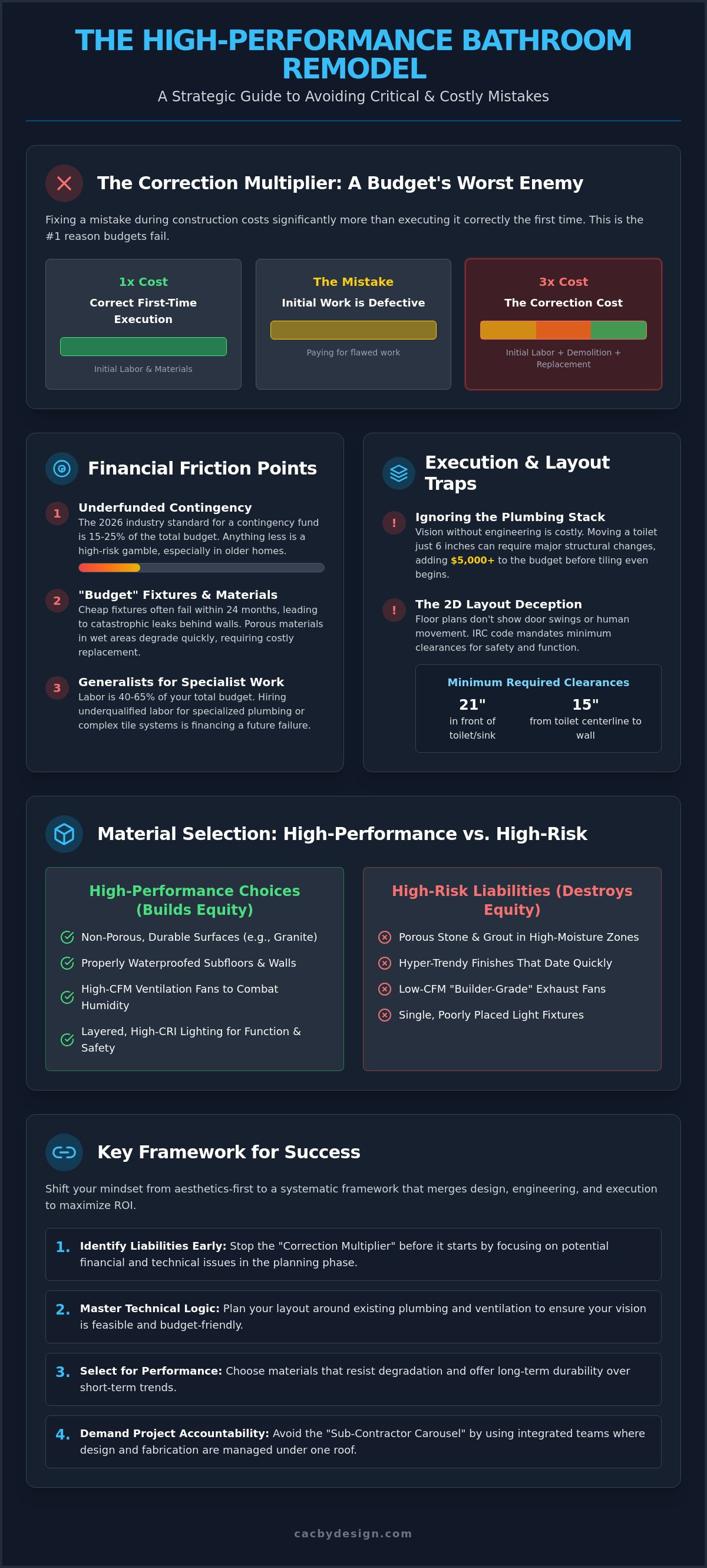
A bathroom remodel isn't a cosmetic hobby. It's a capital investment. If you approach it without a clear strategy, your budget will bleed through technical inefficiencies. Successful asset management starts with understanding the renovation process as a series of technical milestones rather than just aesthetic choices. Errors in this environment aren't just aesthetic; they are financial liabilities that subtract from your home's total value.
We focus on the "Correction Multiplier." Fixing a mistake during construction costs roughly three times more than executing it correctly the first time. You're paying for the initial labor, the demolition of the failure, and the replacement materials. Identifying what not to do when remodeling a bathroom early in the planning phase protects your liquid capital. In our local market, cincinnati oh bathroom remodeling should prioritize driving equity through high-performance engineering rather than just luxury aesthetics. With plumber rates rising 8-10% in 2026, every hour of rework is a direct hit to your ROI.
Ignoring structural water damage during the initial demolition phase.
Underfunding the contingency budget; the 2026 standard is 15-25%.
Selecting porous materials with high maintenance requirements for wet areas.
Hiring generalists for specialized plumbing or high-end tile systems.
The True Cost of 'Budget' Shortcuts
Cheap fixtures are a trap. They often fail within 24 months, leading to catastrophic leaks behind the walls. In older Cincinnati homes, the biggest hidden expense is the non-waterproofed subfloor. Saving money on a cut-rate installer leads to long-term maintenance debt. Since labor accounts for 40% to 65% of your total budget, hiring generalists for specialized systems is a strategic error. When you underpay for labor, you're essentially financing a future failure at a high interest rate.
To see how a Class A contractor applies high-performance standards to larger structural projects, you can read more about the home addition process at Coastal Contracting.
Equity-First Design Principles
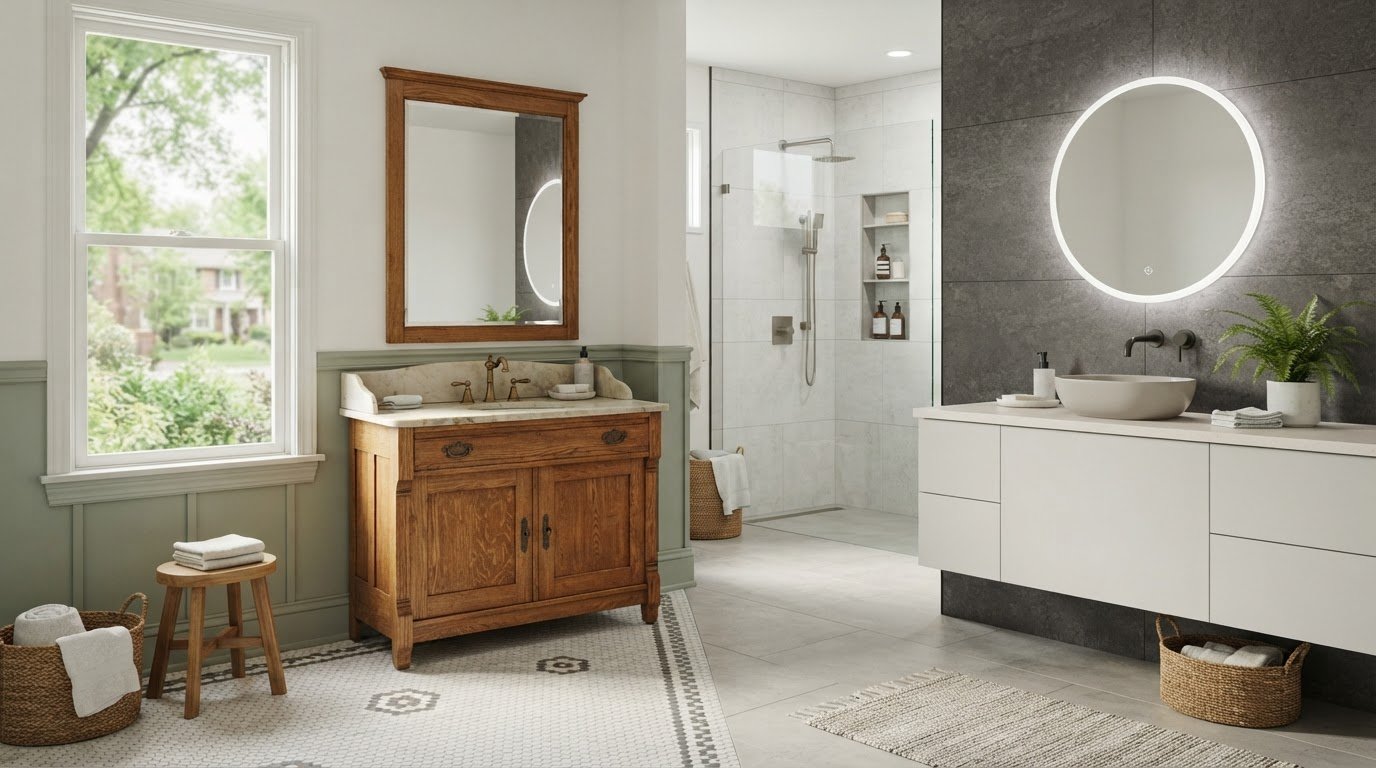
Stop chasing hyper-trendy aesthetics that will look dated by 2028. High-performance design prioritizes durability and timelessness. Direct your capital toward high-touch surfaces that command attention during a resale. Investing in granite countertops cincinnati provides a tangible ROI because the material survives the high-moisture environment of a primary bath. Pair these with custom bathroom cabinets to maximize every square inch of usable space. Understanding what not to do when remodeling a bathroom means distinguishing between vanity spending and value building.
Planning Failures: Why Your Vision Collapses in Execution
Vision without engineering is a hallucination. When considering what not to do when remodeling a bathroom, ignoring the plumbing stack is the fastest way to blow a budget. Moving a toilet just six inches often requires structural modifications to floor joists or complex rerouting of main vent lines. This decision can easily trigger a $5,000 cost spike before you've even selected your tile. Plan your layout around existing wet walls to keep your capital focused on high-visibility upgrades like premium stone or custom cabinetry.
Ventilation is equally critical. Ohio summers are notoriously humid. Standard, low-CFM exhaust fans fail to move enough air to prevent moisture migration into your drywall and vanity. If your fan doesn't clear the mirrors within minutes, you're financing a future mold problem. Similarly, lighting isn't an aesthetic finishing touch. It's a technical requirement. You need layered lighting with high Color Rendering Index (CRI) values to ensure the space is functional for grooming and safe for movement. Poorly placed lighting creates shadows that make even the most expensive marble look dull.
The Layout Trap: Thinking in 2D
Floor plans are deceptive. A 2D drawing doesn't account for door swings, drawer clearances, or the reality of human movement. In historic Hamilton County homes, every inch is contested territory. You must adhere to bathroom remodeling cincinnati standards to ensure long-term usability. This includes maintaining the IRC-mandated 21 inches of clear space in front of toilets and sinks, and ensuring toilets have at least 15 inches of space from their centerline to any wall. Even a luxury shower must meet the 900-square-inch interior minimum. Failing to account for these clearances makes the room feel cramped and creates friction in your daily routine.
Storage Miscalculations
Pedestal sinks are an equity killer in primary bathrooms. They offer zero storage and zero countertop utility. Off-the-shelf vanities are slightly better but still waste nearly 30% of potential storage due to standardized manufacturing. High-performance renovations utilize custom bathroom cabinets cincinnati to solve layout bottlenecks. Custom cabinetry allows for specialized storage like pull-out styling stations and integrated hampers that off-the-shelf models can't provide. If you're struggling to fit a modern lifestyle into a legacy footprint, consulting with a technical designer can identify storage opportunities you've likely overlooked.
Material Selection Regrets: Avoiding Low-Performance Surfaces
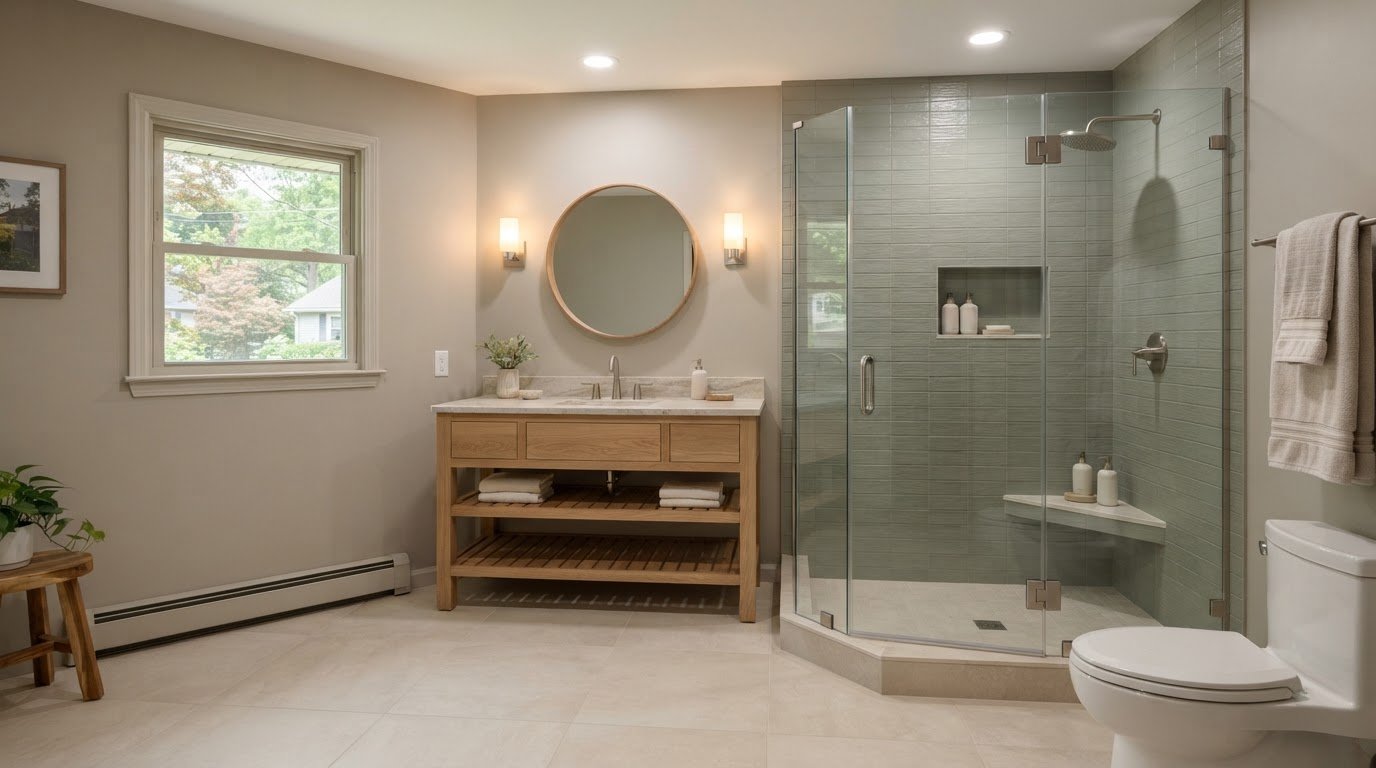
Aesthetic appeal is a vanity metric. Performance is a financial one. Choosing materials based solely on visual trends is exactly what not to do when remodeling a bathroom if you value long-term equity. Natural stone like marble or travertine offers a high-end look but carries a heavy maintenance debt. These materials are porous. Without professional sealing and aggressive upkeep, they absorb moisture, trap bacteria, and eventually degrade in the high-humidity environment of a shower. High-performance renovations prioritize non-porous alternatives like quartz or large-format porcelain slabs to eliminate these technical failure points.
Quartz has become the industry standard for a reason. It offers the aesthetic of natural stone with the engineering of a synthetic, non-porous surface. While marble etches and stains from daily grooming products, quartz remains resilient. However, the material is only as good as the structure beneath it. "Big box" cabinetry often utilizes particle board cores that lack the structural integrity required to support heavy stone or quartzite slabs. In a bathroom, moisture causes particle board to swell and delaminate. This leads to a total system failure within years. High-performance builders use plywood substrates to ensure the cabinet box remains stable under the weight of premium stone.
Minimize grout lines by utilizing large-format porcelain slabs to reduce maintenance.
Prioritize plywood cabinetry construction to resist humidity-induced swelling.
Select hardware with moisture-resistant finishes to prevent corrosion.
Avoid unsealed natural stone in direct "wet zones" to prevent staining and mold.
Countertop Fabrication: More Than Just a Slab
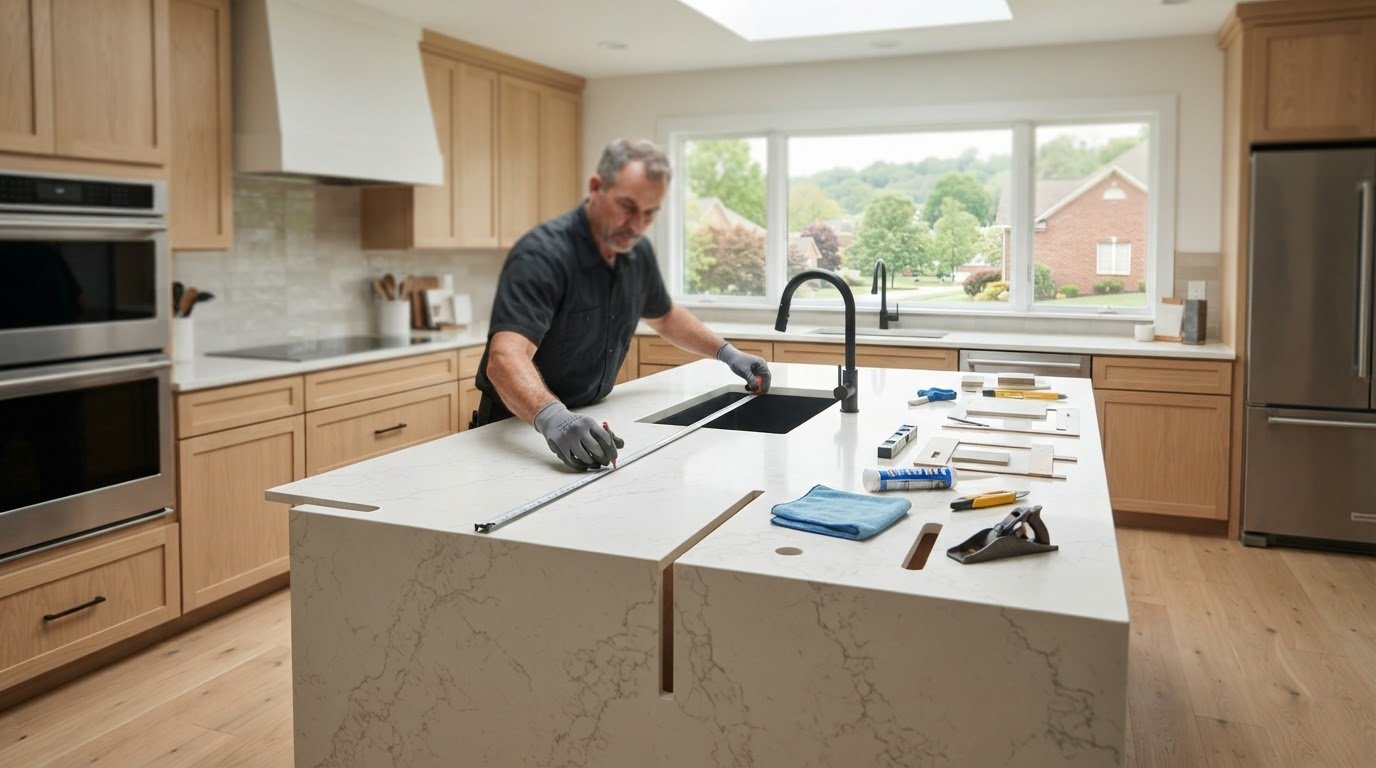
A raw slab is a liability. It only becomes an asset through professional fabrication. Poor edge polishing and improper seam placement are common indicators of low-tier labor. These errors lead to chipping and structural cracks under the weight of sinks or faucets. If you are searching for quartzite countertops near me, ensure the fabricator uses precision CNC systems. Professional fabrication ensures that seams are tight and edges are engineered to withstand the impact of daily use. Heat and chemical resistance are non-negotiable in a high-performance bath where hot styling tools and acidic cleaners are the norm.
Cabinetry Engineering
Identifying what not to do when remodeling a bathroom requires looking inside the cabinet box. Low-cost cabinetry relies on staples and glue. High-performance units use dovetail joints and plywood substrates. Plywood offers superior screw-holding power and resists the swelling risk inherent in Ohio's seasonal humidity shifts. Don't overlook the hardware. Cheap hinges and drawer slides ruin the user experience. They cause expensive custom doors to sag or misalign. A cohesive look requires matching finishes across different substrates. This ensures your hardware, faucets, and lighting exist in a single, unified design language that projects quality and commands a higher resale value.
The Labor Gap: Why Professional Systems Beat Generalists
Hiring a generalist is high on the list of what not to do when remodeling a bathroom. Generalists often manage by proxy. They rely on the "Sub-Contractor Carousel," where fragmented labor leads to total timeline collapse. When your plumber, electrician, and tile installer operate as independent entities, accountability disappears. In-house craftsmen offer a level of precision that day laborers cannot match; for example, the high-quality wall and floor tiling standards maintained by Kroll Interiors illustrate why specialized expertise is essential for a durable finish. If a technical failure occurs, an in-house team owns the resolution. A generalist simply blames the sub-contractor, leaving you to mediate the conflict and pay for the delay.
Permitting in Cincinnati is a non-negotiable step for protecting your home equity. Unlicensed work is a massive red flag that kills resale value. Homebuyers in 2026 are data-obsessed. They'll audit permit histories before signing a contract. If your high-end primary bath lacks the proper legal paper trail, it becomes a liability during the home inspection. A single-point-of-contact project manager ensures these technical and legal requirements are met. They bridge the gap between the design vision and the physical site, removing the burden of micromanagement from the homeowner.
The Design-Build Advantage
Friction between architects and installers is the primary driver of change-order fatigue. The design-build model eliminates this "He Said, She Said" dynamic by housing both functions under one roof. As leading home renovation contractors cincinnati, we use integrated systems to streamline material procurement. Digital templating for custom stone and cabinets ensures the physical build matches the digital plan with sub-millimeter accuracy. This systematic approach prevents the installation errors that occur when hand-drawn plans meet real-world plumbing constraints.
Vetting Your Installation Team
Contract red flags are easy to identify if you look for gaps. Vague labor descriptions and the absence of a firm completion date are warnings of future friction. Vetting your team is a critical step in learning what not to do when remodeling a bathroom. Don't settle for a visit to a glossy showroom. Demand to see the fabrication facility where your materials are processed. High-performance results require specialized craftsmen kitchen and bath experts. These practitioners understand the chemistry of modern adhesives and the mechanics of advanced waterproofing systems.
Ready to eliminate the labor gap and build a high-performance space? Partner with our in-house team for your next renovation.
Scaling Equity: The High-Performance Remodel Framework
Transitioning from a list of failures to a blueprint for success requires a shift in mindset. You've identified what not to do when remodeling a bathroom, but knowing the pitfalls is only half the battle. High-performance equity scaling requires a repeatable framework that replaces guesswork with engineering. Our CAC By Design methodology eliminates the variables that lead to budget creep and structural failure. We integrate design, fabrication, and installation under a single operational roof. This vertical integration ensures that the technical specifications of your quartz countertops or custom cabinetry aren't lost between the drawing board and the job site. By controlling the entire supply chain, we eliminate the friction that typically destroys project timelines.
Prioritizing your budget for maximum impact means focusing on the elements that drive the highest ROI. In the 2026 market, this involves a strategic marriage of aesthetic innovation and financial logic. Don't overspend on hyper-trendy fixtures that offer zero long-term value. Instead, invest in the structural and material integrity of the space. High-touch surfaces like quartzite or granite, paired with precision-engineered cabinetry, serve as the primary levers for financial results. This systematic approach ensures your renovation is a high-yield asset rather than a depreciating expense. It’s time to move beyond the defensive planning of avoiding mistakes and start executing a growth-oriented strategy.
Your 2026 Remodel Roadmap
Success is a product of sequence. Phase 1 begins with a technical assessment and material selection. We don't just look at colors; we audit your plumbing capacity and subfloor stability to prevent the "Correction Multiplier" from draining your capital. Phase 2 moves to custom fabrication. Your stone slabs and bathroom cabinets are processed in our local facility using digital templating to ensure sub-millimeter accuracy. Phase 3 is the precision installation. Our in-house teams execute the build, maintaining total accountability for every joint, seam, and seal. This three-phase roadmap ensures that your vision survives the transition from concept to reality without the typical change-order fatigue.
Experience the CAC Difference
National franchises often lack the local nuance required for Cincinnati's diverse architectural landscape. As a family-owned entity, we prioritize market-specific performance over corporate volume. Visit our showroom to see the synergy of stone and wood in person. You'll see exactly how custom fabrication solves the storage and layout traps that make standard remodels feel cramped. Stop researching what not to do when remodeling a bathroom and start building with a partner that understands the mechanics of digital growth and physical equity. Your high-performance renovation starts with a technical strategy session. Schedule Your Cincinnati Bathroom Remodel Consultation today to secure your place on our 2026 production calendar.
Execute with Precision: Your High-Performance Bathroom Strategy
A bathroom renovation is either a high-yield asset or a financial liability. Success depends on your ability to prioritize technical engineering over superficial trends. By identifying what not to do when remodeling a bathroom, you've moved past the creative guesswork that sinks most budgets. You now understand that moisture resistance, structural integrity, and integrated labor systems are the true drivers of home value. Don't let your vision collapse during the execution phase by settling for fragmented sub-contractors or low-performance materials.
We provide the framework for seamless execution. Our family-owned Cincinnati legacy, established in 2004, is built on a foundation of technical mastery and results-driven design. We utilize an in-house fabrication facility and digital templating to achieve 1/16th inch precision. This ensures your custom stone and cabinetry fit perfectly every time. Stop managing the friction of a failed remodel and start building for durability and aesthetic dominance. Engineered Equity: Start Your Cincinnati Bathroom Remodel with CAC By Design. Your future primary suite is ready to be built with precision.
Frequently Asked Questions
What is the #1 mistake people make when remodeling a bathroom?
The #1 mistake is prioritizing aesthetics over technical engineering and moisture management. Homeowners often blow their budget on high-end tile while ignoring a failing plumbing stack or inadequate ventilation. This is a primary example of what not to do when remodeling a bathroom because it leads to structural failure within years. High-performance projects invest in the invisible infrastructure first to protect the visual assets.
Is it cheaper to buy bathroom cabinets from a big-box store or custom?
Big-box cabinets are cheaper upfront but represent a long-term financial liability. These units often use particle board that swells and delaminates in high-humidity environments. Custom bathroom cabinets utilize plywood substrates and superior joinery designed to support heavy stone slabs. Choosing custom is a strategic move to increase home equity and eliminate the cost of premature replacement.
Can I move the location of my toilet or shower in a remodel?
You can move a toilet or shower, but it's one of the most expensive engineering choices in a renovation. Relocating a toilet even a few inches requires rerouting the main waste line and potentially cutting into floor joists. Unless the current layout creates a significant functional bottleneck, keeping the plumbing in its original wet wall is the most efficient way to scale your ROI.
Why is my bathroom remodel taking longer than the contractor promised?
Timeline collapse is usually a symptom of the "Sub-Contractor Carousel" and fragmented labor. When a generalist hires independent subs, one delay in plumbing triggers a domino effect across the entire project. High-performance teams use in-house craftsmen to maintain a rhythmic schedule. This eliminates the downtime between trades and ensures the project moves toward completion with systematic speed.
Do I need a permit for a bathroom remodel in Hamilton County?
Yes, most bathroom renovations in Hamilton County require permits for plumbing, electrical, and structural changes. Skipping the permit process is a major part of what not to do when remodeling a bathroom because it creates a legal liability during resale. Licensed contractors manage the permit and inspection process to verify that your build meets the International Residential Code (IRC) standards.
Which countertop material is best for a high-use master bathroom?
Quartz is the superior choice for high-use primary bathrooms due to its non-porous nature and chemical resistance. Unlike marble or granite, quartz doesn't require annual sealing and won't etch from contact with acidic grooming products. It provides the aesthetic of natural stone with the engineering of a high-performance synthetic, making it the most durable surface for maximizing master bath equity.
How do I avoid mold and mildew issues after a renovation?
Preventing mold requires a combination of high-CFM ventilation and non-porous surface selection. If your exhaust fan doesn't clear the room of steam within minutes, you're financing a future mold problem. Combine an oversized fan with large-format porcelain slabs or quartz surfaces to minimize grout lines. Reducing porous surface area is the most effective technical solution for maintaining a sterile, high-aesthetic environment.
Should I replace my bathroom vanity or the whole cabinetry system?
You should replace the entire cabinetry system to ensure structural stability for modern stone countertops. A new vanity on top of old, water-damaged boxes is a recipe for system failure. Replacing the whole system allows you to optimize storage with custom configurations like pull-out styling stations. This ensures that your new granite or quartz tops are supported by a stable, moisture-resistant plywood foundation.

Comments