
Choosing the Right Kitchen Sink and Faucet: A High-Performance Guide to 2026 Renovations
- chris138017
- Jun 30
- 10 min read
Updated: Jul 24
Your five-figure quartzite slab is only as valuable as the hardware you mount to it. A cheap faucet or an improperly fitted sink isn't just an eyesore. It's a mechanical liability that threatens your home equity. Most homeowners obsess over the stone and treat the plumbing as an afterthought. This is a strategic error. When choosing the right kitchen sink and faucet, you're selecting the high-frequency touchpoints that define your daily workflow and long-term ROI.
We understand the anxiety of a high-stakes Cincinnati renovation. You want a setup that resists clogs, eliminates leaks, and maintains a premium finish against expensive stone surfaces. This guide provides the data-driven framework needed to align technical performance with modern aesthetics. You'll learn how to navigate 2026 workstation trends and 1.8 GPM flow regulations without sacrificing design. We're stripping away the fluff to help you build a high-performance kitchen that delivers maximum value and zero friction.
Table of Contents
Beyond Aesthetics: Why Sink and Faucet Selection is a Strategic Equity Lever
Engineering the Basin: Selecting Sink Materials and Mounting Systems
The Mechanics of Flow: Faucet Technology and Internal Architecture
Integration Strategy: Matching Fixtures with Premium Quartz and Granite
Execution and ROI: Why Professional Integration Outperforms Standalone Hardware
Beyond Aesthetics: Why Sink and Faucet Selection is a Strategic Equity Lever
Your kitchen sink isn't just a basin. It's the "High-Frequency Command Center" of your home. It's the engine room where every meal begins and ends. Choosing the right kitchen sink and faucet is a strategic decision that dictates the functional lifespan of your entire renovation. In 2026, high-performance design prioritizes integrated utility over superficial "statement" pieces. If your hardware fails, your expensive stone surfaces become useless. This is why fixtures are the ultimate equity lever in a modern kitchen.
Financial logic dictates that your fixtures must match the tier of your countertops. Installing a budget faucet on a premium granite island creates a "valuation gap." Prospective buyers notice when the hardware doesn't match the stone's pedigree. Integrated performance is the 2026 standard. This means selecting sinks with built-in ledges and faucets with internal components that won't degrade. By treating these fixtures as strategic assets, you maximize the ROI of every square foot in your kitchen.
The Daily Interaction Metric
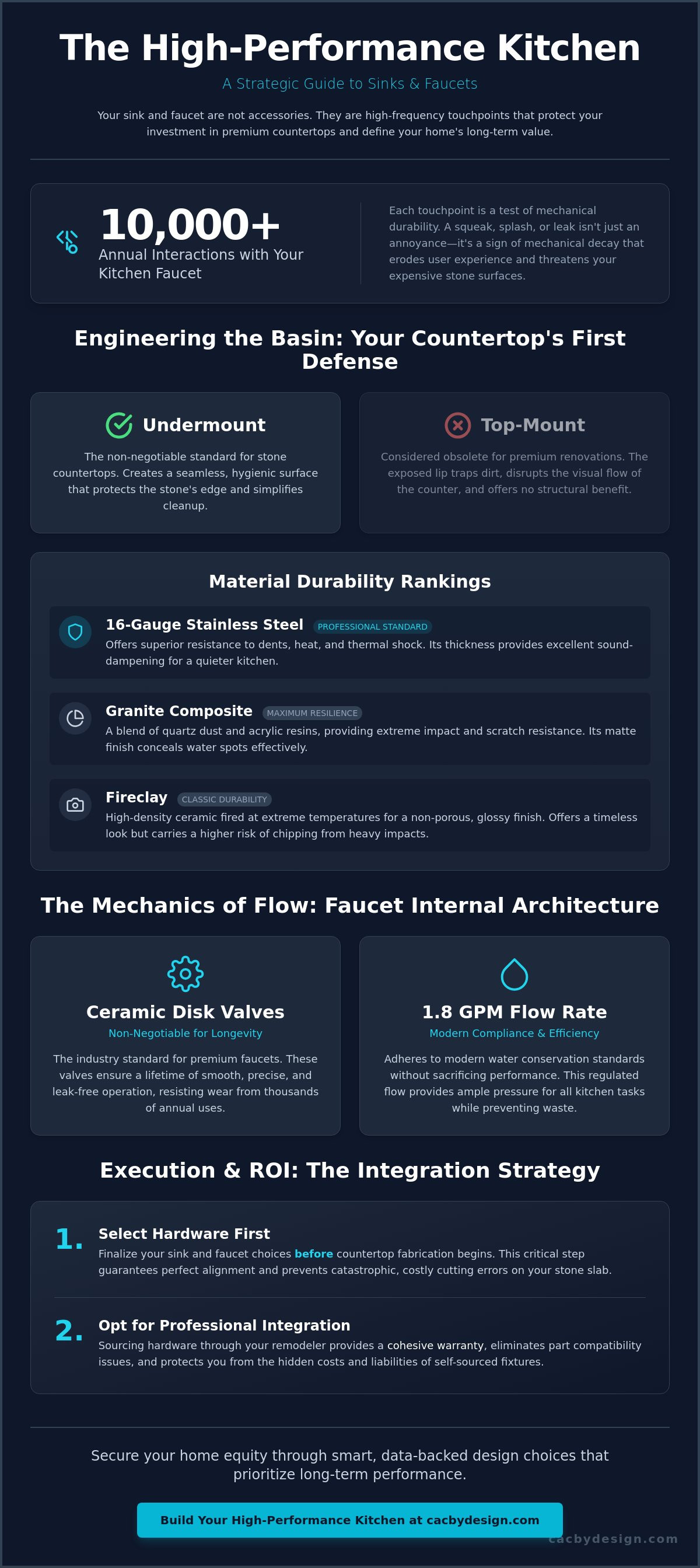
A standard Cincinnati household interacts with the kitchen faucet between 20 and 40 times per day. This adds up to over 10,000 annual touchpoints. Every squeak, splash, or stiff handle is a micro-friction point that erodes the user experience. Ergonomic failure isn't just annoying; it's a sign of mechanical decay. When evaluating faucet technology and internal architecture, look for ceramic disk valves. They offer the precision and durability required for high-traffic environments. A performance-first baseline ensures your kitchen remains an asset rather than a maintenance headache.
Fixtures as Valuation Anchors
Fixtures serve as the visual and mechanical anchors of your kitchen. High-end materials like 16-gauge stainless steel or fireclay do more than look good. They signal quality to future buyers. A thin, 22-gauge sink sounds hollow and feels cheap. It suggests you cut corners elsewhere. This "Visual Asset" theory is critical when planning a kitchen remodel Cincinnati project. You must balance the faucet height with your cabinetry proportions to maintain a cohesive scale. Skimping on these components accelerates the depreciation of your entire remodel. Premium fixtures protect your investment by ensuring the most used part of the room remains pristine and functional for decades.
Engineering the Basin: Selecting Sink Materials and Mounting Systems
Engineering a high-performance kitchen requires moving beyond superficial finishes. The basin is the structural foundation of your cleanup zone. Choosing the right kitchen sink and faucet involves evaluating material density and mounting precision to avoid premature failure. According to the latest 2026 renovation trends, homeowners are shifting toward integrated workstations that prioritize long-term durability over low-cost alternatives. If your sink fails, your entire stone slab is at risk.
Material Durability Rankings
When choosing the right kitchen sink and faucet, the material gauge is your primary performance metric. 16-gauge stainless steel remains the industry benchmark. It offers superior resistance to thermal shock and denting compared to thinner 18-gauge options. Fireclay and porcelain deliver a classic aesthetic but carry a higher risk of chipping under heavy use. For active families, granite composite provides the most resilient surface. It resists scratches and heat while offering a matte finish that conceals water spots.
16-Gauge Stainless Steel: The professional standard for resilience and sound-dampening.
Fireclay: High-density ceramic fired at extreme temperatures for a non-porous, glossy finish.
Granite Composite: A blend of quartz dust and acrylic resins designed for extreme impact resistance.
Mounting Systems and Countertop Integrity
Top-mount sinks are obsolete for high-performance stone surfaces. They create a dirt-trapping lip and disrupt the visual flow of your quartz or granite. Undermount systems are the non-negotiable standard. They allow for seamless cleanup and protect the raw edges of the stone. If you opt for an apron-front or farmhouse style, ensure your custom cabinets West Chester OH are engineered to handle the massive weight of a water-filled fireclay basin. Structural reinforcement is mandatory to prevent cabinet sag over time.
Basin geometry also dictates workflow efficiency. Single-bowl sinks currently dominate the market. They offer the volume needed for large cookware and professional-grade baking sheets. If you value a quiet environment, verify that your sink features heavy-duty rubber sound-dampening pads. This technology eliminates the tinny echoing common in lower-tier products. A well-engineered basin should feel solid and sound silent during high-pressure rinsing. Before you finalize your layout, consult with a design specialist to ensure your hardware and stone are perfectly synchronized.
The Mechanics of Flow: Faucet Technology and Internal Architecture
A faucet is more than a design statement. It's a precision-engineered valve that manages thousands of gallons annually. When choosing the right kitchen sink and faucet, the internal architecture determines whether you'll face a leak in three years or thirty. Ceramic disk valves are the non-negotiable standard for 2026. Unlike rubber washers that degrade, ceramic disks provide a near-diamond-hard seal. This technology eliminates drips and ensures smooth handle operation under high pressure. It's the technical floor for any high-performance renovation.
Internal Valve Systems
Cincinnati's water supply carries specific mineral profiles that can be aggressive on plumbing hardware. Hard water buildup often compromises traditional compression valves, leading to premature mechanical failure and restricted flow. Ceramic disks resist these deposits. They maintain their integrity against the calcification common in Southwest Ohio homes. This makes them a "lifetime" component rather than a replaceable part. Consulting an expert guide to choosing a sink and faucet confirms that investing in superior internal mechanics is the only way to protect your cabinetry from slow, hidden leaks. Don't settle for plastic cartridges that warp under thermal stress.
Advanced Faucet Features
Finish engineering has evolved beyond simple plating. Physical Vapor Deposition (PVD) is the gold standard for 2026. This process bonds the finish to the metal at a molecular level. It creates a surface that's virtually immune to scratches and tarnishing. While touchless sensors offer convenience, they introduce electronic failure points. Analyze your workflow before committing to battery-operated sensors. High-performance households often prefer manual pull-down sprayers with magnetic docking. These systems, found in top-tier models like the Moen Arbor or the upcoming Delta Altado collection, provide a secure, tactile "snap" that prevents the sprayer head from sagging over time.
Efficiency standards are also driving design. The 2026 benchmark for high-performance faucets is a 1.8 GPM (gallons per minute) flow rate. This balance provides the pressure needed for heavy-duty rinsing while adhering to modern water conservation trends. Smart faucets now offer voice activation and precise volumetric pouring. You can ask your faucet to "pour two cups of water" with total accuracy. While these features add cost, they represent the peak of modern kitchen utility. Prioritize these mechanical levers to ensure your fixture performs as well as it looks against your new stone surfaces.
Integration Strategy: Matching Fixtures with Premium Quartz and Granite
The relationship between your hardware and your stone slab is permanent. Once the CNC machine makes the first cut into your slab, your design is locked. Choosing the right kitchen sink and faucet isn't just a shopping trip. It's a technical coordination phase that must occur before fabrication begins. If you change your mind about a soap dispenser or a bridge faucet after the stone arrives, you're looking at a catastrophic project delay or a ruined slab.
Fabrication Precision
Modern stone fabrication relies on extreme precision. When you finalize your sink, you must decide on the "reveal" type. A positive reveal shows a small ledge of the sink rim. A negative reveal allows the stone to overhang the basin. A zero reveal creates a perfectly flush edge. Each choice impacts how you clean your counters and how the stone edge is polished. Dry fitting your faucet at the showroom is a non-negotiable step. It ensures the spout reach aligns with the drain and that the handle won't hit your backsplash when fully engaged.
The "stone bridge" is the most vulnerable part of your installation. This is the narrow strip of stone located between the sink cutout and the backsplash. Drilling too many holes for air gaps, soap dispensers, and filtered water taps can compromise the structural integrity of this bridge. In high-performance 2026 designs, we recommend consolidating functions to minimize these perforations. A single-hole faucet with an integrated pull-down sprayer reduces the risk of stone cracking while maintaining a minimalist aesthetic.
Aesthetic Synergy
Visual weight determines the success of your island design. A massive granite countertops Cincinnati island requires a faucet with a high-arc silhouette to maintain proper proportions. A small, low-profile faucet will look lost against a large, heavily veined slab. Match the "energy" of the stone with your fixture finish. Matte black provides a sharp, modern contrast against white quartz with gray veining. Brushed brass or champagne gold adds warmth to soapstone or warmer granite patterns.
Mixed metal trends are dominating the 2026 market. You don't need to match every finish perfectly. A gold faucet can coexist with brushed nickel cabinet hardware if you maintain a consistent design language. The key is balance. Ensure your faucet height doesn't interfere with upper cabinet clearance or window sightlines. Before you commit to a specific slab, schedule a stone and fixture consultation to see how your materials interact under professional lighting. Use this drill-down checklist to finalize your layout: soap dispenser placement, air gap requirements, and filtered water tap alignment. Precision in the planning phase ensures a flawless execution at the job site.
Execution and ROI: Why Professional Integration Outperforms Standalone Hardware
Professional calibration is the silent driver of kitchen longevity. It involves more than tightening a nut. It's about ensuring the water pressure matches the faucet's internal architecture and that the drainage alignment prevents standing water in a zero-radius basin. A professional remodeler treats the sink and faucet as an integrated unit, not as two separate parts. This holistic approach ensures a seamless workflow and protects your cabinetry from the slow, destructive effects of improper sealing.
The Risk of DIY Fixture Sourcing
The Cincinnati Advantage
Local expertise is your primary asset in a high-stakes renovation. Leveraging the specialized knowledge of home renovation contractors Cincinnati allows you to bypass common procurement errors. A local showroom provides the opportunity to test tactile feedback before you commit. You can feel the weight of the sprayer and the smoothness of the ceramic disk valve in person. This data-driven approach to selection ensures the hardware meets your ergonomic standards before it's permanently mounted to your stone.
The final outcome of a successful 2026 renovation is a kitchen that operates with total efficiency. Every component should work in concert to increase your home equity and reduce your daily friction. Don't leave your project's success to the chance of a standalone hardware purchase. Secure your investment by integrating your fixture selection into a comprehensive design-build plan. Your next step is to schedule a design consultation to finalize your high-performance kitchen and ensure your hardware matches the caliber of your vision.
Engineering Your 2026 Kitchen ROI
Your renovation's success is a calculation of mechanical precision and aesthetic synergy. High-performance fixtures act as the primary levers for your home's daily utility and long-term equity. By prioritizing ceramic disk technology and 16-gauge steel basins, you move beyond surface-level design. Choosing the right kitchen sink and faucet is the final step in securing a seamless, low-maintenance environment that protects your premium stone surfaces from mechanical failure. Every component must serve a strategic purpose to ensure the kitchen remains a high-yield asset.
Don't leave your project's integrity to chance. We've been family-owned since 2004, maintaining an A+ rating for custom stone craftsmanship in Ohio. Our in-house fabrication and installation team ensures that every cut is exact and every seal is permanent. This level of control eliminates the risks associated with third-party hardware and fragmented labor. Upgrade your kitchen with high-performance fixtures and custom stone at our Cincinnati showroom. We're ready to help you build a kitchen that dominates in both form and function. Let's start your high-yield transformation today.
Frequently Asked Questions
What is the most durable material for a kitchen sink in 2026?
16-gauge stainless steel remains the professional benchmark for durability. It resists thermal shock and denting better than thinner 18-gauge or 22-gauge alternatives. If you prioritize scratch resistance, granite composite is the superior choice for active households. Both materials provide the structural density required for high-performance use against stone surfaces.
Should I choose an undermount or drop-in sink for quartz countertops?
Choose an undermount sink for quartz or any premium stone surface. Drop-in sinks are obsolete in modern renovations because they create a dirt-trapping lip on the counter. Undermounting allows for a seamless wipe-down and protects the polished edge of your stone slab. It's the only mounting style that maintains the visual integrity of a high-end island.
Are touchless kitchen faucets worth the extra investment?
Touchless faucets are worth the investment if hygiene and water conservation are your primary metrics. They significantly reduce cross-contamination during food prep. However, they introduce electronic failure points and battery requirements. If you prioritize mechanical simplicity, a manual pull-down with magnetic docking remains the superior high-frequency tool for long-term reliability.
How many holes should I have drilled in my new granite countertop?
Keep hole drilling to a minimum, typically one or two. Every perforation weakens the stone bridge between the sink and the backsplash. Consolidate your soap dispenser and filtered water taps into the main faucet system if possible. This preserves the structural integrity of your granite investment and creates a cleaner, more modern aesthetic.
What is the difference between a pull-down and a pull-out faucet?
A pull-down faucet features a high-arc spout where the spray head pulls directly down into the basin. A pull-out faucet has a shorter, horizontal profile and pulls toward the user. Pull-down models are the 2026 standard for workstation efficiency. They provide the clearance needed for large pots and professional-grade baking sheets.
Does a deeper sink actually make cleaning easier?
A depth of 9 to 10 inches is the high-performance sweet spot. Sinks deeper than 10 inches often cause ergonomic back strain during long cleanup sessions. Shallow basins under 8 inches lead to excessive splashing on your countertops and backsplash. Stick to the 9-inch standard to balance volume with user comfort.
How do I match my faucet finish with my cabinet hardware?
Focus on coordinating tones rather than exact matches. Mixed metal trends allow you to pair a matte black faucet with brushed gold cabinet hardware for a modern, curated look. Ensure the visual weight of the faucet finish complements the veining in your stone slab. Consistency in the "warmth" or "coolness" of the metals is more important than identical finishes.
Can I reuse my old sink with new countertops?
Reusing an old sink with new countertops is a strategic error. Old sinks often have warped rims or outdated dimensions that compromise the precision of a new stone cutout. When choosing the right kitchen sink and faucet for a 2026 remodel, starting with fresh hardware is the only way to guarantee a technical match with your stone. It protects your ROI and ensures a leak-free installation.


Comments