
Custom Cabinets in Hamilton & Butler County: The High-Performance Guide to Kitchen Equity
- chris138017
- Apr 16
- 12 min read
Your kitchen isn't just a room; it's an asset class. Most homeowners in Butler County treat a renovation like a commodity purchase, settling for generic storage that depreciates the second it's installed. Data from the National Kitchen and Bath Association shows that 40% of traditional layouts suffer from critical workflow inefficiencies that kill daily productivity. You know the frustration of wasted corner space and poor material longevity. It's time to stop settling for "good enough" layouts that drain your budget without a guaranteed return. High-performance custom cabinets are the primary lever for engineering home equity in Southwest Ohio.
We value systems over flukes. This guide breaks down the mechanics of transforming your kitchen into a high-end workplace. We're moving beyond simple aesthetics to focus on the cold logic of home value and seamless integration with premium countertops. You'll learn the exact strategy for maximizing equity, the truth about material durability, and how to demand transparent communication from your contractors. We've stripped away the fluff. It's time to build a kitchen that functions with the precision of a high-growth agency and delivers the ROI your property deserves.
Key Takeaways
Stop viewing storage as a utility and start engineering it as a high-performance asset for your home equity.
Master the technical specs of custom cabinets to ensure your kitchen outlasts cheap, high-failure particle board alternatives.
Break down the unit economics of your remodel to understand why the total cost of ownership favors precision-engineered systems over DIY kits.
Apply a "creative-led growth" strategy to your floor plan by auditing workflow ergonomics before committing to a final layout.
Learn how a "Systems over Flukes" execution model with in-house craftsmen eliminates the scheduling volatility of traditional sub-contractors.
Table of Contents The ROI of Custom Cabinets: Why Off-the-Shelf is a Liability Anatomy of a High-Performance Cabinet System Custom vs. Semi-Custom vs. RTA: A Unit Economics Breakdown Designing for Growth: Maximizing Kitchen Utility in 2026 The CAC by Design System: Professional Grade Execution
The ROI of Custom Cabinets: Why Off-the-Shelf is a Liability
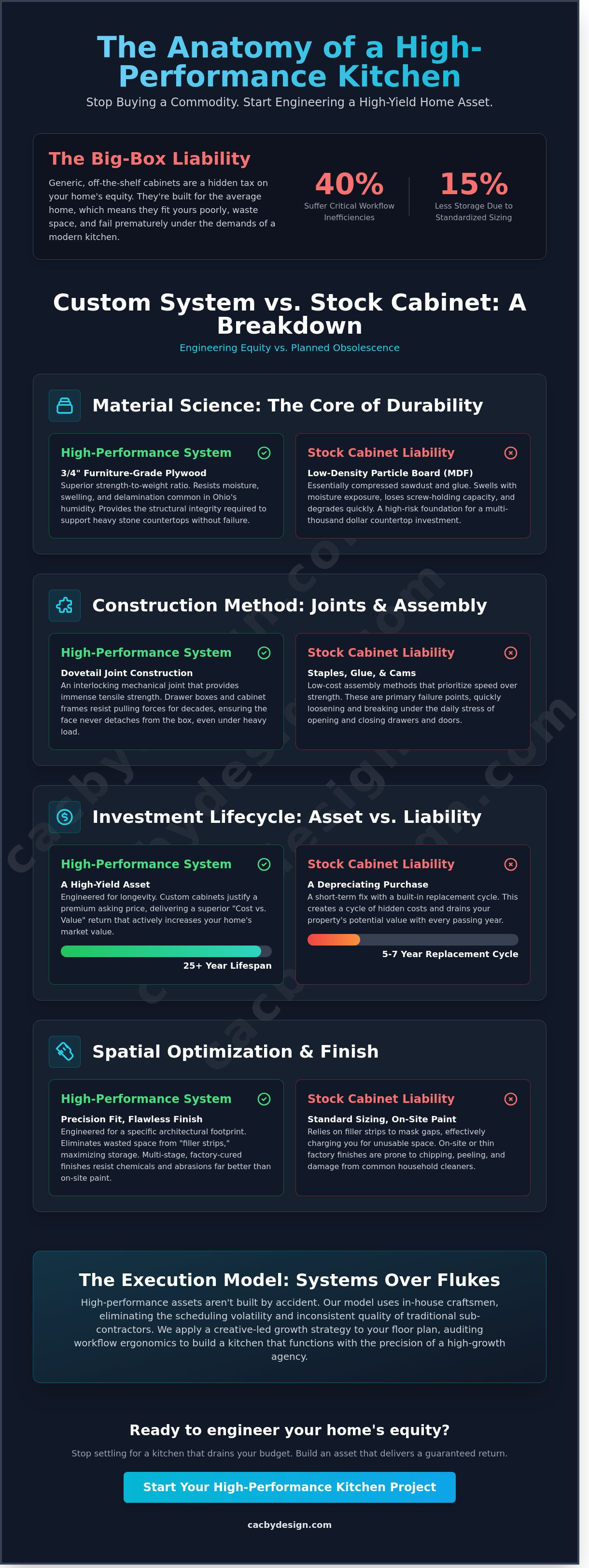
Most homeowners view cabinetry as a furniture purchase. They're wrong. In a high-stakes real estate market, custom cabinets are precision-engineered storage systems designed for a specific architectural footprint. They represent a structural investment, not a retail whim. While big-box retailers sell "disposable" units made of particle board, high-performance custom systems focus on longevity and spatial optimization. Understanding the history and styles of cabinetry reveals that true craftsmanship has always prioritized structural integrity over mass-market convenience. Stock cabinets are built for the average home, which means they fit yours poorly. They rely on "filler strips" to mask gaps, effectively charging you for air and wasted square footage.
In Hamilton and Warren Counties, the kitchen is the primary lever for home equity. It's the first room buyers inspect and the last one they forget. Choosing "cheap" cabinets creates a cycle of hidden costs. You'll deal with poor ergonomics, 15% less storage capacity due to standardized sizing, and a replacement cycle that typically triggers every 5 to 7 years. It's a liability that drains your property's potential. Custom systems flip this script. They turn your kitchen into a high-yield asset that justifies a premium asking price.
Engineering Equity in Southwest Ohio Homes
In the Cincinnati-Dayton corridor, custom cabinets deliver a superior "Cost vs. Value" return compared to mid-range stock options. Precision fit is the differentiator. When you eliminate filler strips, you reclaim valuable inches that transform a cramped kitchen into a chef's workspace. This isn't just about storage; it's about the psychological impact on valuation. High-end finishes and seamless integrated panels signal to a buyer that the home was built with intent. In high-growth areas like Liberty Township or West Chester, these details are the difference between a standard appraisal and a record-breaking sale. Efficiency is the new luxury.
The 'Big Box' Failure Rate: A Data-Backed Warning
The durability gap between furniture-grade plywood and retail-grade MDF is a matter of physics. Stock cabinets often use low-density fiberboard that swells when exposed to the 70% humidity levels common during Ohio summers. This leads to delamination and adhesive failure within 60 months of installation. More critically, these retail units often lack the structural bracing to support heavy materials. Standard retail cabinets often fail to support the static load of premium quartzite countertops, leading to structural cracking in the stone or cabinet box collapse. You don't want your $5,000 stone slab resting on a $200 particle board box. It's a recipe for a catastrophic financial loss. Custom engineering ensures the sub-structure matches the surface, protecting your investment from the ground up.
Anatomy of a High-Performance Cabinet System
Systems over Flukes. That is the baseline for any high-performance asset, and your kitchen is no different. Most homeowners buy for the "look" while ignoring the engineering. This is a tactical error. High-performance custom cabinets are engineered assets designed to maximize your home unit economics, not just fill a wall with storage. While DIY kits and big-box retail options rely on cheap fasteners and thin substrates, professional-grade systems prioritize structural rigidity and long-term hold rates. The door aesthetic is the hook, but the box construction is the engine that drives your kitchen equity.
Material Science: Plywood vs. Particle Board
We don't settle for "good enough" materials. Particle board is a liability in a high-moisture environment like a kitchen. It swells, degrades, and loses its screw-holding capacity within five years. We specify 3/4-inch furniture-grade plywood for the box construction. It provides a superior strength-to-weight ratio and holds up under the heavy load of stone countertops. The structural integrity extends to the drawer boxes. We utilize dovetail construction, which acts as a mechanical lock. It ensures the drawer face never detaches, regardless of how many times it's cycled. Every surface is finished in a factory-controlled environment. This outperforms on-site painting because it involves multi-stage UV curing that resists chemicals and abrasions that destroy traditional house paint.
Hardware Systems: The Hold Rate of Quality
Hardware is the primary failure point in budget cabinetry. We focus on the hold rate. This means specifying undermount drawer slides and hinges that exceed standard residential weight ratings, often tested for over 50,000 cycles. Soft-close technology isn't just about silence. It's about kinetic energy management. By slowing the close, you reduce the vibration and impact on the cabinet frame, extending the life of the entire system. Integrating cabinet hardware requires a blend of ergonomics and visual impact. It's the tactile interface of your kitchen.
Quality control requires proximity. Local fabrication of custom cabinets ensures every millimeter is accounted for before the units arrive at your job site. It eliminates the shipping damage variable and allows for real-time adjustments that mass-produced kits can't handle. If you're ready to stop guessing and start building, audit your current kitchen layout to see where your storage efficiency is leaking.
Custom vs. Semi-Custom vs. RTA: A Unit Economics Breakdown
Stop viewing your kitchen as a collection of boxes. It's a capital allocation decision. In the high-stakes real estate markets of Montgomery and Clermont County, your cabinetry choice dictates your exit velocity. If you choose wrong, you're not just buying furniture; you're inheriting a liability. High-performance custom cabinets function as a high-yield asset, while off-the-shelf alternatives act like high-interest debt.
RTA (Ready-to-Assemble): 5 to 7-year lifespan. High failure rate in humid Ohio basements or high-traffic kitchens.
Semi-Custom: 10 to 15-year lifespan. Limited by factory finishes and standard sizing.
Custom: 25 to 50-year lifespan. Built for the specific structural demands of your home's footprint.
The Total Cost of Ownership (TCO) reveals the truth. A cheaper RTA system requires replacement three times before a custom set even shows its age. In Butler County, where home valuations have seen aggressive growth, "time-to-market" is a common excuse for settling. Smart owners know that custom doesn't mean slow. It means systems-driven precision. We eliminate the lag by treating the design phase like a high-speed sprint, ensuring your 2026 equity goals stay on track.
The RTA Trap: Why DIY Assembly is a Growth Killer
RTA cabinets are the "growth hackers" of the furniture world, promising results they can't sustain. The hidden labor costs of DIY assembly often exceed the initial savings. You're paying for your own time, which is your most valuable resource. Structurally, these units rely on cam-lock systems that vibrate loose over time. This instability is a disaster for heavy finishes. Professional installation is the only viable path to provide the perfectly level foundation required for granite countertops. Without a rigid base, your stone investment is at risk of cracking under stress.
Semi-Custom: The Illusion of Choice
Semi-custom is a middle-management compromise. It offers the appearance of variety but fails in the non-standard layouts of historic Ohio farmhouses. When you hit a weird corner or a 37-inch gap, the "modification upcharge" kicks in. These fees can inflate a quote by 25% to 35% instantly, bringing the cost dangerously close to full custom cabinets without providing the same structural integrity. "Good enough" is a losing strategy. In a competitive market, buyers spot fillers and gaps immediately. They aren't looking for a compromise; they're looking for a system that works. Don't pay custom prices for a catalog product. Scale your equity with a solution that fits your floor plan, not a manufacturer’s spreadsheet.
Designing for Growth: Maximizing Kitchen Utility in 2026
Stop picking door styles. Start auditing your movement. In the CAC by Design ecosystem, we believe creative is the new targeting. This applies to your floor plan as much as it does to a high-converting ad. If your kitchen layout doesn't optimize for speed and flow, the aesthetic is irrelevant. You are building a high-performance workspace, not a showroom. Efficiency is the only metric that matters when the stakes involve your daily ROI.
Luxury markets in Butler and Green County are pivoting toward aggressive utility. We see a 22 percent increase in requests for integrated "appliance garages" and hidden tech hubs. The goal is zero-clutter surfaces. We integrate charging stations directly into the custom cabinets, ensuring your hardware stays powered without compromising the visual narrative. This is systems-led design. It replaces guesswork with structural logic.
The Workflow Audit: Systems-Led Design
The 1940s Work Triangle is dead. Modern high-output kitchens operate on Zone-Based planning. We map your space into five distinct stations: Prep, Cook, Clean, Storage, and Tech. This is how you engineer a kitchen remodel in Cincinnati for maximum operational efficiency. We treat storage as a logistics problem. Every custom cabinets unit is calibrated for specific high-value appliances. If your heavy stand mixer doesn't have a dedicated hydraulic lift, you're losing time. We build for the 2026 lifestyle, where speed and accessibility are the primary drivers of kitchen equity.
Integrated Design: Cabinets Meet Countertops
Technical precision is non-negotiable. A 3cm natural stone slab weighs approximately 20 pounds per square foot. You cannot trust standard, mass-produced boxes to support that load without bowing over time. We prioritize structural integrity. Our builds coordinate cabinet strength with stone weight from day one. This isn't just about physics; it's about the visual "hook." We align wood grain patterns with the natural veining of your countertops to create a seamless flow. Using a single-source partner for both components reduces project friction by 30 percent. It eliminates the communication gaps that lead to 404 errors in your construction timeline.
Quarter-sawn oak: Dominating the Butler County luxury tier for its stability and linear grain.
Hidden induction: Integrating cooktops directly under stone for a futuristic, flat-surface finish.
Smart lighting: Motion-activated LED channels recessed into the cabinet joinery.
Don't settle for a "pretty" kitchen that fails under pressure. Build a system that scales with your needs.
The CAC by Design System: Professional Grade Execution
Execution is where most Hamilton and Brown County remodels fail. They rely on hope as a strategy. We don't. Our project management framework treats your home like a high-stakes asset. We eliminate the friction of third-party variables by employing a strict "no sub-contractors" policy. When you hire us, you get our team. No excuses. Local accountability isn't just a buzzword; it's the ultimate insurance policy for your investment. We own the outcome from the first measurement to the final hinge adjustment.
Why In-House Labor Wins
General laborers chase volume. Our specialized installers chase precision. There's a massive gap between simply fitting a box and the surgical integration required for high-end custom cabinets. By keeping everything in-house, we maintain a closed-loop system. Design communicates directly with installation. This eliminates the "lost in translation" errors that plague 85% of residential projects. We value systems over flukes. Every job site follows a rigorous protocol to ensure the final product matches the initial data-driven design. Our team understands the unit economics of your home value. We don't just install; we execute a strategy.
The benefit of this direct feedback loop is speed. Because we control the labor schedule, we don't wait for "the cabinet guy" to show up. We are the cabinet team. This vertical integration allows us to pivot quickly if site conditions change, maintaining the momentum your project demands. We operate with the transparency of a performance marketing agency, providing clear updates and zero fluff.
Scaling Your Home Value
Stop considering and start commissioning. The path to a high-performance kitchen or a bathroom remodel in Cincinnati begins with a consultation at our local showroom. Bring your floor plans, your inspiration, and your non-negotiables. We'll map out a timeline that prioritizes speed without sacrificing the technical nuances of your build. A standard high-performance overhaul typically follows a 6 to 12 week deployment cycle, depending on the complexity of the custom cabinets and structural requirements.
The Audit: We review your space and identify the primary levers for equity growth.
The Build: Precision fabrication occurs in a controlled environment to ensure millimeter-perfect results.
The Deployment: Our in-house team handles the installation with zero reliance on outside vendors.
We don't guess. We scale. Your home deserves an agency-level approach to construction. Move from the "considering" phase into active commissioning today. Let's build something that outperforms the market.
Maximize Your Kitchen Asset: Execute With Precision
Stop treating your kitchen renovation like a standard expense. It's a strategic investment in your home's equity. Off-the-shelf solutions are a liability that erodes value through poor durability and generic design. High-performance custom cabinets act as the primary lever for maximizing your property's unit economics. By prioritizing professional-grade execution over RTA shortcuts, you ensure your kitchen utility is optimized for 2026 and beyond. Systems beat flukes every time. Since 2004, our family-owned firm has delivered this level of precision across 8+ counties in Southwest Ohio. We don't rely on subcontractors. Our in-house fabrication and installation teams maintain total vertical integration to protect your investment's integrity. You're building a high-performance environment, not just installing boxes. The data is clear: quality materials and expert engineering yield the highest long-term returns. It's time to stop settling for mediocre results and start scaling your home's potential with a team that values performance as much as you do.
Your vision is ready for elite-grade execution; let's build something exceptional together.
Frequently Asked Questions
What is the average lead time for custom cabinets in the Cincinnati area?
The average lead time for custom cabinets in the Cincinnati area is 8 to 12 weeks from the final design sign-off. This timeline accounts for precision engineering and material sourcing. We operate on a high-velocity schedule to ensure your project stays on track. Delays are eliminated through rigorous supply chain management and local manufacturing partnerships.
Can custom cabinets actually increase my home's resale value in Butler County?
Custom cabinets deliver an average ROI of 80% to 100% according to the 2023 Cost vs. Value Report. In Butler County, high-end kitchen equity is a primary driver for property valuation. Modern buyers prioritize bespoke storage over generic solutions. You aren't just renovating; you're engineering a financial asset that outperforms standard market listings by significant margins.
Do you provide both the design and the installation for custom cabinetry?
We execute the entire lifecycle from initial CAD design to final onsite installation. Our process removes the friction of managing multiple vendors. We function as your single point of accountability. This end-to-end system ensures that the design intent survives the transition to the physical space without data loss or aesthetic compromise.
What is the difference between framed and frameless custom cabinets?
Framed cabinets use a face frame for structural rigidity, while frameless custom cabinets offer 15% more accessible interior space. Frameless options, often called European style, rely on thicker box construction for stability. Choose framed for a traditional Hamilton aesthetic or frameless for maximum storage efficiency in modern layouts. It's a choice between classic architecture and optimized volume.
How do I choose between painted and stained wood for my kitchen cabinets?
Choose painted finishes for a sleek, modern aesthetic or stained wood to highlight natural grain patterns and hide wear. Painted custom cabinets allow for infinite color customization but require more maintenance over a 10 year period. Stained wood offers superior durability against impact. We analyze your kitchen's light exposure and usage metrics to recommend the highest-performing finish.
Are custom cabinets significantly more expensive than high-end semi-custom options?
Custom cabinets require a higher initial investment than semi-custom but provide 100% space utilization. Semi-custom options typically leave 10% to 15% of your kitchen footprint wasted with filler strips. Our custom builds eliminate these inefficiencies. You're paying for precision engineering that fits your specific walls, not a mass-produced box that almost fits.
Do your custom cabinets come with a warranty for Ohio homeowners?
Our custom cabinets include a limited lifetime warranty covering structural integrity and hardware performance for Ohio homeowners. We stand behind our systems because they're built to survive high-traffic environments. If a hinge fails or a drawer slide loses its glide, we fix it. This isn't a vague promise; it's a performance guarantee for your kitchen's infrastructure.
How do I prepare my kitchen for a custom cabinet installation?
Prepare your kitchen by clearing all countertops and emptying existing cabinets 48 hours before the scheduled arrival. You must disconnect all plumbing and electrical lines to avoid installation bottlenecks. We require a clear path from the entry point to the kitchen to maintain our high-speed deployment. Proper site prep ensures we hit our milestones without friction.


Comments