
Durable Kitchen Countertops for Families: The 2026 High-Performance Selection Guide
- chris138017
- Jun 3
- 12 min read
Your kitchen countertop isn't a design choice. It's a high-stakes capital asset that either absorbs daily abuse or bleeds home equity. Selecting durable kitchen countertops for families requires moving past surface-level aesthetics to focus on technical resilience. You want a kitchen that looks premium but functions like a high-performance workspace. It's exhausting to sort through conflicting maintenance advice while fearing a single spill or heavy impact will ruin a major investment.
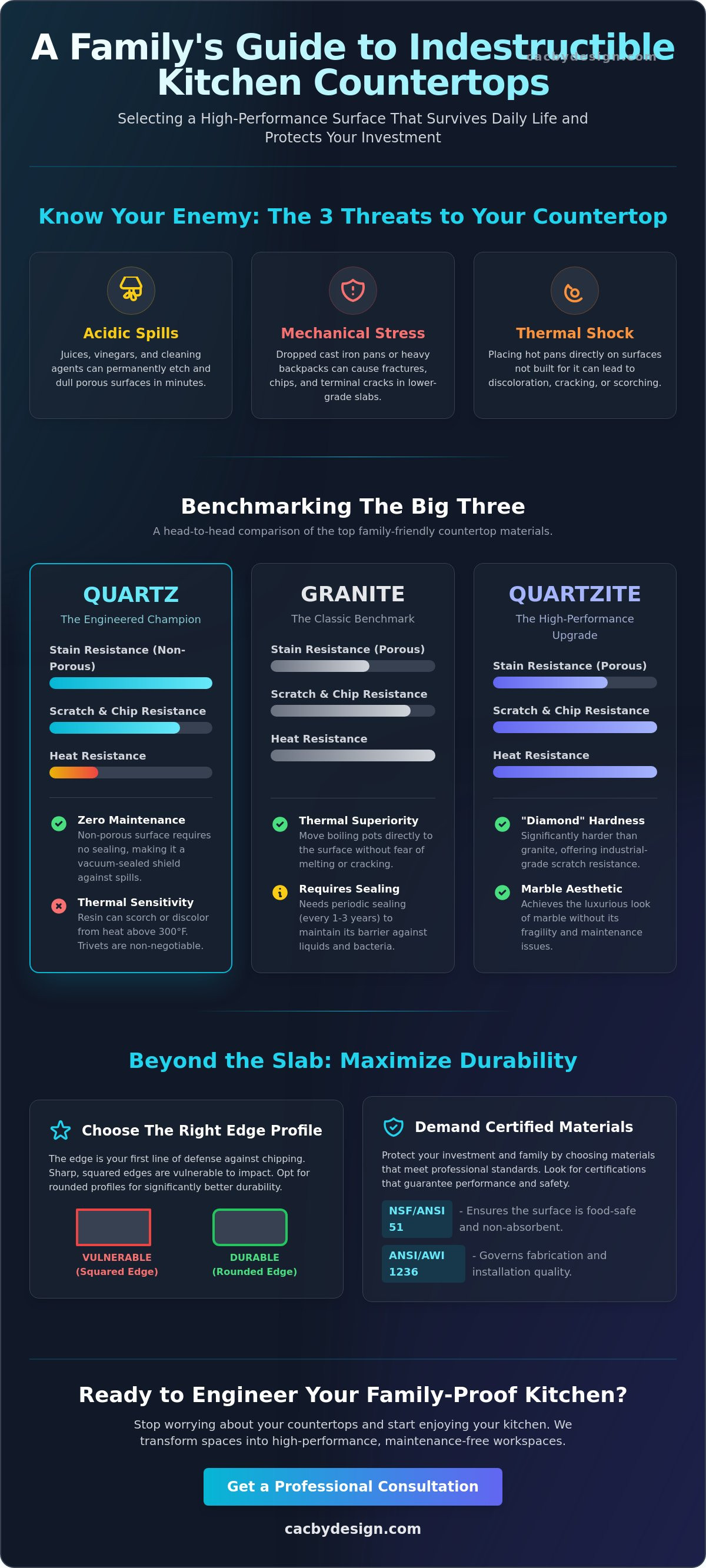
We understand the frustration of 'pretty' surfaces that fail under pressure. This guide cuts through the noise to identify materials engineered to survive impacts, spills, and heavy traffic. You'll learn how to protect your investment using 2026 performance standards like ANSI/AWI 1236-2022 and NSF/ANSI 51 food safety certifications. We'll preview top-tier selections from non-porous quartz to heat-resistant granite, including the latest 2026 shifts toward warmer, organic neutral palettes. This is the data you need to choose a surface that remains maintenance-free for decades.
Key Takeaways
Identify the technical metrics of family-grade durability to prevent surface failures in high-traffic homes.
Benchmark the performance of Quartz, Granite, and Quartzite to select the most durable kitchen countertops for families.
Decode porosity levels to choose a surface that repels stains and resists the effects of local mineral content.
Learn how specific edge profiles serve as the primary defense against chipping and impact damage.
Align material science with expert fabrication to transform your kitchen into a high-performance, maintenance-free workspace.
Table of Contents
The Family Performance Mandate: Why Durability is the Primary Metric
A kitchen island is the command center of a modern home. It’s where homework happens, cast iron pans land, and red wine spills. If you choose a surface based solely on a Pinterest board, you’re gambling with your investment. Family-grade durability isn't just about strength. It’s the technical intersection of impact resistance, low porosity, and thermal stability. When selecting durable kitchen countertops for families, you must evaluate the surface as a performance asset rather than a decorative finish. Aesthetics must follow function to preserve long-term home equity.
Every household has a specific "Damage Profile." Some families deal with constant acidic spills from juices and sodas. Others face mechanical stress from heavy backpacks or dropped cookware. Low-quality materials fail in high-traffic Cincinnati homes because they cannot handle these variables simultaneously. Cheap surfaces often look identical to premium slabs in a showroom; however, they degrade rapidly under consistent mechanical stress. To protect your capital, you need a material that survives the daily chaos without requiring a professional repair team on speed dial.
The ROI of Resilience
In the 2026 real estate market, resilience is a financial lever. Buyers prioritize "maintenance-free" over "trendy." High-performance materials reduce the total cost of ownership by eliminating the need for frequent resealing or chip repairs. Beyond the balance sheet, there is a massive psychological win. You end the "don't touch the counter" anxiety. A kitchen should function like a workspace, not a museum. Choosing a surface that resists the common countertop materials pitfalls ensures your kitchen remains a high-value asset for ten years or more.
Common Family Kitchen Hazards
Understanding the threats is the first step toward prevention. Acidic spills are the silent killers of porous stone. Juices, vinegars, and even some cleaning agents can etch a surface in minutes if the material isn't chemically stable. Mechanical stress is equally dangerous. A dropped cast iron skillet or a heavy backpack slam can cause terminal fractures in brittle, lower-grade slabs. Finally, thermal shock is a constant reality. In a fast-paced family environment, hot pans often end up on the counter. Without high thermal stability, you risk permanent discoloration or cracking. We prioritize materials that mitigate these risks through superior engineering and natural density.
Benchmarking the Big Three: Quartz vs. Granite vs. Quartzite
Families often mistake visual similarity for equal performance. It's a costly error. When selecting durable kitchen countertops for families, you're choosing between engineered precision and geological resilience. Quartz, granite, and quartzite represent the gold standard for high-traffic Cincinnati homes. Each offers a different defense mechanism against your household's damage profile. You must weigh the "No-Babying" requirement of engineered stone against the thermal dominance of natural slabs.
Quartz: The Engineered Solution
Engineered quartz is the non-porous champion. It dominates the market because it effectively eliminates the need for periodic sealing. Resin-bonded surfaces are essentially vacuum-sealed shields against juice boxes, red wine, and oils. For parents in Mason and West Chester, "zero maintenance" isn't a luxury; it's a functional requirement. However, don't buy into the "indestructible" myth. Quartz is sensitive to thermal shock. While granite can withstand extreme heat, quartz resin can scorch or discolor at temperatures above 300 degrees. If your family cooks at high speeds, using trivets is a non-negotiable habit to protect the polymer bonds.
Granite and Quartzite: The Natural Contenders
Granite remains the classic resilience benchmark. Its primary advantage is thermal superiority. You can move a boiling pot directly to the surface without fear of melting the finish or causing structural cracks. Regarding granite safety, the EPA confirms that these natural slabs are safe for residential use, effectively debunking common radiation myths. Because granite is naturally porous, it requires a sealing schedule every one to three years to maintain its barrier against liquids and bacteria.
Quartzite is the high-performance upgrade for those who refuse to compromise. It’s significantly harder than granite, making it the "diamond" of the stone world. It offers the aesthetic of marble with the scratch resistance of an industrial tool. For families with heavy cast iron or high-velocity kitchen activity, quartzite’s impact resistance is unmatched. It is a luxury investment that pays dividends in both durability and home equity.
The Impact Factor: MSI Quartz vs. Premium Slabs
MSI quartz offers consistent patterns and predictable durability at an accessible performance-to-price ratio. These surfaces are ideal for stain-prone zones. Premium natural slabs, however, provide a structural density that engineered stone cannot always replicate. If your "Damage Profile" includes heavy impacts from dropped appliances or metal toys, the hardness of quartzite often outweighs the stain-resistance of quartz. It’s about matching the material to your specific household chaos. If you're ready to see these materials in person, exploring the options at CAC By Design provides the clarity needed to make a data-backed decision.
The 'No-Babying' Framework: Porosity and Maintenance Realities
A countertop that requires constant vigilance is a liability. For active households, the 5-minute cleanup test is the ultimate benchmark. If a splash of grape juice or a ring of olive oil can’t sit for five minutes without causing a permanent stain, the material isn't fit for purpose. This is why understanding porosity is essential when selecting durable kitchen countertops for families. Porosity is the primary indicator of household stain risk. Surfaces with high absorption rates 'drink' liquids, leading to deep-set discoloration that no amount of scrubbing can fix. You need a surface that repels, not absorbs.
In Cincinnati, local water hardness adds a specific layer of complexity to maintenance. Our water is rich in minerals like calcium and magnesium. On porous surfaces, this mineral content can lead to 'ghosting' or white hazy deposits that are notoriously difficult to remove without damaging the stone finish. Non-porous materials like quartz effectively repel these minerals. Natural stones, however, rely on high-performance sealants to maintain a functional barrier against local water spots. Selecting the right durable kitchen countertop material means accounting for these environmental variables before the slab is even installed.
Stain Resistance Benchmarks
Ranking materials by liquid absorption reveals a clear performance hierarchy. Engineered quartz holds the top spot because its resin-bonded structure is industrially non-porous. Quartzite follows closely, offering high natural density that resists penetration better than almost any other natural stone. Granite remains a strong contender but requires a more proactive approach. Bacteria resistance is a critical secondary benefit of low porosity. Surfaces that don't absorb liquids also don't harbor microbes. This keeps your food prep areas naturally sanitary without the need for harsh, abrasive chemicals that can strip away finishes or leave toxic residues near your family's food.
Maintenance Systems for Busy Lives
Maintenance-free living in 2026 means your daily protocol should involve nothing more than mild soap and a microfiber cloth. Specialized cleaners are largely unnecessary for high-performance engineered surfaces. For those who prefer the natural aesthetic of granite countertops cincinnati, long-term care involves a simple resealing process every 12 to 36 months. This isn't a chore; it's an asset protection strategy. By automating your maintenance through smart material choice, you reclaim hours of time and ensure your kitchen remains a premium asset rather than a source of daily stress. You shouldn't have to baby your kitchen. Your kitchen should work for you.
Beyond the Slab: Edge Profiles and Installation for Safety
A countertop slab is only as resilient as its weakest point. In a high-traffic family environment, that point is almost always the edge. While most homeowners focus on color and material, the edge profile is the hidden durability factor that dictates long-term chip resistance. Sharp, 90-degree edges are structural liabilities. They catch impacts from heavy pots, metal toys, and belt buckles, leading to terminal fractures. When selecting durable kitchen countertops for families, the geometry of the cut is just as vital as the stone itself.
Top Edge Profiles for Families
Bullnose and Eased edges are the industry standards for high-performance kitchens. A Bullnose edge features a fully rounded profile that effectively eliminates sharp corners. This design allows impacts to be distributed across a larger surface area, significantly reducing the risk of chipping. Eased edges offer a similar benefit with a slightly more modern, squared-off look that still incorporates a softened radius. These profiles don't just protect the stone; they protect your family. Rounding off sharp corners on kitchen islands creates a "Safety Radius" that prevents injuries in toddler-heavy homes. Conversely, "fancy" edges like Ogee or Dupont feature thin, decorative ridges. These ridges are prone to impact damage and are significantly harder to repair once a chip occurs. In a workspace that doubles as a living area, simplicity equals longevity.
The Installation Quality Standard
Technical resilience depends on the foundation. Even the hardest quartzite slab will fail if the underlying structure is compromised. Proper substrate preparation ensures a perfectly level foundation, preventing stone fatigue and stress cracks over time. This is why the quality of your custom cabinets west chester oh is inseparable from the performance of your countertops. If the cabinets shift or settle, the stone bears the weight, leading to structural failure.
Seam placement is the final frontier of professional fabrication. High-performance installation requires engineering seams away from high-stress areas like sinks and ranges. Moisture and heat are the primary enemies of seam adhesives. By placing seams in low-traffic, supported zones, our in-house craftsmen ensure the structural integrity of the entire surface. We don't outsource this precision. In-house mastery from digital templating to final polish is the only way to guarantee a kitchen that functions like a workspace and looks like a premium asset. Ready to engineer a safer, more resilient kitchen? Connect with the experts at CAC By Design today.
Engineering Your Cincinnati Kitchen: The CAC By Design Advantage
Choosing durable kitchen countertops for families is a technical decision, but executing that choice requires a high-performance partner. We don't just sell stone. We vet materials through a 'Performance First' philosophy. This means every slab in our inventory is evaluated for its ability to handle the specific mechanical and chemical stresses of a high-traffic Cincinnati home. We prioritize technical resilience over creative guesswork. When you work with us, you're investing in a repeatable framework for success rather than a lucky speculation.
The CAC advantage is rooted in total vertical integration. We control the entire stack: from digital templating to master fabrication and final installation. By keeping these processes in-house, we eliminate the communication gaps that plague traditional remodeling models. Our team lives and breathes the technical nuances of stone fabrication. We understand how a specific quartzite slab will react to a Bullnose cut or how a quartz resin will perform under Cincinnati’s unique environmental conditions. This level of precision is how we ensure your kitchen remains a high-value asset for decades.
The Design-Build System
Durability isn't a standalone feature. It's the result of a seamless, integrated workspace. Our design-build system merges high-performance countertops with precision-engineered cabinetry to create a unified structural foundation. This prevents common installation failures, such as stone fatigue caused by shifting or unlevel surfaces. When we manage your kitchen remodel cincinnati, we eliminate the finger-pointing between separate contractors. Our craftsmen-led approach ensures that every seam, edge, and substrate is optimized for long-term equity. We build kitchens that function like workspaces but feel like home.
Start Your Transformation
Visualizing a high-performance kitchen requires more than a digital mockup. You need to touch the stone. We invite you to visit our local showrooms in the Cincinnati and West Chester areas for tactile testing. Feel the difference between a honed quartzite and a polished granite. Our consultation process is data-backed, focusing on selecting the specific durable kitchen countertops for families that match your household's unique 'Damage Profile.' We help you choose a material that fits your lifestyle, not just your budget.
Ready to stop compromising on quality and start maximizing your home’s performance? It’s time to partner with a team that values speed, clarity, and results. Book your high-performance design consultation today. We’ll help you navigate the complexities of 2026 material standards and engineer a kitchen that dominates the market in both beauty and resilience.
Own Your High-Performance Kitchen Asset
Your kitchen is a high-stakes investment. It shouldn't be a source of daily anxiety. We've established that the Big Three materials, Quartz, Granite, and Quartzite, provide the technical resilience required for modern life. You now understand that durability isn't just about the slab. It’s the result of precision edge profiles and a level structural foundation. Choosing durable kitchen countertops for families is the most effective way to protect your home equity while reclaiming your time from endless maintenance chores.
CAC By Design provides the framework to execute this transformation. We’ve served the Cincinnati area as a family-owned entity since 2004. Our system is built on total vertical integration. We use in-house master craftsmen rather than third-party contractors to maintain total quality control over every seam and edge. From the initial design phase to the final installation, we handle the technical nuances so you don't have to. Stop settling for surface-level aesthetics that fail under pressure. It’s time to upgrade to a surface that works as hard as you do. Secure your high-performance kitchen upgrade with CAC By Design today. Your resilient, maintenance-free workspace is ready.
Frequently Asked Questions
What is the single most durable countertop material for a family with young kids?
Quartz is the top recommendation for durable kitchen countertops for families because it combines industrial non-porosity with high impact resistance. It survives heavy daily traffic without staining and never requires professional resealing. While other materials offer specific benefits, quartz remains the consistent performance champion for households with active children and high-velocity kitchen activity.
Is quartz better than granite for preventing stains from juice and wine?
Quartz outperforms granite in preventing liquid penetration due to its resin-bonded structure. This manufacturing process creates a vacuum-sealed surface that acidic liquids like juice and wine cannot penetrate. Granite is naturally porous and relies entirely on the integrity of its sealant to block stains. If you want a maintenance-free barrier that repels liquids indefinitely, quartz is the logical choice.
How do I prevent my kitchen countertop edges from chipping?
Selecting a rounded edge profile like Bullnose or Eased is the most effective way to prevent chipping. Sharp, decorative edges are structural liabilities that fracture easily under impact from heavy pots or metal toys. A softened radius distributes impact force across a larger surface area, protecting your investment from the terminal damage common in high-traffic zones.
Do I really need to seal my granite countertops every year?
Annual sealing isn't always mandatory for every household. Most high-density granite slabs require resealing every one to three years depending on usage levels and the specific stone’s porosity. You can verify your sealant's performance with a simple water drop test. If water beads on the surface, your barrier is intact; if it absorbs into the stone, it is time to reseal.
Can I put hot pans directly on a quartz countertop?
Never place hot pans directly on quartz surfaces. While the stone content is heat-resistant, the polymer resins used to bond the material can scorch or discolor at temperatures exceeding 300 degrees. Granite and quartzite offer superior thermal stability for stovetop-to-counter transitions, but quartz requires the consistent use of trivets to prevent permanent structural damage to the finish.
What are the easiest countertop materials to keep sanitary and bacteria-free?
Quartz and other non-porous surfaces are the easiest materials to keep sanitary in a family environment. Because these surfaces do not absorb liquids, they don't provide the moisture or organic traps needed for bacteria to grow. Simple soap and water cleaning is sufficient to maintain a food-safe environment without the need for harsh chemical disinfectants that can strip stone finishes.
Is quartzite more durable than standard quartz?
Quartzite is harder and more heat-resistant than quartz, but it carries a higher maintenance profile. It offers superior scratch resistance, scoring higher on the Mohs scale, yet it remains a natural stone that requires periodic sealing to prevent staining. Quartzite is the choice for those prioritizing thermal stability, while quartz wins on stain-proof convenience for durable kitchen countertops for families.
How long does a professional countertop installation take in Cincinnati?
A professional installation typically takes four to seven hours once the slabs have been fabricated and delivered. This timeline covers the physical placement, seam joining, and sink mounting. The total lead time from digital templating to final polish depends on material availability and fabrication complexity. We focus on precision during this window to ensure the long-term structural integrity of your workspace.


Comments