
Hidden Costs of Kitchen Remodeling: The 2026 Guide to Budget Precision
- chris138017
- Jul 7
- 11 min read
Updated: 7 days ago
That 25% tariff on imported cabinets isn't a suggestion. It is a line item currently gutting renovation budgets across Cincinnati. Most homeowners realize too late that the hidden costs of kitchen remodeling aren't actually hidden. They are the predictable results of low-discovery planning and lazy audits. Whether it is the 2023 NEC electrical code changes for islands or structural liabilities in older homes, these variables are manageable if you use a high-performance framework.
You already know the sting of lifestyle debt when a project timeline slips or a change order appears out of nowhere. It is a failure of precision. We are here to eliminate mid-project financial surprises and replace them with a guaranteed budget-to-value ratio. This guide previews the exact mechanics of our 2026 strategy. We will show you how to navigate domestic sourcing and electric-ready requirements to ensure your renovation builds equity instead of anxiety. Stop guessing and start auditing before the demolition begins.
Table of Contents
What Are the Hidden Costs of Kitchen Remodeling?
Budget leakage is the silent killer of Cincinnati renovations. Most homeowners define the hidden costs of kitchen remodeling as random accidents. They aren't. They are the mathematical result of un-scoped technical debt and un-accounted-for lifestyle friction. When you start understanding the renovation process from a data-first perspective, you realize that "surprises" are usually just missed variables in the initial audit. In 2026, precision isn't optional. It is the only way to protect your equity from the volatility of the current market. If your plan doesn't account for the systemic liabilities of your home's architecture, you aren't remodeling; you're gambling.
Hard Costs vs. Soft Costs: The Financial Split
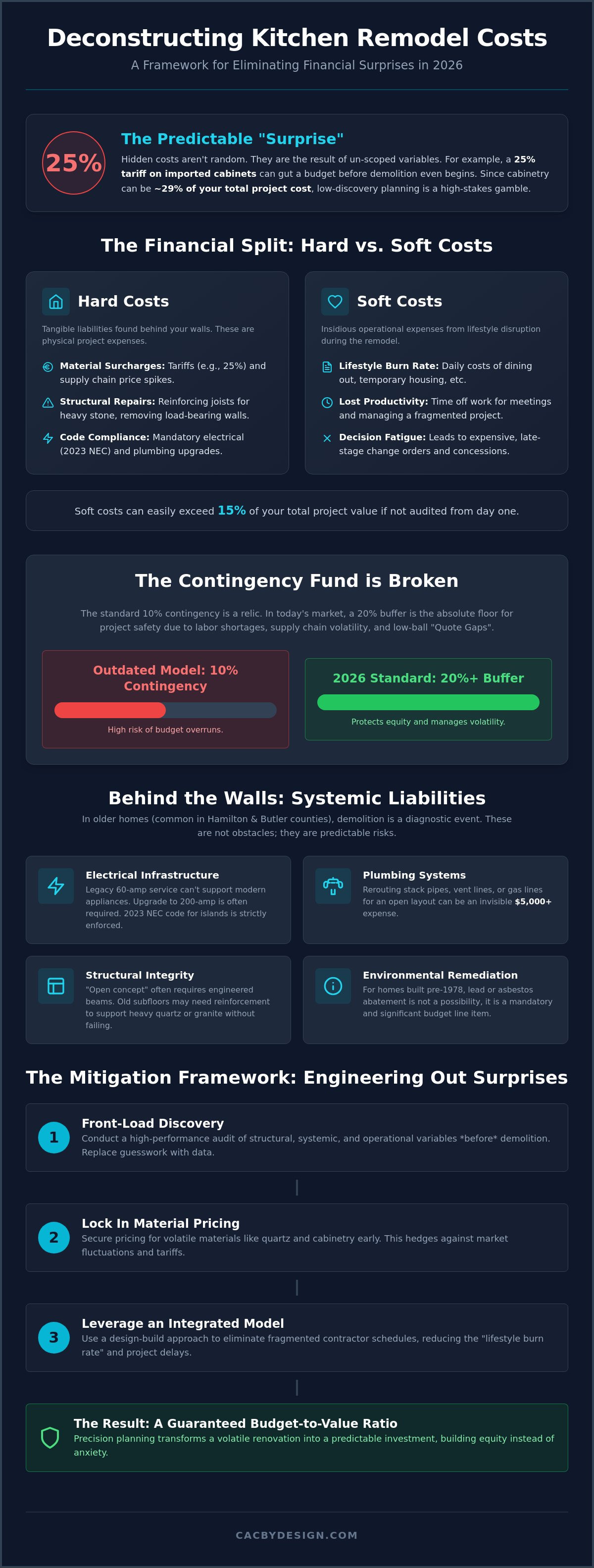
Hard costs are the tangible liabilities found behind your drywall. This includes structural repairs, mandatory code compliance, and material surcharges. For example, the 25% Section 232 tariff on imported cabinetry components is a hard cost that often catches unprepared homeowners off guard. Since cabinetry typically accounts for 29% of the total kitchen budget, a tariff-driven price spike can derail a project before it starts. Soft costs are more insidious. These are the operational expenses of living through a remodel. Temporary housing, dining out, and lost professional productivity can easily exceed 15% of your total project value. If your budget only accounts for the materials you see on a showroom floor, you are already underwater. High-performance planning requires a full-spectrum audit of both physical and operational expenses.
The 20% Rule: Why Traditional Estimates Fail
The standard 10% contingency fund is a relic of a slower, more stable economy. It is a mathematical failure in 2026. Between ongoing labor shortages and the "Quote Gap" created by low-ball estimates, a 20% buffer is now the absolute floor for project safety. Labor alone typically accounts for 20% to 30% of your total expense. Any delay in the supply chain for premium surfaces like quartz or quartzite multiplies this overhead daily. When estimates fail, it's usually because they ignored the "lifestyle burn rate" or the technical nuances of the 2023 NEC electrical code updates for islands.
Beyond the spreadsheets, you must also calculate the psychological cost. Decision paralysis and project fatigue are real variables that lead to expensive, late-stage change orders. When homeowners reach the "fatigue zone," they begin making concessions that compromise the budget-to-value ratio. Precision engineering eliminates this by front-loading every decision. We move the complexity to the beginning of the funnel to ensure the execution phase is a straight line to completion. Efficiency is the only hedge against the hidden costs of kitchen remodeling in a high-stakes market.
Behind the Walls: Structural & Systemic Liabilities
Cincinnati’s architectural legacy is a liability masquerading as character. In Hamilton and Butler counties, the demolition phase is a diagnostic event. The hidden costs of kitchen remodeling emerge when 1920s framing meets 2026 performance standards. If your home dates back to the pre-1978 era, environmental remediation for lead or asbestos isn't a suggestion; it's a mandatory budget line item. These aren't random obstacles. They are predictable systemic risks that traditional contractors overlook during the initial walkthrough. We don't move forward on hope. We move forward on data-backed audits of your home's skeletal integrity.
Electrical and Plumbing Infrastructure
Modern kitchens are power-hungry hubs. A legacy 60-amp service common in older Cincinnati suburbs cannot support induction cooktops or professional-grade refrigeration. Upgrading to a 200-amp panel is a prerequisite for any high-performance build. The 2023 National Electrical Code, specifically Section 210.52(C), changed the game for island receptacles. In 2026, inspectors are enforcing these safety standards with zero flexibility. Plumbing presents similar hurdles. Rerouting stack pipes or moving vent lines to accommodate an open layout can become an invisible $5,000 expense. Gas lines must also meet modern safety specifications, which often requires full replacement rather than simple extensions.
Structural Integrity and Load-Bearing Surprises
The "Open Concept" trend is the primary driver of structural overruns. Removing a wall in a Butler County colonial requires more than just a sledgehammer. It demands engineered beams and temporary shoring to maintain the home's center of gravity. Subfloor integrity is the hidden enemy of heavy materials like Quartzite or Granite Countertops. Old floor joists often lack the deflection rating required for heavy stone slabs. To prevent structural failure, floor joists must be reinforced or sistered to meet the specific deflection ratings required for the massive weight of premium stone surfaces. Correcting floor levels for seamless cabinet installation is another critical step. If your subfloor is out of plumb, your custom cabinetry will never align perfectly.
Precision execution starts with a deep audit of what’s behind the surface. Our team specializes in identifying these risks before the first swing of a hammer. If you are planning a full kitchen remodel in the Cincinnati area, you need a partner who understands local building codes and architectural history. We don't guess at structural capacity; we engineer it. By addressing systemic liabilities early, we protect your investment from the code compliance traps that drain traditional renovation budgets. Efficiency is the only hedge against volatility.
The Soft Costs of Fragmented Projects
The burn rate of a kitchen renovation is the daily cost of not having a functional home. Most homeowners ignore this metric. They focus on cabinet quotes but miss the lifestyle debt accumulating every day the project drags on. Fragmented projects multiply this debt. When you hire separate contractors, you aren't just paying for labor. You're paying for the coordination gap. This gap is where the hidden costs of kitchen remodeling thrive, fueled by misaligned schedules and overlapping overhead.
Lifestyle Debt: The Price of a Non-Functional Kitchen
Living without a kitchen is a financial drain. A family of four can easily spend significant extra capital daily on dining out and takeout. Over a six-week project, that lifestyle surcharge adds up. Then there is the logistics of a temporary setup. Hot plates, portable storage, and the sheer inefficiency of a makeshift meal station eat into your time. For remote workers, the productivity hit is even sharper. Noise, dust, and constant contractor questions create a distraction tax that directly impacts your professional output. If your project timeline slips because of a fragmented schedule, your lifestyle debt grows. Precision execution isn't just about the build; it is about protecting your daily operational capacity.
Logistics, Disposal, and Permit Fees
Debris removal is an escalating expense. Waste management companies have increased prices for dumpster rentals and "dirty" demolition disposal. In Cincinnati, navigating permit structures in jurisdictions like Montgomery or Warren County requires technical precision. Each municipality has different requirements for structural, electrical, and plumbing inspections. Poor scheduling leads to expediting fees or dry run fees when an inspector arrives and the work isn't ready. Fragmented contractors often fail to sync these inspections, leading to dead days where no work happens but your burn rate continues.
Integrated design-build models eliminate this friction. By housing every phase under one management umbrella, you stop the contractor-to-contractor overhead multiplier. DIY-Assist models often backfire here. Homeowners think they're saving money by handling their own demolition or debris removal, but they usually end up paying more in delayed timelines and lost momentum. Precision execution requires a single point of accountability. It's the difference between a project that stays on budget and one that bleeds cash through a thousand small logistical cuts. Efficiency is the only hedge against a runaway burn rate.
The Mitigation Framework: Engineering Out the Surprises
Hidden costs are the price of guessing. We don't guess. We engineer. The hidden costs of kitchen remodeling are neutralized when you shift complexity from the job site to the planning phase. Most contractors start demolition and hope for the best. We start with a high-performance audit. This framework identifies structural and mechanical liabilities before they become financial leaks. By front-loading discovery, we secure your budget-to-value ratio and ensure a straight line to completion. Efficiency isn't an accident; it's a deliverable.
Pre-Construction Discovery Systems
Execution is only as good as the data behind it. We use thermal imaging and non-invasive diagnostic tools to map out what's behind your drywall. This isn't just about finding leaks. It's about auditing the entire mechanical ecosystem of your home. We perform comprehensive mechanical audits to verify that your existing electrical and plumbing can support 2026 performance standards. 3D rendering allows for a pixel-perfect visualization of the final space, effectively neutralizing the risk of late-stage change orders that devastate budgets. This level of precision ensures that when the first sledgehammer swings, every variable is already accounted for.
Material Procurement and Price Protection
Market volatility is a constant threat to renovation budgets. We hedge against inflation by leveraging in-house fabrication and local inventory. Selecting quartzite countertops or granite from local stock allows us to bypass middleman markups and global shipping delays. We lock in pricing at the design stage to protect you from sudden surges in material costs. This systemic integration extends to our custom cabinets West Chester OH services, where we align fabrication timelines with your project schedule. By controlling the supply chain, we eliminate the 'Quote Gap' that plagues fragmented projects.
The design-build model is your ultimate insurance policy. One contract means one point of accountability. You don't have to navigate the blame game between architects and contractors. We create a data-backed contingency plan tailored to the age of your home. If you live in a historic Hamilton County neighborhood, your buffer reflects those specific architectural risks. This isn't a generic 10% safety net. It is a calculated reserve designed to absorb 2026 market realities. If you're ready for a project managed with surgical precision, book your high-performance site audit today. We don't just build kitchens; we engineer equity.
The CAC Advantage: High-Performance Predictability
Predictability is the highest form of luxury in Cincinnati construction. Most contractors operate on a "best-case scenario" model that collapses at the first sign of a structural liability. We don't. We operate on a data-driven execution model. The hidden costs of kitchen remodeling are almost always tied to the friction between separate entities. When your designer, material supplier, and installer are different companies, you are the one paying for their lack of coordination. Our model eliminates that friction. We provide a single point of accountability that ensures your budget remains a fixed target rather than a moving one. Efficiency is our primary baseline.
In-House Excellence vs. Subcontractor Chaos
Subcontractors are the primary source of the "Subcontractor Tax." This is the markup and scheduling inefficiency that occurs when a general contractor loses control of their timeline. We don't use a rotating door of unknown crews. Our in-house craftsmen are the ultimate hedge against hidden labor costs. By employing our own team, we control the quality, the schedule, and the cost. Doing it right the first time is the most effective financial safeguard you can have. Quality control isn't just about aesthetics. It's about engineering a build that doesn't require costly rework or mid-project corrections. This single-source accountability turns a chaotic process into a rhythmic execution. We own the outcome because we own the labor, a standard of excellence that allows homeowners to discover Cardwell Property Services Inc. when seeking similar precision in property maintenance and construction.
Engineering Equity in Your Cincinnati Home
A kitchen remodel is not an expense. It is a high-performance asset. When you eliminate the budget leakage discussed throughout this guide, you maximize your return on investment. You aren't just buying cabinets or countertops; you're buying a systemic upgrade to your home's market position. This standard of quality should extend to your final interior selections, where pieces from Darseys Furniture & Mattress can serve as an example of the craftsmanship that matches a professionally engineered space. Our 'One-Price' philosophy ensures that the engineering and design are locked before we break ground. This transparency is why we are Cincinnati’s choice for zero-friction kitchen and bath transformations. We bridge the "Quote Gap" by providing a comprehensive financial roadmap that accounts for everything from 2026 code compliance to premium material procurement.
Your next step is to move from budget anxiety to high-yield action. Turning a complex renovation into a predictable investment requires a high-discovery partner. Visit our showroom to see the precision of our materials and the logic of our framework in person. It's time to stop the budget bleeding and start building equity. Secure your 2026 project window with Countertops and Cabinetry By Design and experience the clarity of a high-performance renovation. Stop guessing at your budget and start engineering your results.
Secure Your Remodel's Financial Future
Precision is a choice. Data is the weapon. In the 2026 market, the hidden costs of kitchen remodeling are only "hidden" to those who rely on hope instead of audits. You now understand that structural liabilities and lifestyle debt are predictable metrics. By moving from a fragmented contractor model to a unified framework, you neutralize the variables that gut traditional budgets. This isn't just a renovation. It is a calculated investment in your home's equity.
Countertops and Cabinetry By Design has been refining this high-performance approach since 2004. As a family-owned and operated entity, we've replaced industry guesswork with a rigorous full-service design-build system. We eliminate the coordination gap through in-house fabrication and installation, ensuring every line item serves a strategic purpose. We don't just manage projects; we engineer outcomes. Stop the budget leakage and start your transformation with a partner who values speed, clarity, and surgical precision.
Schedule Your High-Performance Design Consultation and take command of your renovation today. Your ideal kitchen is within reach. Let's build it with the precision your investment deserves.
Frequently Asked Questions
What is the most common hidden cost in kitchen remodeling?
Unforeseen structural and mechanical repairs discovered after demolition are the most frequent hidden costs of kitchen remodeling. When walls come down, legacy issues like mold, rot, or outdated wiring often surface. These are not random accidents; they are the result of aging infrastructure. Addressing these liabilities immediately is mandatory to meet 2026 safety standards and protect your long-term equity.
How much should I actually set aside for a contingency fund in 2026?
You should set aside at least 20% of your total budget for a contingency fund in 2026. The traditional 10% buffer is a mathematical failure in the current market. Labor shortages and material volatility require a more aggressive safety net. This reserve ensures that technical surprises or supply chain fluctuations don't stall your project or force compromises on material quality.
Are permits and inspections included in most kitchen remodel quotes?
Permit and inspection fees are not always included in standard contractor quotes. Many low-ball estimates omit these to appear more competitive at first glance. A high-performance design-build firm will include all municipal filings as a standard line item. Always verify that structural, electrical, and plumbing permits are part of the initial contract to avoid unexpected administrative surcharges later.
How do I avoid material price increases during my renovation?
Lock in your material selections and pricing during the design phase to hedge against inflation. Leveraging in-house fabrication for surfaces like Quartzite Countertops or Granite Countertops allows you to bypass middleman markups. Selecting from local stock instead of relying on global shipping minimizes exposure to tariff-driven price spikes. Speed and early commitment are the only effective tools for price protection.
Can a design-build firm really eliminate all hidden costs?
A design-build firm eliminates the hidden costs of kitchen remodeling caused by miscommunication and fragmented scheduling. While no one can predict every joist issue before demolition, an integrated model identifies systemic risks during the audit phase. This approach replaces random surprises with a data-backed contingency plan. You get a single point of accountability instead of a blame game between contractors.
What structural issues are common in older Cincinnati homes?
Joist deflection and non-standard framing are pervasive in older Cincinnati neighborhoods like Hyde Park or O'Bryonville. Many legacy floors lack the structural capacity to support the massive weight of modern stone slabs. Outdated balloon framing also presents fire safety challenges during electrical upgrades. Identifying these skeletal liabilities during the pre-construction audit prevents expensive structural failures during the installation phase.
How do hidden costs change for a bathroom vs. a kitchen remodel?
Bathroom renovations carry higher risks related to moisture damage and plumbing sub-surface liabilities. While kitchen costs are often driven by cabinetry and large-scale material volume, bathroom overruns typically stem from hidden rot or outdated stack pipes. Both require a rigorous mechanical audit. However, the smaller footprint of a bathroom means that a single structural discovery can represent a much higher percentage of the total budget.
Is it cheaper to buy my own appliances and materials?
Buying your own materials usually backfires due to logistical friction and lost liability coverage. When you source your own items, you take on the risk of damage during transit and the cost of scheduling delays. Most professionals won't warrant labor on client-supplied materials. An integrated partner provides professional-grade procurement that includes delivery coordination, installation precision, and full performance accountability.
