
How to Care for Quartzite Countertops: The High-Performance Maintenance Protocol
- chris138017
- 2 days ago
- 12 min read
Quartzite is an indestructible asset. But only if you treat its maintenance like a high-performance engine. Many homeowners invest in this premium stone only to watch the finish degrade. They don't know how to care for quartzite countertops with precision. You bought this material for its rare blend of beauty and durability. It's a high-yield investment that signals quality. Without a repeatable system, you're one oil spill away from a permanent liability. This isn't just about cleaning; it's about asset protection.
The fear of staining or using the wrong chemical is a common friction point. It's entirely avoidable with the right data. This guide eliminates the guesswork. It delivers the exact systems required to protect your stone. Maintain your market-leading aesthetic for decades. We'll break down a rapid daily cleaning routine, clarify technical sealing requirements, and provide a protocol for handling accidents before they become permanent. By the end, you'll have a master maintenance system that ensures your countertops remain a centerpiece of your home's value.
Key Takeaways
Quartzite outranks granite in raw hardness. Learn why this requires a proactive preservation system to protect your surface equity.
Master how to care for quartzite countertops by adopting a zero-friction daily routine that eliminates harmful acidic cleaners.
Use the Water Bead Test as the only metric that matters for maintaining your stone's primary defense layer.
Deploy tactical protocols like the Poultice Method to extract deep-set discoloration and reverse accidental staining.
Identify how professional fabrication and installation prevent structural risks like edge chipping and seam failure.
Table of Contents
Quartzite vs. The World: Protecting Your Surface Equity
Quartzite isn't just a countertop choice. It's a high-yield investment in your home's infrastructure. To master how to care for quartzite countertops, you have to look past the aesthetics and focus on the mechanics of the stone. This material isn't delicate. It's a geological powerhouse. But even the strongest assets require a proactive preservation system to maintain their peak performance. Treating your surfaces like a passive fixture is a strategic error. You need a protocol that respects the stone's unique physical properties.
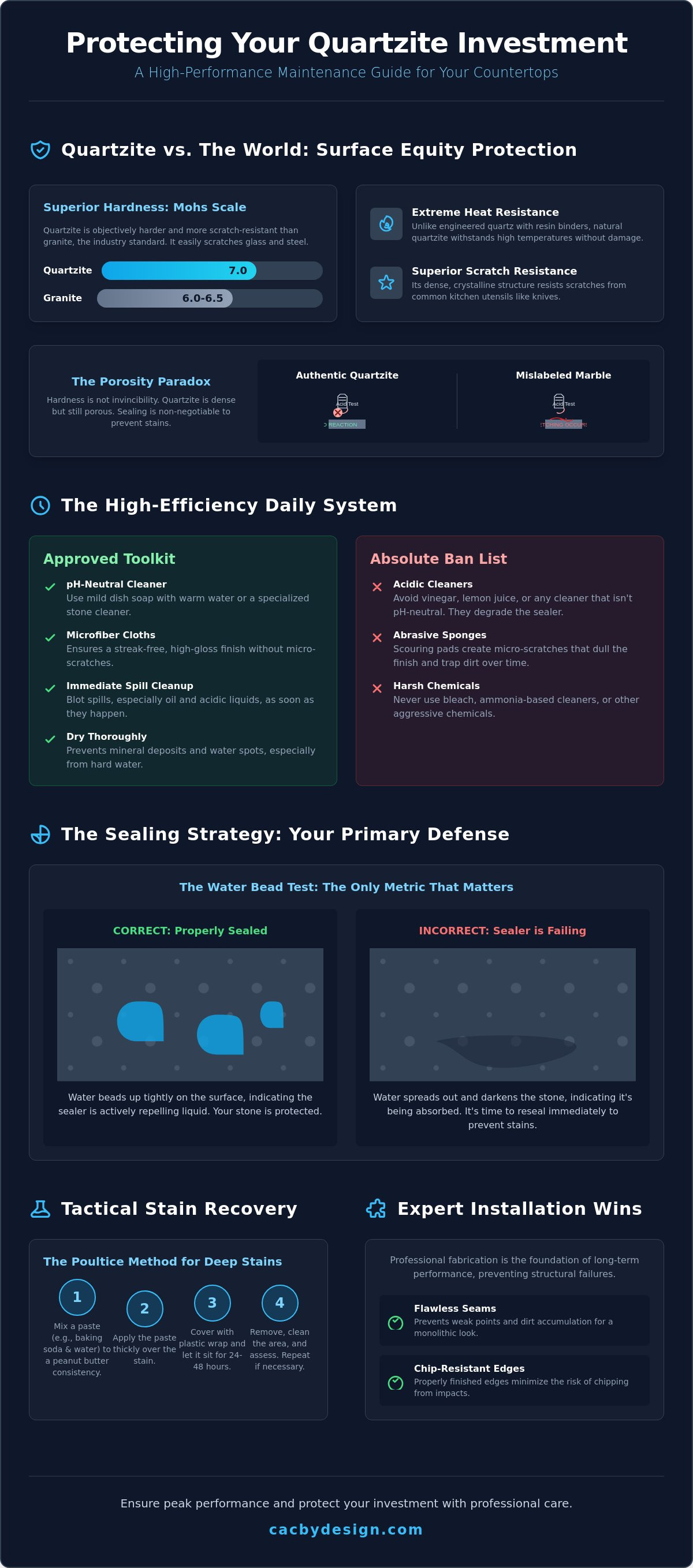
The performance data is clear. On the Mohs scale of mineral hardness, quartzite typically registers a 7. For context, granite usually sits between 6 and 6.5. This means quartzite is objectively harder and more scratch-resistant than the industry standard. It'll easily scratch a glass bottle or a steel knife blade. However, hardness isn't a synonym for invincibility. Understanding this distinction is the first step in a professional maintenance routine.
The Geological Edge: Hardness and Heat Resistance
Quartzite begins its life as sandstone. Through intense tectonic heat and pressure, it undergoes a metamorphic transformation. This process fuses quartz grains into a dense, crystalline structure. Quartzite is a metamorphic rock that resists scratching better than glass and offers extreme thermal stability. Unlike engineered quartz, which relies on plastic resin binders that can melt or discolor, natural quartzite handles high temperatures with ease. It's built to withstand the thermal shocks of a high-performance kitchen without degrading the finish.
The Porosity Factor: Why Density Matters
We see a common failure point in stone care: the Porosity Paradox. Homeowners assume that because a stone is hard, it's also waterproof. This is false. While quartzite is incredibly dense, its interlocking crystals still leave microscopic pathways for moisture. If you leave your stone unsealed, these pathways become entry points for organic stains and oils. Contrast this with marble, which is both soft and highly porous. Quartzite offers a much higher baseline of durability. It's a low-maintenance material, not a no-maintenance one. Your goal is to engineer a barrier that prevents liquid penetration while allowing the stone's natural beauty to lead the room's aesthetic.
You must also identify impostors. The market is flooded with "soft quartzite," which is often just mislabeled marble or dolomitic limestone. These materials will etch when they touch acidic substances like lemon juice or vinegar. Authentic quartzite is chemically inert to these acids. If your stone reacts to citrus, it's not quartzite. Protecting your equity starts with verifying your material and applying a system that matches its actual geological profile.
Daily Maintenance: The High-Efficiency Cleaning System
Efficiency is the baseline of high-performance home management. You don't need an hour of scrubbing to protect your stone. You need a zero-friction system that takes less than two minutes. When you understand how to care for quartzite countertops on a daily basis, you prevent the accumulation of microscopic debris that dulls a finish over time. This isn't about deep cleaning. It's about maintaining the surface equity established during installation.
The pH-neutral mandate is your primary rule of engagement. Many homeowners reach for vinegar or lemon-based cleaners, assuming "natural" means safe. It's a mistake. Acidic substances are the enemy of your finish. They chemically attack the sealer, stripping away your first line of defense. Once the sealer is compromised, the stone is vulnerable. Stick to a Quartzite care and maintenance guide approved cleanser to ensure you aren't inadvertently accelerating wear.
Beware of invisible abrasives. Standard kitchen sponges often contain scouring pads with tiny mineral particles. These might not leave a visible gouge immediately, but they create micro-scratches that trap dirt. For those in the Cincinnati area, hard water adds another layer of complexity. High concentrations of calcium and magnesium in local water can leave a stubborn white mineral film on dark slabs. If you don't dry the surface completely, you're essentially letting a thin layer of rock form on top of your countertop.
The Approved Toolkit: Chemicals and Cloths
Your toolkit should be minimalist and high-quality. Use mild dish soap diluted in warm water or a specialized stone cleaner. Microfiber cloths are the industry standard for a reason. They provide a streak-free, high-gloss performance without the risk of scratching. Your ban list is absolute. Never use bleach, ammonia-based window cleaners, or any acidic pantry staples. If you're currently planning a remodel, choosing the right quartzite countertops ensures your maintenance routine remains simple and effective.
The "Wipe-Down" Protocol
Execution matters as much as the tools. When wiping the surface, use circular motions. This prevents the linear streaking common on polished finishes. If you encounter dried-on food, don't reach for a metal scraper. Use a plastic putty knife or a damp cloth held over the spot for sixty seconds to soften the debris. The final step is non-negotiable: dry the surface with a fresh microfiber cloth. This eliminates water spotting and prevents mineral buildup, keeping the stone's clarity at peak levels.
The Sealing Strategy: Engineering a Non-Porous Barrier
Sealing is the tactical core of how to care for quartzite countertops. It's the primary defense layer for your investment. Without it, you're exposing a porous mineral structure to aggressive organic contaminants. Don't rely on arbitrary schedules or "once-a-year" myths. Some slabs need sealing every six months; others can go three years. You need data, not guesswork. The density of your specific stone dictates your maintenance frequency.
Avoid topical sealers. They create a film that eventually peels and traps moisture. You want a penetrating, or impregnating, sealer. These formulas travel into the stone's microscopic pores. They create a hydrophobic barrier from the inside out without altering the aesthetic. In the Cincinnati market, environmental variables matter. High summer humidity can interfere with the chemical curing process. If you're applying sealer during a humid spell, extend your drying time. This ensures the chemical bond is absolute before you resume heavy kitchen use.
The Water Bead Test: A 15-Minute Audit
Stop guessing. Perform an audit. Pour a tablespoon of water on high-use areas like the prep zone or near the sink. Wait 15 minutes. If the water remains beaded on the surface, your defense is intact. If the stone absorbs the liquid or develops a dark spot, your protection has failed. Immediate absorption means your stone is currently a liability. If water darkens the stone, the barrier is compromised.
Application Framework: DIY vs. Professional
Execution requires precision. Start with a deep clean. The slab must be bone-dry. Trapped moisture will cause the sealer to cloud or "bloom" under the surface. Apply a uniform layer using a lint-free cloth. Don't let it sit too long. Wipe off the excess within the manufacturer's window to prevent a permanent haze. For complex layouts or high-value installations, professional application is the safest route. This is often integrated into a comprehensive kitchen remodel Cincinnati maintenance plan. It ensures your stone's finish remains at a market-leading standard without the risk of DIY errors. High-performance stones demand high-performance care.
Stain Recovery: Tactical Protocols for Spills and Etching
Accidents are inevitable in a high-performance kitchen. A spilled glass of red wine or a leaked bottle of olive oil shouldn't be a catastrophic event. It's a maintenance challenge that requires a tactical response. When you understand how to care for quartzite countertops, you stop reacting with panic and start executing a protocol. The first rule of engagement is simple: blot, don't wipe. Wiping a liquid spill pushes the contaminant deeper into the stone's microscopic pathways. Blotting with a clean microfiber cloth lifts the substance vertically, minimizing the risk of a deep-set stain.
You must distinguish between a stain and etching. A stain is an addition; it's organic matter or oil that has physically entered the stone's pores. Etching is a subtraction. It's a chemical burn that occurs when acid eats away at the stone's surface. While authentic quartzite is chemically inert to household acids, many "soft" varieties on the market are not. If your surface loses its luster in a specific spot after contact with citrus, you're dealing with etching. This requires mechanical restoration, not just a cleaner.
The Poultice Playbook
For deep-set oil or organic stains, the Poultice Method is your primary extraction system. Create a thick paste using baking soda and water. It should have the consistency of peanut butter. Apply a half-inch layer over the stain and cover it with plastic wrap. Poke a few small holes in the plastic to allow for evaporation. This creates a vacuum effect that pulls the contaminant out of the stone and into the paste. The 24-hour dwell time is a technical requirement. Don't rush the process. Once dry, remove the paste with a plastic scraper and immediately re-seal the area to restore the defense layer.
Managing Etch Marks and Scratches
If you're seeing widespread etching, your material may have been mislabeled at the slab yard. True quartzite resists these chemical reactions. You can compare these performance benchmarks against granite countertops Cincinnati, which offer a similar level of chemical resistance. DIY kits rarely fix deep etching or heavy scratches. These issues require professional diamond-grit polishing to level the stone and restore the factory finish. If your stone has sustained structural damage, contact our fabrication experts for a professional surface assessment. We specialize in restoring high-value stone assets to their original market-leading aesthetic.
Long-Term Performance: Why Expert Installation Wins
Maintenance starts at the saw. If your stone isn't fabricated with precision, even the most rigorous cleaning routine won't save your investment. Structural integrity is the silent partner of aesthetic longevity. Understanding how to care for quartzite countertops is only half the battle. The other half is ensuring the material was handled by experts who understand its geological stress points. Poorly supported overhangs or misaligned seams create tension that leads to hairline fractures. You can't clean your way out of a structural failure. High-performance care requires a high-performance foundation.
Local expertise in Butler and Warren County is a strategic advantage. Material selection isn't just about color; it's about matching stone density to your specific lifestyle. Our in-house craftsmen treat every slab as a unique engineering challenge. We don't outsource your equity to third-party installers who prioritize speed over accuracy. We focus on the technical nuances that ensure your stone performs as well in year ten as it does on day one.
The Fabrication Advantage
Precision cutting is the primary lever for durability. We use advanced technology to reduce stress points in the natural stone, preventing the edge chipping common in lower-quality installations. High-grit polishing is another critical factor. A superior factory polish closes the stone's surface at a microscopic level, which significantly improves natural stain resistance. This mechanical seal complements your chemical sealers and simplifies how to care for quartzite countertops over the long haul. Countertops and Cabinetry By Design employs a systems-led installation approach that accounts for every variable, from cabinet leveling to seam placement.
Scaling Your Home Equity
Maintained quartzite is a powerful driver of home valuation in the Cincinnati market. It signals a level of quality and attention to detail that resonates with high-value buyers. Once your surfaces are stabilized, you can look toward expansion. Integrating new custom cabinets in West Chester, OH is the logical next step in maximizing your kitchen's ROI. This holistic approach ensures your cabinetry and stone work in tandem to create a cohesive, high-performance environment.
Visit our Mason or Cincinnati showrooms to see the real-world performance of aged quartzite. You'll see the difference that professional fabrication makes in person. Don't leave your home's most visible asset to chance. If you're ready to upgrade your kitchen's performance metrics, schedule a high-performance design consultation today. Let's build a system that lasts for decades.
Secure Your Surface Equity
Mastering how to care for quartzite countertops is about shifting from reactive cleaning to proactive asset management. You've learned that a zero-friction daily routine and a data-driven sealing schedule are the keys to longevity. By using the Water Bead Test, you eliminate the guesswork that leads to permanent staining. You also know that the highest level of performance begins with expert fabrication. This isn't just a kitchen surface; it's a structural investment that requires a repeatable maintenance protocol.
Our team has been serving Hamilton, Butler, and Warren Counties since 2004. Our in-house craftsmen utilize a systems-led design-build approach to ensure your stone is a durable, high-yield asset. We don't just install material. We engineer environments that perform at the highest level for decades. If you're ready to invest in a kitchen that blends extreme durability with a market-leading aesthetic, we're your high-performance partner. We provide the technical expertise required to turn raw stone into a lifelong centerpiece.
Upgrade your kitchen with high-performance quartzite at our Cincinnati showroom.
Your home deserves a protocol that matches its quality. Take the next step toward a resilient, beautiful kitchen today. Let's protect your investment together.
Frequently Asked Questions
Is quartzite high maintenance compared to quartz?
Quartzite is a low-maintenance material, but it isn't zero-maintenance like engineered quartz. While quartz is non-porous, quartzite is a natural stone that requires a penetrating sealer to prevent absorption. However, quartzite offers superior hardness and thermal stability. It won't melt or discolor under high heat, making it a more durable asset for high-performance kitchens that prioritize raw material strength over synthetic binders.
Can I use Windex or Clorox wipes on my quartzite countertops?
Never use ammonia-based window cleaners or bleach-heavy wipes on your stone. These aggressive chemicals are too harsh for the finish. They will chemically strip your sealer and eventually dull the polished surface. This leaves your investment vulnerable to deep-set stains and organic contaminants. Stick to pH-neutral cleaners that protect your surface equity without compromising the chemical barrier engineered during your maintenance routine.
How often should I seal my quartzite countertops in Ohio?
Sealing frequency isn't determined by a calendar; it's determined by the Water Bead Test. While some slabs need attention every year, others can go much longer. In Ohio, high summer humidity can impact how a sealer cures, so always apply treatments during dry periods. Perform an audit every six months by pouring water on high-use areas. If the water doesn't bead, it's time to re-seal.
Does quartzite stain easily with red wine or coffee?
True quartzite is highly resistant to staining when the sealing protocol is intact. The stone's density is naturally high, but its microscopic pores can still trap pigments from red wine or coffee if left to dwell. If you know how to care for quartzite countertops, you'll blot these spills immediately rather than wiping them. This vertical lift prevents the liquid from being forced into the stone's crystalline structure.
Can I put hot pans directly on a quartzite surface?
Quartzite handles heat better than almost any other countertop material. Because it's a metamorphic rock formed under tectonic pressure, it doesn't contain the resins found in engineered quartz that melt at high temperatures. You can place hot pans on the surface without fear of scorch marks. However, using trivets is still a tactical move to prevent localized thermal shock and preserve the stone's structural integrity over several decades.
What is the best daily cleaner for quartzite countertops?
The most efficient daily cleaner is a specialized pH-neutral stone spray or a simple solution of mild dish soap and warm water. This combination removes surface oils without leaving a film or attacking the sealer. When you master how to care for quartzite countertops, you avoid "natural" pantry cleaners like vinegar or lemon juice. These acidic substances will eventually etch the surface if your material contains any trace amounts of calcite.
Why does my quartzite countertop feel gritty or rough in some spots?
Grittiness is usually caused by mineral deposits from hard water or dried soap residue. In areas with high mineral content, water that evaporates on the surface leaves behind calcium and magnesium. This creates a rough texture that can be mistaken for stone damage. Use a plastic scraper and a stone-safe deep cleaner to remove the buildup. Always dry your counters with a microfiber cloth to prevent these minerals from settling.
How can I tell if my quartzite is actually marble?
Perform a scratch test and an acid test on a remnant or an inconspicuous corner. True quartzite will easily scratch a glass bottle and will not react to lemon juice. If the stone etches or dulls when it touches acid, you're likely dealing with mislabeled marble or dolomitic limestone. Identifying your material correctly is the first step in ensuring your maintenance system matches the stone's actual geological requirements.


Comments