
Quartzite vs Quartz Cost in Warren County: 2026 Homeowner Investment Guide
Updated: 1 day ago
The most expensive countertop mistake isn't selecting the higher-grade slab; it's failing to audit fabrication physics before committing capital. When evaluating the real quartzite vs quartz cost Warren County homeowners encounter, raw material estimates tell only half the story. Big-box quotes routinely conceal critical project drivers, from digital CNC cutting and edge profiling to seam placement and structural support.
You already know the frustration of inconsistent contractor pricing, paired with the valid anxiety of resin scorching under hot cookware or porous stone absorbing red wine. You deserve transparent metrics and a surface engineered for your real kitchen workflow. In this guide, you'll master the definitive material, maintenance, and equity differences between natural quartzite and engineered quartz for your upcoming renovation. We analyze the functional trade-offs, lifecycle costs, and precision fabrication standards required to secure a high-performing investment.
Table of Contents
Material Anatomy: How Quartz and Quartzite Define Project Investment
Cost Comparison Matrix: Analyzing Procurement, Fabrication, and Tooling
Long-Term Performance: Durability, Maintenance, and Asset Valuation
Warren County Decision Framework: Selecting Your Surface Strategy
Turnkey Execution: Mitigating Financial Risk Through In-House Craftsmanship
Material Anatomy: How Quartz and Quartzite Define Project Investment
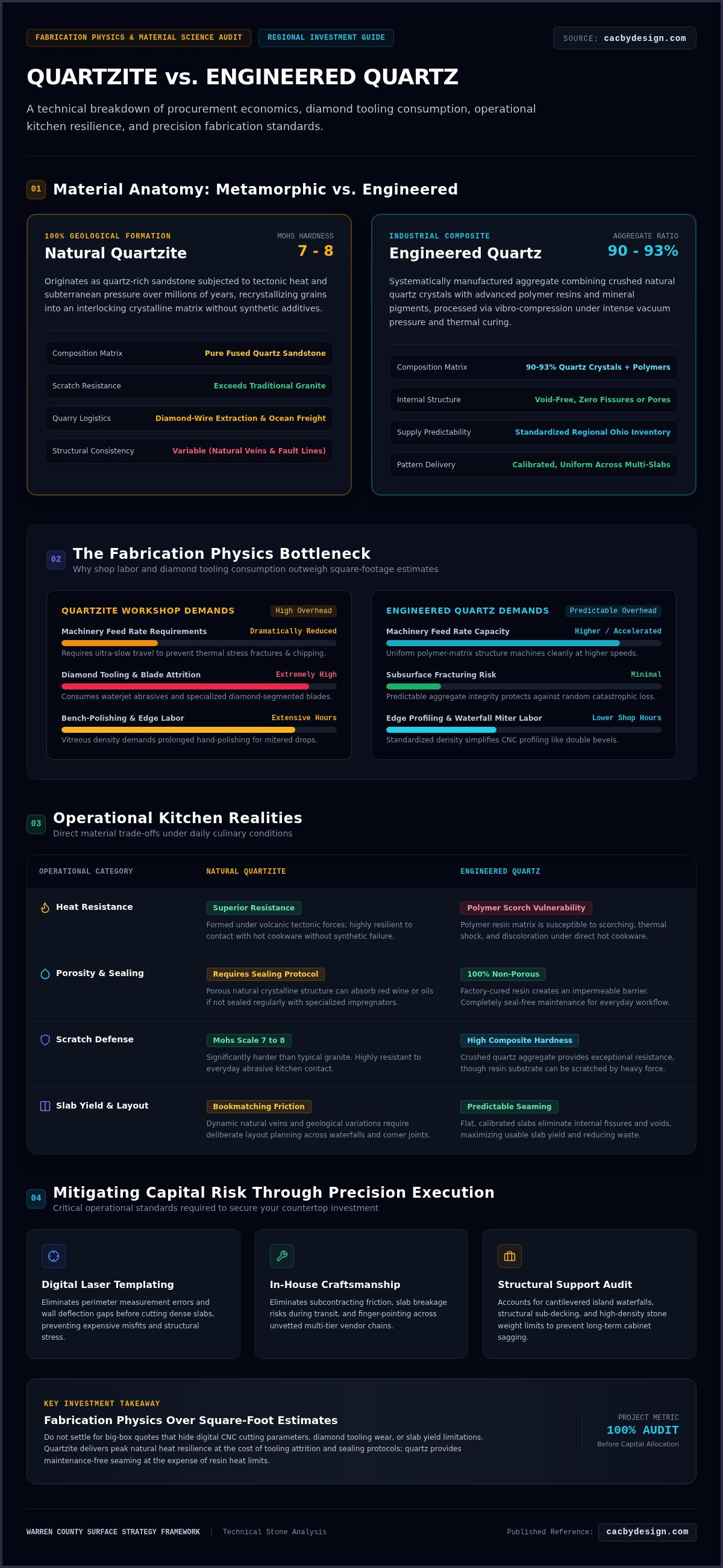
Surface composition dictates project risk, fabrication overhead, and operational lifespan. When evaluating the overall quartzite vs quartz cost Warren County homeowners encounter, your calculation starts at the molecular level. Metamorphic natural stone and engineered composites demand entirely different quarrying logistics, factory production lines, and material handling protocols. On the Mohs hardness scale, natural quartzite registers between 7 and 8, creating an exceptionally dense surface that easily outranks traditional granite in scratch resistance.
The Geological Formation of Natural Quartzite Slabs
Natural quartzite is a pure metamorphic rock. It begins as quartz-rich sandstone before subterranean tectonic forces apply intense heat and pressure over millions of years. This process fuses individual sand grains into an interlocking crystalline matrix. Citing validated quartzite geological properties shows that this recrystallization creates extreme structural density without synthetic additives.
Extracting these dense formations requires diamond-wire quarrying, precision block stabilization, and global container freight. Because geological fault lines and mineral variations occur naturally within every quarry bench, slab yields vary widely. This structural unpredictability and heavy international logistics directly inflate acquisition expenses for regional stone distributors before fabrication even starts.
The Engineering and Composition of Modern Quartz Surfaces
Engineered quartz relies on systematic industrial manufacturing rather than geological chance. Facilities combine roughly 90 to 93 percent crushed natural quartz crystals with advanced polymer resins and mineral pigments. The aggregate undergoes vibro-compression under intense vacuum pressure, followed by thermal curing.
Structural Consistency: Controlled factory environments eliminate internal fissures, voids, and weak mineral veins.
Predictable Patterns: Slabs deliver consistent coloration, allowing for uniform design matching across multiple sections.
Supply Chain Stability: Standardized production provides dependable inventory across Ohio suppliers, bypassing the volatile shipping delays common to exotic natural stone.
This manufacturing predictability fundamentally shifts the quartzite vs quartz cost Warren County buyers calculate. Engineered slabs arrive flat, calibrated, and structurally uniform, minimizing material waste during production. Natural quartzite slabs arrive with raw, one-of-a-kind geological dynamics that demand far more respect, technical tooling, and handling labor inside the shop.
Cost Comparison Matrix: Analyzing Procurement, Fabrication, and Tooling
Big-box retailers reduce countertop estimates to superficial square-footage rates. This model conceals the real operational bottleneck: fabrication physics. When calculating the net quartzite vs quartz cost Warren County projects demand, precision shop labor and tooling consumption consistently outweigh raw material pricing. A technical Natural Stone Institute comparison confirms that processing dense metamorphic rock requires an entirely distinct machinery footprint compared to engineered agglomerates.
Fabrication Complexity: Tooling Wear and Shop Labor Demands
Quartzite's high mineral hardness exacts a heavy toll on machinery. Cutting natural quartzite demands high-pressure waterjets and specialized diamond-segmented bridge saw blades running at dramatically reduced feed rates. Pushing a blade too fast through dense quartzite causes thermal stress fractures, chipping, and catastrophic blade wear. Waterjet consumables, electric draw, and diamond abrasive attrition increase shop overhead substantially.
Conversely, engineered quartz machines predictably. Its uniform resin-matrix structure allows fabricators to run CNC tooling at higher feed rates with minimal risk of subsurface fracturing. Complex edge profiles, like double bevels or mitered waterfall drops, require fewer bench-polishing hours on engineered quartz than on vitreous natural stone, directly lowering workshop labor hours.
Slab Yield Ratios and Waste Management Realities
Raw slab geometry and structural inclusions alter layout economics. Natural quartzite formations feature unpredictable fissures, localized density shifts, and dramatic veining paths. Managing these traits requires deliberate layout planning:
Bookmatching Friction: Aligning dynamic natural veins across island waterfalls and corner joints requires generous cutting margins, which often demands extra slab square footage.
Structural Yield: Natural fissures can render specific sections unusable for long, unsupported spans, reducing net yield per slab.
Engineered Precision: Uniform quartz slabs offer calibrated dimensions from edge to edge, yielding higher usable surface area per slab and minimal scrap.
To eliminate expensive material overages, our team deploys in-house digital templating and custom fabrication to map kitchen layouts directly onto slab scans before making a single cut. This engineering-first approach eliminates unexpected slab purchases and protects the overall quartzite vs quartz cost Warren County homeowners invest in their spaces.
Long-Term Performance: Durability, Maintenance, and Asset Valuation
Initial fabrication invoices represent only the entry fee. A genuine return on investment accounts for daily functional friction, chemical upkeep, and surface preservation across a decade of use. When calculating the comprehensive quartzite vs quartz cost Warren County properties demand, lifestyle wear patterns quickly reveal which material earns its keep. Natural stone requires an active defense strategy against stains, while engineered surfaces demand strict thermal discipline around open flames.
While natural quartzite mandates recurring applications of penetrating chemical sealants to maintain its protective barrier, engineered quartz permanently limits culinary workflow due to the irreversible thermal breakdown point of its synthetic polymer resins. That divergence dictates how you operate in your kitchen every single day.
Thermal Resilience and Daily Cooking Vulnerabilities
Culinary heat represents the single biggest threat to engineered quartz. Because slabs rely on polymer binders, sustained contact with hot cast-iron skillets or baking sheets causes thermal shock, yellowing, or permanent white ring marks. Once resin scorches, the damage is chemical; it cannot be polished out on site. Home chefs must commit to trivets across every square inch of counter space.
Natural quartzite ignores high heat entirely. Having crystallized under geological extremes, it easily absorbs direct contact from high-temperature cookware without scorching, warping, or chemical degassing. For kitchens centered around high-output commercial ranges, natural stone offers bulletproof operational freedom.
Sealing Protocols vs. Non-Porous Surface Chemistry
Every surface claims specific cleaning workflows. Engineered quartz delivers unmatched baseline protection against acidic etching from wine, citrus, and tomato sauce:
Engineered Non-Porosity: Zero liquid absorption means routine cleanups require nothing beyond mild dish soap and warm water, keeping chemical maintenance expenses at zero.
Quartzite Impregnation: Dense as it is, natural stone possesses capillary pores that require fluoropolymer or siloxane sealers every one to two years to prevent oil discoloration.
Chemical Sensitivity: Natural quartzite demands pH-neutral cleansers; acidic bathroom or degreasing kitchen sprays strip protective sealants and invite deep staining.
In high-equity neighborhoods across Mason and Springboro, material selection directly affects appraisal appeal. Discerning buyers scrutinize kitchen condition during property walkthroughs. A scorched engineered slab registers as an immediate replacement liability, whereas properly maintained natural quartzite delivers enduring, authentic luxury that anchors property valuation long after installation.
Warren County Decision Framework: Selecting Your Surface Strategy
Surface selection is not an isolated cosmetic exercise. It's an operational and equity calculation. Navigating the real quartzite vs quartz cost Warren County homeowners encounter requires a structured evaluation method rather than retail guesswork:
Audit Structural Baseline: Inspect perimeter lighting, room proportions, and the load-bearing rating of existing cabinet carcasses.
Calculate Functional Wear: Weigh high-heat cooking habits and red wine spills against your tolerance for recurring stone sealing.
Calibrate Real Estate Equity: Match surface investment brackets directly to regional neighborhood appraisal ceilings.
Review Digital Slab Projections: Require high-resolution digital mockups to inspect veining flow, mitered seams, and cutouts before shop cutting begins.
Aligning Stone Choices with Warren County Real Estate Standards
Property benchmarks dictate stone allocations. Executive estates across Mason, Springboro, and South Lebanon command premium listing appraisals when anchored by genuine, exotic natural quartzite. Discerning buyers in these enclaves expect architectural authenticity and rare geological movement.
Conversely, engineered quartz represents the benchmark for active family households prioritizing zero maintenance and clean, modern palettes. Quartz surfaces maximize functional utility while preserving healthy return on equity. To protect your investment, calibrate your stone selection within an end-to-end kitchen remodel cincinnati architectural framework that balances material procurement with total space design.
Integrating Countertops with Cabinetry and Architectural Backsplashes
A countertop cannot perform if the structural foundation shifts beneath it. Dense natural quartzite imposes significant dead-load pressure on perimeter boxes and deep kitchen islands. Large overhangs require hidden steel cantilever brackets and reinforced gables integrated into custom joinery.
Vein transitions must align seamlessly across waterfall edges, vertical tile backsplashes, and cabinet reveals. Coordinate box integrity and load ratings early through proven custom cabinets west chester oh resources to eliminate structural deflection.
Eliminate project guesswork before committing your budget. Schedule a project evaluation with our design team to review digital slab layouts and align your surface strategy with lasting home value.
Turnkey Execution: Mitigating Financial Risk Through In-House Craftsmanship
Subcontracting is the single largest failure point in custom residential renovations. Big-box retailers and stone brokers sell slabs at retail counters, then broker out measuring, cutting, and installation to disconnected third-party crews. This fragmented chain creates severe scheduling drag, misaligned sink cutouts, and zero accountability when a rare slab breaks during transit. When assessing the real quartzite vs quartz cost Warren County homeowners encounter, operational execution determines whether your renovation becomes an appreciating asset or an expensive operational compromise.
The Single-Source Design-Build Advantage
A unified design-build model eliminates trade friction entirely. Since 2004, our family-owned practice has kept digital laser templating, custom cabinetry construction, stone fabrication, and final fitting strictly in-house. Direct communication between our cabinet builders and stone sawyers ensures overhang tolerances and sink centerlines match before raw slabs touch the cutting bed. Accountability remains under one roof from initial concept to project sign-off.
If you are also evaluating igneous surfaces alongside metamorphic or composite slabs, review our granite countertops cincinnati material guide to audit alternative natural stone performance. Visiting our local Mason showroom provides tactile slab evaluations under calibrated residential lighting, preventing the color distortion common to dark warehouse yards.
From Digital Template to Secure Structural Installation
Precision stone fitting requires sub-millimeter accuracy, not manual tape measures. Our technicians deploy digital laser templating across your leveled cabinet boxes to map drywall warps, out-of-square corners, and plumbing rough-ins. This digital blueprint feeds our waterjet and CNC saws directly, guaranteeing tight perimeters and razor-sharp seams along complex architectural perimeters.
Zero Handoff Risk: Our own specialized craftsmen manage transportation, vertical rigging, and placement safely.
Structural Bonding: Color-matched structural epoxies stabilize multi-piece layouts across extensive island spans.
Predictable Timelines: In-house fabrication eliminates multi-week delays caused by third-party subcontract scheduling.
This closed-loop system protects the bottom-line quartzite vs quartz cost Warren County renovations require, eliminating slab replacement waste and field errors. Secure your consultation by scheduling an evaluation through our dedicated design team today.
Secure Your Surface Investment with Direct In-House Craftsmanship
Deciding between natural quartzite and engineered quartz isn't a cosmetic coin toss; it's an engineering calculation. Quartz delivers zero-maintenance convenience and uniform surface patterns, while natural quartzite provides unyielding heat tolerance and geological authenticity that commands top-tier appraisal value. Your operational habits and long-term property goals determine the winning asset.
Mastering the actual quartzite vs quartz cost Warren County homeowners encounter means eliminating subcontracting risks before fabrication begins. Backed by over two decades of family-owned craftsmanship in Ohio, our team provides complete in-house digital fabrication and installation specialists, alongside comprehensive kitchen design-build solutions under one roof. Schedule your Warren County design consultation with Countertops and Cabinetry By Design to build a high-performing kitchen that elevates your daily workflow and secures your home's equity.
Frequently Asked Questions
Is quartzite always more expensive than engineered quartz in Warren County?
Not universally. Baseline natural quartzite varieties often align closely with premium engineered quartz featuring intricate veining or specialized finishes. However, when auditing the total quartzite vs quartz cost Warren County homeowners face, rare exotic quartzite slabs coupled with diamond-tooling fabrication requirements generally push natural stone into a higher investment tier overall. Your slab tier, layout yield, and edge profile selections dictate the final cost variance far more than material categorization alone.
Can you place hot cooking pans directly on quartz and quartzite countertops?
You can place hot cookware directly on natural quartzite without structural damage, but never on engineered quartz. Quartzite crystallizes under intense volcanic heat, making it thermally resilient during demanding meal preparation. Engineered quartz contains synthetic polymer resins that melt, scorch, and discolor when exposed to sustained temperatures above manufacturer limits. Homeowners choosing quartz surfaces must consistently deploy heat-resistant trivets or hot pads under hot pots, skillets, and baking trays.
How frequently does natural quartzite require professional chemical sealing?
Natural quartzite typically requires a penetrating sealant application every twelve to twenty-four months, depending on daily kitchen use. Because quartzite is a porous natural stone, unsealed surfaces absorb cooking oils, red wine, and acidic liquids, leading to stubborn subsurface stains. Testing surface porosity is simple: drop water onto the stone. If the water beads up, the barrier holds; if it darkens the rock, it's time to reapply sealant.
Will natural quartzite scratch or etch more easily than engineered quartz?
Quartzite's extreme geological density forces fabrication machinery to run at significantly slower feed rates, demanding far more dedicated technician bench time. Cutting dense natural stone rapidly wears out expensive diamond-segmented saw blades and consumes high volumes of waterjet abrasives. Slabs also contain unpredictable fissures requiring specialized stabilization before cutting. Conversely, engineered quartz cuts faster, behaves predictably on CNC tables, and requires less bench labor to achieve smooth, crisp edge profiles.
How do quartz and quartzite countertops impact residential home appraisal values?
Both surfaces increase property marketability, but they target distinct equity tiers. In executive neighborhoods across Mason and Springboro, genuine natural quartzite serves as an architectural differentiator that justifies top-tier appraisals for luxury properties. In contrast, engineered quartz delivers dependable equity returns across active suburban developments by appealing to buyers prioritizing clean aesthetics and zero maintenance. Factoring long-term neighborhood value into your quartzite vs quartz cost Warren County equation ensures optimal investment yield.
Does Countertops and Cabinetry By Design handle installation with in-house teams?
Yes, every phase of your project stays strictly in-house. Countertops and Cabinetry By Design never relies on third-party subcontracting crews. Founded in 2004, our family-owned business operates its own precision digital templating, stone fabrication, and custom cabinetry installation divisions. This unified design-build approach guarantees millimeter-exact fitting along your walls, protects against costly material transit damage, and provides clear, single-source accountability from your initial showroom visit to final project completion.


Comments