
Soapstone Countertops Cincinnati: The 2026 High-Performance Design Guide
- chris138017
- 5 days ago
- 11 min read
Updated: 4 days ago
Your kitchen island isn't a museum piece. It's a high-stress workstation that should handle a 500-degree cast iron skillet without a second thought. Most Cincinnati homeowners feel trapped between the fragile beauty of marble and the synthetic, off-gassing profile of mass-market quartz. Choosing soapstone countertops Cincinnati allows you to bypass these compromises with a surface that performs under pressure and looks better ten years from now than it does today.
We agree that the search for the perfect balance between aesthetics and utility is often overwhelming. This 2026 guide reveals why soapstone is the strategic choice for high-performance kitchens. You'll discover how this naturally non-porous, heat-neutral stone eliminates the need for chemical sealants while building unique aesthetic equity through its signature patina. We're diving into the technical specs, local procurement lead times, and the precision fabrication required to turn this stone into your home's most durable asset. It's time to stop settling for generic slabs and start investing in a workspace designed for peak culinary performance.
Table of Contents
Defining Soapstone: The Performance Mineral for Cincinnati Homes
Soapstone isn't just a rock. It's a strategic asset. Technically known as steatite, it's a metamorphic rock composed mainly of talc, magnesite, and chlorite. Designers are asking What is Soapstone? because they need surfaces that don't just look good but perform like industrial tools. In 2026, the Cincinnati market is rejecting the high-maintenance promises of synthetic materials. Homeowners want soapstone countertops Cincinnati because they offer a heat-neutral profile that survives the most aggressive culinary environments without flinching.
Mineral Composition and Density
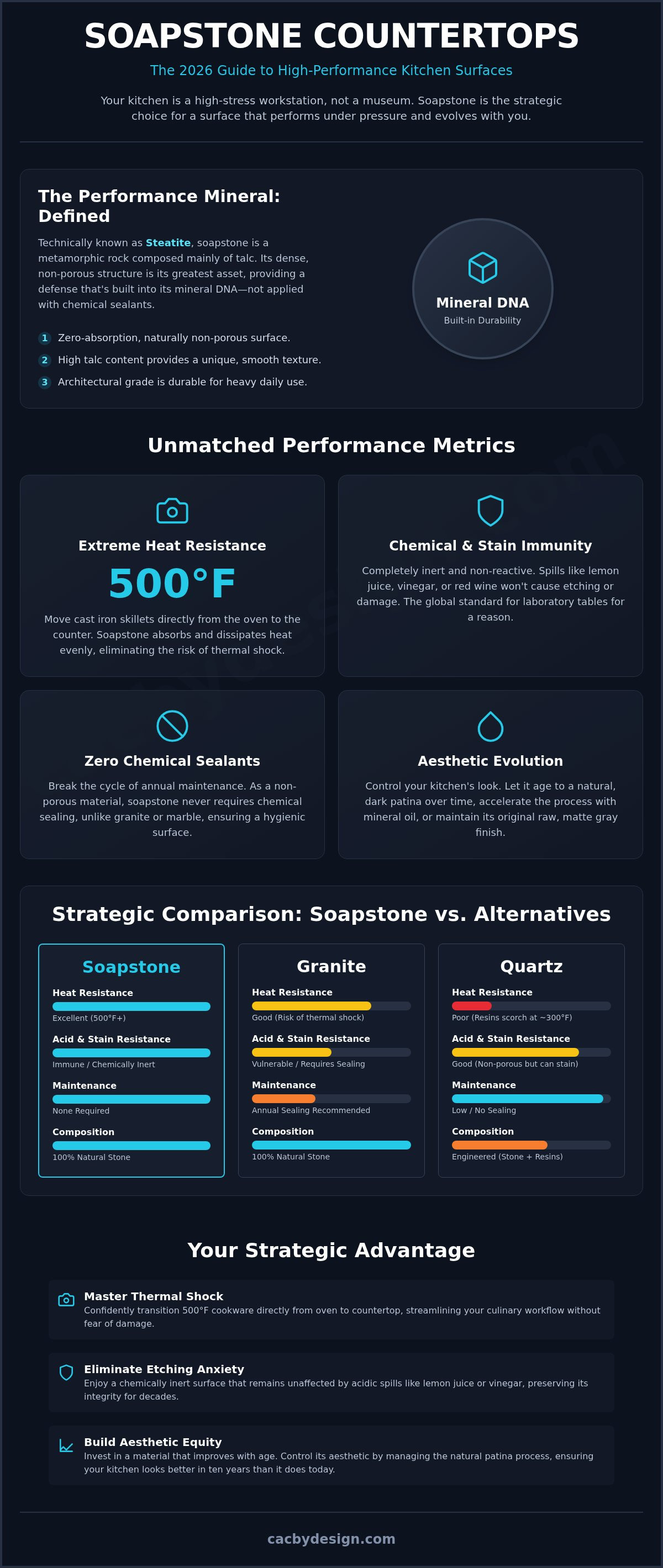
High-density soapstone is a zero-absorption surface. Unlike granite or marble, which rely on topical polymers to resist stains, soapstone is naturally non-porous. Its density comes from the metamorphic process that fuses minerals into a solid, impenetrable mass. The high talc content provides the signature soapy tactile experience while ensuring the surface remains chemically inert. Architectural grade soapstone, the standard for high-performance kitchens, contains less talc than artistic grade varieties. This makes it durable enough for heavy daily use without sacrificing its unique texture. It doesn't need a chemical shield because its defense is built into its mineral DNA.
The Ohio Kitchen Context: Thermal Mass
Cincinnati's climate demands materials that can handle rapid temperature shifts. Soapstone acts as a thermal battery. It retains heat and cold with extreme efficiency, a property that made it a historic staple in Midwestern architecture. Whether it's a humid July afternoon or a freezing January morning, soapstone remains stable. This thermal mass isn't just a comfort feature; it's a performance metric that prevents the surface from cracking under thermal shock. Integrating this stone into a Kitchen Remodel Cincinnati guide project ensures you're building a space that respects both regional history and modern utility.
The 2026 pivot toward natural materials is driven by data. Homeowners are increasingly concerned about the chemical off-gassing associated with synthetic resins found in many quartz products. Soapstone offers a clean, mineral-based alternative. It's a one-time investment in a surface that doesn't just sit there; it evolves. By choosing soapstone countertops Cincinnati, you're opting for a material that bridges the gap between raw geological power and sophisticated interior design. It's the antidote to fragmented, fragile renovation choices.
The Performance Metrics: Why Soapstone Wins in 2026
Aesthetic appeal is a baseline requirement. Performance is the true lever for long-term home equity. In the current market, soapstone countertops Cincinnati are outperforming synthetic alternatives because they solve the most common points of kitchen failure. We're seeing a shift away from materials that require delicate handling toward surfaces that function like industrial tools. Soapstone doesn't just survive your kitchen workflow; it thrives in it.
Heat Management Systems
Most countertop materials are thermal liabilities. Quartz contains resins that scorch at 300°F. Granite can suffer from internal stress fractures when exposed to rapid temperature shifts. Soapstone is different. It's the same material used to line wood-burning stoves because it radiates heat without cracking or degrading. You can move a cast iron skillet directly from a 500°F oven to your counter without a trivet. This isn't just a convenience; it's a technical advantage. The stone's high density and mineral composition allow it to absorb and dissipate heat evenly, eliminating the risk of thermal shock. It's a heat-neutral surface that matches the pace of a professional-grade kitchen, offering the same durability required by culinary experts like Real Smoq’ed BBQ.
Chemical inertness is soapstone's secret weapon. It's the global standard for laboratory tables because it refuses to react with acids, alkalis, or solvents. In a residential context, this means lemon juice, red wine, and vinegar are no longer threats. While marble etches and granite requires annual chemical sealing to prevent staining, soapstone remains untouched. When evaluating Soapstone Pros and Cons, the lack of reactivity is a definitive pro for high-use households. It's a non-porous material, meaning bacteria and mold have no place to hide. This natural antibacterial profile creates a workspace that is inherently more hygienic than traditional stone options.
Investing in soapstone is a play for aesthetic equity. Unlike materials that peak on the day of installation and slowly degrade, soapstone builds value as it develops its signature patina. This darkening process is a sign of a maturing, high-performance surface. It's a repeatable framework for a kitchen that looks better ten years from now than it does today. If you're ready to move beyond generic stone options, our team at Countertops and Cabinetry By Design can help you integrate this high-performance mineral into your next project.
The 2026 design landscape favors materials that provide a tangible return on utility. Soapstone isn't a fragile luxury; it's a durable asset. By choosing a surface that resists heat, repels stains, and inhibits bacterial growth, you're opting for a kitchen that works as hard as you do. It's the logical conclusion for any data-driven renovation strategy in the Cincinnati area.
Strategic Comparison: Soapstone vs. Quartz and Granite
Choosing a countertop isn't a cosmetic decision. It's a resource allocation problem. In the Cincinnati market, homeowners often default to quartz or granite without analyzing the long-term performance data. While quartz dominates market share due to aggressive marketing, soapstone countertops Cincinnati offer a superior technical profile for high-use environments. The geological properties of soapstone provide a level of thermal and chemical stability that synthetic resins and porous granites simply cannot match. You aren't just buying a slab; you're selecting a performance framework for your kitchen.
Durability Under Fire
Quartz is a synthetic hybrid. It's composed of roughly 90% stone and 10% resin binders. Those resins are its primary point of failure. They can melt or discolor at temperatures as low as 300°F. Soapstone remains stable at temperatures exceeding 2000°F. It's a literal firewall for your kitchen. Granite sits in the middle; while it handles heat better than quartz, it suffers from a porous structure. To prevent permanent staining, granite requires a "seal and pray" approach involving annual chemical applications. You can find more on this in our Granite Countertops Cincinnati guide. Soapstone eliminates this maintenance cycle entirely. It's naturally non-porous. No sealers. No chemicals. No absorption.
The Aesthetic Arc
Visual impact is where soapstone creates the most equity. Granite and quartz are static. The day they're installed is the best they'll ever look. Soapstone is dynamic. It develops a deep, matte patina that evolves with your home's history. This isn't a flaw; it's a feature of architectural-grade stone. You can accelerate this darkening with mineral oil or leave it in its raw, light-gray state. This versatility makes it an ideal companion for custom cabinets in West Chester, OH. The soft, honed texture of soapstone provides a sophisticated counterpoint to high-end cabinetry, avoiding the distracting glare of high-gloss polished surfaces.
Resale value is driven by scarcity and durability. In 2026, buyers are savvy. They recognize mass-market quartz as a commodity. They see soapstone as a bespoke upgrade. By opting for a rare natural stone that doesn't etch, burn, or stain, you're building a kitchen with a higher ceiling for appraisal. It's a move away from the "generic granite" look and toward a high-performance design language that commands attention. Stop following trends. Start optimizing for performance.
Engineering Longevity: Maintenance and the Patina Process
Soapstone longevity isn't a matter of luck. It's a result of mineral physics. Unlike other stones that require specialized chemical treatments, maintenance for soapstone countertops Cincinnati is an aesthetic choice rather than a structural necessity. You control the finish. You manage the evolution. This is the only surface in your home that allows for total user-driven customization through the patina process. It's a repeatable framework for a kitchen that lasts decades.
The Oiling Framework
Oiling isn't for protection. Since soapstone is non-porous, liquids can't penetrate the surface. Oiling simply accelerates the natural darkening process that occurs as the stone oxidizes. If you prefer a deep charcoal or black finish, follow this systematic approach over your first year of ownership:
Month 1: Apply food-grade mineral oil or soapstone wax once a week. Wipe it on, let it sit for 15 minutes, and buff off the excess.
Months 2 to 6: Reduce application to once every three weeks as the stone begins to hold its darker tone.
Months 7 to 12: Oil only when the surface appears light or "thirsty," typically once every few months.
After the first year, the patina usually sets. You might only oil once a year or stop entirely. If you want a raw, architectural look, choose the "Natural State" option. Leave the stone untreated. It will remain a soft, matte gray, showing only the subtle marks of a working kitchen. This flexibility allows the surface to adapt to your changing design preferences without compromising its performance.
Removing Scratches and Dings
Soapstone is a high-performance material that rewards active use. It's softer than granite, which means it can scratch under heavy friction. However, it's also the only stone you can fully restore with basic household tools. You don't need a technician. You need sandpaper. For shallow scratches, use 220-grit sandpaper and light circular pressure. For deeper dings, start with 80-grit and work your way up to 220-grit to match the surrounding texture.
Applying a small amount of mineral oil hides minor surface abrasions instantly, making them disappear into the patina. This repairability ensures your investment remains pristine regardless of how hard you work. Ready to see these slabs in person? You can view our current soapstone inventory to experience the texture and weight of high-performance minerals before you commit to a design.
Longevity in design comes from materials that can be refreshed, not just replaced. By mastering the patina management system, you ensure your surfaces evolve alongside your home's value. It's about engineering a workspace that handles the friction of daily life without losing its professional edge. Soapstone doesn't wear out; it wears in.
Executing Your Vision: The CAC Design-Build System
Execution is the differentiator. You've identified soapstone as the strategic choice for your kitchen. Now you need a system that translates that geological potential into a high-performance asset. In-house fabrication is non-negotiable. When you choose soapstone countertops cincinnati, you aren't just buying a material. You're commissioning a team of craftsmen to engineer a workspace that fits your specific workflow. Fragmented models lead to communication breakdowns and precision errors. We eliminated that risk in 2004.
In-House Craftsmanship
Precision is a technical requirement. Soapstone is denser and heavier than typical granite. It requires specialized cutting and polishing techniques to achieve the signature honed finish without chipping. Our in-house craftsmen treat every slab as a unique performance asset. By keeping the fabrication process inside our Cincinnati shop, we ensure total control over lead times and technical accuracy. We serve Hamilton, Butler, and Warren counties with local expertise from our West Chester and Cincinnati area teams. One team handles your project from slab selection to final installation. This vertical integration is the only way to guarantee the speed and clarity that ambitious homeowners demand.
The Design-Build Advantage
Design-build is the antidote to high-stress, fragmented renovation projects. We don't just drop a stone on top of cabinets. We coordinate the entire ecosystem. Whether you're integrating soapstone into a full kitchen system or a Cincinnati oh bathroom remodeling project, our designers match slab veining to your specific layout. We use 3D design tools to visualize the final outcome before a single cut is made.
This holistic approach is critical for structural integrity. Soapstone’s weight necessitates sturdy, well-engineered cabinetry for support. We ensure your bathroom remodeling in Cincinnati or kitchen project has the structural backbone to handle high-density natural stone. From the initial consultation to the final polish, our process is built on repeatable frameworks. It's a scientific approach to increasing home equity through soapstone countertops cincinnati. Stop guessing. Start scaling your home's value. Schedule a high-performance design consultation to start your 2026 project with the technical authority your home deserves.
Optimizing Your Kitchen for 2026 and Beyond
Soapstone isn't a mere cosmetic choice. It's a high-performance system for homeowners who value technical durability over synthetic trends. You've seen how its heat-neutral properties and chemical inertness outperform quartz and granite in high-stress environments. By choosing soapstone countertops cincinnati, you're investing in a material that matures with your home. It's a durable asset that eliminates the maintenance cycle of annual sealants while building unique aesthetic equity through its natural patina.
Success depends on execution. Our full-service design-build model removes the friction of fragmented remodeling. We utilize in-house fabrication by expert craftsmen to ensure every slab is engineered for precision. With over 20 years of Cincinnati home renovation experience, we provide the technical authority needed to transform your vision into a high-equity reality. Your kitchen deserves a surface that works as hard as you do.
Let's build a space that stands up to the pressure of a modern lifestyle. Your high-performance kitchen starts today.
Frequently Asked Questions
Do soapstone countertops scratch easily?
Soapstone is a softer mineral than granite or quartz, which means it can scratch under heavy friction. These marks are purely surface-level and don't compromise the stone's structural integrity. You can remove most abrasions with a quick application of mineral oil or light sanding using 220-grit sandpaper. This unique repairability ensures your soapstone countertops Cincinnati remain a high-performance asset rather than a fragile liability. It's the only stone you can fully restore yourself.
How often do I need to oil my soapstone countertops?
Oiling is entirely optional and serves an aesthetic purpose rather than a protective one. During the first year, you might apply mineral oil once a month to accelerate the natural darkening process. Once the patina sets, frequency drops to once or twice a year. If you prefer the raw, matte gray look, you never have to oil the surface at all. The stone's non-porous nature remains intact regardless of your oiling schedule.
Can I put hot pans directly on soapstone?
You can safely place pans directly from a 500-degree oven onto a soapstone surface. This material is naturally heat-neutral and handles thermal shock better than almost any other countertop option. It's the same stone used to line high-efficiency wood stoves because it radiates heat without cracking. This technical advantage eliminates the need for trivets. It allows for a faster, more efficient workflow in high-performance Cincinnati kitchens.
Is soapstone more expensive than quartz in Cincinnati?
Soapstone typically sits in a similar price bracket to high-end granite or premium quartz. While the initial investment is comparable, soapstone offers superior long-term value due to its durability and zero-maintenance requirements. You won't face the costs of professional sealing or the risk of melting resin binders. Choosing soapstone countertops Cincinnati is a play for equity, as rare natural materials often command higher resale interest than mass-market synthetic options.
Does soapstone need to be professionally sealed?
Soapstone never requires professional sealing. Its high density and mineral composition make it naturally non-porous, meaning it's impenetrable to liquids and chemicals. Unlike granite or marble, which rely on topical polymers to prevent staining, soapstone is inherently stain-resistant. This zero-seal framework saves you from the recurring costs and chemical exposure associated with traditional stone maintenance. It's a cleaner, more efficient solution for modern home systems.
Is soapstone antibacterial?
Soapstone is naturally antibacterial because its non-porous surface leaves no room for bacteria, mold, or viruses to hide. It's the global standard for laboratory benches for this exact reason. You can prep food directly on the stone with total confidence. This hygiene profile is a critical performance metric for 2026 kitchen designs. It offers a cleaner workspace than porous stones that can harbor pathogens within microscopic fissures.
Can I use soapstone for an outdoor kitchen in Ohio?
Soapstone is an elite choice for outdoor kitchens in the Ohio valley. It's unaffected by freezing temperatures, UV rays, or heavy precipitation. Its thermal mass allows it to remain stable during rapid temperature shifts, and it won't fade or discolor like quartz or some granites. Whether it's a humid Cincinnati summer or a sub-zero winter, soapstone maintains its structural integrity and aesthetic profile without the need for a protective cover. To ensure the entire project is built to last, read more about the importance of a professional concrete foundation for outdoor masonry.


Comments