
What is the Most Durable Kitchen Cabinet Finish? The High-Performance Guide to 2026 Kitchen Equity
If you think a premium gallon of boutique paint is the secret to a twenty-year kitchen, you've already lost the ROI game. Most homeowners allocate nearly half their renovation budget to cabinetry only to watch the edges chip before the second anniversary. It's a massive waste of capital. In Cincinnati, where summer humidity triggers warping and peeling, the stakes for your finish are even higher. You deserve a surface that survives daily impact and steam without losing its factory-fresh edge.
We're here to settle the debate on what is the most durable kitchen cabinet finish by analyzing the chemistry, not the marketing. You'll discover the engineered finishes, specifically conversion varnish and 2K poly, that professional shops use to protect 2026 kitchen equity. We'll break down why factory-cured systems outperform DIY methods in every performance metric. This guide previews the high-performance materials that transform your cabinets from a depreciating asset into a durable investment for the next decade.
Table of Contents
Defining Durability: Why Your Kitchen Cabinet Finish is a High-Yield Asset
The High-Performance Hierarchy: Comparing Today’s Most Durable Finishes
Factory-Applied vs. On-Site Finishing: The Technical Performance Gap
Environmental Resilience: Protecting Cabinets from Cincinnati Humidity
Engineering Your Remodel: Integrating Durable Cabinets with Premium Countertops
Defining Durability: Why Your Kitchen Cabinet Finish is a High-Yield Asset
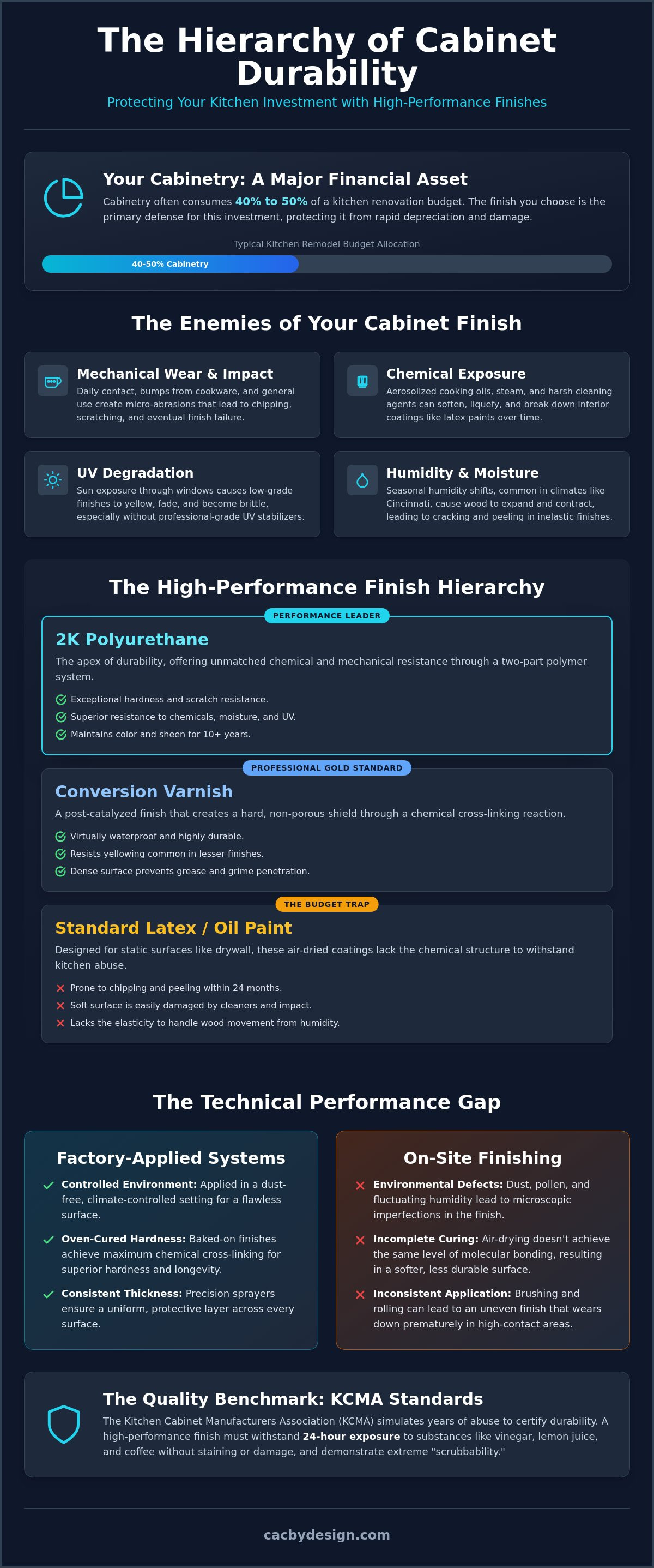
A kitchen remodel isn't a simple purchase. It's a strategic capital investment. When you consider that cabinetry typically accounts for 40% to 50% of your total renovation budget, the finish becomes the primary layer of protection for that equity. If your cabinets chip or peel within 24 months, your ROI evaporates. True durability isn't about finding a "pretty" color; it's about engineering a surface that survives the high-traffic reality of a modern home. You need a finish that resists chemical cleaners, withstands intense UV exposure, and absorbs daily mechanical impact without flinching.
Homeowners often get distracted by aesthetics while ignoring the mechanics of degradation. Understanding professional Wood finishing techniques is the first step in identifying what is the most durable kitchen cabinet finish for a high-performance environment. A factory-grade coating preserves that "new kitchen" feel for a decade or more, ensuring your home remains market-ready and high-value. This isn't just paint. It's an industrial barrier designed to keep your investment intact.
The Stress Test: What Actually Kills Cabinet Finishes?
Cooking is a chemical process, and your cabinets are on the front lines. Steam and aerosolized cooking oils are silent killers that liquefy inferior latex paints over time. Mechanical wear is equally brutal. Daily contact from "little fingers," pets, and heavy cookware creates micro-abrasions that eventually lead to full finish failure. In the Cincinnati area, the problem is compounded by UV degradation. High sun exposure through kitchen windows can cause low-grade coatings to yellow and become brittle, especially when they lack the chemical stabilizers found in professional-grade polymers. You aren't just fighting spills; you're fighting environmental decay.
Measuring Performance: The KCMA Standards
Don't guess at quality. The Kitchen Cabinet Manufacturers Association (KCMA) provides the data you need to make an informed decision. Their testing protocols are rigorous because they simulate years of abuse in a matter of days. For a finish to be truly high-performance, it must demonstrate extreme "scrubbability," the ability to be cleaned repeatedly without thinning the protective layer. The KCMA finish test requires cabinets to withstand 24 hours of exposure to common household substances like vinegar, lemon, and orange juice without showing any signs of staining or finish failure. If a finish can't pass this benchmark, it doesn't belong in a high-yield kitchen. When homeowners ask what is the most durable kitchen cabinet finish, the answer always begins with a coating that meets or exceeds these industrial standards.
The High-Performance Hierarchy: Comparing Today’s Most Durable Finishes
Stop looking at paint swatches and start looking at chemical data. Standard latex paint is designed for drywall, not the mechanical stress of a kitchen door. When homeowners ask what is the most durable kitchen cabinet finish, they are usually looking for a high-performance polymer system. These coatings create a molecular bond that turns a liquid application into a solid, impenetrable shell. The hierarchy of durability moves from basic air-dried paints to sophisticated, chemically-cured industrial finishes.
For those prioritizing long-term equity, the choice usually narrows down to three categories: conversion varnish, 2K polyurethane, and engineered laminates. Each offers a different level of resistance to the heat and impact common in active kitchens. If you're investing in custom kitchen cabinets, the finish system is just as important as the wood species you select.
Conversion Varnish: The Professional Gold Standard
Conversion varnish is the benchmark for high-end custom cabinetry. It's a post-catalyzed system, meaning a chemical hardening agent is added just before application. This catalyst triggers a cross-linking reaction. It creates a permanent shield that is significantly harder and thicker than standard lacquer or oil-based products. This finish is virtually waterproof and resists the yellowing that plagues cheaper alternatives. Maintenance is minimal. Because the surface is so dense, grease and grime can't penetrate the film, making it easy to wipe clean with a damp cloth.
2K Polyurethane: The Performance Leader in 2026
2K Polyurethane is the current elite standard in the industry. It mimics the chemical resistance found in automotive finishes. This two-component system provides a "bulletproof" layer that is especially effective in high-moisture zones near sinks or dishwashers. Unlike older coatings that can become brittle and crack, 2K poly maintains a critical degree of flexibility. This allows the finish to expand and contract along with the wood's natural movement. This elasticity is vital for longevity, as USDA Forest Products Laboratory research shows that wood cells are constantly reacting to indoor climate shifts.
For modern, minimalist aesthetics, textured melamine and high-pressure laminates offer engineered durability. These aren't the thin foils of the past. Modern laminates are fused under intense heat to create a surface that is nearly impossible to scratch or stain. While these are excellent for high-traffic areas, many homeowners still prefer the look of natural wood or painted finishes.
When deciding between stained and painted options, consider how you live. Stains penetrate the wood fibers and hide small dents or scratches effectively. Paint sits on top of the surface. While paint provides the clean, sophisticated look dominant in 2026 designs, it requires the chemical strength of a 2K poly or conversion varnish to prevent premature wear. If you want a kitchen that looks brand new for a decade, choosing a high-performance chemical system is your only viable path.
Factory-Applied vs. On-Site Finishing: The Technical Performance Gap
The environment where your cabinets are finished dictates their lifespan. You can have the best chemical formula, but if it's applied in a kitchen under renovation, it's already compromised. When discussing what is the most durable kitchen cabinet finish, the application environment is the silent variable. Professional factory finishes happen in "Clean Rooms." These are pressurized, dust-free environments that eliminate microscopic debris. In a residential setting, household dust and pet dander settle into wet paint, creating structural weak points that lead to premature chipping. It's a technical failure, not just an aesthetic one.
Speed and hardness are chemically linked. On-site painters rely on air-drying, which can take weeks to reach full hardness. Factory systems use oven-curing. This process uses heat to trigger immediate chemical cross-linking, reaching maximum durability in minutes. Automated spray systems also ensure precise mil-thickness. This prevents the drips and thin spots common with hand-spraying, ensuring every square inch of the door has the same level of protection. Consistency is the hallmark of a high-performance asset.
The VOC reality is another dealbreaker. The most durable industrial coatings, like conversion varnish, release high levels of Volatile Organic Compounds during application. These chemicals require sophisticated ventilation systems found only in industrial facilities. Attempting to apply these high-performance materials in a home is a safety hazard and a technical impossibility. You end up compromising on the chemical strength of the paint just to make it safe for a residential environment.
Why On-Site Painting Often Fails the Durability Test
Air-dry enamels are limited by their chemistry. They are designed for easy application, not maximum resistance. In a home, you can't control humidity or temperature with industrial precision. This creates the "curing trap." The paint feels dry to the touch, but the chemical bond remains soft and vulnerable for up to 30 days. One accidental bump with a grocery bag during this window can ruin the finish permanently. You're left with a surface that looks decent on day one but fails by month twelve.
The Value of Factory-Finished Custom Cabinetry
Factory finishing allows for 360-degree coverage. Every edge and interior surface is sealed before the cabinet is even assembled. This prevents moisture from sneaking into joints, a common cause of failure in on-site jobs. While the upfront cost of factory systems is higher, the performance-to-cost ratio is superior. You pay for longevity once instead of paying for repairs every three years. You can see the difference in quality by looking at Custom Cabinets West Chester OH, where factory-grade results are the baseline for every project. High-performance finishes require high-performance facilities. Don't settle for a finish that was compromised before it even dried.
Environmental Resilience: Protecting Cabinets from Cincinnati Humidity
Cincinnati homeowners face a unique technical challenge. The Ohio Valley climate swings from sweltering humidity in July to bone-dry conditions in January. This atmospheric volatility forces wood to expand and contract aggressively. If your finish lacks the engineered elasticity to move with the substrate, it will develop hairline fractures. These cracks aren't just an aesthetic flaw. They are entry points for moisture. When analyzing what is the most durable kitchen cabinet finish for this region, you must prioritize coatings that balance extreme hardness with structural flexibility.
Our 20 years of experience in Hamilton and Butler County has proven that standard coatings fail here. We engineer our cabinets to survive these shifts. By combining high-performance finishes with stable substrates, we eliminate the structural movement that leads to finish failure. This is how you protect your equity in a climate that is actively trying to degrade it. We don't rely on luck. We use repeatable frameworks to ensure your kitchen remains a high-yield asset despite the local weather.
Moisture Resistance in the Kitchen 'Wet Zones'
The sink base is the primary failure point in most local kitchens. Constant exposure to water splashes and dishwasher steam creates a micro-climate of intense humidity. A 2K poly finish acts as a vapor barrier for wood substrates, sealing the material against moisture penetration and fiber swelling. Without this barrier, the wood expands, causing the finish to delaminate from the edges. High-heat appliances like pressure cookers and steam ovens also contribute to stress. You need a finish that handles 212-degree vapor without softening or clouding. It's about engineering a surface that performs under pressure.
Substrate Stability: The Secret to Finish Longevity
Substrate choice is the foundation of finish performance. While many believe solid wood is always the premium choice, HDF (High-Density Fiberboard) is often superior for painted finishes. It lacks the grain movement found in solid maple or oak. This stability prevents "bridge cracking" at the cabinet seams where different components meet. In Montgomery and Warren County homes, we utilize specific material combinations to ensure longevity. This approach ensures your cabinets look brand new regardless of the season. We select materials that thrive in the specific Ohio climate to maximize your long-term results.
Ready to build a kitchen that survives the Ohio Valley climate? Contact our Cincinnati team to select high-performance materials for your next remodel.
Engineering Your Remodel: Integrating Durable Cabinets with Premium Countertops
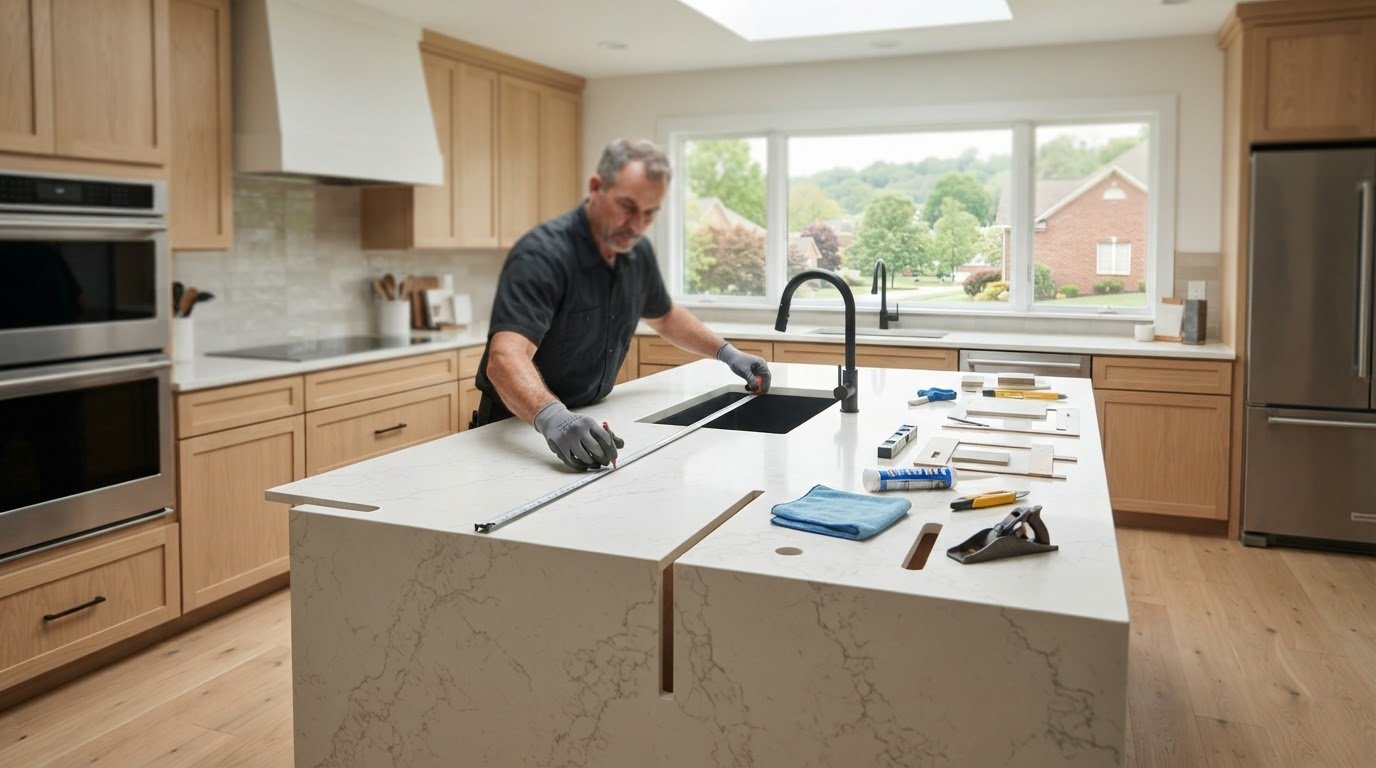
A high-performance kitchen is a unified system. It's not a collection of isolated products. Even if you've identified what is the most durable kitchen cabinet finish, that coating must work in tandem with your countertops to ensure long-term stability. A cabinet finish that resists steam is irrelevant if the countertop installation allows water to seep behind the face frame. We view the kitchen as a total engineering project. This means aligning the chemical resistance of your 2K poly cabinets with the non-porous performance of a Quartz or Granite slab.
Structural integrity is the foundation of finish longevity. Premium stone slabs are heavy. They require cabinet boxes built to industrial tolerances. If a cabinet box sags under the weight of a 3cm Quartzite countertop, the finish at the joints will eventually crack. This isn't a finish failure. It's a structural failure. Our framework ensures that the in-house craftsmen who build your cabinets understand the exact load-bearing requirements of the stone you've selected. This prevents the micro-shifts that destroy even the best factory-applied coatings. Determining what is the most durable kitchen cabinet finish is only half the battle; the other half is structural integration.
The Synergy of Stone and Finish
Visual equity relies on light reflectance. You must balance the luster of your cabinets with the polish of your counters. Since roughly 65% of new cabinets ship in a satin finish, matching that soft sheen with a honed or polished stone requires technical precision. The wrong pairing can make a durable finish look dull or dated. Additionally, the countertop overhang must be engineered to direct water runoff away from the cabinet face. This protects the finish from the standing water effect that often occurs near sinks. For a comprehensive look at total project integration, see our guide to Kitchen Remodel Cincinnati.
Next Steps: Building Your High-Performance Kitchen
Don't leave your kitchen equity to chance. The first step to a twenty-year kitchen is a consultation with an in-house practitioner who understands the mechanics of durability. Before signing a contract, ask your builder these specific questions:
Do you use a post-catalyzed conversion varnish or a 2K polyurethane system?
Is the finish applied in a controlled factory environment or on-site?
How does the cabinet construction account for the weight of premium stone?
What is your repeatable framework for ensuring finish elasticity in the Ohio climate?
These questions separate high-performance partners from general service providers. We offer a repeatable framework that removes the guesswork from your remodel. It's time to move beyond aesthetics and start engineering for growth. Schedule your design-build consultation with our Cincinnati team today to secure your investment.
Secure Your 2026 Kitchen Equity
Your kitchen is a high-traffic asset that demands industrial-grade protection. We've established that determining what is the most durable kitchen cabinet finish isn't about color choice; it's about chemical engineering. Whether you choose the resilience of 2K polyurethane or the classic strength of conversion varnish, your finish must be factory-applied to survive the Cincinnati humidity. Air-dried, on-site paints simply cannot compete with the hardness and consistency of oven-cured systems.
Investing in a full-service design-to-installation system ensures your cabinetry and premium stone countertops function as a single, high-performance unit. With over 20 years of Cincinnati remodeling expertise, our in-house team of professional craftsmen builds for longevity. We remove the variables of random success by applying repeatable frameworks to every custom project. You deserve a kitchen that maintains its factory-fresh edge for the next decade.
It's time to stop settling for finishes that chip and start building a kitchen that performs.
Frequently Asked Questions
Is a painted or stained cabinet finish more durable?
Stained finishes technically offer more durability because they penetrate the wood fibers rather than sitting on the surface. This prevents the visible chipping often seen in painted cabinets. However, a factory-applied 2K poly painted finish can rival stain for longevity if applied correctly. Identifying what is the most durable kitchen cabinet finish requires looking at the chemical bond between the coating and the wood substrate.
What is the hardest cabinet finish available for residential kitchens?
Industrial conversion varnish and 2K polyurethane represent the hardest finishes available for residential kitchens. These systems use chemical catalysts to trigger a cross-linking reaction, creating a permanent shield that resists mechanical impact and heat. When homeowners ask what is the most durable kitchen cabinet finish, these are the industrial standards. They outperform standard lacquers and retail paints in every measurable performance metric used by the KCMA.
Can I get a factory-quality finish by painting my own cabinets?
You cannot replicate a factory-quality finish by painting your own cabinets. Professional results require a "Clean Room" environment to eliminate microscopic dust and debris that ruin the finish bond. Factory systems also use oven-curing to reach maximum hardness in minutes. DIY air-dry methods leave the coating soft and vulnerable for weeks, which eventually leads to the premature peeling and chipping common in home projects.
How long should a professional kitchen cabinet finish last?
A professional kitchen cabinet finish should last 15 to 20 years under normal use. High-performance coatings like 2K poly are engineered to withstand decades of steam, grease, and daily mechanical impact. If your cabinets show signs of wear, yellowing, or delamination within five years, the finish system was likely a low-grade air-dry product rather than an industrial, chemically-cured factory coating.
Does Cincinnati's humidity affect which cabinet finish I should choose?
Cincinnati's humidity swings aggressively from 20% in winter to 80% in summer, making finish elasticity a critical technical requirement. Wood movement in the Ohio Valley will crack brittle coatings at the cabinet seams. To protect your equity, you must choose a finish like 2K polyurethane that expands and contracts with the wood. This prevents moisture from entering the substrate and causing the finish to peel or bubble.
What is the difference between conversion varnish and standard polyurethane?
The primary difference is that conversion varnish is a post-catalyzed industrial coating that dries harder and faster than standard polyurethane. While standard poly is a common retail product for DIY projects, conversion varnish requires professional equipment and a controlled environment. It provides a significantly thicker, more durable barrier that is virtually waterproof. It also resists the yellowing that occurs when standard oil-based products are exposed to UV light.
Are matte cabinet finishes harder to keep clean than gloss finishes?
Matte cabinet finishes are actually easier to keep clean than gloss finishes. Gloss surfaces reflect light in a way that highlights every fingerprint, grease spot, and micro-scratch on the door. Modern matte topcoats are engineered for high "scrubbability," meaning they can be wiped down repeatedly without losing their low-sheen profile. This makes matte or satin the preferred choice for high-traffic kitchens that require frequent maintenance.
How do I clean high-performance cabinet finishes without damaging them?
Clean high-performance cabinet finishes with a soft microfiber cloth and a mild, pH-neutral soap solution. Avoid using abrasive pads, steel wool, or harsh chemical cleaners that can strip the protective topcoat over time. Because industrial finishes are non-porous, grease and steam residue should wipe away easily without aggressive scrubbing. Regular maintenance with gentle products ensures the finish maintains its factory luster and protective properties for the life of the kitchen.

Comments