
What to expect from your contractor when renovation costs change
What if the renovation budget changes, but the contractor expects work to continue as planned? Knowing what to expect from your contractor means asking for cost changes to be explained and contract revisions to be acknowledged in writing by everyone involved. Don’t treat a higher total as automatic approval: make sure the revised scope, cost, and schedule are clear before the work moves forward.
It’s reasonable to want quality work without losing control of your budget. A clear agreement and defined payment schedule help you understand what is changing, what you’re being asked to pay, and what work remains.
This article explains how to assess past work, understand staged payments, and review insurance documents. It also covers how written change orders clarify your options when costs shift, so you can make decisions with a better understanding of the work and agreement.
Table of Contents
1. Checking references and past work
Start with referrals from friends who have completed similar renovations. Ask what the contractor handled, how clearly they communicated, and whether the finished work matched the agreement. A referral is a useful lead, not a complete basis for choosing a contractor.
Ask each prospective contractor for at least two references for similar work. Contact past clients and ask about workmanship, materials, customer service, schedule changes, and how problems were resolved. If a client mentions a countertop installation, for example, ask whether the material and finished details matched expectations. Review examples of completed work, too, and look for quality relevant to your project.
Compare at least three written estimates. Match the scope, materials, work methods, and timeline line by line, since a lower total may cover less work. Ask which tasks, materials, preparation, or cleanup are excluded. Work not described in the estimate can change the total, so get the scope and any revisions in writing before proceeding.
Permit and inspection requirements depend on the project and its location. A general contractor may obtain required permits and schedule inspections, so clarify who handles each step and when it fits into the written timeline.
Before work begins, agree on the schedule, daily access, cleanup, and how updates will be shared. A written timeline should identify project stages and estimated start and finish dates. Regular check-ins can help flag delays or decisions promptly.
Warning signs include unusually high or low estimates, pressure to sign immediately, or refusal to leave a contract overnight. A contractor who won’t provide a local physical address also warrants caution. Check licensing requirements with your state or local building department; a business license indicates that the contractor is a legitimate business and has met government requirements. Ask for a certificate of insurance, and don’t sign until the scope and terms are clear.
2. Payment schedules and avoiding full advance payment
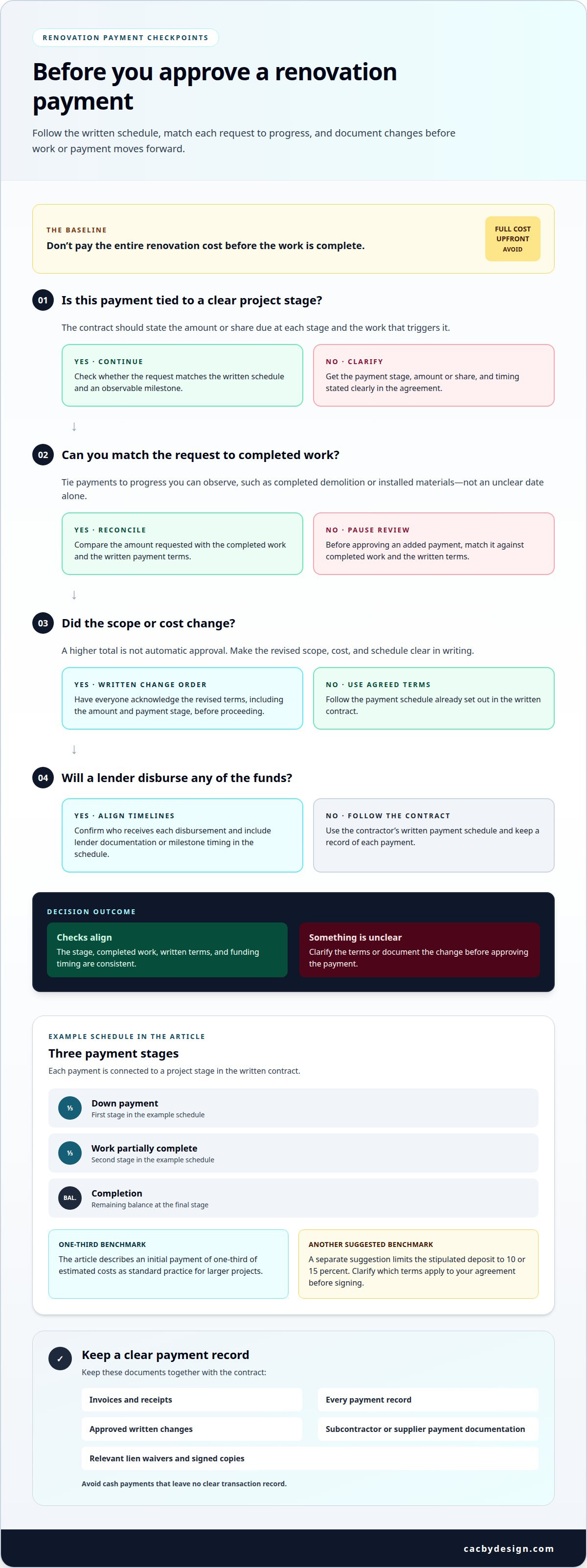
A payment schedule should connect each payment to a clear project stage. Don’t pay the entire renovation cost before the work is complete. For larger projects, an initial payment of one-third of estimated costs is described as standard practice. Another suggested benchmark limits the stipulated deposit to 10 or 15 percent, so clarify which terms apply to your agreement before signing.
An example payment schedule divides the total into three stages: one-third down, one-third when work is partially complete, and the balance at completion. The written contract should state the amount or share due at each stage, the work that triggers payment, and how delays affect timing. Tie each payment to observable progress, such as completed demolition or installed materials, rather than relying on an unclear date alone.
Home improvement loan funds may follow the lender’s disbursement process, while the contractor’s schedule sets payment deadlines. Before work starts, align the timelines and confirm who receives each disbursement. If the lender releases funds after documentation or a project milestone, include that step in the schedule. Don’t assume loan approval means the contractor is paid automatically.
Keep a record of every payment, invoice, approved change, and receipt. If subcontractors or suppliers are involved, ask what documentation supports their payment before releasing the next installment. A lien waiver may be relevant to that process; understand what each document covers and keep signed copies with your contract. Avoid cash payments that leave no clear transaction record.
Before approving an added payment, match it against completed work and the written terms. If a new request follows a scope change, get the revised amount and stage in writing first. Clear scope helps set the payment schedule; plan the renovation scope around the work and materials you’ve chosen.
3. Verifying insurance and bonding
References and past project photos show a contractor’s work, but they don’t establish current insurance coverage. Before hiring, request current certificates for liability insurance and workers’ compensation. Confirm that the named contractor or business matches the party in your written agreement. A certificate should identify the insurance company, policy number, and policy limits.
Liability insurance and workers’ compensation address different risks. Liability coverage may apply to certain property damage or accidents, while workers’ compensation relates to employee injuries. Insurance certificates show coverage for accidents or injuries that may occur on your property. Read the certificate details, including the policy period, so you can see whether the document is current for the planned work.
Ask for updated documents if work is postponed or the policy period ends before the project is completed. If subcontractors will enter your home, clarify who employs them and how their coverage is documented. A general contractor may coordinate several trades, so identify which company is responsible for each crew and keep the relevant certificates with your contract.
Licensing requirements vary by state, county, and municipality. Check the rules that apply to your location through the relevant state or local building department. A business license indicates that the contractor is a legitimate business and has met government requirements. Licensing and insurance serve different purposes; neither document replaces the other.
A bonded contractor may provide another form of protection if the contractor fails to complete the project as specified or goes bankrupt. Bond terms determine what protection applies, so read the documentation rather than treating “bonded” as a blanket promise. Keep bond information, insurance certificates, the contract, and correspondence together in one project file. This creates a clear record if a coverage or completion question arises.
4. Contract agreement and homeowner rights
A signed contract turns estimates into a defined project. It should describe the work in detail, list item prices, and explain the contractor’s responsibilities and your rights as a homeowner. For larger projects, include estimated start and completion dates. Define materials, hardware, work methods, and cleanup expectations before signing, so everyone works from the same scope.
Cost changes need a paper trail. A change order records revisions to the original agreement, including changes to scope, cost, or completion date. Require everyone involved to acknowledge each change in writing before the revised work proceeds. If demolition reveals damage, for example, document the affected area, proposed repair, added work, and schedule impact. Verbal approval can leave the new terms unclear.
Before work starts, establish who will obtain required permits and confirm they’re in place. Licensing and permit requirements vary by state, county, and municipality, so local rules matter. Don’t sign an agreement with blank sections. Keep the contract, change orders, plans, specifications, invoices, canceled checks, insurance certificates, and contractor correspondence together in one job file.
Homeowners also need a clear closeout process. Don’t sign a completion certificate until all contract work is finished to your satisfaction. Federal law may require a cooling-off period that lets a consumer cancel a contract without penalty. In Missouri, the Missouri Revisor of Statutes says a contractor may not promise to pay or rebate any part of an insurance deductible to induce a sale.
Use the signed scope as your decision point when an unexpected charge appears: compare the requested work with the original terms, then approve or dispute the written change. For a renovation plan with clearly defined materials and work, discuss your remodeling project.
Countertops and Cabinetry By Design
Countertops and Cabinetry By Design helps homeowners plan kitchen and bathroom renovations. If changing costs involve countertop selections, the team can guide material selection and professional installation, making the chosen surface part of a clearly defined project scope. Options include marble, quartzite, quartz, and granite countertops.
Bring your priorities for appearance, function, and project scope into the planning conversation. Clear choices make it easier to document the intended materials and align expectations before work begins. This is a practical next step when your renovation includes new countertops and you want design, material selection, and installation coordinated as part of the project.
Contact Countertops and Cabinetry By Design to discuss your renovation.
Move your renovation forward with clarity
Cost changes are easier to manage when each new decision has a clear place in the project plan. Treat the next design choice as an opportunity to make the scope more precise, not as a reason to rush approval. A useful standard for what to expect from your contractor is a process that keeps the work, materials, and decisions aligned as the renovation develops.
If your plans include a new countertop, choose a material that suits the look and use of your space. Countertops and Cabinetry By Design offers marble, quartzite, and quartz countertops as part of its remodeling work. A focused conversation about your project can turn material preferences into a more defined plan.
Contact Countertops and Cabinetry By Design to discuss your renovation. Take the next step with a clearer vision for the space you want to create.
Frequently Asked Questions
What happens if my renovation goes over the original budget?
Pause before approving extra work, then identify what changed and why. If opening a wall reveals damage, ask for the affected area, proposed repair, added work, and schedule impact to be documented. Clear documentation is central to what to expect from your contractor when costs shift. Compare the new scope with the original agreement, then decide whether to proceed once the revised terms are clear in writing.
When’s the deadline?
Agree on the project deadline with the contractor and record it in the schedule. Ask for estimated start and completion dates, plus target dates for major stages such as demolition, installation, and inspection. If you have a fixed move-in date or event, raise it before work begins. Weather and scheduling changes can affect progress, so agree on how timeline updates will be communicated.
What should a contractor provide before starting a home renovation?
Before work starts, expect a signed agreement that defines the project, materials, responsibilities, and payment milestones. The contractor should also clarify which permits and inspections are required and who will arrange them. For a kitchen update, document chosen finishes and hardware rather than relying on a verbal description. Keep project plans and insurance documents with the agreement so essential details stay accessible during the work.
What questions should you ask a contractor before hiring them?
Ask how the proposed scope will be delivered, who will perform each part, and how progress updates will work. Request references for comparable projects, then ask past clients how the contractor handled unexpected changes. Clarify expected work hours, site access, cleanup, and how decisions affecting the schedule are approved. Knowing what to expect from your contractor also means understanding how communication and daily logistics will fit your household.
How do you verify a contractor's license, insurance, and references?
For your local renovation project, check applicable licensing requirements with the relevant state or local building department. Review current liability and workers’ compensation certificates for the insurer, policy number, limits, and coverage dates. Ask for at least two references for similar work, then contact past clients about workmanship and communication. Keep copies of documents and reference notes together for easy comparison as you decide.
What should a home improvement contract include?
A useful contract connects the planned work to clear terms: detailed scope, itemized prices, selected materials, payment stages, and estimated dates for larger projects. It should also explain how proposed changes are recorded and approved. Before signing, make sure every section is complete and responsibilities are understood. For example, specify who handles permit applications, inspection scheduling, and cleanup instead of leaving those tasks open to interpretation.




Comments