
Avoiding Kitchen Remodel Mistakes: The 2026 High-Performance Strategy
Updated: Jun 20
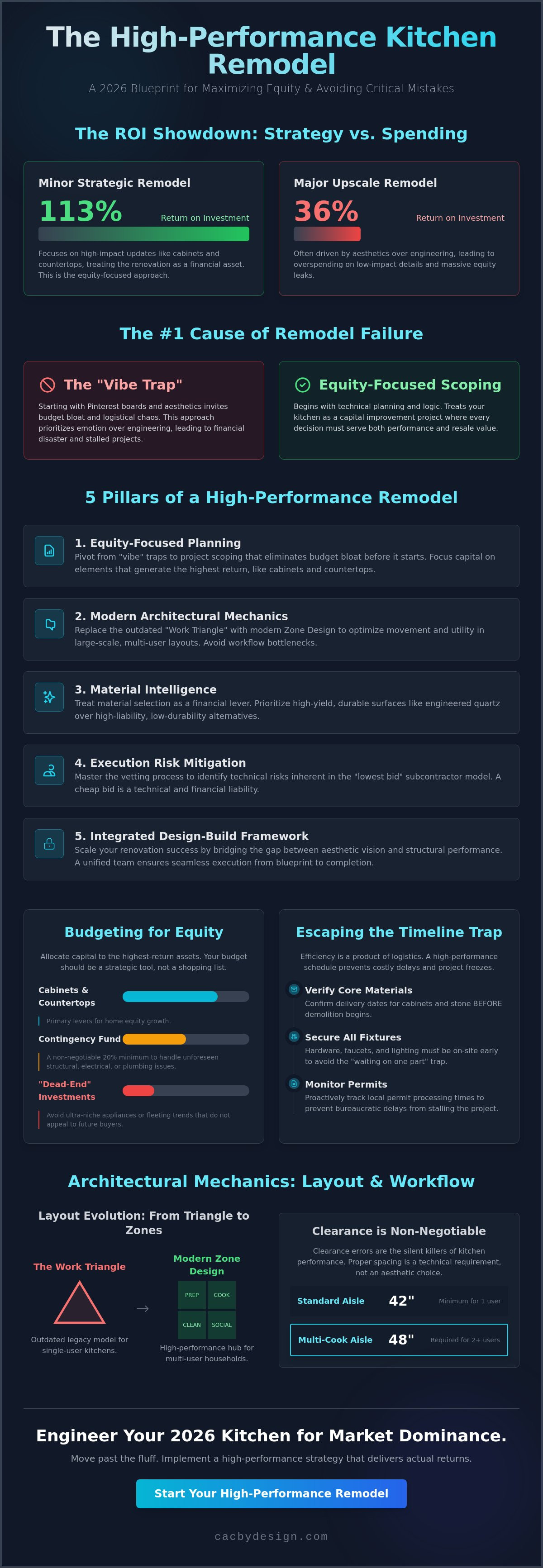
A major upscale remodel yields a 36% ROI. A minor strategic shift hits 113%. Most homeowners confuse "expensive" with "high-performance," leading to massive equity leaks before the first cabinet is hung. If you're anxious about overspending in the Tri-State area or choosing materials that will be obsolete by next year, your instincts are right. Avoiding kitchen remodel mistakes requires more than an eye for design. It demands a calculated strategy that treats your renovation as a financial asset.
Key Takeaways
Pivot from Pinterest-driven "vibe" traps to equity-focused project scoping to eliminate early-stage budget bloat.
Replace the outdated "Work Triangle" with modern kitchen mechanics to optimize movement and utility in large-scale layouts.
Treat material selection as a financial lever by prioritizing high-yield surfaces over high-liability, low-durability alternatives.
Master the vetting process for avoiding kitchen remodel mistakes by identifying the technical risks inherent in the "lowest bid" subcontractor model.
Scale your renovation success using an integrated design-build framework that bridges the gap between aesthetic vision and structural performance.
Table of Contents
Strategic Planning: Eliminating the #1 Cause of Remodel Failure
Pinterest is a budget killer. Most homeowners start with a "vibe" and end with a financial disaster. This is the primary driver of project failure. When you prioritize aesthetics over engineering, you invite budget bloat. High-performance renovations require a shift in perspective. You aren't just picking tile; you're managing a capital improvement project. Avoiding kitchen remodel mistakes begins with neutralizing the emotional lure of social media mood boards. Logic must dictate the scope. If the design doesn't serve the mechanics of the room, it's a liability.
Technical planning must precede material selection. You need to understand kitchen design principles before you fall in love with a specific slab of quartzite. This involves mapping out the mechanics of the space. In 2026, the supply chain remains a volatile factor. Lead times for custom cabinetry or imported stone can stall a project for months. If your strategy doesn't account for these lags, your kitchen will sit in a state of demolition while your equity evaporates. We've seen projects stall because a single faucet was backordered. Don't let your renovation become a case study in poor logistics.
Budgeting for Equity, Not Just Aesthetics
Stop spending on low-impact details. Focus your capital where it generates the highest return. Research shows minor remodels can see an ROI of 113%, while major upscale projects often drop to 36%. The difference is strategic allocation. Focus on cabinets and countertops. These are the primary levers for home equity growth. In the Cincinnati market, a 20% contingency fund is non-negotiable. It isn't a suggestion; it's a structural requirement to handle unforeseen electrical or plumbing issues in older homes. Avoid "dead-end" investments like ultra-niche appliances that don't appeal to future buyers. Every dollar must serve a dual purpose: performance and resale value.
The Timeline Trap: Engineering Your Schedule
Project freezes happen when sequencing fails. You can't start demolition until your core materials are verified and ready for fabrication. In the Tri-State area, local fabrication lead times are the bottleneck. Efficiency is a product of logistics. If you're avoiding kitchen remodel mistakes, you're prioritizing the schedule over the "reveal" moment. A streamlined schedule reduces labor costs and minimizes the disruption to your daily life. It’s about speed, clarity, and execution.
Verify cabinet delivery dates before swinging a sledgehammer.
Sequence demolition to ensure the sink and basic utilities remain functional as long as possible.
Secure all hardware and fixtures early to avoid the "waiting on one part" trap.
Monitor local permit processing times to prevent bureaucratic delays.
Speed is a metric of success. By locking in your technical specifications before the first hammer strike, you eliminate the guesswork that leads to expensive delays. This is the high-performance approach to 2026 remodeling.
Architectural Mechanics: Avoiding Layout and Workflow Bottlenecks
Layout is not an aesthetic choice. It is a technical specification. Kitchen mechanics refers to the spatial engineering of movement and utility. It's the difference between a room that looks like a kitchen and a room that performs like one. The traditional "Work Triangle" is a legacy model. It was built for single-user, small-scale environments of the mid-20th century. In 2026, high-performance layouts demand a more sophisticated approach. When you ignore the physics of the space, you create permanent bottlenecks that no amount of expensive stone can fix.
Clearance errors are the silent killers of kitchen performance. You can invest in the finest finishes, but if the dishwasher door blocks the main traffic aisle, the layout is a failure. Avoiding kitchen remodel mistakes means calculating the physics of door swings and aisle widths during the blueprint phase. Standard aisles should be 42 inches. For multi-cook spaces, 48 inches is the non-negotiable floor. Anything less is a technical liability. Proper clearance ensures that the kitchen remains a high-speed environment even during peak social hours.
Zone Design vs. The Work Triangle
Modern kitchens are multi-functional hubs. They require distinct zones for prep, cooking, cleaning, and social interaction. This prevents the collision of family members during meal preparation. Strategizing for multi-chef households is critical for the larger floor plans found in Cincinnati. You must minimize the distance between your primary water source and the cooktop. This isn't just about convenience; it's efficiency engineering. If you are planning a kitchen remodel in Cincinnati, layout performance is your primary lever for long-term satisfaction and home equity growth.
Infrastructure Blind Spots: Outlets, Lighting, and HVAC
Under-powering the kitchen island is a common strategic error. Modern kitchens are tech-heavy. You need dedicated circuits for wine fridges, microwave drawers, and high-wattage countertop appliances. If your island isn't engineered for these loads, you're building obsolescence into your home. Lighting is equally technical. A single overhead source creates shadows and kills precision. High-performance kitchens require layered lighting: task, ambient, and accent. Each layer serves a specific functional purpose.
Ventilation mechanics are often the most overlooked infrastructure element. You must match your hood's CFM (Cubic Feet per Minute) capacity to your range's BTU output. If you install a high-output professional range without the corresponding ventilation, you're inviting moisture damage and poor air quality. Precision in these invisible details separates a successful renovation from a high-maintenance headache. Don't let infrastructure be an afterthought. It's the foundation of kitchen performance.
Material Intelligence: Selecting High-Yield Surfaces and Cabinetry
Material selection is a high-stakes financial decision. It isn't just about color palettes or textures. It's about performance engineering. In 2026, material intelligence separates high-yield renovations from high-maintenance money pits. Avoiding kitchen remodel mistakes requires a shift from aesthetic "vibes" to technical specifications. Every surface you choose should be evaluated as a performance asset. If a material requires constant maintenance, it's a liability to your home equity and your time.
Porosity is the primary metric for stone selection. A porous surface absorbs liquids, stains easily, and requires periodic sealing. This is why quartz countertops have become the dominant choice for high-performance kitchens. Quartz is non-porous and engineered for durability. It offers the aesthetic of natural stone without the structural weaknesses. When you prioritize material science over trend-chasing, you ensure that your kitchen remains functional and valuable for decades.
Countertop Regrets: Why Material Science Matters
The "Marble Mistake" is a common trap for homeowners seeking luxury. Marble is beautiful, but it's soft and chemically sensitive. In a high-traffic family kitchen, marble etches and stains almost immediately. It's a technical failure in any environment where performance matters. Quartz and quartzite offer superior maintenance-to-ROI ratios. They withstand the heat, acids, and impacts of daily cooking without degrading. Even the edge profile matters. A simple eased edge is less prone to chipping and easier to clean than complex, ornate profiles. Small details dictate long-term durability.
Custom Cabinetry vs. Pre-Fab Pitfalls
Cabinetry typically accounts for 30-40% of your total budget. It's the most significant structural investment in the room. Choosing cheap pre-fab options is a mistake that leads to early failure. Particle board cabinets are a liability; they swell when exposed to moisture and cannot be easily repaired. Investing in custom cabinets in West Chester, OH ensures you're getting furniture-grade construction that handles the weight of modern stone tops and heavy cookware.
Custom builds utilize solid plywood or hardwood boxes for maximum structural integrity.
High-performance hinges and soft-close glides prevent the mechanical fatigue common in big-box units.
Vertical volume is a critical equity lever. Standard cabinets stop short of the ceiling, creating a dust-collecting gap. Custom designs go to the ceiling to maximize storage and create a seamless, high-end look.
Wood cabinets have officially surpassed white cabinets in popularity, with 29% of homeowners now choosing natural wood tones for their warmth and durability.
Don't settle for "good enough" in your storage strategy. Custom cabinetry allows for precision engineering of the space, ensuring that every square inch serves a functional purpose. This is how you build a kitchen that performs as well as it looks.
Execution Risk: Why the Lowest Bid is a Technical Liability
The "middle quote" strategy is a myth. In high-performance construction, the lowest bid is often a signal of technical incompetence or hidden fragmentation. Choosing a contractor based on a spreadsheet line item is one of the most common ways people fail at avoiding kitchen remodel mistakes. You aren't buying a commodity. You're buying an execution chain. When that chain is broken by the "Subcontractor Shuffle," your project becomes a series of hand-off errors. Fragmented teams don't share a unified vision. They share a desire to finish their specific task and leave. This leads to misaligned plumbing, poorly leveled cabinets, and stone that doesn't fit the footprint.
Vetting for the Cincinnati market requires local due diligence. National platforms don't understand Ohio's specific licensing and insurance non-negotiables. A "labor-only" contract might look lean on paper, but it shifts the risk of material failure and logistical delays onto you. If a slab cracks during transit or a cabinet arrives damaged, a labor-only crew will charge you for the downtime. A high-performance partner owns the entire lifecycle. Integrated systems are the only way to ensure the architectural mechanics discussed earlier actually manifest in the physical space. Precision is a product of control.
Vetting the Design-Build System
Identify firms with in-house fabrication. If your contractor is outsourcing stone cutting to a third party, they've lost control over the precision of your kitchen. Ask about their facility. Can you see the Cincinnati stoneworks in person? Seeing the equipment and the raw slabs provides a transparency that digital portfolios lack. Communication is your primary diagnostic tool. If a contractor is slow to respond during the sales phase, they'll be invisible during the demolition phase. Red flags in project management early on are data points you cannot ignore.
The In-House Craftsman Advantage
In-house teams eliminate the "not my job" blame game. When the person measuring the cabinets is on the same payroll as the person installing the stone, the friction of hand-offs disappears. This continuity is essential for the precision required in modern, heavy stone surfaces like quartzite or granite. A single millimeter of error in cabinet leveling can cause a stone countertop to crack under its own weight. Craftsman continuity ensures that technical standards are maintained from the first measurement to the final faucet install. By avoiding kitchen remodel mistakes in the labor pool, you protect your primary financial asset.
Quality is a product of total oversight. By consolidating the design, fabrication, and installation under one roof, you neutralize the execution risk that kills home equity. If you're ready to eliminate the guesswork and secure a high-performance renovation, partner with an integrated design-build team today.
The CAC System: Engineering Your 2026 Kitchen Remodel
Success isn't a happy accident. It's an engineered outcome. Traditional remodeling models rely on a fragmented chain of contractors, each passing off responsibility to the next. This is where most homeowners lose their grip on the project. Our 20-year framework for a kitchen remodel in Cincinnati is the antithesis of that chaos. We've replaced guesswork with an integrated design-build system. By consolidating design, fabrication, and installation, we eliminate the friction points that lead to budget bloat and project stall. This is the only way to ensure avoiding kitchen remodel mistakes isn't just a goal, but a technical certainty.
Our "Material-First" philosophy dictates the schedule. We don't wait for third-party fabricators to fit you into their queue. We control the shop. We control the slab. This vertical integration allows us to verify every architectural specification against the actual material before demolition begins. It creates a closed-loop system where accountability is absolute. When one team owns the measurement and the cut, the installation is a formality. This level of precision is non-negotiable for high-performance 2026 renovations.
From Slab Selection to Precision Fitting
Our Cincinnati showroom isn't just a gallery. It's a strategic hub. It streamlines the material selection process by providing direct access to our in-house stone fabrication shop. You aren't choosing from a tiny sample; you're selecting the specific slab that will define your kitchen's performance. This proximity reduces logistical lag. It ensures that the technical advantage of our precision cutting equipment is applied directly to your project. Accountability is simplified to a single point of contact. No more chasing three different vendors for an update on your countertops.
Securing Your Cincinnati Home Equity
High-quality materials are the ultimate hedge against market volatility. As we've established, minor strategic remodels can yield over 100% ROI, provided the execution is flawless. A kitchen that performs as well as it looks will maintain its value for decades. We build for the long term. By utilizing durable, non-porous surfaces and furniture-grade custom cabinetry, we secure your home's future performance. Every decision is filtered through the lens of home equity growth.
Integrated design-build eliminates the "Subcontractor Shuffle."
In-house fabrication ensures millimeter precision for stone surfaces.
Strategic material selection protects against early obsolescence.
Project timelines are compressed through vertical logistics.
Don't settle for a traditional, slow-moving model that leaves your equity at risk. High-performance results require a high-performance partner. Control the variables. Secure the outcome. Schedule your high-performance design consultation today to begin engineering your 2026 kitchen.
Engineering Your Competitive Advantage
High-performance remodeling isn't about following trends. It's about mastering the mechanics of the space. You've seen how strategic material selection and zone-based design layouts protect your financial interest. Success in 2026 requires moving beyond the "vibe" and into the data. By prioritizing structural integrity and workflow efficiency, you ensure your renovation remains a high-yield asset. Every decision you make should serve the dual purpose of daily performance and equity growth.
Mastering the art of avoiding kitchen remodel mistakes is ultimately a matter of execution. Fragmented teams create friction; integrated systems create results. CAC By Design was founded in 2004 to solve the problem of project fragmentation. With over 20 years of local expertise, our in-house team of craftsmen and stone fabricators manages every technical detail under one roof. We don't just build kitchens. We engineer high-performance environments that maximize home equity through a full-service design-build system. Control your variables and secure your investment.
Ready to take control of your renovation? Schedule your high-performance kitchen consultation with CAC By Design. Let's build a space that works as hard as you do.
Frequently Asked Questions
What is the most expensive mistake in a kitchen remodel?
Change orders caused by poor strategic planning are the most expensive errors you can make. Starting demolition before finalizing every technical specification leads to project stalls and expensive labor penalties. High-performance projects rely on a locked-in design-build framework to prevent these financial leaks. This is a primary factor in avoiding kitchen remodel mistakes that kill home equity.
How do I avoid a layout that feels cramped?
Maintain a minimum of 42 inches for work aisles and 48 inches for multi-cook environments. Anything less creates a physical bottleneck that degrades kitchen performance. You must account for the full swing of dishwasher and refrigerator doors during the blueprint phase. Zone-based design ensures that prep and cleaning areas don't overlap, keeping the workflow fluid even in smaller footprints.
Is it a mistake to keep my old appliances in a new remodel?
Reusing old appliances in a high-end remodel is often a technical liability. Modern custom cabinetry is engineered for specific dimensions and panel-ready integrations. If an old unit fails shortly after the renovation, finding a replacement that fits the existing cabinet footprint can be impossible. Energy-efficient upgrades also offer a 60-75% ROI, making them a sound financial choice for 2026.
How much should I realistically spend on kitchen cabinets?
Allocate 30-40% of your total renovation budget to cabinetry. This is the structural and financial anchor of the room. Investing in furniture-grade wood cabinets provides a higher return than spending on ephemeral aesthetic trends. High-quality boxes and hardware handle the weight of heavy stone surfaces and prevent mechanical failure over time.
Should I choose my countertops before my cabinets?
You must finalize and install your cabinets before templating your countertops. Cabinets provide the level foundation required for heavy stone slabs like quartz or quartzite. While you should select your material early in the design phase to secure the slab, the actual fabrication cannot happen until the cabinet boxes are secured in their final position.
What is the biggest regret people have after a kitchen renovation?
Insufficient storage and poor material durability are the most common post-renovation regrets. Many homeowners prioritize "vibe" over material science, choosing porous stones that stain or cabinets that don't reach the ceiling. Maximizing vertical volume and selecting non-porous surfaces ensures the kitchen performs at a high level for decades without requiring constant maintenance.
How do I vet a kitchen remodeling contractor in Cincinnati?
Verify that the firm uses an in-house team of craftsmen rather than a fragmented subcontractor model. Ask to see their local fabrication facility and confirm they hold current Ohio licensing and insurance. A design-build partner with 20+ years of local expertise offers a level of accountability and technical control that national platforms cannot match.
Can I change my kitchen layout without moving plumbing?
Significant layout changes almost always require plumbing adjustments. While you can sometimes shift a sink within a few feet of the existing stack, moving it to an island or a different wall involves floor or wall modifications. If you want to avoid these costs, focus on optimizing the existing footprint through smarter cabinetry configurations and high-performance material upgrades.


Comments