
Best Quartz Fabricators in Warren County: The 2026 Buyer’s Guide
A misaligned, cracked seam running across a large kitchen island isn't bad luck. It's the predictable result of fragmented subcontracting and outsourced shop work. When shopping for quartz fabricators Warren County homeowners often get trapped by retail brokers who never touch a wet CNC saw. That operational gap leaves vein matching, digital laser scribing, and cantilever physics entirely to chance, creating project delays and structural headaches before the slab is even anchored.
You shouldn't have to coordinate third-party handoffs or accept compromised aesthetics on an architectural investment meant to anchor your home. Flawless stone surfaces require uncompromised, end-to-end accountability from digital design to final placement. Discover how to evaluate Warren County quartz fabricators by precision engineering, in-house capabilities, and local installation standards to secure maximum home equity. From strict substrate levelness tolerances to structural steel support integration, here is your actionable framework for choosing an accountable local partner across Mason, Springboro, and beyond.
Table of Contents
Evaluating Quartz Fabricators in Warren County: The Engineering Standards
Top Criteria for Vetting Local Warren County Quartz Fabricators
Warren County Home Prep: Cabinetry Alignment and Overhang Logistics
Selecting Quartz Edge Profiles and Backsplashes for Regional Architecture
Why Countertops and Cabinetry By Design Sets the Warren County Standard
Evaluating Quartz Fabricators in Warren County: The Engineering Standards
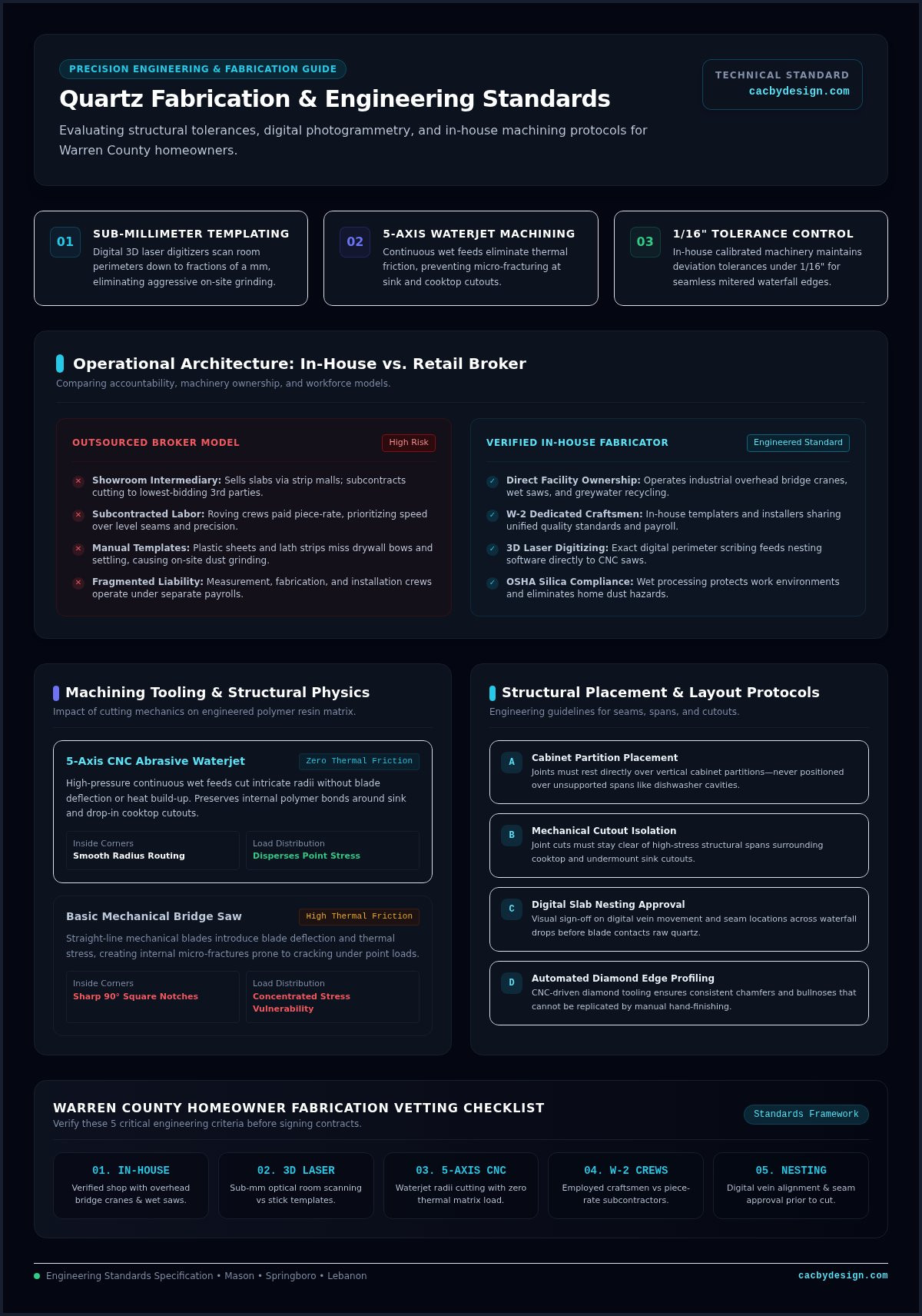
Stone fabrication isn't an artistic craft relying on guesswork. It's high-tolerance mechanical engineering. The composition of engineered quartz blends dense mineral aggregates with specialized polymer resin binders, producing a non-porous slab that punishes improper diamond tooling. Retail brokers often hide this operational reality. They sell slabs out of strip-mall showrooms, then contract the cutting to the lowest-bidding third party. Top-tier quartz fabricators Warren County homeowners rely on don't outsource. They control calibrated machinery in-house, maintaining standard deviation tolerances under 1/16 inch to execute crisp, seamless mitered waterfall edges on expansive kitchen islands.
Digital Photogrammetry and Laser Templating Precision
Corrugated plastic templates and manual lath strips belong in the past. Warren County estate homes, particularly historic builds in Lebanon or custom layouts in Mason, feature drywall bows and settled framing that manual sticks can't capture. Digital 3D laser digitizers scan room perimeters down to fractions of a millimeter. This optical data feeds directly into fabrication software to align natural-look veining across adjoining slabs before cutting. Exact digital scribing eliminates aggressive on-site grinding, keeping your home clean and free from airborne particulate dust during installation.
Bridge Saw vs. 5-Axis CNC Waterjet Machining
Basic bridge saws rely on straight-line mechanical blades that generate high thermal friction and blade deflection. That stress induces micro-fractures around interior 90-degree cuts, leaving undermount sinks and drop-in cooktops vulnerable to sudden stress cracks under point loads. Elite quartz fabricators Warren County features deploy high-pressure 5-axis CNC abrasive waterjets running continuous wet feeds. Waterjets cut complex radii with zero thermal load, preserving structural integrity.
Thermal control: Continuous waterjet feeds prevent resin matrix burning and internal micro-cracking.
Internal corner strength: CNC tooling routes smooth radius inside corners rather than sharp square notches, dispersing physical load.
Edge consistency: Automated diamond profiling tooling produces uniform chamfers and bullnoses that hand-finishing cannot replicate.
Top Criteria for Vetting Local Warren County Quartz Fabricators
Most retail storefronts are marketing brokers, not true stone manufacturers. They take your deposit, buy raw slabs from a distributor, and hand your project off to detached third-party cutters. When vetting quartz fabricators Warren County homeowners must look past slick showroom displays. Inspect their actual operational infrastructure. A legitimate fabrication shop operates industrial overhead bridge cranes, closed-loop greywater recycling setups, and continuous-feed wet saws that comply strictly with OSHA crystalline silica safety standards. If a vendor cannot walk you through their physical production floor, they are outsourcing your investment.
In-House Craftsmen vs. Third-Party Subcontractor Networks
Subcontracting creates a dangerous liability void. When the company measuring your kitchen does not employ the crew cutting the slab or setting the stone, accountability disappears. Retail box stores frequently rely on roving crews paid by the piece rather than the hour, incentivizing fast installations over level seams. In contrast, dedicated in-house craftsmen share a single payroll and quality standard. Ask prospective fabricators directly: Are your templaters and installers W-2 employees, and how many years have they worked your equipment?
Slab Layout Approvals and Seam Placement Protocols
Never permit a blade to touch raw quartz without visual sign-off. Elite quartz fabricators Warren County features use digital nesting software, allowing you to preview seam locations and vein movement across complex L-shaped runs or waterfall drops. Reliable fabricators follow strict placement protocols:
Span integrity: Seams are placed directly over cabinet partitions, never over unsupported spans like dishwasher cavities.
Mechanical isolation: Joint cuts must stay away from high-stress structural spans around sink and cooktop cutouts.
Joint geometry: Straight butt joints or precision French miters are selected based on slab pattern movement, not shop convenience.
Warranty Integrity and Direct Fabricator Accountability
Do not confuse a manufacturer slab warranty with an installation guarantee. Slab brands cover resin defects, pitting, or internal discoloration. They do not cover cracked sink rails, chipped ogee edges, or failing adhesive joints resulting from poor field leveling. Many engineered stone brands void material warranties entirely if slabs are fabricated by non-certified third parties. Partnering with a dedicated regional provider gives you direct, single-source recourse. For comprehensive project planning, explore our kitchen remodel guide to align your timeline from initial framing to final stone placement.
Warren County Home Prep: Cabinetry Alignment and Overhang Logistics
A standard 3cm quartz slab weighs approximately 16 to 19 pounds per square foot. Drop an 800-pound island surface onto unreinforced, unlevel casework, and the stone will flex until it snaps. In older historic homes across Lebanon and Springboro, century-old joists settle unevenly. In rapid suburban builds across Mason and Deerfield Township, green framing lumber dries and shrinks behind drywall. Experienced quartz fabricators Warren County relies on never treat stone as a structural beam. Countertops reflect the integrity of the substrate beneath them, requiring strict pre-install site preparation:
Clear perimeter pathways: Provide an unobstructed, level path from the entry door to the kitchen for heavy transport carts.
Disconnect rough mechanicals: Shut off water, gas, and power lines; remove existing sinks and cooktops.
Secure sub-framing: Fasten all base cabinets securely to wall studs, confirming zero face-frame racking.
Verify appliance clearances: Have final slide-in ranges and dishwashers on-site to confirm drop-in openings.
Execute laser level checks: Audit the entire cabinet perimeter with a digital laser level before the stone arrives.
Substrate Leveling Tolerances and Structural Deflection
According to Natural Stone Institute technical guidelines, base cabinets must not deviate by more than 1/8 inch across a 10-foot span, or 1/16 inch over a 3-foot span. When cabinets dip beyond this threshold, the rigid slab bridges the low spots unsupported. Under point loads, such as a person leaning on an edge, that tension transfers into shear stress, fracturing cutouts. Pairing stone installation with professional cabinetry leveling resolves this risk before slabs leave the shop.
Island Overhang Engineering: Steel Plate vs. Corbel Support
Engineered quartz cantilevers adhere to strict mechanical boundaries. For 3cm quartz, the unsupported overhang limit is capped at 1/3 of the total countertop depth, up to a maximum of 12 inches. Beyond 12 inches, dynamic vertical loads dramatically increase the risk of edge fracture. Professional fabricators enforce clear support rules:
Concealed steel support plates: Route 1/2-inch or 3/8-inch flat structural steel plates directly into the cabinet stretchers every 24 inches on-center, delivering floating knee clearance without visible obstructions.
Architectural corbels: Use solid wood or metal corbels tied mechanically into interior cabinet corner blocking for overhangs exceeding 15 inches.
Post-and-rail subframes: Frame perimeter aprons with structural corner legs when breakfast bars exceed 18 inches of projection.
Selecting Quartz Edge Profiles and Backsplashes for Regional Architecture
A countertop edge is a mechanical buffer, not just a decorative trim. In high-traffic family kitchens across Warren County, edge profile selection dictates long-term chip resistance. Sharp 90-degree bevels concentrate kinetic force when struck by cast-iron pans or heavy ceramic bowls, leading to edge blowouts. Leading quartz fabricators Warren County homeowners trust guide selections based on architectural context and lifestyle demands. Colonial estates in Lebanon call for classic demi-bullnose or ogee contours. Transitional builds in Mason and modern farmhouses in Clearcreek Township lean toward clean eased profiles or thick architectural drop aprons, frequently paired with natural stone accents or granite countertops across adjacent prep sculleries.
High-Impact Edge Profiles: Eased, Demi-Bullnose, and Mitered Aprons
A slight 1/8-inch radius eased or pencil edge disperses mechanical impact across a curved plane, making it exceptionally resilient against daily kitchen abuse. Rounded demi-bullnose profiles offer similar impact protection while channeling spilled liquids directly onto the floor rather than into lower cabinet drawer faces. Building a modern 2-inch to 3-inch mitered island apron requires high fabrication precision. Technicians must cut 45-degree angle joints on a calibrated 5-axis saw, clamp the edges under continuous tension, and colour-match structural epoxy along the seam to maintain flawless vein continuity without visible adhesive lines.
Full-Height Quartz Splash vs. Custom Artisan Tile Backsplashes
The transition between horizontal worktops and vertical wall planes defines your kitchen's functional longevity. Warren County homeowners typically evaluate two high-performance solutions:
Full-height continuous quartz slabs: Extending engineered stone directly up to the upper cabinetry creates an impervious, zero-grout barrier. Waterjet cutting systems mill exact rectangular cutouts for electrical boxes, preventing jagged hand-cut edges that weaken the vertical panel under wall settlement.
Custom artisan tile backsplashes: Glazed ceramics, dimensional subways, or handcrafted natural tiles deliver acoustic dampening and tactile contrast against smooth quartz perimeters.
Whether you demand seamless continuous stone or handcrafted ceramic textures, your surfaces must work in harmony with your overall layout. Ready to engineer your next space? Schedule a design consultation with our fabrication specialists to evaluate live slab options and custom edge profiles built to endure.
Why Countertops and Cabinetry By Design Sets the Warren County Standard
Fragmented remodels bleed equity. When you buy custom cabinetry from one retail vendor, source quartz slabs from an independent stone yard, and hire third-party installers, coordination collapses. If an overhang bows or a seam gaps, the stone crew blames the cabinet installer, while the cabinet maker faults the drywall crew. Since 2004, Countertops and Cabinetry By Design has eliminated that operational friction across Greater Cincinnati. As premier quartz fabricators Warren County property owners trust, we consolidate design, cabinetry construction, stone manufacturing, and field installation under one roof, using employed craftsmen rather than outsourced subcontractors.
Full-Service Alignment: Cabinetry, Countertops, and Tile Under One Roof
Eliminating third parties accelerates your project schedule while locking down structural tolerances. Our internal team simultaneously engineers the base cabinet framework, routes concealed steel supports, and cuts the stone slab to the exact digital template. Sinks, plumbing faucets, cabinet hardware, and matching tile backsplashes align without trade conflicts. That synchronized workflow prevents multi-week gaps between cabinet setting and stone placement. To see how integrated execution elevates overall property value, review our comprehensive kitchen remodel Cincinnati guide.
Precision Craftsmanship Grounded in Greater Cincinnati and Warren County
Local roots drive accountable results. Countertops and Cabinetry By Design remains a family-owned business deeply invested in communities across Mason, Springboro, Lebanon, and surrounding townships. We operate permanent physical design showrooms where you can inspect full quartz displays, compare solid hardwood cabinetry profiles, and review physical edge samples under realistic residential lighting. Our systematic process delivers clear milestones from day one:
Showroom consultation: Meet directly with design specialists to evaluate full slabs, edge cuts, and custom cabinetry configurations.
Digital laser field audit: Our employed templating specialists capture the exact structural perimeters of your space.
In-house precision cutting: Slabs are cut, routed, and polished on calibrated, wet-processing machinery by company craftsmen.
Turnkey installation: A dedicated crew manages the placement, leveling, sink integration, and final detailing with complete single-source warranty accountability.
Eliminate the headaches of disconnected trades and compromised craftsmanship. Visit our Mason showroom or contact Countertops and Cabinetry By Design today to schedule your design consultation and bring precision stone engineering to your home.
Secure Precision Engineering for Your Warren County Home
A successful stone installation isn't defined by showroom slab samples. It's measured by digital laser templating precision, rigorous subtop leveling, and structural cantilever engineering that protects long-term property equity. When evaluating quartz fabricators Warren County offers, bypassing retail middlemen who subcontract their field labor is the single most critical decision you'll make.
Countertops and Cabinetry By Design delivers total project accountability through complete full-service integration. As a family-owned local business established in 2004, our dedicated in-house craftsmen handle your custom cabinetry, quartz countertops, and tile backsplashes under one unified roof. We eliminate third-party subcontractor delays, communication breakdowns, and misaligned seams before the first cut is made. Take the uncertainty out of your renovation. Schedule your Warren County quartz design consultation today and build a kitchen surface engineered to perform for decades.
Frequently Asked Questions
How do I choose the best quartz fabricator in Warren County?
Look directly at their production workflow. The most reliable quartz fabricators Warren County has to offer run calibrated CNC waterjets, perform 3D laser digitizing on-site, and manage full-time W-2 installation crews. Tour their local facility or showroom in person. If a company cannot show you where slabs are actively cut, shaped, and inspected under continuous wet feeds, they are outsourcing your job to third-party subcontractors.
Can an existing kitchen cabinet layout support heavy 3cm quartz countertops?
Yes, provided the cabinetry framework is structurally intact and level within 1/8 inch across a 10-foot span. Solid 3cm quartz adds significant dead load to your casework. In older homes across Warren County, settling floors often induce sagging along perimeter runs. Technicians must inspect cabinet corner blocks, reinforce spanning stretchers, and shim low spots before setting stone. Uneven cabinets cause mechanical deflection that can fracture slabs under static load.
What is the standard turnaround time between laser templating and quartz installation?
Turnaround typically ranges from one to three weeks with a vertically integrated shop. Because digital laser scans feed directly into computerized cutting saws on-site, in-house teams bypass external order queues. Conversely, retail brokers and box stores frequently take four to six weeks or longer. Their multi-layered supply chain requires shipping measurements to off-site cutting plants, creating communication logjams and prolonged kitchen downtime.
Are seams visible in custom-fabricated quartz countertops?
Seams are never completely invisible, but expert fabrication makes them practically unnoticeable. High-precision 5-axis waterjets cut crisp edges that join with hairline gaps under 1/16 inch. Skilled installers use two-part epoxy colour-matched specifically to your slab's base resin and veining pattern. Poor seam appearance happens when out-of-region cutters dry-grind joints by hand or ignore slab pattern flow across large, continuous island spans.
Why should I avoid buying quartz countertops through big-box retail brokers?
Big-box stores sell materials through an indirect brokerage system. They keep sales commissions, then contract fabrication and installation out to the lowest-bidding regional third parties. This fragmented chain leaves you with zero direct communication with the cutter shaping your slab. When vetting quartz fabricators Warren County homeowners achieve tighter tolerances, faster schedules, and unified warranty coverage by working directly with an established local design-build facility.
Does quartz fabrication require specialized tooling compared to natural granite?
Engineered quartz contains polymer resins that react poorly to excessive heat. Dry blade cutting melts resins, leading to blade binding, micro-fissuring, and visible edge burns. Dedicated shops utilize high-pressure waterjet systems and continuous-feed wet diamond tooling specifically calibrated for engineered composites. Natural granite is harder and more heat-tolerant, meaning tooling feeds, cutting speeds, and edge-polishing sequences must be distinctly calibrated for quartz slabs.
Do custom quartz fabricators also handle undermount sink cutouts and plumbing disconnects?
Professional fabricators routinely cut, profile, and drill undermount sink openings using digital DXF sink templates directly inside their CNC workflow. While basic stone-only vendors drop the slab and leave plumbing to independent plumbers, full-service design-build firms provide seamless integration. They coordinate sink mounting, faucet placement, and cabinet adjustments under one project scope, eliminating the scheduling hassle of hiring separate mechanical contractors.


Comments