
Cabinet Makers in Hamilton County: Engineering High-Performance Kitchen Equity
In a market where the median home price now hits $475,000, settling for big-box cabinetry isn't just a design flaw; it's a financial liability. Your home is your most aggressive asset. When you install generic, mass-produced storage, you're capping your property's performance. The most effective cabinet makers in Hamilton County know that high-end residential spaces demand more than just aesthetics. They require precision engineering that withstands 25,000 open-close cycles and supports the massive weight of premium stone slabs without failing.
You've likely felt the frustration of contractor unreliability or the sting of hidden remodeling costs. You want a kitchen that functions perfectly and builds real equity. This guide helps you discover how elite custom cabinetry from Countertops and Cabinetry By Design transforms residential spaces into high-yield assets through precision engineering and design-build excellence. We'll explore the technical standards of high-performance hardware, the durability of premium materials, and the specific frameworks used to execute seamless projects across the Cincinnati and Dayton regions.
Key Takeaways
Custom cabinetry acts as a strategic financial lever, maximizing home equity in Hamilton County’s high-value real estate market.
Systems-led engineering ensures your kitchen infrastructure supports heavy stone loads while maintaining mechanical integrity for decades.
Stock cabinetry "filler strips" waste valuable footprint; custom solutions reclaim every square inch to optimize storage and operational flow.
Partnering with elite cabinet makers in Hamilton County through a design-build model eliminates contractor friction and ensures single-point accountability.
Precision-fit cabinetry provides the structural foundation for premium stone integration, creating a unified and durable residential asset.
Table of Contents
The ROI of Custom Cabinetry in Hamilton County Homes
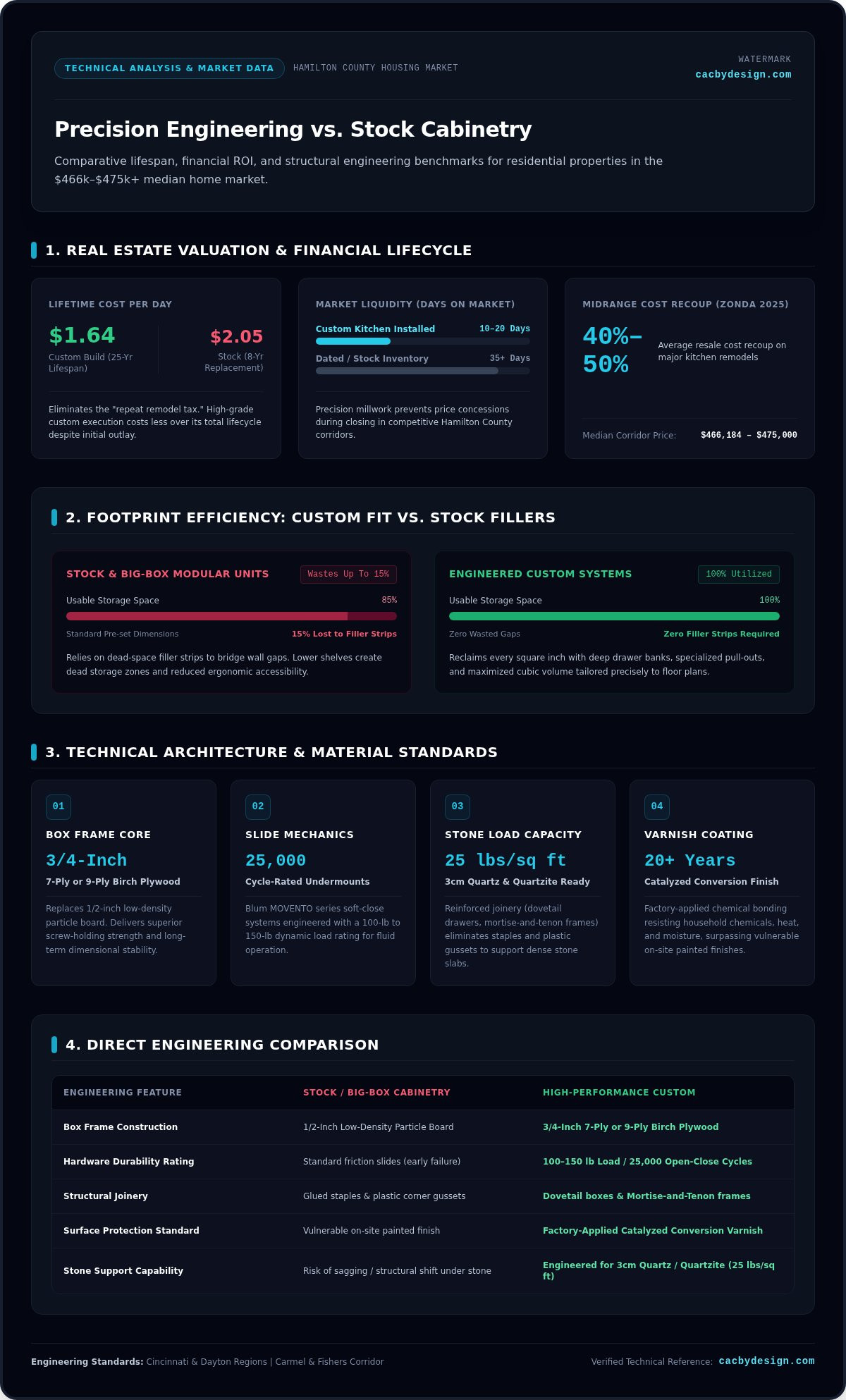
Stop viewing your kitchen as a collection of boxes. In the high-stakes real estate market of Carmel and Fishers, custom cabinetry is high-performance residential infrastructure. While stock units offer a temporary fix, elite cabinet makers in Hamilton County engineer assets that outlast the mortgage. The median home price in this corridor sits between $466,184 and $475,000. At this level, buyers don't just want a kitchen; they demand a precision-engineered culinary hub. Cheap cabinets carry hidden costs: sagging shelves, peeling veneers, and a total lack of ergonomic flow. You'll end up replacing them in eight years. Custom builds last twenty-five. The math is simple. High-quality execution eliminates the "repeat remodel" tax. Research shows the lifetime cost of custom units is actually lower, averaging $1.64 per day compared to $2.05 for stock options that require early replacement.
Equity Gains in the 2026 Market
Appraisals in luxury enclaves like Indian Hill or the Village of WestClay hinge on the quality of fixed finishes. For a major midrange kitchen remodel, the average resale cost recoup is between 40% and 50% according to Zonda’s 2025 Cost vs. Value report. However, the real metric is speed. Hamilton County homes with updated, custom kitchens sell in 10 to 20 days. Dated inventory sits for 35 days or more. Buyers in 2026 are data-obsessed. They spot big-box fillers instantly. When they see custom millwork, they see a home that's been maintained to a professional standard. This perceived value prevents aggressive price concessions during the closing process. Investing in top-tier cabinet makers in Hamilton County ensures your property remains a liquid, high-demand asset.
Operational Efficiency vs. Simple Storage
Storage is a solved problem. Efficiency is the new luxury. Stock cabinets rely on filler strips to bridge gaps between pre-set sizes, wasting up to 15% of your footprint. Custom design-build models achieve 100% utilization. By understanding kitchen cabinet construction and mechanics, homeowners can leverage specialized pull-outs and deep drawer banks that replace standard lower shelves. This isn't just about hiding spice jars. It's about reducing footsteps and maximizing the cubic volume of your floor plan. High-performance storage is the primary lever for daily productivity. It turns a standard room into a high-yield asset that functions with the same precision as a professional workspace. Every square inch is engineered for use, not just for show.
Anatomy of High-Performance Cabinetry: Materials and Mechanics
The door of a cabinet is the face, but the carcass is the engine. High-performance cabinetry relies on a systems-led construction model where the internal structure is engineered to outlast the aesthetic trends. The most skilled cabinet makers in Hamilton County prioritize structural physics over surface-level trends. They utilize 3/4-inch furniture-grade 7-ply or 9-ply birch plywood for the box frames. This contrasts sharply with the 1/2-inch low-density particle board found in big-box units. Plywood provides superior screw-holding power and dimensional stability, ensuring your kitchen doesn't shift or sag under the weight of premium stone surfaces. Professional material selection is a primary driver in kitchen cabinet construction and mechanics, which directly impacts long-term durability.
Hardware is the primary point of failure in inferior builds. High-yield cabinetry utilizes undermount soft-close slide assemblies with a 100-pound to 150-pound dynamic load rating. These systems, like the Blum MOVENTO series, are rated for 25,000 cycles. When you invest in elite cabinet makers in Hamilton County, you're buying mechanics that remain fluid for decades. This precision extends to the finish. Factory-applied, catalyzed conversion varnishes create a chemical bond that on-site painting cannot replicate. These coatings are engineered to resist household chemicals, heat, and moisture, maintaining a furniture-grade standard that remains tactile and vibrant for over 20 years.
Joinery and Structural Integrity
True custom cabinetry eliminates staples and plastic gussets. Instead, it relies on dovetail drawer boxes and mortise-and-tenon face frames. These mechanical joints distribute stress across the wood fibers rather than relying solely on adhesives. This structural integrity is non-negotiable when supporting 3cm engineered quartz or natural quartzite slabs, which can weigh up to 25 pounds per square foot. If your cabinet boxes use thin particle board backings, they risk corner creep or total joint failure under these continuous dead loads. High-performance builds use pocket-screwed or dadoed corner cleats to ensure the chassis remains square for the life of the home.
The Finish: Aesthetics Built for Endurance
A "furniture-grade" finish in 2026 is defined by its resistance to Indiana’s seasonal humidity shifts. Two-part polyurethane or catalyzed finishes are applied in humidity-controlled environments to prevent the joint cracking common in field-painted cabinets. This level of precision is why professional installation and material selection are key drivers in remodeling cost recovery and ROI benchmarks. For those ready to upgrade their residential infrastructure, exploring the integrated design-build services at Countertops and Cabinetry By Design ensures your finishes are as durable as they are beautiful. These coatings provide a moisture barrier essential for bathroom environments, preventing the delamination that destroys cheaper alternatives.
Custom Cabinetry vs. Stock Options: The Real Cost of "Cheap"
Stock cabinetry is a short-term gamble masquerading as a bargain. In the high-demand real estate environment of Carmel and Fishers, these modular boxes represent a significant design compromise. Stock units are built in three-inch increments. If your wall doesn't perfectly match those dimensions, your installer uses "filler strips." These are essentially dead-weight pieces of wood that provide zero storage and kill the visual flow of your kitchen. Top-tier cabinet makers in Hamilton County eliminate this inefficiency. They engineer every unit to fit your specific footprint, reclaiming up to 15% of the square footage that stock options waste. In a market where every inch of residential space carries a premium, filler strips are an expensive mistake.
The durability gap is equally aggressive. Stock cabinets typically use 1/2-inch or 3/8-inch low-density particleboard held together with staples and plastic corner gussets. This structure is fundamentally incapable of supporting the long-term dead load of 3cm engineered quartz or natural granite. Over time, the weight leads to corner creep or total joint failure. Custom 3/4-inch furniture-grade plywood boxes are built with pocket-screwed or dadoed corner cleats. They are designed to carry heavy stone loads without structural fatigue. Beyond strength, custom builds adhere to strict EPA formaldehyde emission standards for composite wood, ensuring your indoor air quality isn't compromised by the off-gassing common in cheap, imported stock lines.
The Design-Build Advantage
Fragmented contracting creates friction. When you buy stock cabinets, you're often left coordinating between a salesperson, a delivery team, and a third-party installer. Custom design-build models solve this through vertical integration. This approach allows for the seamless integration of panel-ready appliances and floor-to-ceiling millwork that stock lines simply can't achieve. Utilizing in-house craftsmen ensures that the CAD engineering matches the shop fabrication perfectly. This level of quality control is what separates a standard kitchen from a high-performance residential asset. It allows for unique architectural responses to 10-foot ceilings or historic alcoves that modular units can't handle.
Long-Term Financial Performance
The math favors the investment-grade choice. A standard stock kitchen often requires replacement or major repair after eight years, resulting in a lifetime cost of approximately $2.05 per day. Custom cabinetry, engineered for a 25-year horizon, averages only $1.64 per day. You avoid the "demo tax" and the disruption of a second remodel. This is why custom cabinets in West Chester, OH and Hamilton County have become the benchmark for savvy homeowners. They reduce days on market and prevent buyers from demanding concessions for "dated" or "failing" storage systems. It's a calculated move for those who value speed, clarity, and long-term equity growth.
Architectural Alignment: Designing for Hamilton County Neighborhoods
Architecture in Hamilton County isn't a monolith. You can't drop a sleek, minimalist slab door into a Glendale Victorian and expect it to hold its value. High-performance cabinet makers in Hamilton County must act as architectural chameleons. They bridge the gap between structural history and modern mechanics. A mismatched kitchen is a financial drag. In neighborhoods like Mason or Wyoming, the cabinetry must align with the home's bones to maximize equity. If the design feels like an afterthought, the appraisal will reflect that lack of cohesion. We treat every project as a site-specific engineering challenge, ensuring the millwork respects the local aesthetic while delivering 2026-level performance.
The "Modern Transitional" Standard
Mason and West Chester represent the hub of the modern transitional movement. Shaker-style doors remain the high-performance baseline for 2026. They offer a clean, versatile profile that resists aging. However, the market is moving away from sterile, all-white palettes. We're seeing an aggressive shift toward "organic neutrals" and deep, saturated tones like forest green and navy. These colors provide a sophisticated anchor for open-concept floor plans. They add visual weight without sacrificing the "transitional" appeal that drives buyer demand. For a deeper dive into the metrics driving these choices, check our latest report on Kitchen Remodel Cincinnati trend data.
Historic Integrity in Hamilton County
Glendale and Wyoming demand a different playbook. These historic enclaves require "Heritage Restoration" strategies. Inset cabinetry is the non-negotiable standard here. In this construction style, the door sits flush within the frame, mimicking the furniture-built look of the 19th century. It honors the home's history while hiding 21st-century hardware. We integrate custom millwork and oversized crown moldings to bridge the gap between cabinet tops and soaring, historic ceilings. Balancing these antique aesthetics with modern soft-close mechanics requires extreme precision. It ensures the kitchen feels original to the home but functions with the speed of a modern workspace. Don't settle for modular compromises in a historic space. Explore how our custom cabinetry systems provide the perfect architectural fit for your neighborhood's unique standards.
The goal is seamless integration. Whether you're building in a new development or restoring a local landmark, your storage systems should look like they've always been there. Expert cabinet makers in Hamilton County use on-site scribing to handle the uneven walls often found in older properties. This eliminates the need for bulky filler strips and ensures a tight, furniture-grade fit. By matching the cabinetry's scale and detail to the surrounding architecture, you create a unified residential asset that commands a premium. It's about engineering a space that is as beautiful as it is durable.
The Design-Build System: Why Homeowners Choose Our Cabinet Makers
Fragmented remodeling is a failure of logic. You shouldn't be the project manager for three different subcontractors who don't talk to each other. Our "Single-Point Accountability" model centralizes the entire process. We've positioned ourselves as the leading cabinet makers in Hamilton County because we own the entire value chain. From the first CAD drawing to the final on-site scribe, we eliminate the gaps where traditional contractors fail. This isn't just about convenience. It's about data-backed reliability. No finger-pointing. No scheduling conflicts between the cabinet shop and the stone fabricator. Just a high-performance system designed for speed and total clarity.
Seamless Countertop and Cabinet Integration
Most homeowners treat cabinets and stone as separate purchases. This is a structural risk. Fitting granite countertops in Cincinnati onto custom bases requires extreme technical precision. A 3cm granite slab weighs up to 25 pounds per square foot. If the cabinet boxes aren't engineered for that specific dead load, you'll see joint failure or corner creep within a few years. Our team manages these load-bearing requirements in-house. We align the cabinet engineering with the stone's physical properties. This synergy creates a unified vision that stock-and-slab models simply can't touch. You get a perfect fit because the same entity that built the base is cutting the stone.
The Execution Framework: Design to Done
We replace creative guesswork with repeatable execution frameworks. Our process is a logical progression from identifying your needs to delivering a high-yield asset. We prioritize speed without sacrificing the 1/16-inch tolerances required for high-end residential work. As premier cabinet makers in Hamilton County, we ensure every step serves a strategic purpose.
Step 1: Data-driven design. We use our showroom to select materials based on performance and architectural alignment. We don't just pick colors; we engineer a layout that maximizes your home's equity.
Step 2: Precision fabrication. Our in-house craftsmen build your units to exacting standards. By keeping fabrication under our roof, we ensure the quality of every dovetail and finish.
Step 3: High-speed installation. Our dedicated team handles the site-work. They understand the mechanics of our specific builds, ensuring a furniture-grade finish that modular installers can't replicate.
Engineering Your Next Equity Milestone
Your kitchen isn't just a culinary space; it's a high-performance engine for home value. Settling for modular, stock cabinetry caps your property's growth potential and introduces structural risks that "cheap" fixes can't solve. By prioritizing precision engineering and architectural alignment, you transform a standard renovation into a high-yield asset. The design-build model is the only logical path for homeowners who value speed, clarity, and single-point accountability. It eliminates the friction of fragmented contracting and ensures your storage systems are built to support the massive loads of premium stone for decades.
With 20+ years of local Hamilton County expertise, our in-house fabrication and installation team delivers results that mass-produced units simply can't touch. We don't just hang boxes; we engineer custom residential infrastructure. Partnering with elite cabinet makers in Hamilton County means investing in a legacy of durability and aesthetic precision. It's time to stop managing unreliable subcontractors and start building equity with a team that understands the mechanics of residential growth. Execute your vision with Hamilton County’s elite cabinet makers. Your home deserves a system built to perform at the highest level.
Frequently Asked Questions
How long does the custom cabinet process take in Hamilton County?
Total project timelines vary based on complexity, but most custom projects require eight to twelve weeks from design approval to final installation. Our in-house team of craftsmen manages the entire lifecycle, which eliminates the delays common with third-party suppliers. By controlling both fabrication and stone integration, we maintain a tight schedule. This ensures your kitchen remodel moves from the design phase to high-performance reality with maximum efficiency and zero contractor friction.
Are custom cabinets worth the investment for a mid-range home?
Custom cabinetry is a strategic equity play for any residential property in the $400,000 range. It eliminates the "filler strip" waste found in stock options and provides a structural foundation for premium stone surfaces. While the initial cost is higher, the lifetime performance and increased resale speed make it a high-yield asset. Expert cabinet makers in Hamilton County help you avoid the "demo tax" of replacing cheap units every eight years.
What is the difference between custom and semi-custom cabinetry?
Custom cabinetry offers 100% dimensional freedom, allowing for unique heights and site-specific scribing. Semi-custom units are modular boxes with limited modifications to depth or width. True custom builds use 3/4-inch furniture-grade plywood and mechanical joinery like dovetails. Semi-custom often relies on thinner substrates and adhesives. Investing in full custom ensures every square inch of your Hamilton County floor plan is utilized for operational efficiency rather than hidden behind fillers.
Can you match new cabinets to my existing Hamilton County home architecture?
We specialize in architectural alignment for diverse neighborhoods like Glendale and Wyoming. Whether your home requires traditional inset cabinetry for a historic look or modern transitional Shaker doors, our design-build system ensures a perfect match. We integrate custom millwork and crown moldings to bridge the gap between your storage and historic ceiling heights. This cohesion is critical for maintaining the aesthetic integrity and appraisal value of your specific residential property.
Do you provide both cabinetry and countertop installation in-house?
Countertops and Cabinetry By Design provides a full-service, in-house approach for both cabinetry and stone surfaces. We employ our own craftsmen to handle fabrication and installation, which eliminates contractor finger-pointing. This synergy is vital when mounting heavy quartzite or granite countertops onto custom bases. By managing the entire structural load-bearing requirements under one roof, we guarantee a precision fit that fragmented contracting models simply cannot achieve in the local market.
What materials are best for high-durability kitchen cabinets in 2026?
High-performance storage in 2026 requires 3/4-inch furniture-grade plywood for the carcass and solid hardwood for the face frames. Avoid low-density particleboard, as it fails under the weight of modern stone slabs. For finishes, factory-applied catalyzed conversion varnishes provide the best moisture and chemical resistance. These materials ensure your cabinets withstand Indiana’s seasonal humidity shifts without joint cracking or delamination, protecting your investment for a 25-year horizon.
How do I start a kitchen remodel project with cabinet makers in Hamilton County?
The process begins with a data-driven design consultation in our showroom. You'll select materials and hardware while our team maps out a layout that maximizes your home’s operational flow. Once the CAD engineering is approved, our in-house craftsmen begin the fabrication phase. Starting with professional cabinet makers in Hamilton County ensures that your project is grounded in technical precision and financial logic from the very first day of the renovation.
Is there a warranty on custom cabinetry and installation?
We stand behind our in-house labor and material selection as part of our commitment to high-performance results. While specific terms depend on the selected hardware and finishes, our design-build model is engineered for life-of-furniture durability. We utilize commercial-grade mechanics like Blum soft-close slides, which are rated for 25,000 cycles. Our team provides clear documentation on all structural and mechanical protections during your initial design consultation to ensure total transparency.


Comments