
Waterfall Edge Countertop Cost Cincinnati: The 2026 Performance Guide
- chris138017
- 6 hours ago
- 11 min read
A waterfall edge isn't just a design choice. It's a high-stakes engineering feat where a single millimeter of error turns a premium slab into expensive scrap. You want the seamless flow of stone from the island to the floor, but the math behind the waterfall edge countertop cost Cincinnati homeowners face in 2026 often feels like a moving target. It's easy to get lost in the delta between material waste and fabrication premiums.
We agree that transparency is the only way to build a high-performance kitchen. You shouldn't have to guess if your mitered joints will hold or if your slab yield was optimized for efficiency. This guide eliminates the guesswork. We'll analyze the technical variables of quartz and quartzite drops, explain the regional labor factors specific to Ohio, and provide a framework for selecting a fabricator who treats your stone like a structural asset.
We're breaking down the data-driven reality of material yields and the precise mechanics of a flawless mitered drop to ensure your investment delivers maximum aesthetic ROI.
Table of Contents
Defining the Waterfall Edge: Architectural Impact vs. Standard Overhangs
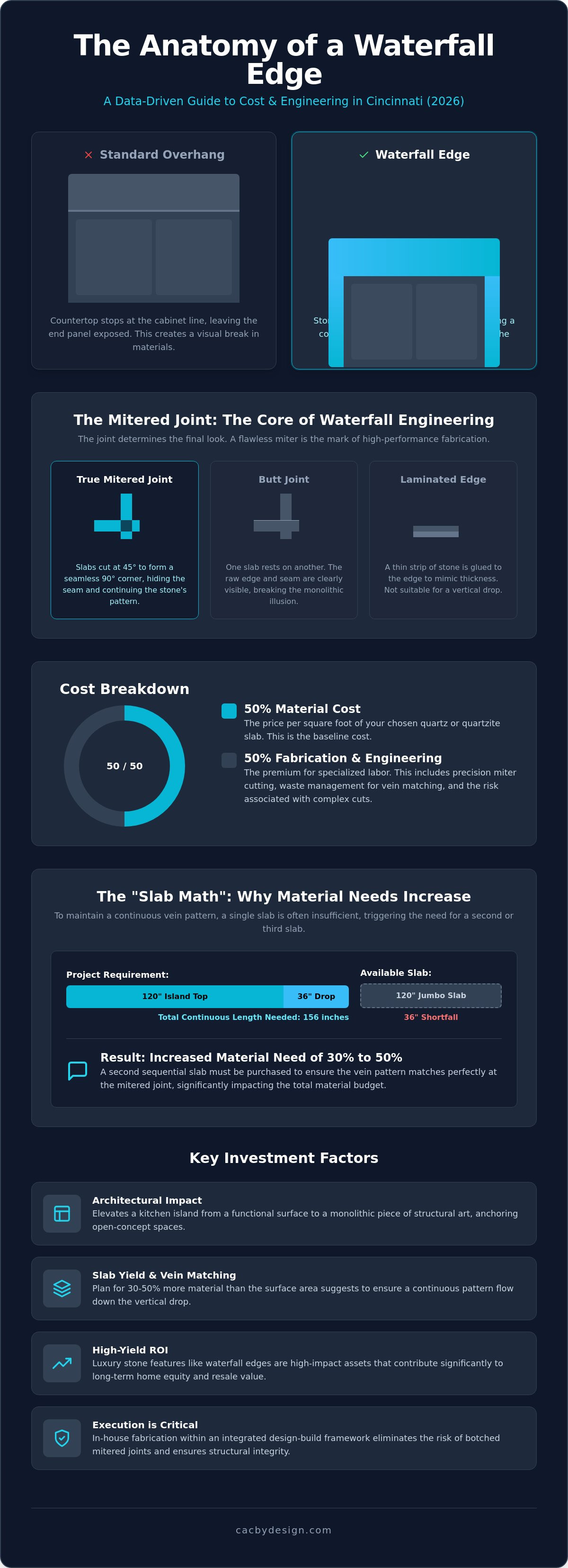
A waterfall edge is an architectural pivot. It’s the moment a horizontal surface becomes a vertical statement. Most countertops stop at the cabinetry line, relying on wood or laminate end-panels to finish the run. A waterfall edge rejects this compromise. It extends the stone vertically to the floor, creating a continuous, monolithic block of material. This isn't a standard finish. It's a technical upgrade that redefines the kitchen's geometry.
When calculating the waterfall edge countertop cost Cincinnati homeowners should prepare for, the complexity of this vertical drop is the primary variable. It requires more than just extra stone. It demands a level of fabrication precision that standard overhangs never touch. You aren't just buying material; you’re investing in engineering. This feature eliminates traditional cabinet end-panels. It replaces them with a seamless flow of stone that anchors the entire room.
The Mitered Joint: Where Engineering Meets Aesthetics
The soul of a waterfall edge is the mitered joint. This involves cutting both the horizontal and vertical slabs at precise 45-degree angles. When joined, they form a seamless 90-degree turn. Contrast this with a butt joint, where one slab simply sits on top of another, exposing the raw edge. Or a laminated edge, which uses a glued-on strip to mimic thickness. Neither achieves the high-performance look of a true miter. This joint is the main driver of labor complexity.
The two pieces must align perfectly. If the cut is off by a fraction of a degree, the vein matching fails and the seam becomes an eyesore. Different Countertop materials respond differently to this stress. Quartz and quartzite require specific blade speeds and cooling techniques to prevent chipping during the miter cut. This is why in-house craftsmen are non-negotiable for this feature. Precision hinges on the quality of the cut, not just the quality of the stone.
Visual Momentum in Modern Cincinnati Kitchens
In the open-concept floor plans common across Hamilton and Butler counties, the kitchen island is the visual anchor. A standard countertop leaves the sides of the cabinetry exposed, often breaking the visual flow with wood grains that clash with the stone. The waterfall edge solves this. It creates visual momentum, drawing the eye from the surface down to the floor. It transforms a functional island into a piece of structural art.
For modern luxury designs, this is the ultimate creative lever. It hides appliance ends and cabinet seams, replacing them with the raw power of natural or engineered stone. It’s a bold statement of intent. It signals that the kitchen wasn't just assembled; it was architected for maximum impact. By extending the material to the floor, you create a sense of permanence and weight that standard cabinetry simply cannot match.
Breaking Down the Cost: Material Selection and Slab Yield
Buying stone is a simple transaction. Engineering a waterfall is a complex investment. While material selection dictates the raw price per square foot, slab yield determines the total project budget. In the 2026 market, material cost accounts for only 50% of the equation. The remaining half is a mix of fabrication engineering, waste management, and the technical premiums required for a flawless mitered drop. When assessing the waterfall edge countertop cost Cincinnati homeowners encounter, the biggest surprise is often the "waste tax" required for pattern continuity.
Fabrication labor for mitered edges isn't a flat fee. It's a per-linear-foot premium that reflects the risk and precision involved. Every cut is a potential failure point. If a slab chips during a 45-degree miter, the entire piece is compromised. This risk profile is why high-performance firms utilize in-house craftsmen rather than outsourcing to generic installers. While the Cost vs. Value Report provides a macro view of kitchen investments, the micro-level reality of slab yield is what dictates your final invoice.
The "Slab Math" of a Waterfall Drop
Stone doesn't stretch. A standard jumbo slab is roughly 120 inches long. If you're designing a 10-foot island with a 36-inch vertical drop, your total linear requirement is 156 inches. You've exceeded the slab length. To maintain a seamless vein flow from the horizontal surface down to the floor, you cannot simply piece together remnants. You must purchase a second, or even third, sequential slab. This ensures the patterns "bookmatch" at the mitered joint. This requirement for pattern alignment can increase your material needs by 30% to 50% for a single design feature.
Material Difficulty Ratings for 2026
Not all stones are engineered for easy miters. Your choice of material directly scales the labor hours required.
Quartz: The consistency king. It's predictable, easier to cut without internal stress fractures, and offers the most reliable vein matching for modern aesthetics.
Quartzite: The "difficult" champion. It's significantly harder than granite. It requires specialized diamond tooling and slower feed rates to prevent chipping. Expect a higher labor premium here.
Porcelain: High-risk, high-reward. It allows for ultra-thin, razor-sharp profiles but is notoriously brittle during the fabrication phase.
Our integrated system allows you to view slab layouts digitally before a single cut is made, ensuring your vein matching is mathematically perfect. This level of planning is the only way to avoid the botched joints that plague lower-tier installations.
Cincinnati Market Analysis: Local Labor and Sourcing in 2026
Cincinnati isn't a commodity market. When you look at the waterfall edge countertop cost Cincinnati homeowners navigate, you're seeing the intersection of Midwest logistics and high-precision demand. In Hamilton and Butler counties, labor rates for specialized stone fabrication reflect a regional scarcity of master mitering talent. This isn't a job for a general installer. It requires a dedicated fabrication facility equipped with CNC machinery and waterjet cutters capable of executing 45-degree angles with zero margin for error.
Local sourcing in the tri-state area has shifted. While national supply chains remain volatile, Cincinnati's position as a logistics hub provides better access to premium slabs than many coastal markets. However, the cost of moving these oversized, mitered pieces is significant. Handling a 300-pound vertical panel requires specialized A-frame transport and a multi-person install team. By hiring a local firm with in-house craftsmen, you eliminate middleman markups and the communication gaps that lead to botched seams during transport.
Regional Cost Drivers in the Tri-State Area
Demand in Mason and West Chester has spiked for high-performance architectural features. Homeowners in these areas are increasingly viewing the kitchen as a structural asset rather than a utility space. This "Cincinnati Premium" is a reflection of quality. While the Midwest generally aligns with national averages for standard installs, the complexity of a waterfall drop pushes local projects into a higher tier of fabrication. According to the Cost vs. Value Report, high-end kitchen remodels in the Ohio Valley continue to show strong equity retention, provided the execution matches the investment.
Comparing Standard vs. Waterfall Project Budgets
The budget delta between a standard overhang and a waterfall drop is driven by time and technical risk. A standard edge is often cut and polished in a single day. A waterfall requires a multi-stage process of templating, digital vein matching, precision mitering, and structural reinforcement. In 2026, specialized labor hours for a mitered precision project can easily double the standard 29.4-hour installation baseline for a typical kitchen.
Choosing a local partner who owns the entire process from design to installation ensures that these timelines are met without sacrificing the structural integrity of your stone.
The ROI of Luxury: Performance Metrics and Resale Value
A waterfall edge is more than a design trend. It's a high-yield asset for your home's equity. In the 2026 real estate market, the kitchen island is the primary focal point of the home. It's the first thing buyers see. It's the last thing they remember. When you analyze the waterfall edge countertop cost Cincinnati homeowners invest, you have to look at the "First Impression" metric. An architectural feature like this differentiates a listing in a crowded field. It signals a level of quality that standard overhangs can't match.
Poor execution is a resale liability. A botched job with visible seams or mismatched veins doesn't just look bad. It destroys value. Modern buyers are data-obsessed. They see a poorly executed miter as a future repair bill. Precision is the only way to protect your ROI. By treating the waterfall as a structural investment rather than a cosmetic add-on, you ensure the feature adds to your bottom line during a future sale.
Aesthetic Equity in Modern Renovations
High-end buyers in Hamilton and Butler counties prioritize move-in ready detail. They want architectural intent. Stone continuity creates a psychological sense of permanence. It makes the space feel engineered rather than just decorated. This aesthetic equity is a core component of any Kitchen Remodel Cincinnati strategy aimed at market dominance. When the stone flows seamlessly to the floor, the perceived value of the entire kitchen scales, often far exceeding the actual cost of the extra material.
Durability as a Performance Metric
Durability is a performance metric. Stone side panels provide a structural shield. They protect your cabinetry from high-traffic wear, kick marks, and moisture. This is especially true for mitered quartz, which offers a superior maintenance profile compared to natural stone. Precision engineering prevents the seam separation that plagues low-tier installs. A correctly executed waterfall won't crack or pull apart over time. It's built to last as long as the home itself.
Ready to secure your home's architectural future? Schedule a design-build consultation with our in-house fabrication team to see how we maximize your stone's ROI.
Executing the Vision: The Countertops and Cabinetry By Design Framework
Execution is the only metric that matters. You can purchase the most expensive quartzite in the world, but if the fabrication fails, your investment is zero. At Countertops and Cabinetry By Design, we've engineered a framework that treats the waterfall edge as a technical project, not a simple installation. Our system eliminates the technical guesswork that often inflates the waterfall edge countertop cost Cincinnati homeowners pay when hiring fragmented, low-performance teams. We control every variable from the first measurement to the final seam.
The integration of design and build is non-negotiable for architectural stone. A vertical waterfall panel adds significant weight to the end of a cabinet run. Standard cabinetry isn't always designed to support a vertical stone drop without structural reinforcement. Our team ensures the cabinetry and stone are engineered as a single unit. This prevents the sagging or shifting that ruins mitered seams years down the line. We manage the vein matching and slab selection for maximum visual impact, ensuring the transition from horizontal to vertical is mathematically perfect.
The In-House Advantage for Cincinnati Homeowners
We don't outsource. Third-party shops prioritize volume over precision. Our in-house craftsmen own the outcome. They're specialists in the "unbroken" look, utilizing CNC technology and hand-finishing techniques to ensure every mitered joint is a structural masterpiece. This level of control is why we're recognized among the elite Home Renovation Contractors Cincinnati residents trust for high-stakes projects. By keeping fabrication in-house, we eliminate the communication gaps that lead to botched vein alignments and delayed timelines.
Your Next Steps for a High-Performance Kitchen
Preparation is the first step toward a flawless install. Before your consultation, identify the primary sightlines in your kitchen. Where do you want the vein flow to be most prominent? When you visit our Cincinnati showroom, you'll be able to visualize your slab and see exactly how our digital mapping system aligns patterns across a 45-degree cut. This transparency ensures there are no surprises on installation day.
Stop guessing about your kitchen's potential. Demand a framework that prioritizes engineering and aesthetic ROI. Schedule your high-performance design consultation today and let our team architect a space that drives long-term value.
Maximize Your Architectural ROI
A waterfall edge is a structural statement. It requires a high-performance framework to deliver real equity. You now understand the variables of slab math and the technical demands of a mitered drop. Managing the waterfall edge countertop cost Cincinnati homeowners face in 2026 means eliminating the risk of third-party errors. Precision is the only lever that matters when turning raw stone into a monolithic asset. If the engineering fails, the aesthetic value disappears.
Since 2004, we've operated as a family-owned firm serving the tri-state area with total accountability. Our in-house fabrication team ensures 100% precision control over every mitered joint and vein match. We specialize in high-yield kitchen renovations that prioritize systematic scaling of home value over creative guesswork. We don't just install surfaces; we architect environments that command attention and retain equity.
Your vision deserves an execution that matches its ambition. We're ready to provide the technical expertise and creative strategy required for market dominance. Let's turn your kitchen into a high-performance asset.
Engineered for Equity: Start Your Cincinnati Countertop Project
Frequently Asked Questions
How much does a waterfall edge add to a kitchen island cost in Cincinnati?
A waterfall edge typically adds a fabrication premium of approximately $20 to $60 per linear foot to the total project budget. This figure doesn't include the cost of the extra slab material required for the vertical drop. When calculating the waterfall edge countertop cost Cincinnati homeowners should also account for the "waste tax" involved in matching stone patterns across the mitered joint.
Can I add a waterfall edge to my existing countertops?
Adding a waterfall edge to existing countertops is technically impossible for a seamless look. The feature requires a precise 45-degree miter cut on both the horizontal and vertical panels from the same material batch to ensure vein continuity. Attempting to "bolt on" a side panel to an installed slab results in a butt joint that lacks structural integrity and architectural flow.
What is the best material for a waterfall countertop in terms of durability?
Quartz is the top-performing material for durability and maintenance in 2026. It's non-porous and resists the chipping often associated with natural stone during the fabrication of sharp mitered edges. While quartzite offers extreme hardness, its natural fissures make it more susceptible to fractures during the high-pressure cutting process. Choosing engineered stone reduces the risk of long-term seam failure.
Do waterfall countertops go out of style?
Waterfall edges remain a staple of modern intentional design rather than a fleeting trend. In 2026, they've shifted from a default luxury upgrade to a focused architectural pivot used to anchor large kitchen islands. When paired with high-movement slabs or warm wood cabinetry, the waterfall edge provides a timeless, structural geometry that transcends seasonal decor shifts.
How do you hide the seam on a waterfall edge?
You don't hide the seam; you engineer it to be invisible. We utilize CNC-guided 45-degree miter cuts and digital vein-matching software to align the stone's pattern perfectly at the corner. Once joined, a high-performance, color-matched epoxy resin is applied to the joint. This creates a monolithic appearance where the material seems to fold naturally toward the floor.
Does a waterfall edge require special cabinetry support?
A waterfall edge adds significant dead weight to the end of your cabinetry run. Standard cabinet end-panels aren't designed to support a 300-pound vertical stone slab. Our design-build framework includes structural reinforcement of the island's sub-frame to ensure the stone doesn't shift or sag. This prevents the mitered joint from separating or cracking under its own weight over time.
Is a waterfall edge more prone to chipping than a standard edge?
The sharp 90-degree corner of a mitered waterfall edge is more exposed to impact than a rounded or eased edge. However, this risk is mitigated through precision fabrication and "micro-beveling" the joint. This technique removes the razor-sharp point that is most vulnerable to chipping while maintaining the crisp, modern aesthetic of the vertical drop.
