
Granite vs. Quartzite Durability: Which Countertop Stone Lasts?
Quartzite is harder than granite, but that doesn’t automatically make it the better countertop. The real answer to granite vs quartzite durability depends on more than scratch resistance: stains, heat, chips, the specific slab, and how your household uses the surface all matter.
It’s reasonable to want a stone that handles everyday cooking without demanding more care than you expected. Both granite and quartzite are durable natural stones, but they have different performance trade-offs, and neither is maintenance-free. A slab’s characteristics, along with the quality of its fabrication and installation, also affect how it holds up over time.
This guide compares how granite and quartzite respond to scratches, heat, stains, and daily wear. You’ll learn what to look for when comparing individual slabs and planning a Cincinnati-area countertop project, so you can choose a surface that suits your home, routine, and preferred level of upkeep.
Table of Contents
Granite vs. quartzite durability: what should homeowners compare?
How granite and quartzite handle scratches, heat, stains, and chips
Granite or quartzite: which durability trade-offs fit your household?
How to assess granite and quartzite durability before choosing a slab
Choose durable countertops with Cincinnati-area design and installation support
Granite vs. quartzite durability: what should homeowners compare?
Countertop durability means how well a surface handles everyday contact, impact, heat, spills, and care over time. That definition is more useful than calling a stone simply “hard” or “strong.” When comparing granite vs quartzite durability, consider the full performance picture. Mineral hardness can indicate scratch resistance, but it doesn’t tell you how a particular slab will respond to a dropped pan, a spill left to sit, or a hard knock to an edge.
Granite and quartzite are both natural stones, and neither behaves identically in every installation. True quartzite forms when sandstone is transformed by heat and pressure. The Quartzite overview explains its formation and quartz-rich composition. The stone name is a starting point, not a complete durability specification.
What does durable mean for a kitchen countertop?
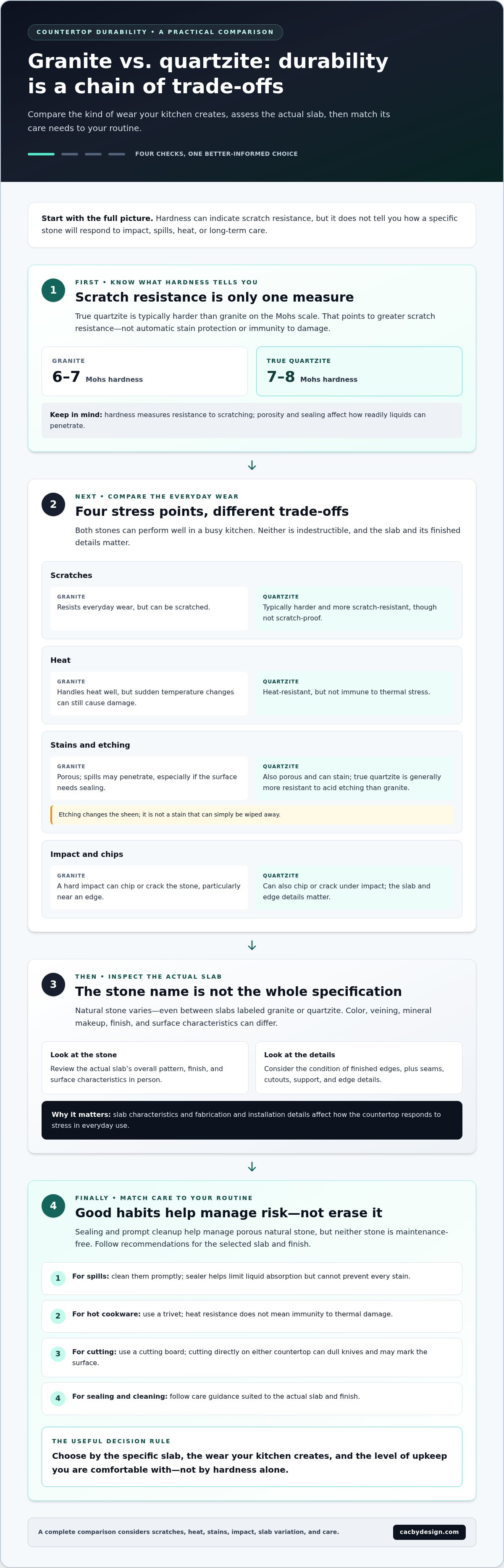
Different types of wear have different causes. A knife or rough ceramic dish can scratch a surface. A dropped heavy pot can chip an edge or, under enough force, contribute to a crack. Hot cookware can expose a countertop to sudden temperature changes, so using a trivet is a sensible habit. Oil, wine, and other spills can stain if they penetrate the stone, while acidic foods may dull or etch some mineral surfaces. Etching changes the sheen; it isn’t a stain that can simply be wiped away.
Sealing and prompt cleanup help manage porous natural stone, but care is only one part of long-term performance. Fabrication and installation matter too. Seams, cutouts, support, and edge details affect how the countertop handles stress in everyday use. Even a well-chosen slab needs thoughtful handling and care.
Why the specific stone slab matters
Natural stone varies. Color, veining, mineral makeup, and surface characteristics can differ between slabs, even when both are labeled granite or quartzite. These differences shape the appearance and can affect how the stone responds to wear and maintenance. Hardness is one useful measure, but it doesn’t capture porosity, impact resistance, or the condition of a finished edge.
Evaluate the actual slab you’re considering rather than deciding from a stone name or small image alone. Look at its overall pattern and finish, then weigh those qualities against your kitchen’s daily demands. Cincinnati-area homeowners can consider slab choice alongside edge details and installation planning. That gives you a more informed fit for your home, without assuming every slab will perform the same way.
How granite and quartzite handle scratches, heat, stains, and chips
Both stones can perform well in a busy kitchen, but their strengths aren’t identical. True quartzite typically measures 7 to 8 on the Mohs hardness scale, compared with 6 to 7 for granite. That points to greater scratch resistance, not automatic stain protection. Hardness measures resistance to scratching, while porosity and sealing affect how readily liquids can penetrate. The Natural Stone Institute’s quartzite guidance discusses the material’s strength, density, and hardness.
Scratch and impact resistance in daily use
Quartzite’s greater mineral hardness can offer an advantage against scratches, but neither stone is indestructible. Cutting directly on either countertop can dull knives and may mark the surface, so use a cutting board. A heavy pot dropped near an exposed edge can cause a chip. The outcome depends on the force, stone, edge profile, and installation.
Heat, stains, and sealing: what care can and cannot do
Use a trivet for hot pans. Heat resistance doesn’t mean immunity to thermal damage, especially when a hot object creates a sudden temperature change. Sealer helps limit liquid absorption, but it can’t prevent every stain or replace prompt cleanup. Follow care recommendations suited to the actual slab and finish.
For a project-specific comparison, explore granite and quartzite countertop options alongside fabrication and installation details. These decisions help connect the stone’s properties to the way you use your kitchen.
Granite or quartzite: which durability trade-offs fit your household?
There isn’t one durability winner for every kitchen. The better choice depends on how you cook, how quickly you clean spills, and how much ongoing stone care you’re comfortable with. Granite and quartzite can both serve as durable everyday surfaces, but slab characteristics and maintenance expectations matter as much as the material category. For a broader comparison, Use Natural Stone’s comparison of granite and quartzite performance explains how the stones compare and why accurate identification matters.
When granite may suit your priorities
Granite may suit homeowners who want a resilient natural-stone surface and appreciate varied patterns, from subtle movement to pronounced mineral variation. Its appearance can anchor a kitchen design, but don’t assume every slab has the same composition, stain resistance, or care needs. Review the specific slab and finish, then weigh its maintenance requirements against your routine. For a deeper overview, see this granite countertop guide for Cincinnati.
When quartzite may suit your priorities
Quartzite may appeal if you’re drawn to natural veining and want a hard, durable stone surface. Accurate material identification matters because stones can look similar while having different properties and care needs. Don’t choose based on appearance or a label alone. Evaluate the slab and understand its maintenance profile before deciding. This quartzite countertop buying guide offers additional material-selection context.
Keep performance and design in separate columns as you compare. Color, veining, and pattern determine how the slab works with cabinets and backsplashes. Cooking habits, cleanup, and care determine whether its upkeep fits your household. A dramatic pattern isn’t a durability advantage, and the hardest stone isn’t automatically the best match if its appearance or maintenance doesn’t suit you.
Cook often? Prioritize a surface and care routine that work with frequent food prep and your hot cookware habits.
Prefer quick cleanup? Consider how promptly you can wipe spills and whether you’re willing to maintain a sealed surface.
Choosing for looks? Compare actual slabs, not just sample images, and consider the edge and finish planned for your countertop.
That’s the practical answer to granite vs quartzite durability: choose the slab whose performance, care needs, and appearance align with your daily life. Material selection, fabrication, and installation all contribute to the finished result.
How to assess granite and quartzite durability before choosing a slab
A stone name narrows the options. The actual slab, planned layout, and care routine help you make the decision. Use this review process to compare granite and quartzite based on how the finished countertop will look and work in your kitchen.
A practical slab-selection checklist
1. View the full slab. Natural color, veining, and mineral variation can look different across a large surface than on a small sample. Consider how the pattern will read across the counters and where prominent features may fall.
2. Match it to your kitchen routine. Think through where you prep, place hot cookware, and handle spills. Be realistic about how quickly you clean up and how much ongoing care you’re willing to do.
3. Compare the finish. Look at how the selected finish changes the stone’s appearance and feel. Include everyday cleaning and care in your assessment, and follow guidance tailored to the slab and finish.
4. Review the countertop layout. Consider seams, sink and cooktop cutouts, and exposed edges. These details shape the finished look and should be included in fabrication planning.
5. Decide with maintenance in view. Understand the care routine for each slab before choosing. A surface that looks right but demands more upkeep than you want may not be the best fit.
Plan for care and fabrication together
Care and fabrication are connected decisions. A clear layout helps coordinate the slab’s natural pattern with seams, openings, and edge details. Precise templating and professional fabrication help translate that plan into a countertop fitted to the project. During material selection, Countertops and Cabinetry By Design connects slab choice with fabrication and installation through its in-house craftsmen.
Use this checklist in a Cincinnati-area design consultation: Does the full slab suit the room? Does its finish fit my routine? Have I considered seams, cutouts, and edges? Am I comfortable with its care needs? The answers turn the granite vs quartzite durability comparison into a practical choice for your home. For more project context, explore professional stonework and craftsmanship guides.
When you’re ready to consider your slab choice and countertop details as part of a project plan, plan your countertop design and installation.
Choose durable countertops with Cincinnati-area design and installation support
The right countertop isn’t simply the stone with the highest hardness rating. It’s the slab that fits your priorities, routine, and room. Decide what matters most: scratch resistance, stain care, impact concerns, or a particular natural-stone look. Then compare actual slabs and understand their care needs before committing.
Turn the comparison into a project decision
If scratch resistance leads your list, quartzite may deserve a closer look. If a particular granite slab better suits your design and maintenance preferences, it may be the stronger fit for your project. Neither choice removes the need for sensible care. The practical answer to granite vs quartzite durability comes from matching the stone’s characteristics to how you cook, clean, and use the kitchen.
Consider the whole room, too. Countertop color and pattern need to work with the cabinetry, layout, and intended design. Plan seams, sink cutouts, and exposed edges as part of fabrication, not as afterthoughts. A coordinated decision connects the slab you choose to the countertop you’ll use every day.
What local full-service support can add
Countertops and Cabinetry By Design serves Cincinnati-area homeowners with natural-stone countertop design, material selection, fabrication, and installation as part of a full-service remodeling approach. In-house craftsmen handle fabrication and installation, connecting the material decision to the details that shape the finished surface. That coordination helps bring the slab, layout, and fabrication into one plan rather than treating durability as a label on a sample.
As a family-owned and operated local business founded in 2004, the team works with homeowners across Cincinnati and surrounding counties. Whether you’re comparing granite and quartzite for a kitchen update or planning a broader remodel, the goal is a stone and design choice shaped around your home and daily-use priorities.
Bring your questions about granite, quartzite, slab selection, and care into the project conversation. Discuss granite and quartzite for your countertop project with Countertops and Cabinetry By Design.
Choose the stone that fits your kitchen
The best choice isn’t decided by hardness alone. Granite and quartzite both offer durable natural-stone surfaces, but individual slabs vary, and scratch resistance, stain care, and upkeep all matter. Compare the actual slabs, consider how you cook and clean, and understand the care each one needs before choosing.
That’s the practical takeaway from granite vs quartzite durability: match the stone’s characteristics to your household, then plan fabrication and installation around the specific slab and kitchen layout. Seams, cutouts, and edges are part of the finished result, not minor details.
Countertops and Cabinetry By Design is a family-owned and operated Cincinnati-area business founded in 2004. The team’s full-service remodeling approach includes design and material selection, with in-house craftsmen supporting fabrication and installation. Ready to compare options for your home? Explore granite and quartzite countertops with our Cincinnati-area design team. With a clear plan, you can choose a surface that suits both your space and everyday routine.
Frequently Asked Questions
Is granite more durable than quartzite?
Not categorically. True quartzite is generally harder and more scratch-resistant, while both stones can make durable countertops when the slab, fabrication, installation, and care suit the kitchen. Hardness alone doesn’t measure stain resistance, impact performance, or maintenance needs. For a useful granite vs quartzite durability comparison, assess the specific slabs and prioritize the wear concerns that matter most in your household.
Can quartzite scratch or chip?
Yes. Quartzite can scratch, chip, or crack, even though true quartzite is typically harder than granite. Avoid cutting directly on the countertop: a cutting board protects both the stone and your knives. A dropped heavy pot can damage an exposed edge. The result depends on the impact, slab, edge profile, and installation. Durable doesn’t mean damage-proof, so everyday handling still matters.
Does granite need to be sealed more often than quartzite?
There isn’t one sealing schedule that applies to every granite or quartzite slab. Both are natural stones that can be porous, and their maintenance needs vary with the stone’s characteristics and finish. Sealing helps reduce liquid absorption, but it doesn’t prevent every stain. Follow the care guidance for your selected slab, clean spills promptly, and use the recommended sealing routine rather than assuming one stone always needs more frequent attention.
What happens if acidic liquids spill on granite or quartzite?
Acidic liquids can dull or etch some stone surfaces, changing the sheen rather than leaving a stain that wipes away. True quartzite is generally more resistant to acid etching than granite, but individual slabs vary, and either surface can be affected by spills or residue. Wipe up lemon juice, vinegar, and similar liquids promptly. Use care instructions tailored to the specific slab and finish.
Is quartzite more heat-resistant than granite?
There’s no simple guarantee that quartzite will handle every heat exposure better than granite. Both are natural stones with good heat resistance, but neither is immune to damage from sudden temperature changes or repeated stress. A hot pan can create a thermal shock risk, so use a trivet instead of placing cookware directly on the counter. Slab composition and installation also influence performance.
How do I choose between granite and quartzite for my kitchen?
Choose by balancing the specific slab’s appearance, durability priorities, and care needs with your cooking and cleanup habits. Compare full slabs, consider the finish, and plan for edges, seams, and cutouts as part of the design. For homeowners in Hamilton, Butler, Warren, Montgomery, Green, Clinton, Clermont, and Brown counties, Countertops and Cabinetry By Design coordinates material selection, fabrication, and installation to support a project-specific decision.


Comments