
Kitchen Countertop Replacement in Cincinnati: A Clear Plan for Your Upgrade
A countertop replacement doesn’t have to trigger a full kitchen remodel. A successful kitchen countertop replacement Cincinnati homeowners can plan starts with a clear scope: choose a surface that suits daily cooking, upkeep, and the look of your kitchen, then coordinate the work from removal through installation.
It’s reasonable to worry that one decision will set off a chain of others. The countertop affects how cabinets, sinks, faucets, and backsplashes come together, and timing the steps can feel complicated. You can keep the project focused by deciding early which connected features should stay and which should change.
This guide compares quartz, granite, marble, quartzite, soapstone, and wood based on appearance, care, and how each may fit your routine. It also covers how to plan the replacement sequence and decide whether cabinets, the sink, or backsplash belong in the project. Countertops and Cabinetry By Design brings design, material selection, fabrication, and professional installation together through one coordinated team, giving you a clear path from a worn surface to a kitchen that works better.
Table of Contents
When Does Kitchen Countertop Replacement Make Sense in Cincinnati?
Choose a Kitchen Countertop Material for Your Cincinnati Home
Compare a Countertop-Only Upgrade With a Larger Kitchen Remodel
Plan Your Cincinnati Countertop Replacement From Design to Installation
Make Your Cincinnati Countertop Replacement a Coordinated Project
When Does Kitchen Countertop Replacement Make Sense in Cincinnati?
Countertop replacement removes an existing kitchen surface and installs a new one to address damage, improve function, or update the room’s design. When considering kitchen countertop replacement in Cincinnati, start by identifying whether the problem is limited to the counter or points to a larger issue with the cabinets or layout.
A visible stain or chip may catch your eye, but assess the whole work area before deciding. Look for persistent damage, seams or edges that are difficult to maintain, and surfaces that no longer support how you cook, clean, or entertain. A new counter can address a surface problem. It won’t correct an unstable cabinet or a layout that consistently makes the kitchen hard to use.
Which countertop problems can replacement address?
Replacement may make sense when the counter’s condition or design no longer fits your needs. Perhaps your cooking habits have changed, cleanup feels like a chore, or the existing surface clashes with the look you want. Consider how the whole counter works: the available prep space, sink placement, and the areas you use most. For an overview of common countertop materials, see Wikipedia’s countertop entry.
Can you replace countertops without remodeling the kitchen?
Yes. If the cabinets are in suitable condition and the current layout works, replacing the countertops can remain a focused upgrade. The scope may expand if you also want a different sink or faucet, or if the backsplash needs to change to work with the new surface. Decide which connected features matter before work moves forward. If you’re considering broader changes, explore the kitchen remodel guide to think through the wider scope.
Use this checklist to set a clear direction:
Condition: Is the damage persistent, or limited to an isolated mark?
Function: Does the available work area support how you cook and clean?
Design: What look do you want the new surface to bring to the kitchen?
Connected features: Should the sink, faucet, or backsplash stay, or be part of the update?
If the cabinets and layout still serve you, worn counters don’t automatically call for replacing them or remodeling the whole kitchen. Define what needs to improve first. That keeps the project aligned with the result you want.
Choose a Kitchen Countertop Material for Your Cincinnati Home
The right surface balances appearance, care, and how you use your kitchen. For a kitchen countertop replacement in Cincinnati, compare materials in the context of the whole room rather than choosing from a color sample alone. Cabinets, flooring, backsplash, and lighting all affect how a countertop’s color and pattern look in place.
How do quartz and natural stone differ?
Quartz is engineered, while granite, marble, quartzite, and soapstone are natural stone. Engineered patterns may feel more visually consistent; natural stone varies from slab to slab. Neither is universally best. Compare the actual surface options and their care guidance, then consider how the pattern and color will work with the rest of your kitchen. The Natural Stone Institute’s overview of natural stone countertop standards offers further context on stone selection and care. For a focused discussion of engineered options, read the Mason quartz guide.
Which countertop material fits your kitchen routine?
Start with your habits and preferences. If frequent cooking and quick cleanup are priorities, pay close attention to the care routine for each option. Marble may appeal if distinctive veining is central to your design; wood may suit a kitchen where a warm, natural look matters most. Compare care guidance with the upkeep you’re willing to do, as well as the appearance you want.
View samples alongside cabinet finishes, flooring, backsplash, and the room’s lighting. If possible, compare a broader view of the surface as well as a small sample to understand the pattern’s movement. For help coordinating material selection with fabrication and installation, explore countertop design and installation.
Compare a Countertop-Only Upgrade With a Larger Kitchen Remodel
A new countertop can refresh the kitchen without changing every feature around it. The right scope depends on what needs to work better, not on an assumption that a worn surface requires a full renovation. To plan kitchen countertop replacement in Cincinnati, compare the condition of existing features with the finished look and function you want.
When can existing cabinets stay?
Cabinets may remain when their condition and layout meet your needs and they can work with the planned countertop. Assess the cabinetry in the context of your specific kitchen rather than assuming it is ready to stay. If it’s suitable, retaining it can keep the project focused on the surface. If cabinet condition or placement is part of the problem, plan those changes alongside the counter.
When should you coordinate the sink, backsplash, or cabinets?
Coordinate connected features when changing one affects the result or project plan. A new sink or faucet can influence countertop planning and installation, while a backsplash update can bring the wall and work surface together. If cabinetry, fixtures, and finishes all need attention, consider a broader renovation and use the Cincinnati kitchen remodel guide to explore that scope.
Use this quick decision path:
Cabinets and layout work for you? Keep them in the plan for a focused replacement, subject to assessment.
Keeping the sink and faucet? Coordinate the existing fixtures with the new counter. If changing them, include those choices in the plan.
Does the backsplash fit the finish you want? Retain it if it works; include an update if it doesn’t.
Several features need to change? A larger remodel may better match the project’s goals.
Set the scope around the kitchen’s actual needs. A focused upgrade is a strong fit when the surrounding features still serve you; a wider remodel makes sense when several connected decisions need attention.
Plan Your Cincinnati Countertop Replacement From Design to Installation
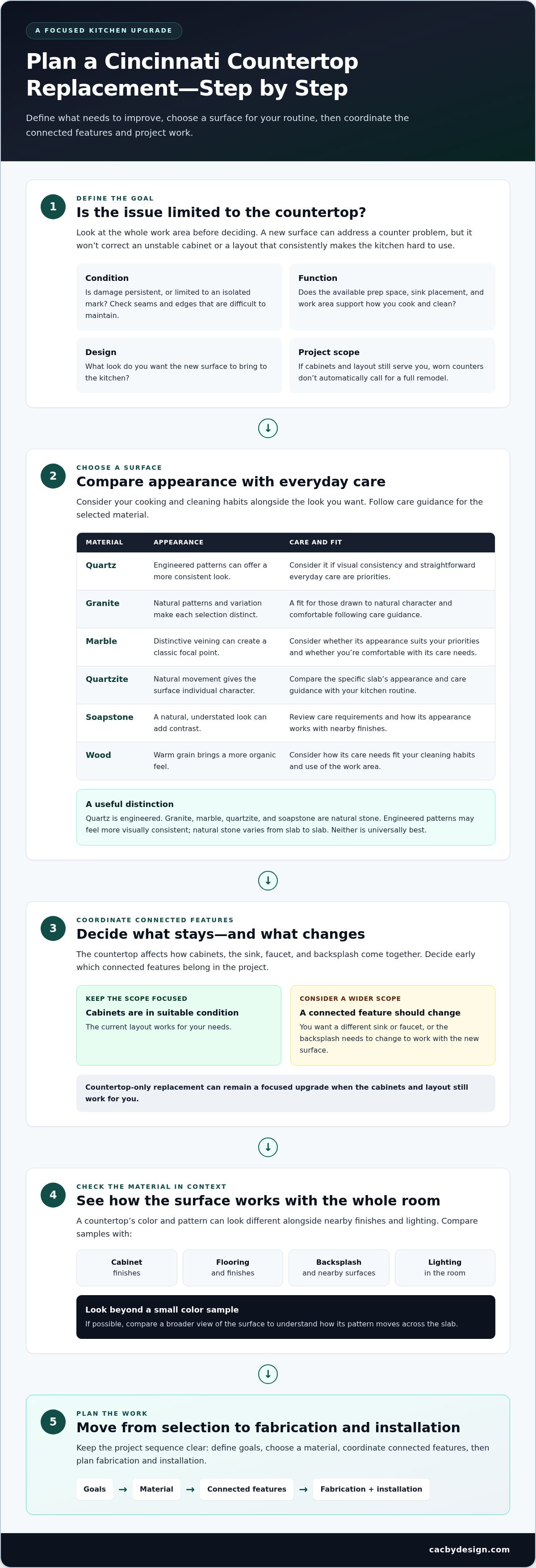
A clear sequence keeps design choices connected to the work that follows. Plan a kitchen countertop replacement in Cincinnati in five stages: define your goals, select the surface, coordinate nearby features, fabricate the countertop, and install it.
Define the goal first. Decide what the new counter needs to improve, then set the project scope. Is your focus a fresh look, a more useful work area, or coordinating the countertop with other kitchen updates? Those priorities shape material selection and help keep decisions focused.
Select the material, then coordinate the details. Compare appearance and care needs with your routine. Before fabrication, settle choices that affect the finished result, including edge appearance, sink and faucet plans, and how the countertop meets the backsplash or other adjacent surfaces. Early coordination brings these decisions together instead of leaving connected details until installation.
Fabricate and install. Measurements and project requirements guide fabrication. Once the counter is ready, removal and installation proceed according to the existing kitchen and agreed scope. The work varies by project, so don’t assume every kitchen follows the same schedule or has the same level of disruption.
What decisions should you make before fabrication?
Settle the material, edge appearance, sink and faucet coordination, and transitions to nearby surfaces. These choices inform the measurements and fabrication plan. Unanswered details can affect how the pieces come together, so resolve them early. In a coordinated project, design and material selection inform fabrication and installation as connected steps rather than separate decisions.
What should homeowners expect during installation?
Clear the work surfaces and nearby areas, and plan for kitchen access to be affected while work is underway. Follow the project-specific preparation and care guidance for the selected material and installation. Removal needs depend on the existing counter, while added work can change the scope. An in-house team of craftsmen carries fabrication and professional installation through a coordinated process, with the work planned around the specifics of your kitchen.
Countertop replacement moves from goals and material selection to coordinated details, fabrication, and installation. Countertops and Cabinetry By Design brings design, material selection, fabrication, and installation together for Cincinnati-area projects. Plan your countertop replacement with a coordinated team.
Make Your Cincinnati Countertop Replacement a Coordinated Project
A successful kitchen countertop replacement in Cincinnati depends on more than choosing a surface. Material, design, fabrication, and installation need to work as one plan. Countertops and Cabinetry By Design brings these steps together for projects across Hamilton, Butler, Warren, Montgomery, Green, Clinton, Clermont, and Brown counties, with an in-house team of craftsmen supporting the work through installation.
What does a full-service countertop project bring together?
It connects the look you want with the decisions that shape the finished countertop. Material selection informs design; design choices guide fabrication; and the installation team works from the project plan. Considering these steps together helps keep details aligned, including how the counter relates to the sink, faucet, cabinets, and backsplash.
The goal isn’t to expand every project into a remodel. If the countertop is the main priority, keep the scope focused. If a nearby fixture or finish needs to change to achieve a cohesive result, account for it early. That lets the team coordinate the details without losing sight of the surface upgrade.
How do you take the next step?
Start with three points: the surface you have now, the material you’re considering, and what you want the new counter to do better. You might prioritize a different look, a work area that suits your cooking routine, or a care routine that better matches your preferences. Note whether the sink, faucet, cabinets, or backsplash are part of the decision, too.
A project conversation can align those preferences with practical scope. Countertops and Cabinetry By Design is a family-owned local business founded in 2004. Its design, material selection, fabrication, and installation approach provides a coordinated path from planning to finished countertop, supported by in-house craftsmanship. For more on fabrication and craftsmanship, explore the Cincinnati stonework guide.
Bring your priorities and questions to the conversation. Plan your Cincinnati countertop project.
Set Your Countertop Upgrade in Motion
A strong kitchen countertop replacement in Cincinnati starts with a clear goal: choose a surface that fits your household’s routine and design, then decide whether the cabinets, sink, faucet, or backsplash belong in the scope. If the surrounding kitchen still works, a focused counter upgrade may be all you need. If several connected features need attention, plan them together.
Countertops and Cabinetry By Design brings design, material selection, fabrication, and installation together through a full-service approach. The family-owned local business was founded in 2004, and its in-house craftsmen provide professional installation. That continuity connects early material decisions to the finished surface.
Ready to turn your priorities into a clear project plan? Plan your Cincinnati countertop project and discuss your existing surface, preferred materials, and desired scope. Your next kitchen upgrade can start with one focused decision.
Frequently Asked Questions
How much does kitchen countertop replacement cost in Cincinnati?
The total depends on the selected material, countertop dimensions, fabrication details, removal needs, and whether connected features such as a sink or backsplash are included. A straightforward surface replacement has a different scope from a project that also changes fixtures or cabinetry. Countertops and Cabinetry By Design coordinates material selection, fabrication, and installation as part of a project. Discussing your kitchen and desired scope is the clearest way to understand what the work involves.
Can you replace kitchen countertops without replacing the cabinets?
Yes, existing cabinets can remain if their condition, layout, and compatibility with the planned countertop suit the project. Assess their condition in the context of the specific kitchen rather than assuming they are ready to stay. Keeping suitable cabinetry can focus the work on the surface. If cabinet condition or placement is part of the problem, include those decisions in the project plan so the countertop and surrounding features work together.
How long does it take to replace kitchen countertops?
There isn’t one timeline that applies to every kitchen. The work depends on the existing counter, selected material, fabrication requirements, and whether the project includes changes to the sink, faucet, backsplash, or cabinets. Removal and installation details vary with the project scope. Plan for kitchen access to be affected during the work, and follow the preparation and care guidance for your specific project and chosen surface.
What is the best countertop material for a busy kitchen?
The best choice depends on your cooking routine, cleanup habits, and preferred appearance. Quartz offers an engineered, more consistent pattern, while granite, marble, quartzite, and soapstone have natural variation. Wood brings a distinct, warm look. Compare care guidance for each option with the upkeep you’re comfortable doing, and consider how the material will pair with cabinets, flooring, lighting, and the backsplash.
Do you have to replace the backsplash when replacing countertops?
No. A backsplash can stay if it’s in suitable condition and works with the new countertop and the finish you want. If its color, pattern, or edge relationship clashes with the new surface, coordinating a backsplash update may create a more unified result. Decide early, since backsplash choices affect the overall design and project scope. Countertops and Cabinetry By Design can include tile backsplash decisions in a coordinated countertop project.
What happens to the sink when kitchen countertops are replaced?
The sink may remain or be part of the update, depending on its condition, your preferences, and how it coordinates with the new countertop. If you’re changing the sink or faucet, include those choices in planning before fabrication. The existing setup and project scope influence removal and installation details. Coordinating countertop and sink decisions early helps align the finished work area and keeps connected choices in the same plan.
Can a kitchen countertop be replaced without a full remodel?
Yes. A countertop replacement can be a focused upgrade if the cabinets and layout still meet your needs. A broader remodel may make sense if several connected features, such as cabinetry, sink, faucet, and backsplash, also need changes. Set the scope around the kitchen’s actual condition and your goals. Replacing a worn surface doesn’t automatically mean you need to renovate the entire room.
How do I plan a kitchen countertop replacement in Cincinnati?
Start by identifying your current surface, what you want to improve, and which materials fit your household’s routine and design preferences. Then decide whether the sink, faucet, cabinets, or backsplash should remain or change. Countertops and Cabinetry By Design brings design, material selection, fabrication, and installation together for Cincinnati-area projects. Homeowners across Hamilton, Butler, Warren, Montgomery, Green, Clinton, Clermont, and Brown counties can use this sequence to define a clear project scope.


Comments