
How to Hire a Remodeler in Cincinnati: A 2026 Homeowner’s Guide
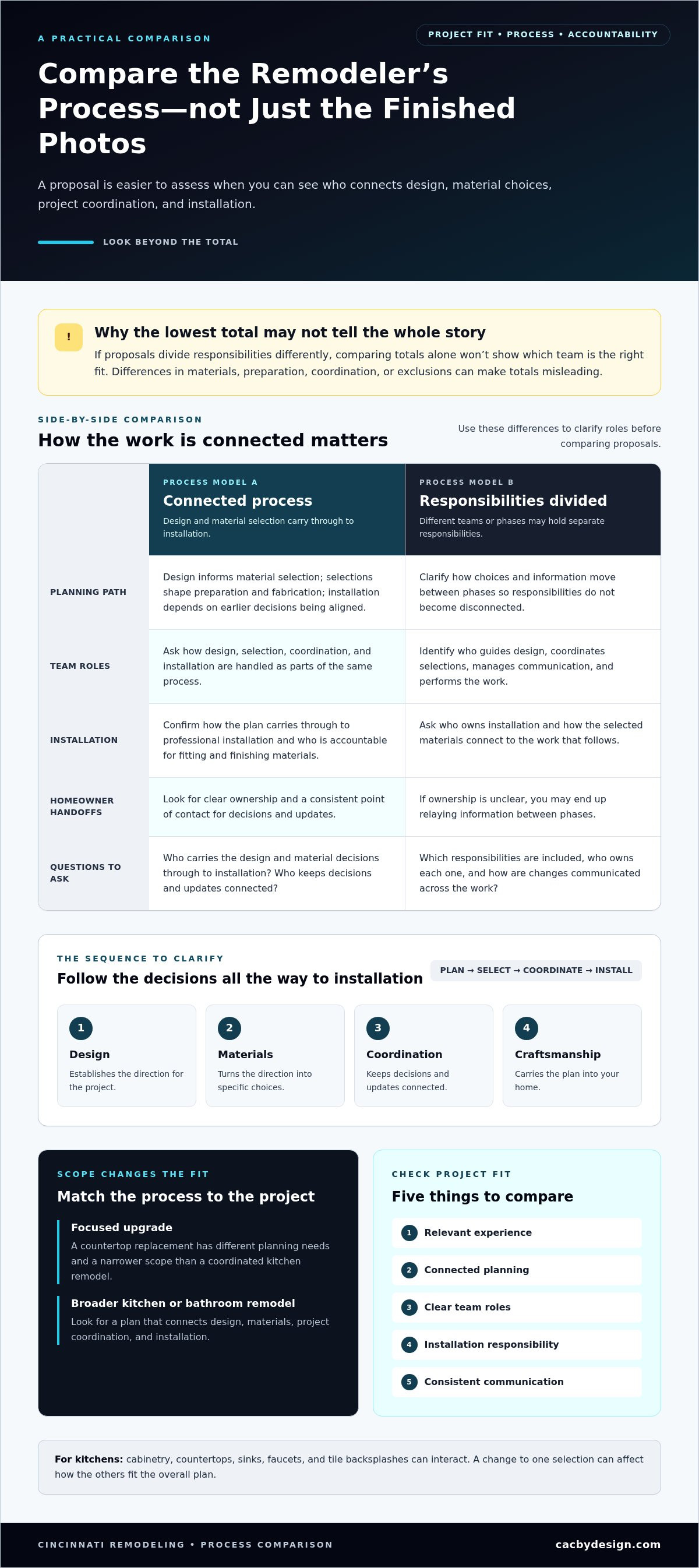
The smartest way to learn how to hire a remodeler in Cincinnati is to start with the project, not the sales pitch. A kitchen or bathroom remodel can involve design, material selection, project coordination, and installation. If proposals divide those responsibilities differently, comparing totals alone won’t show which team is the right fit.
Look beyond finished photos. You need a clear scope, defined responsibilities, coordinated material choices, and a realistic plan for work in your home. In Cincinnati, permits and scheduling can also affect a remodel, so clarify those details early.
This guide gives you a practical framework for comparing remodelers and following the process from planning through installation. You’ll learn what to look for in a proposal, how cabinetry and countertop decisions fit into the bigger picture, and how a connected design-to-installation process can reduce handoffs. Countertops and Cabinetry By Design is a family-owned Cincinnati-area remodeling business founded in 2004, with design, material selection, and installation handled by an in-house team of craftsmen. Use the steps ahead to define your project and choose your next move with confidence.
Table of Contents
How to hire a remodeler in Cincinnati: define the project before comparing teams
How to evaluate a Cincinnati remodeler’s team, process, and project fit
How to compare Cincinnati remodeler proposals without comparing unlike scopes
What Cincinnati homeowners should clarify about permits, timing, and communication
Choose a Cincinnati remodeler whose process carries the project through installation
How to hire a remodeler in Cincinnati: define the project before comparing teams
Choose a remodeler based on project fit and accountability, not a directory listing alone. A focused upgrade, such as replacing a countertop, has different planning needs from a coordinated kitchen remodel involving cabinetry, surfaces, fixtures, and installation. Define what success looks like first. That gives each conversation a clear starting point and makes it easier to compare who will manage each part of the work.
Project scope is the work to be completed, the materials involved, who is responsible for each task, and the outcomes the homeowner expects. Keep that definition in view as you plan. The Home Improvement Wikipedia overview describes common reasons homeowners undertake improvement projects. Your own goals and priorities should guide the decisions.
What should you decide before contacting a Cincinnati remodeler?
Write a short project brief before reaching out. You don’t need final drawings or product selections yet. You do need a shared view of what matters, what can change, and who has a say.
Set your goals. Identify the functional problem you want to solve and the outcome you want from the remodel.
Name the rooms. Record which spaces are included and how your household uses them.
Rank priorities. Separate must-haves from design preferences that could change during planning.
List constraints. Note practical limits, such as how the work may affect daily routines and which project details are still undecided.
Identify decision-makers. Agree on who approves the design, materials, and project decisions so choices don’t stall later.
Also describe the finish level you have in mind. “Update the kitchen” is broad. “Improve storage and choose cabinetry and countertops that work together” gives the planning conversation a useful direction.
Which parts of the remodel need one coordinated plan?
Map the sequence, not just the wish list. Design informs material selection. Selections shape preparation and fabrication. Installation depends on those earlier decisions being aligned. In a kitchen, cabinetry, countertops, sinks, faucets, and tile backsplashes interact. A change to one selection can affect how the others fit the overall plan. A bathroom remodel can require similar coordination across cabinets, surfaces, sinks, and faucets.
A focused upgrade may involve fewer connected decisions. A full kitchen or bathroom remodel calls for a broader plan that clarifies how design, materials, project coordination, and craftsmanship come together. Countertops and Cabinetry By Design coordinates design and material selection through professional installation with an in-house team of craftsmen, keeping those responsibilities connected. If you’re still defining the rooms, priorities, and decisions in a kitchen project, use the published kitchen remodel guide to shape your scope before comparing proposals.
How to evaluate a Cincinnati remodeler’s team, process, and project fit
A strong fit is more than a polished portfolio. The team’s experience, responsibilities, and installation approach should match the rooms, materials, and complexity of your remodel. A specialist may suit a focused task. A broader kitchen or bathroom renovation also needs a process that connects design choices with material selection and the work that follows.
As you consider how to hire a remodeler in Cincinnati, compare the delivery model, not just the finished photos. Use this checklist:
Relevant experience: Look for completed work that resembles your project in room type, materials, and overall complexity.
Connected planning: Check whether the process carries design and material decisions through to installation.
Clear team roles: Understand who guides design, coordinates selections, manages project communication, and performs the work.
Installation responsibility: Identify who is accountable for fitting and finishing the selected materials.
Consistent communication: Look for a clear point of contact and an agreed approach to decisions and updates.
How can you tell whether a remodeler fits your project?
Match the team’s demonstrated work to your actual needs. A team experienced with cabinetry and countertops may fit a kitchen plan that combines storage changes with new surfaces. A single-material upgrade has a narrower scope. For a broader renovation, prioritize a process that links planning, selections, and installation rather than treating each as an isolated task. The right fit is the one whose experience and responsibilities align with the work you’ve defined.
Who is responsible for each phase of the remodel?
Map ownership across the work. Design establishes the direction; material selection turns that direction into specific choices; project coordination keeps decisions and updates connected; craftsmanship carries the plan into your home. If responsibilities are unclear, you may end up relaying information between phases. Clear ownership makes it easier to know where decisions belong and how a selection connects to the finished work.
Countertops and Cabinetry By Design brings design, material selection, and professional installation together, with installation handled by an in-house team of craftsmen. That structure connects selected cabinetry and countertops with the work needed to complete the project. To see how this design-to-installation approach applies to kitchen and bathroom remodeling, explore the company’s remodeling process.
How to compare Cincinnati remodeler proposals without comparing unlike scopes
Two proposals can describe the same room and still cover different work. One may include material selection and installation; another may leave selections undecided or exclude preparation. A lower total doesn’t tell you which proposal is the better fit until you compare what each team is responsible for delivering.
Proposals are comparable only when their scope, materials, and responsibilities align. For homeowners learning how to hire a remodeler in Cincinnati, that’s the key rule: compare the written details before weighing totals. Note what each proposal includes, what it excludes, and what remains open.
What should a remodeling proposal spell out?
Use a simple worksheet to line up each proposal. Record the rooms and work phases, material categories, labor, coordination, installation responsibilities, exclusions, and unresolved selections. This turns vague differences into specific questions and helps you avoid relying on assumptions.
Record assumptions and open decisions in the same worksheet. If one proposal describes countertop installation but leaves material selection open, mark that difference rather than treating the proposals as equivalent. Compare written descriptions and allowances on their stated terms. Don’t assume an allowance represents the same materials or work in every proposal.
How do design and material choices affect proposal comparisons?
Selections shape the scope. Cabinetry can affect the countertop plan; sinks and faucets need to be considered alongside those choices; a tile backsplash adds another material and installation component. A proposal that groups these decisions together is not directly comparable to one that covers only selected parts.
Compare material categories consistently, too. If you’re reviewing countertop options, line up the same category across proposals, such as quartz, granite, marble, or quartzite. Note how fabrication and installation are described instead of assuming the details match. A countertop material guide can help you understand the options as you refine your selections. Clear comparisons start with aligned descriptions, not guesswork.
What Cincinnati homeowners should clarify about permits, timing, and communication
Before work begins, clarify three moving parts: which local requirements apply, how the work fits your household routine, and how decisions and updates will be handled. Cincinnati-area projects can fall under different local authorities depending on the property’s address and the project scope. A plan that accounts for those details is more useful than assuming one set of rules or one schedule fits every home. This is relevant across Hamilton, Butler, Warren, Montgomery, Green, Clinton, Clermont, and Brown counties.
How should homeowners handle permits and local requirements?
Start with the project description and property address. Use both to identify which authority has jurisdiction, then verify which approvals and contractor registration requirements apply to that specific scope before work begins. Don’t assume a rule for one location or type of work applies across the Cincinnati area.
Keep a short verification list with the project file:
Authority: Identify the city, county, or other authority responsible for the property.
Scope: Describe the planned work clearly, including the rooms and changes involved.
Requirements: Verify applicable permits, registrations, and project-specific approvals with the authority having jurisdiction.
This address-first approach gives you a more reliable planning baseline. It also keeps discussions about timing grounded in the actual project rather than assumptions.
What communication plan makes a remodel easier to manage?
Set expectations for how the project will run at home. Clarify access arrangements, household routines affected by the work, how progress updates will be shared, and where questions or urgent issues should go. Agree on decision points for materials and design. Timely choices help keep connected phases, such as material selection and installation, coordinated.
Keep one shared record of the agreed scope, selections, open questions, and decisions. If a detail changes, record the change and who approved it. This helps everyone work from the same information and makes it easier to spot when a schedule or installation plan needs an update.
If you’re considering a larger project, the Cincinnati home renovation contractors guide can help you explore the broader planning picture. For a kitchen or bathroom remodel, Countertops and Cabinetry By Design connects design and material selection with professional installation by an in-house team of craftsmen. Explore the remodeling process to see how those phases work together.
Choose a Cincinnati remodeler whose process carries the project through installation
The final choice should come down to fit, clarity, and accountability. A team may focus on one part of a remodel, while a full-service process can connect design, material selection, coordination, and installation. Neither label matters as much as whether the responsibilities match your project and are clear from the start.
Use this decision matrix to make the comparison:
Project fit: Does the team’s experience align with your rooms, materials, and renovation goals?
Scope clarity: Does the written plan reflect your priorities, define the work, and identify exclusions or open decisions?
Team accountability: Is it clear who guides design, coordinates selections, manages the work, and handles installation?
Materials: Are the selected or planned materials described clearly enough to understand how they fit the project?
Communication: Do you know how decisions, progress updates, and questions will be handled?
Local requirements: Is there a clear plan to identify and verify requirements with the relevant authority?
What is the final checklist for hiring a remodeler?
Before deciding, compare the written scope against the project you defined. Check that the rooms, work boundaries, material selections, and responsibilities match your priorities. Confirm that design, material procurement, project coordination, and professional installation each have clear ownership. Make sure local requirements and communication expectations are part of the plan, not assumptions left to sort out later.
This is the practical answer to how to hire a remodeler in Cincinnati: choose the process that gives your project a clear path from decisions to finished work. A full-service approach brings connected tasks into one coordinated plan; separate tasks may require more homeowner coordination between phases. Focus on fit for your scope, not labels alone.
How does a full-service Cincinnati remodeling process come together?
Countertops and Cabinetry By Design provides kitchen and bathroom remodeling, design and material selection, and professional installation by an in-house team of craftsmen. In a kitchen, cabinetry choices affect how countertops fit the overall plan, while fabrication and installation carry those selections into the finished space. Connecting these decisions keeps design intent and execution in view together.
If a kitchen project is still taking shape, continue with the Cincinnati kitchen remodel guide for more planning context. When you’re ready to discuss your home, discuss your Cincinnati remodeling project with Countertops and Cabinetry By Design.
Move Your Cincinnati Remodel Forward With a Clear Plan
The best remodeler for your home is the team whose experience, responsibilities, and process match the project you’ve defined. Start with clear priorities, compare written scopes side by side, and make sure materials, installation, communication, and local requirements have a place in the plan. That’s how to hire a remodeler in Cincinnati with confidence, without relying on a directory listing or a total price alone.
For a kitchen or bathroom remodel, Countertops and Cabinetry By Design brings design and material selection together with custom cabinetry, countertop fabrication, and professional installation by an in-house team of craftsmen. The family-owned Cincinnati-area business was founded in 2004 and carries projects from planning through installation.
Your next step is straightforward. Discuss your Cincinnati remodeling project and start shaping a plan around your home, priorities, and vision. A well-defined project is a strong foundation for the result you want.
Frequently Asked Questions
How do I hire a remodeler in Cincinnati?
Start by defining the rooms, goals, must-haves, constraints, and decision-makers for your project. Then compare remodelers based on relevant experience, written scope, team responsibilities, communication, and who handles installation. For homes in Hamilton, Butler, Warren, Montgomery, Green, Clinton, Clermont, or Brown counties, identify the property’s local authority and verify which requirements apply to your project. Choose the team whose process fits the work, not just the listing.
What should I look for when choosing a remodeler?
Look for relevant project experience and a clear process connecting design, material selection, coordination, and installation. Understand who manages decisions at each phase, who performs the work, and how updates are shared. For a kitchen remodel, cabinetry, countertop fabrication, and installation need to work together. A clear explanation of responsibilities helps you assess accountability before work begins.
How can I compare remodeling estimates fairly?
Compare the written scope line by line, not just the totals. Check which rooms and work phases are included, how materials are described, what labor and coordination cover, who handles installation, and which items are excluded or undecided. Record assumptions and open selections in one worksheet. If one proposal includes countertop fabrication and installation while another leaves them outside its scope, the totals aren’t directly comparable.
Do I need a permit to remodel a home in Cincinnati?
Permit requirements depend on the project scope and the property’s jurisdiction, so verify them with the authority having jurisdiction before work begins. Start with the property address and a clear description of the planned work. Confirm which permits, registrations, or other approvals apply to that project rather than assuming the same requirements cover every Cincinnati-area home. The remodel plan should account for any required approvals and related inspections.
How long does a home remodeling project take?
There isn’t one reliable timeline for every remodel. The schedule depends on the project’s scope, the work phases involved, material decisions, coordination, and any applicable local review or inspection steps. A focused upgrade may involve a different sequence from a full kitchen or bathroom remodel. Ask for a project-specific schedule that identifies decision points, expected updates, and dependencies, then keep material selections moving to support coordination.
Is it better to hire one full-service remodeler or coordinate separate contractors?
It depends on your project and how much coordination you want to manage. Separate specialists can divide responsibilities, but you may need to keep decisions and schedules aligned across phases. A full-service remodeler can connect design, material selection, project coordination, and installation within one process. For a kitchen or bathroom remodel, consider which approach makes ownership of cabinetry, countertops, and installation clearest.
What happens during a remodeling consultation?
A productive project discussion clarifies the rooms involved, what you want to improve, your priorities, and which decisions are still open. It can also establish how design, materials, coordination, installation, communication, and local requirements fit into the project. Bring notes about household needs and preferred finishes, along with questions about responsibilities and next steps. The aim is to turn a broad idea into a defined scope for planning.
How much does it cost to hire a remodeler in Cincinnati?
The cost depends on the project scope, materials, fabrication, labor, and coordination involved, so a broad average may not reflect your remodel. A focused countertop upgrade and a full kitchen renovation involve different work and selections. Request a written proposal that explains included work, material categories, installation responsibilities, allowances, and exclusions. Compare proposals only after confirming they cover a similar scope. That gives you a more useful basis for evaluating the investment.


Comments